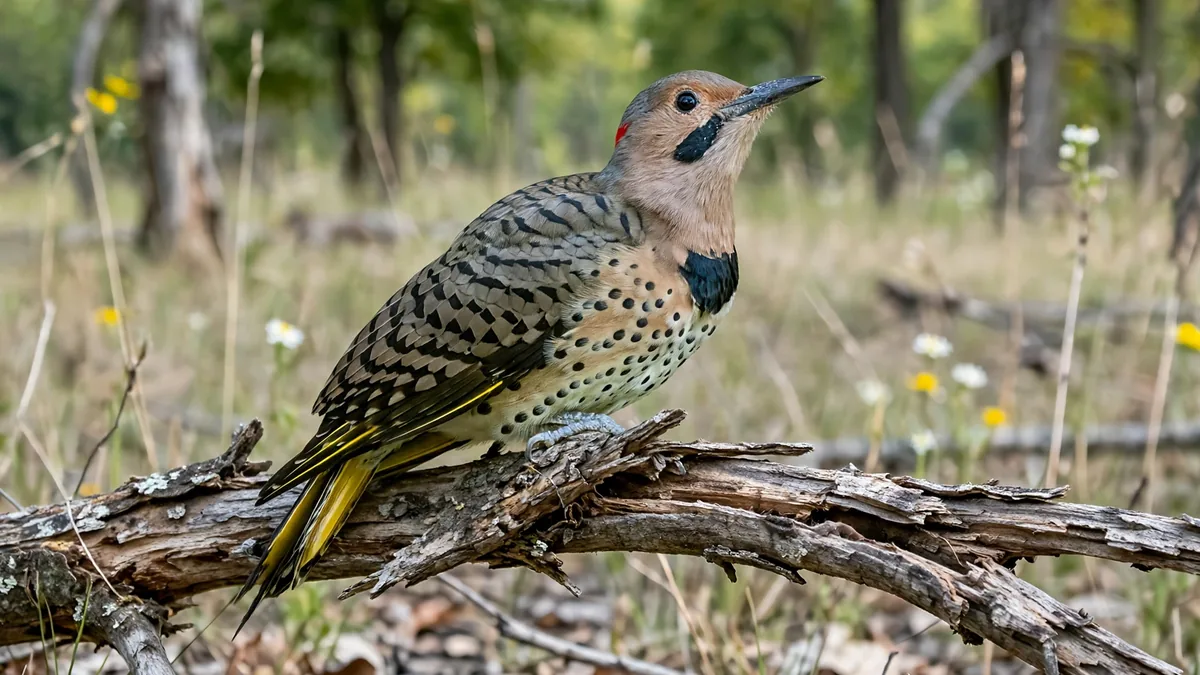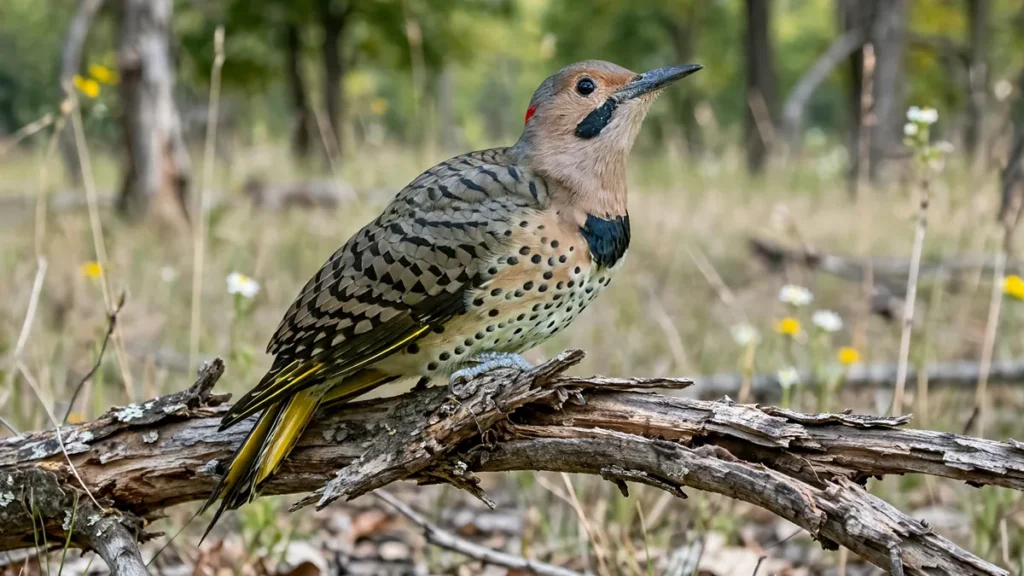
The northern flicker species is a single species, Colaptes auratus, a large brown woodpecker of North America that spends more time feeding on the ground than any other woodpecker on the continent. If you are asking how many northern flicker species there are, the answer is one, though it comes in two main forms, the yellow-shafted flicker of the east and the red-shafted flicker of the west.
The flicker is a bird of open woodland, lawns and gardens, recognised by its barred brown back, spotted breast and black bib, and by the flash of yellow or red under its wings and tail when it flies. Its loud call and its habit of hammering on metal roofs in spring make it one of the best-known woodpeckers in North America.
Key takeaways
- The northern flicker species is Colaptes auratus, a large woodpecker of North and Central America with a barred back, spotted breast and black bib.
- Adults are 28 to 36 centimetres long, with a wingspan of 42 to 54 centimetres and a weight of 86 to 167 grams.
- Flickers feed mostly on the ground, and ants can make up about 45 per cent of their diet.
- They nest in holes they dig in dead trees, and old flicker holes are later used by many other birds.
- The species is listed as Least Concern, though numbers are falling in parts of its range.
What makes a northern flicker a northern flicker
A northern flicker is a large woodpecker, 28 to 36 centimetres long, with a brown back barred with black, a cream breast covered in black spots, and a bold black bib across the chest. The male has a black moustache mark, while the female has a plain face. In flight, the undersides of the wings and tail glow yellow in the eastern form and salmon red in the western form, and the white rump shows.
The two forms differ in small ways beyond the colour of their wing shafts. The yellow-shafted flicker of the east has a red patch on the back of the head and a black moustache on the male, while the red-shafted flicker of the west has a red moustache on the male and no red patch on the nape. Where they meet on the Great Plains they interbreed freely, producing mixed birds, which is one reason they are now treated as a single species. Its call is a loud, laughing wicka-wicka-wicka and a sharp kleer, and in spring males drum on hollow wood or metal roofs to claim a territory.
The northern flicker species and their relatives
The northern flicker belongs to Colaptes, a genus of ground-feeding woodpeckers in the family Picidae, and Colaptes auratus is its most widespread member. About ten subspecies are recognised, grouped into the yellow-shafted group in the east and north, the red-shafted group in the west, and the Cuban flicker of Cuba and the Cayman Islands.
Its closest relative is the gilded flicker of the deserts of Arizona and Mexico, which also feeds on the ground and nests in the arms of giant cacti. The genus also includes the green-barred woodpecker of South America, while the pileated woodpecker, the largest woodpecker in North America, is a more distant cousin that keeps to the trees and rarely comes to the ground.
| Type | Animal | Where it lives | Best-known food | Length or Weight |
|---|---|---|---|---|
| Genus | Flickers (genus Colaptes) | Open woodland across the Americas | Ants and other insects | About 25 to 36 cm long |
| Species | Northern flicker (Colaptes auratus) | North and Central America | Ants, beetles and fruit | About 28 to 36 cm long |
| Form | Yellow-shafted flicker | Eastern North America | Ants and berries | About 28 to 36 cm long |
| Form | Red-shafted flicker | Western North America | Ants and acorns | About 28 to 36 cm long |
| Species | Gilded flicker (Colaptes chrysoides) | Deserts of Arizona and Mexico | Ants and cactus fruit | About 28 to 31 cm long |
| Species | Pileated woodpecker (Dryocopus pileatus) | Forests of North America | Carpenter ants and beetle larvae | About 40 to 49 cm long |
How northern flickers live
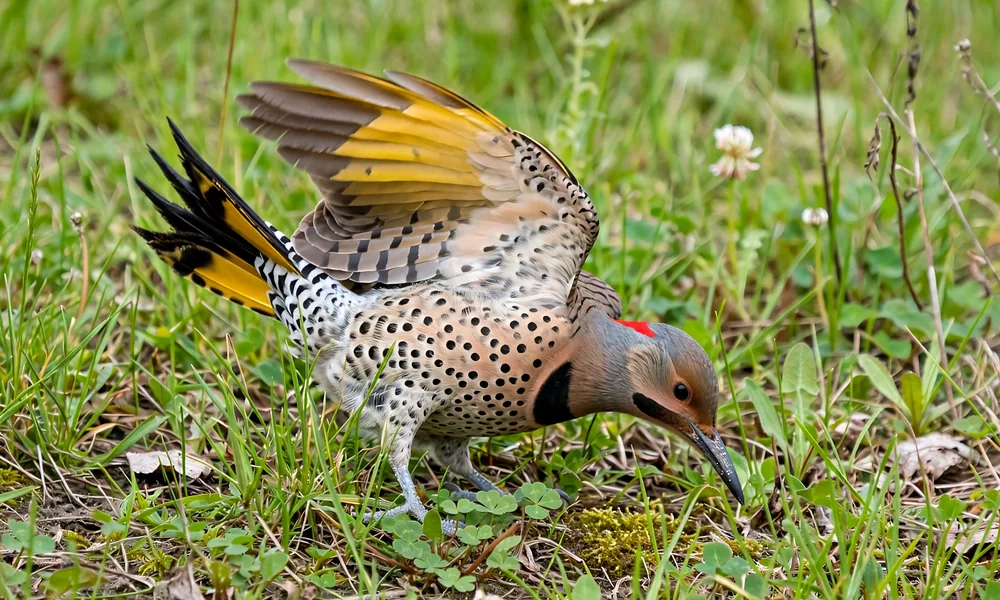
Northern flickers are ant specialists, and ants can make up about 45 per cent of what they eat, more than for any other North American bird. They hop across lawns and open ground, probing the soil with a slightly curved bill and lapping up ants with a long, barbed tongue. One flicker stomach was found to hold almost 2,000 ants, and the birds also eat beetles, caterpillars and spiders, with fruit, berries, seeds and nuts in autumn and winter.
Flickers are also known for anting, in which a bird picks up ants and rubs them through its feathers, or lies on an anthill and lets the ants crawl over it. The ants release formic acid, which may help to remove parasites from the feathers, though the exact reason is still debated. Flickers do climb trees and hammer at bark, but they are the most terrestrial of all North American woodpeckers, and they often perch on a horizontal branch rather than clinging upright to a trunk.
Flickers nest in a hole they dig themselves, usually in a dead tree, a dead limb or a wooden post, and sometimes in a nest box. Both parents take one to two weeks to dig the cavity, and the female lays five to eight glossy white eggs, which both parents incubate for 11 to 12 days. The chicks fledge after 25 to 28 days. Old flicker holes are valuable homes afterwards, used by bluebirds, swallows and other cavity nesters, and a barn owl may take over a large old cavity in an open barn.
Where northern flickers live
Northern flickers live across almost all of North America, from Alaska and Canada south through the United States to Mexico, Central America and Cuba. They are birds of open country rather than deep forest, found in woodland edges, groves, orchards, parks, gardens and farmland, where trees stand beside open ground. They avoid dense, unbroken forest but are common in suburbs and towns.
Northern flickers are partial migrants: birds breeding in Alaska and Canada move south for the winter, while southern birds stay put all year. Autumn migration peaks from late September through October. On a lawn in spring you may see a flicker feeding beside an American robin, another ground feeder, though the robin hunts worms while the flicker digs for ants.
The northern flicker is listed as Least Concern on the IUCN Red List, with a breeding population estimated at about 9 million birds. Numbers are falling slowly, however, largely because dead trees are removed and European starlings compete for the same nest holes. Keeping dead trees standing where safe, and putting up a flicker-sized nest box, are the simplest ways to help them.
Best seasons for northern flicker watching
The best time to look for northern flickers is spring, from March to May, when males call and drum and pairs dig their nest holes in dead trees. Early morning is best, when the birds feed on lawns and open ground, and autumn migration from September to October brings large numbers of northern birds through gardens and parks. In winter they visit backyard feeders for suet and seeds. A common loon may be calling on a northern lake while flickers drum in the trees above the shore.
Staying safe around northern flickers
A northern flicker is a harmless bird that would rather fly away than meet a person, and it has no defence beyond its sharp bill and its speed in the air. Watch from a distance with binoculars, and never approach or reach into a nest hole, because a disturbed nest may be abandoned. Keep dogs on a lead near known nest trees.
If you find a nest hole, enjoy it from well away and do not return every day, because repeated visits can draw predators to the site. Stay on marked paths, ask before crossing private land, and never handle a flicker, which is protected by law in the United States and Canada. If you meet a bird on a lawn, stop and give it room to hop away.
Northern flicker watching checklist
A little preparation turns a walk through open woodland or a garden into a real chance of seeing a northern flicker.
- A spring or autumn visit to open woodland, a park or a garden, where trees stand beside open ground.
- An early morning start, when flickers feed on lawns and call from low perches.
- Binoculars, because a flicker on the ground is easy to miss until it flashes its wings.
- An ear tuned for the laughing wicka-wicka call, which carries further than the bird is visible.
- Patience on lawns and bare paths, where the birds probe the soil for ants.
- A camera with a zoom lens, for close views from a distance without approaching a nest.
- Respect for nest holes and private land, because a disturbed nest may be abandoned.
Frequently asked questions
How many northern flicker species are there?
There is one northern flicker species in this guide, Colaptes auratus. Its two main forms, the yellow-shafted flicker of the east and the red-shafted flicker of the west, were once treated as separate species, but they interbreed where they meet, so they are now counted as one.
What is the difference between yellow-shafted and red-shafted flickers?
The yellow-shafted flicker of the east has yellow shafts under its wings and tail, a red patch on the back of its head, and a black moustache on the male. The red-shafted flicker of the west has salmon-red wing and tail shafts, a red moustache on the male, and no red nape patch. Birds in the middle of the continent often show a mix of both.
What do northern flickers eat?
Northern flickers eat mostly ants, which can make up about 45 per cent of their diet, along with beetles, caterpillars, termites and spiders. In autumn and winter they also eat fruit, berries, seeds and nuts, and they visit backyard feeders for suet.
Why do northern flickers feed on the ground?
Northern flickers feed on the ground because their main food, ants, lives in the soil and in anthills, and their slightly curved bill and long, barbed tongue are made for probing soil and lapping up ants. Most other woodpeckers hunt insects under bark, but the flicker is the most terrestrial woodpecker in North America.
How is this guide different from the nightingale guide?
This guide covers the northern flicker, a large brown woodpecker of North America that feeds on ants on the ground and nests in holes in dead trees, while our nightingale species guide covers the nightingale, a small brown songbird of Europe and Asia famous for its powerful night song. One digs for ants by day; the other sings unseen from the bushes at night.
Are northern flickers endangered?
No. The northern flicker is listed as Least Concern on the IUCN Red List, with a breeding population estimated at about 9 million birds. Numbers are falling slowly where dead trees are cleared and starlings take over nest holes, but the species as a whole is not threatened.
Conclusion
The northern flicker species breaks the woodpecker rules: one species, Colaptes auratus, a brown, spotted bird that feeds on the ground, flashes yellow or red in flight, and laughs its wicka-wicka call across lawns and woodland edges.
If you go looking for one, go in spring, go early, and listen for the call over open ground. Find a flicker digging for ants in the morning sun, and you will see why this ground-feeding woodpecker is so loved in North America.