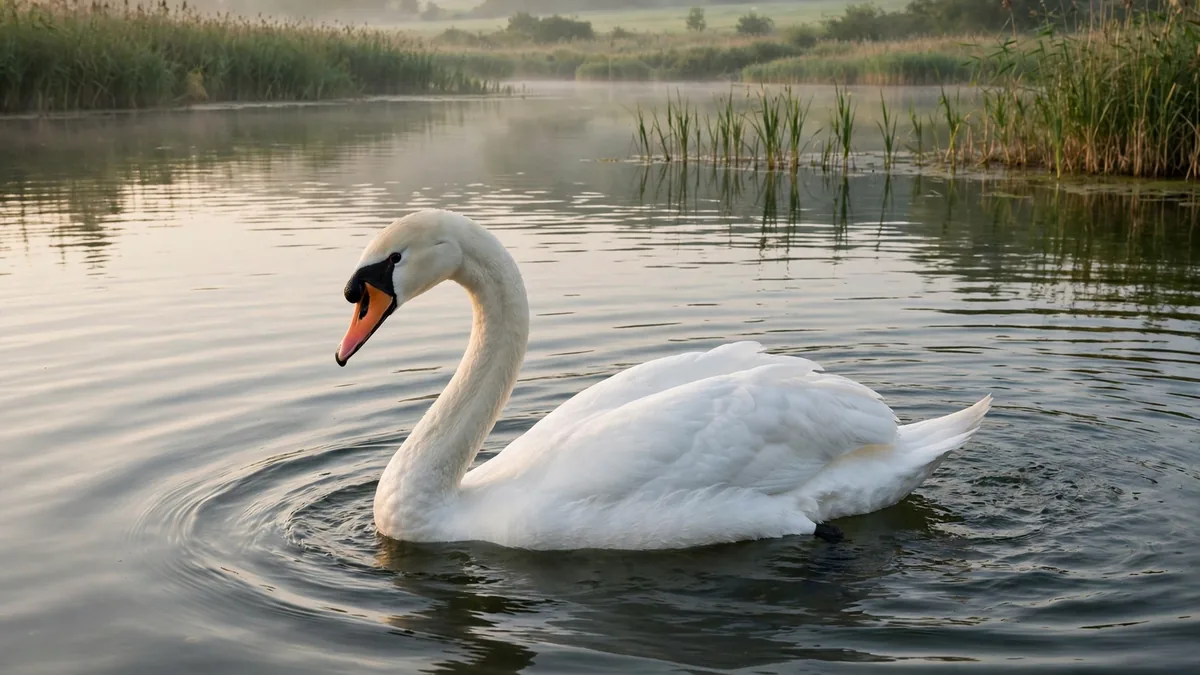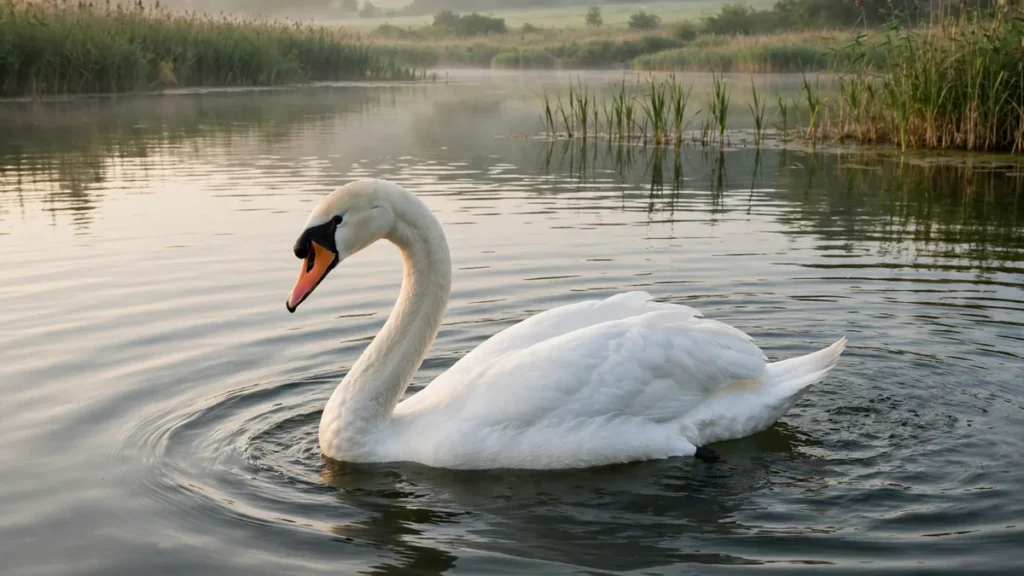
The mute swan species is a single species, Cygnus olor, a great white waterbird with a long S-curved neck, an orange bill and a black knob, that lives on shallow lakes, slow rivers and sheltered coasts across Europe and Asia. If you are asking how many mute swan species there are, the answer is one, and it is one of the heaviest flying birds in the world, with large males weighing more than 12 kilogrammes.
The mute swan is the swan of storybooks and park lakes, the bird that glides with its wings half raised and its neck curved like a question mark. It is quieter than its cousins, the whooper and Bewick’s swans, which is where its name comes from.
Key takeaways
- The mute swan species is Cygnus olor, a single species, and one of the heaviest flying birds in the world.
- Adults are 140 to 160 centimetres long, with a wingspan of 208 to 238 centimetres and a weight of 7 to 12.4 kilogrammes.
- Mute swans live on shallow lakes, slow rivers, canals, gravel pits and sheltered estuaries across Europe and Asia.
- They eat almost nothing but water plants, reaching down with the long neck or upending to pull up pondweed and stoneworts.
- The species is listed as Least Concern, with a population of around 500,000 to 600,000 birds.
What makes a mute swan a mute swan
A mute swan is a very large white bird, 140 to 160 centimetres long, with a wingspan of 208 to 238 centimetres and a weight of 7 to 12.4 kilogrammes. Males, called cobs, are larger than females, called pens, and a cob’s black knob is bigger than a pen’s. The bill is orange with black edges and a black knob at the base, the legs are black, and the neck is usually held in a graceful S-curve with the bill pointing down.
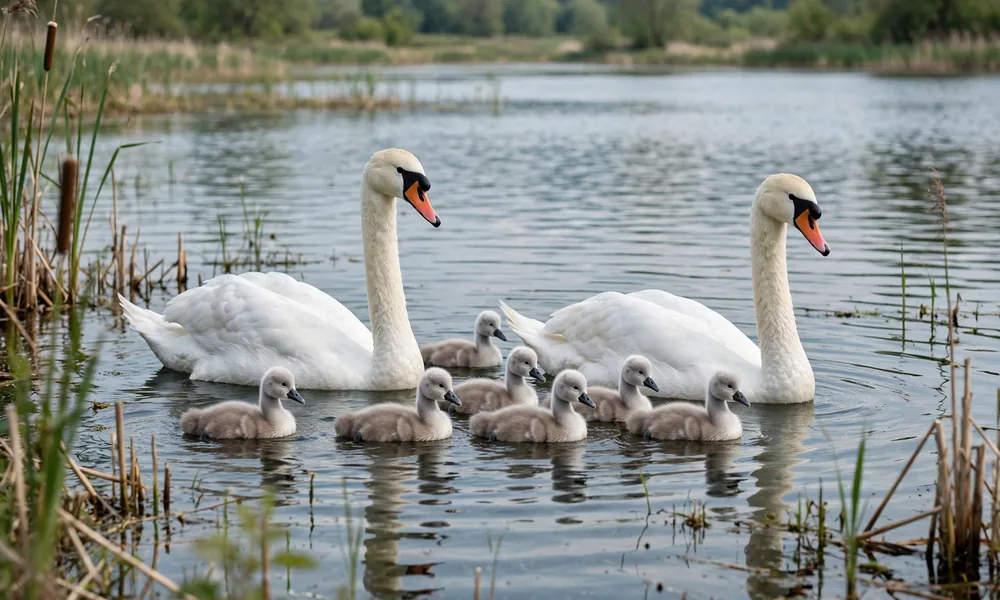
On the water a mute swan often swims with its wings raised and arched over its back, a posture called busking, which makes the bird look even larger. It is not truly mute: adults grunt, snort and hiss, and their wings throb loudly in flight, but they lack the far-carrying bugle calls of the whooper swan. Cygnets are grey or brownish grey at first, sometimes white, and they often ride on a parent’s back under a raised wing.
The mute swan species and their relatives
The mute swan belongs to Cygnus, the genus of the true swans, in the duck family Anatidae. The genus holds seven species, and the mute swan is the only one with an orange bill and a black knob, which makes it easy to tell apart from the yellow-billed whooper swan and the black-billed Bewick’s swan. The coscoroba swan of South America is usually placed in its own genus, so it is not counted among the seven.
Its closest relatives are the other northern swans, the whooper, Bewick’s and tundra swans and the trumpeter swan of North America, all of them large white waterbirds with long necks. The black swan of Australia is a more distant cousin in the same genus, black where the mute swan is white, with a red bill and a habit of holding its neck upright rather than curved.
| Type | Animal | Where it lives | Best-known food | Length or Weight |
|---|---|---|---|---|
| Genus | Swans (genus Cygnus) | Wetlands of the northern hemisphere | Water plants | Up to about 160 cm long |
| Species | Mute swan (Cygnus olor) | Europe and Asia | Pondweeds and stoneworts | About 140 to 160 cm long |
| Species | Whooper swan (Cygnus cygnus) | Northern Europe and Asia | Water plants and grass | About 140 to 160 cm long |
| Species | Trumpeter swan (Cygnus buccinator) | North America | Pondweeds and sedges | About 140 to 165 cm long |
| Species | Black swan (Cygnus atratus) | Australia and New Zealand | Water plants and algae | About 110 to 140 cm long |
| Species | Black-necked swan (Cygnus melancoryphus) | South America | Water plants | About 102 to 124 cm long |
How mute swans live
Mute swans eat almost nothing but plants. Most of their food is water plants from below the surface, such as pondweeds, stoneworts, eelgrass and algae, and outside the breeding season they also graze grass and winter crops close to the water. They feed by dabbling at the surface, dipping the head and neck, or upending in deeper water, which lets them reach food about a metre down. Insects, snails and tadpoles are swallowed now and then, tangled in the greenery. A moulting adult can need up to 4 kilogrammes of wet food a day.
Mute swans form long-term pairs, often lasting for life, though a bird that loses its mate may pair again. Each pair defends a territory of open water, and the cob will hiss, raise its wings and charge at intruders that come too close to the nest. The nest is a large mound of reeds and grasses built on an island or at the water’s edge, often a metre or more across, and the same site may be used year after year.
The pen lays five to seven eggs and incubates them for 35 to 42 days while the cob stands guard nearby. Cygnets hatch covered in grey down and can swim and feed themselves within a day, though they stay close to their parents for months. They take their first flights at around four to five months and turn white during their second year. Mute swans often live 10 to 20 years in the wild, and they moult all their flight feathers at once in summer, leaving them unable to fly for several weeks.
Where mute swans live
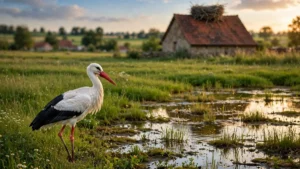
Mute swans are native to temperate Europe and Asia, from Ireland and Britain east through Russia and Central Asia to Mongolia and north-eastern China. They live on shallow lakes, slow rivers, canals, gravel pits, reservoirs, park lakes, marshes and sheltered estuaries, anywhere with calm, fertile water and plenty of submerged plants. They avoid deep, bare or fast water and high ground, and outside the breeding season they graze wet meadows and pasture close to water.
The species was also taken to North America, Japan, Australia and New Zealand as an ornamental park bird, and it now breeds wild in the eastern United States and the Great Lakes, where it is managed as an introduced species because it strips shallow water of plants and drives out native waterbirds. In its native range it is mostly resident, staying on the same waters all year, with northern birds moving south only when ice closes their lakes.
The mute swan is listed as Least Concern on the IUCN Red List, with a population estimated at around 500,000 to 600,000 birds, and numbers are stable or rising in much of Europe. Its greatest threats are lead poisoning from swallowed fishing weights and shot, collisions with power lines, and the loss of quiet, plant-rich shallows. In Britain all unmarked mute swans in open water are traditionally said to belong to the Crown.
Best seasons for mute swan watching
Mute swans can be seen all year across most of Britain and Ireland, and through much of Europe, because most birds do not migrate. Spring is best, when pairs hold territories and cygnets hatch from May onwards, and winter is good too, when family groups gather in flocks on large lakes and estuaries. Early morning is best, when the water is still and the swans are feeding close to the reeds.
Staying safe around mute swans
A mute swan is a large, powerful bird, and a cob defending its nest or cygnets can be aggressive. It will hiss, raise its wings and charge, so never approach a nest or a family with young cygnets, and keep dogs on a lead near swans in the breeding season. Watch from a distance with binoculars, stay on the path, and never try to handle a swan, which is protected by law in most of Europe.
Do not feed swans bread, which fills them without nourishing them; grain, corn or leafy greens are far better if feeding is allowed at all. Keep to marked paths along lakes and rivers, ask before crossing private land, and give a swimming family plenty of room to pass, because a cornered swan on a narrow bank has nowhere to go.
Mute swan watching checklist
A little preparation turns a walk by the water into a real chance of seeing a mute swan at close range.
- A spring or summer visit to a shallow lake, slow river, canal or gravel pit with reeds at the edge.
- An early morning start, when swans feed close to the reeds on still water.
- Binoculars, because a swan family on a large lake is easy to miss without them.
- An eye for the orange bill with a black knob, which separates the mute swan from every other swan.
- Patience on the bank, while a feeding swan upends and stays down.
- A camera with a zoom lens, for close views from a distance without approaching a nest.
- Respect for nesting pairs and private land, because a disturbed nest may be abandoned.
Frequently asked questions
How many mute swan species are there?
There is one mute swan species, Cygnus olor. It is one of seven species in the genus Cygnus, the true swans, alongside the whooper, Bewick’s, tundra, trumpeter, black and black-necked swans.
Why is it called a mute swan?
The name comes from its quiet voice. Compared with the whooper and Bewick’s swans, which bugle loudly, the mute swan only grunts, snorts and hisses, and its calls do not carry far. It is not silent, but it is the quietest of the swans.
What does a mute swan eat?
A mute swan eats almost nothing but plants, above all submerged water plants such as pondweeds, stoneworts, eelgrass and algae, reached with its long neck or by upending in water about a metre deep. It also grazes grass and winter crops on land, and swallows insects, snails and tadpoles now and then.
Are mute swans dangerous?
Mute swans are not usually dangerous, but a cob defending its nest or cygnets can be aggressive, hissing, raising its wings and charging at people and dogs. Keep your distance in the breeding season, keep dogs on a lead, and never try to handle one.
How is this guide different from the mourning dove guide?
This guide covers the mute swan, a great white waterbird of lakes and slow rivers that eats water plants and guards a territory with hisses and raised wings, while our mourning dove species guide covers the mourning dove, a small grey-brown garden bird of North America that feeds on seeds and coos softly from wires and rooftops. One weighs up to 12 kilogrammes and rules a lake; the other weighs about 120 grammes and visits a bird table.
Are mute swans endangered?
No, mute swans are not endangered. The species is listed as Least Concern on the IUCN Red List, with a population estimated at around 500,000 to 600,000 birds, and numbers are stable or rising in much of Europe. Lead poisoning and the loss of quiet, plant-rich shallows are its main threats.
Conclusion
The mute swan species is a bird that needs no introduction once you have seen it: one species, Cygnus olor, a great white swan with an orange bill, a black knob and a neck curved like a question mark.
If you go looking for one, go to still water, go early, and watch for the wings raised over the back and the cygnets riding between the reeds. Find a mute swan gliding across a lake in the morning light, and you will see why it has been the swan of storybooks for centuries.