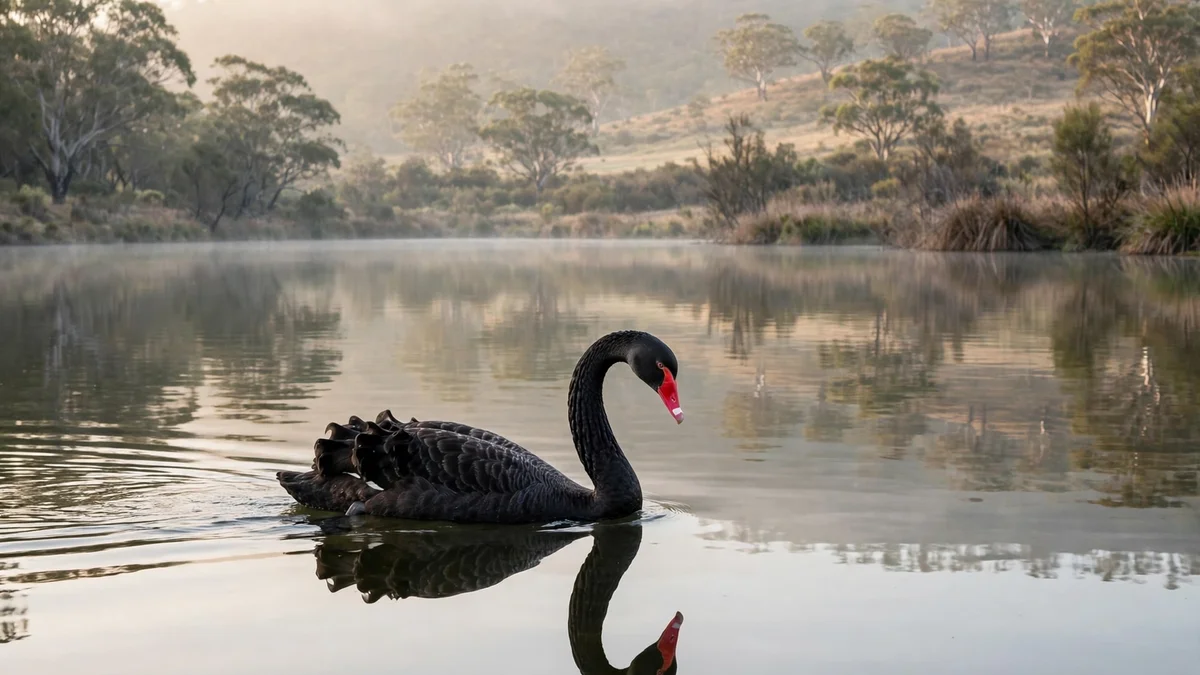
The black swan species number one, a single species called Cygnus atratus, and it is the only swan in the world with black plumage, a bird of black feathers, a bright red bill and white flight feathers that show only when it flies. If you are asking how many black swan species there are, the answer is one: there is one recognised black swan species in the world, and every black swan alive today belongs to it.
The black swan lives in Australia, where it is native, and in New Zealand, where it was introduced in the 1860s and now lives wild. It is a large graceful waterbird of lakes, lagoons and estuaries, famous for two things that set it apart from every other swan: its colour, and its voice.
Key takeaways
- There is one black swan species, Cygnus atratus, native to Australia and introduced to New Zealand.
- Black swans are about 110 to 142 centimetres long, weigh 3.7 to 9 kilogrammes, and have a wingspan of 1.6 to 2 metres.
- They are almost entirely black, with a bright red bill carrying a white band near the tip and white flight feathers hidden until they fly.
- Black swans pair for life, with only about 6 per cent splitting, and both parents share the sitting and the care of the cygnets.
- Unlike the mute swan, the black swan is not silent: it has a musical bugling call that carries across the water.
What makes a black swan a black swan
A black swan is a large waterbird with a long curved neck, measuring about 110 to 142 centimetres from bill to tail, with a wingspan of 1.6 to 2 metres and a weight of 3.7 to 9 kilogrammes. Males are slightly larger than females, with a longer and straighter bill, and the neck is relatively the longest of any swan, held in a deep S-curve when the bird is swimming. Its legs and feet are greyish black, and its eyes are red.
The plumage is what gives the bird its name. A black swan is covered in black feathers, often ruffled along the wings, and the white flight feathers stay hidden while it swims or rests, flashing into view only when it opens its wings. The bill is bright red, with a narrow white band near the tip and a pale tip, and there is a small red patch of skin in front of each eye. Cygnets look quite different: they are greyish brown with pale-edged feathers, and their bills start out dull rather than scarlet.
The voice is the other mark of the species. The mute swan is famously quiet, but the black swan is not: it gives musical bugling and trumpeting calls, and its wings whistle in flight. In flight a group forms a line or a V, flying strongly on undulating necks, and the bugling carries a long way across a lake. Unlike the flightless emperor penguin, a fellow bird of the southern hemisphere, the black swan is a strong flier that moves between wetlands as the rains come and go.
The black swan species and their relatives
There is one black swan species. It belongs to the genus Cygnus, the true swans, and its closest relatives are the mute swan of Europe and Asia, the whooper swan of the far north, and the trumpeter swan of North America. The black-necked swan and the coscoroba swan of South America are its nearest southern neighbours, and all of them share the same long neck, heavy body and strong pair bonds.
The mute swan is the best-known swan in Europe, a white bird with an orange bill and a black knob, the swan of parks and palace lakes. The whooper swan is a wild northern bird with a yellow and black bill, while the trumpeter swan is the largest swan in North America, with a deep trumpet-like call. The tundra swan is an Arctic breeder, and the black-necked swan of South America is white-bodied with a black neck and head, the mirror image of the black swan.

| Type | Animal | Where it lives | Best-known food | Length or Weight |
|---|---|---|---|---|
| Species | Black swan (Cygnus atratus) | Australia and New Zealand | Aquatic plants and algae | About 110 to 142 cm long, 3.7 to 9 kg |
| Close relative | Mute swan | Europe and Asia, introduced elsewhere | Aquatic plants | About 140 to 160 cm long, 9 to 13 kg |
| Close relative | Whooper swan | Northern Europe and Asia | Aquatic plants and grasses | About 140 to 165 cm long, 7 to 14 kg |
| Close relative | Trumpeter swan | North America | Aquatic plants | About 150 to 180 cm long, 7 to 13 kg |
| Close relative | Tundra swan | Arctic North America and Eurasia | Aquatic plants and grasses | About 115 to 150 cm long, 6 to 10 kg |
| Close relative | Coscoroba swan | Southern South America | Aquatic plants and algae | About 90 to 115 cm long, 3 to 5 kg |
| Close relative | Black-necked swan | Southern South America | Aquatic plants and algae | About 102 to 124 cm long, 3.5 to 6.7 kg |
How black swans live
Black swans are plant eaters. They feed on aquatic plants and algae, dipping their long necks below the surface to reach deep weeds, and grazing on grasses on the shore. The bill is broad and serrated along the edges, well suited to cropping plants just below the surface, and a swan may spend much of the day feeding with its head under the water and its tail tipped up.
Breeding is a job both parents share. A pair builds a large mound nest of reeds, grasses and weeds, up to 1.5 metres across, on a small island or in shallow water, and the female lays four to eight eggs. Both parents take turns sitting for about 35 to 40 days, the female usually taking the night shift, and both then care for the cygnets. The young can swim and feed themselves from the day they hatch, stay with their parents for about nine months, and can fly at about four to six months old.
Black swans are famously faithful, forming pair bonds that often last for life, with only about 6 per cent splitting. About a quarter of pairs are two birds of the same sex, most often two males, which sometimes raise cygnets together. After breeding, black swans lose all their flight feathers at once when they moult, and cannot fly for about a month. A black swan lives about 10 to 15 years in the wild.
Where black swans live
The black swan is native to Australia, where it breeds mainly in the south-east and south-west, and it is nomadic, moving in loose groups as the rains fill the wetlands. It lives on lakes, lagoons, estuaries, swamps and slow rivers, singly or in loose companies numbering into the hundreds. In New Zealand, black swans were released from 1864 onwards, and some also arrived on their own across the Tasman Sea, and the bird is now widespread there too.
Black swans are listed as Least Concern, with healthy numbers across most of their range. The main pressures are the draining of wetlands, the loss of shallow feeding lakes, and disturbance at nesting sites, though the birds adapt well to park lakes and farm dams. Like the flamingo, the black swan depends on shallow water, so keeping wetlands wet and undisturbed matters most.
Best seasons for black swan watching
There is no closed season, because black swans are active all year, but the best time to look is the breeding season, when the pairs are at their nests. In Australia the breeding season follows the rains, so it varies from place to place, and the birds often nest after heavy rain. Early morning and late afternoon are best, when the swans are feeding in the shallows.
Staying safe around black swans
A black swan has a strong beak and powerful wings, and it can give a painful bite or a hard wing blow to a person who comes too close, especially near a nest. Keep your distance, never feed a swan from your hand, and never walk between a swan and its cygnets. If you see black swans by a lake, stay calm, stay still, and let them swim past, because swans that are chased may abandon their nests for good.
Black swan watching checklist
A little preparation turns a lakeside visit into a real chance of seeing a black swan, so pack for sun and long quiet hours by the water.
- Binoculars, because the swans often feed far from the shore.
- A camera with a zoom lens, for the red bill and the white flight feathers without getting close.
- A field guide to waterbirds, for telling a black swan from a black-necked swan at a glance.
- Sun protection and a hat, for long hours beside an Australian lake.
- A plan to be out in the morning or late afternoon, when the swans are feeding in the shallows.
- Patience and silence, because a noisy group will send them away.
- A map of the local wetlands, for finding the shallow lakes and lagoons the swans prefer.
Frequently asked questions
How many black swan species are there?
There is one black swan species, Cygnus atratus. It is the only swan with black plumage, and it lives in Australia and New Zealand. Its closest relatives are the mute swan, the whooper swan and the trumpeter swan.
Why are black swans black?
Black swans are black because of melanin, the dark pigment in their feathers, which also makes the feathers tougher and slower to wear. The black plumage is broken only by the white flight feathers, which stay hidden until the bird opens its wings, and by the bright red bill.
What do black swans eat?
Black swans eat aquatic plants and algae, which they reach with their long necks, and they also graze on grasses on the shore. Their broad serrated bills are well suited to cropping plants just below the surface.
Do black swans mate for life?
Mostly, yes. Black swans form pair bonds that often last for life, and only about 6 per cent of pairs split. Both parents share the sitting and the care of the cygnets, and the bond is kept strong by mutual preening and nest building.
How is this guide different from the bee hummingbird species guide?
This guide covers the single black swan species, a 110-centimetre Australian waterbird that weighs up to 9 kilogrammes, while our bee hummingbird species guide covers the single bee hummingbird species, a 5-centimetre Cuban bird that weighs less than a coin. The black swan is one of Australia’s largest flying birds, and the bee hummingbird is the smallest bird in the world.
Are black swans endangered?
No. Black swans are listed as Least Concern, with healthy numbers across Australia and New Zealand. The main threats are the draining of wetlands and disturbance at nesting sites.
Conclusion
The black swan species shows how one bird can turn an old idea upside down: a single species of swan, black where every other swan is white, with a red bill and a musical bugling call.
If you go looking for one, go to an Australian lake after the rains, in the morning, and quietly. Watch a black swan glide across still water with its neck in a deep curve, and you will understand why it has become an emblem of Australia, and why keeping its wetlands wet matters most.