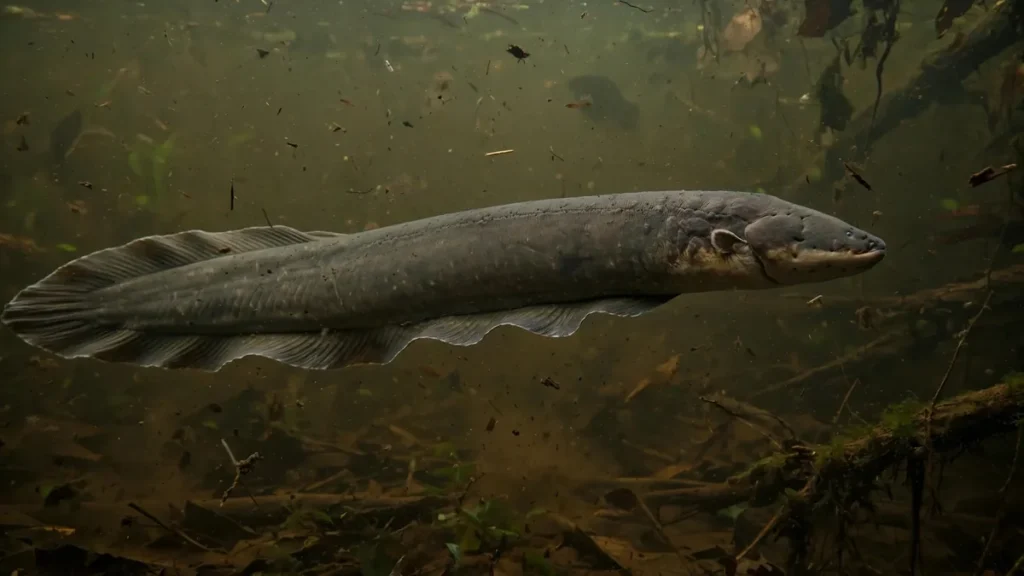
The electric eel species are the living batteries of the Amazon, long, eel-shaped fish that can stun their prey with a shock of hundreds of volts, navigate muddy water they cannot see through with a weak electric field, and breathe air at the surface like a whale coming up for breath. If you are asking what an electric eel is, the short answer is a knifefish of the genus Electrophorus, a group of three recognised species that grow to 2.5 metres and about 20 kilograms, live in the slow rivers, swamps and flooded forests of the Amazon and Orinoco basins, and carry three electric organs along the back four-fifths of their body that can deliver a discharge of up to 860 volts, the strongest electric shock of any animal known to science. Despite the name, it is not a true eel at all, and it is more closely related to catfish and carp than to any eel.
Most people meet the electric eel in a story before they meet one in the water: the tale of the Italian physicist Alessandro Volta, who built the first electric battery in 1800 after studying the eel’s organs, or the account of the explorer Alexander von Humboldt, who wrote in 1800 of horses driven into a pool to draw the eels’ shocks, a famous story that scientists still argue over today. The animal has held its place in the imagination for more than two hundred and fifty years, since the Swedish naturalist Carl Linnaeus first described it in 1766, and it was only in 2019 that researchers discovered there were three species, not one. This guide follows the group as a whole, led by the classic electric eel, and looks at how they look, where they live, what they eat, how they hunt with electricity, and why a fish that can shock its prey still has to come up for air.
Key takeaways
- The electric eel species number three, all in the genus Electrophorus, recognised only in 2019 after researchers studied 107 specimens from across the Amazon and found three distinct kinds.
- The classic electric eel, Electrophorus electricus, grows to 2.5 metres and about 20 kilograms, and it can discharge up to about 650 volts, while its cousin Electrophorus voltai reaches up to 860 volts, the strongest shock of any known animal.
- Electric eels are not true eels at all: they are knifefishes of the order Gymnotiformes, more closely related to catfish and carp than to any eel.
- Electric eels are obligate air-breathers, rising to the surface about every ten minutes to gulp air, and they take about 80 per cent of their oxygen from the air rather than the water.
- The electric eel is listed as Least Concern, with stable populations across the Amazon and Orinoco basins, and it uses a weak electric field of less than 10 volts like radar to find its way in muddy water.
The electric eel species and their relatives
Electric eels belong to the family Gymnotidae, the naked-back knifefishes, a family of South American freshwater fish that holds the electric eels and their close cousins, and the family ranges from about 5 centimetres, in the smallest knifefishes, to 2.5 metres in the electric eel itself, the largest of all the knifefishes by a wide margin. The family sits in the order Gymnotiformes, the South American knifefishes, a group of fish that swim by rippling a long fin along their belly rather than by beating their tail, and that carry electric organs of one kind or another, most of them weak, for finding their way and talking to each other in the dark. The electric eel is the only member of the order that can deliver a powerful shock, and it is the only fish in the world that produces a discharge of hundreds of volts.
The classic electric eel, Electrophorus electricus, is the lead species of this guide, and it is the fish that Linnaeus described in 1766 and that Volta studied more than two centuries ago. It lives in the highlands of the Guiana Shield, in the northern part of the Amazon region, in the rivers of Guyana, Suriname, French Guiana and the Brazilian states of Amapa, Amazonas and Roraima, and it grows to 2.5 metres and about 20 kilograms. The discharge of the classic electric eel reaches up to about 650 volts, a shock strong enough to stun a fish, to knock a person off their feet, and to make a horse shy away from the water, and it is produced by three pairs of electric organs that fill the back four-fifths of the body, behind the head and the gut.
| Type | Animal | Where it lives | Best-known food | Length or Weight |
|---|---|---|---|---|
| Family | Knifefishes (Gymnotidae) | Rivers of South America | Fish and invertebrates | About 5 cm to 2.5 m long |
| Genus | Electric eels (Electrophorus) | Amazon and Orinoco basins | Fish, frogs and invertebrates | About 1.5 m to 2.5 m long |
| Species | Electric eel (Electrophorus electricus) | Guiana Shield, northern South America | Fish and invertebrates | Up to 2.5 m long |
| Species | Volta’s electric eel (Electrophorus voltai) | Brazilian Shield, southern Amazon | Fish and invertebrates | Up to 2.5 m long |
| Species | Vari’s electric eel (Electrophorus varii) | Lowland Amazon and Orinoco | Fish and invertebrates | About 1.5 m long |
| Species | Banded knifefish (Gymnotus carapo) | Rivers of South America | Fish, insects and crustaceans | Up to 76 cm long |
The genus Electrophorus holds three species, and they grow to between about 1.5 and 2.5 metres. The second species, Volta’s electric eel, Electrophorus voltai, lives further south on the Brazilian Shield, and it is the one that produces the record discharge: in field measurements with a voltmeter, researchers recorded a shock of 860 volts from a specimen of this species, the highest voltage ever measured from any animal, and a full 210 volts more than the classic electric eel had ever produced. The third species, Vari’s electric eel, Electrophorus varii, lives in the slow-moving, murky waters of the lowland Amazon and Orinoco, and it is the smallest of the three, at about 1.5 metres, named for the Smithsonian zoologist Richard Vari. The three species split from each other millions of years ago, and they look so alike that only DNA, the shape of the skull and the voltage of the shock could tell them apart.
The closest relatives outside the genus are the other knifefishes, and they show what the electric eel’s family looks like without the great shock. The banded knifefish, Gymnotus carapo, is a common fish of South American rivers that grows to 76 centimetres, and it produces only a weak electric field, which it uses to navigate and to communicate, not to hunt. The black ghost knifefish, a popular aquarium fish, does the same, rippling its long belly fin to swim backwards as easily as forwards. Like the catfish, the electric eel is a freshwater fish of South America that hunts in murky water by senses other than sight, but the catfish is a bottom-feeder that finds its food by taste and touch with the barbels around its mouth, while the electric eel is a hunter that finds its prey with a weak electric field and stops it with a shock.
What an electric eel looks like
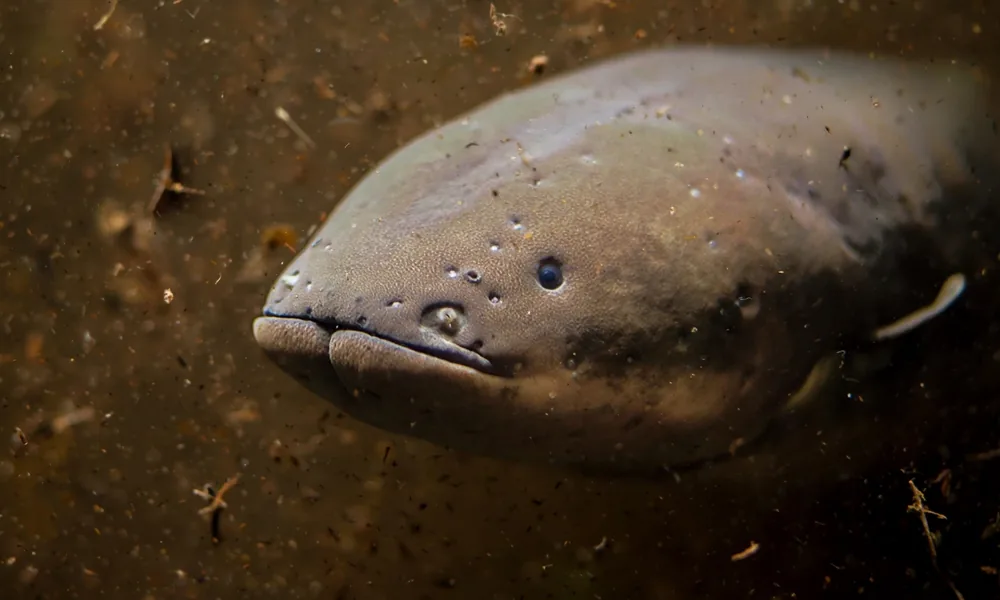
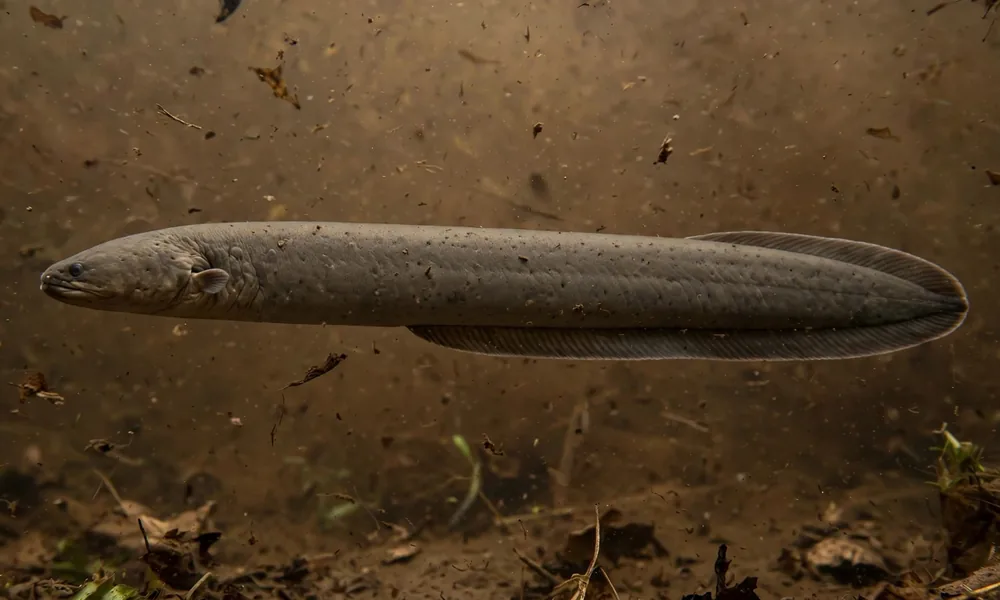
An electric eel looks like a thick, dark snake that happens to be a fish, and once you have seen one you will never mistake it for anything else. The body is long and cylindrical, without scales, and it is coloured a dull grey-brown above and a yellow-orange below, a colouring that blends into the muddy water it lives in. The head is blunt and flat, the mouth is wide, and the eyes are small and dark, almost lost in the head, because the animal does not need them much. The dorsal fin is absent altogether, and the anal fin runs the whole length of the belly, rippling in waves that push the fish forward, backwards and sideways with a grace no tail-beating fish can match.
The inside of the fish is stranger than the outside, and it explains the whole animal. The organs that other fish keep along their whole body are crowded into the front fifth of the electric eel, just behind the head, and the back four-fifths is given over to muscle and to the three pairs of electric organs: the Main organ, the Hunter’s organ and the Sachs’ organ. Each organ is made of thousands of thin cells called electrocytes, stacked in series like the cells of a battery, and the Main organ alone holds 5,000 to 6,000 of them, so that a single discharge can reach 650 volts in the classic species and 860 volts in Volta’s electric eel, with a current of up to about 1 ampere. The brain and the spinal cord are wrapped in fat and connective tissue, insulated against the animal’s own shock, which is why the eel can fire its organs again and again without hurting itself.
Where electric eels live
Electric eels live in the slow, warm, muddy waters of northern South America, and they are fish of the Amazon and the Orinoco basins. Their range runs through Brazil, Colombia, Venezuela, Peru, Guyana, Suriname and French Guiana, through the great river systems and their tributaries, the flooded forests and the swamps, and they are found from the Guiana Shield in the north to the Brazilian Shield in the south. They favour water that is warm, usually between 25 and 30 degrees Celsius, and they are rarely found in fast, clear water, where the current is too strong and the oxygen too rich for a fish that has given up on gills.

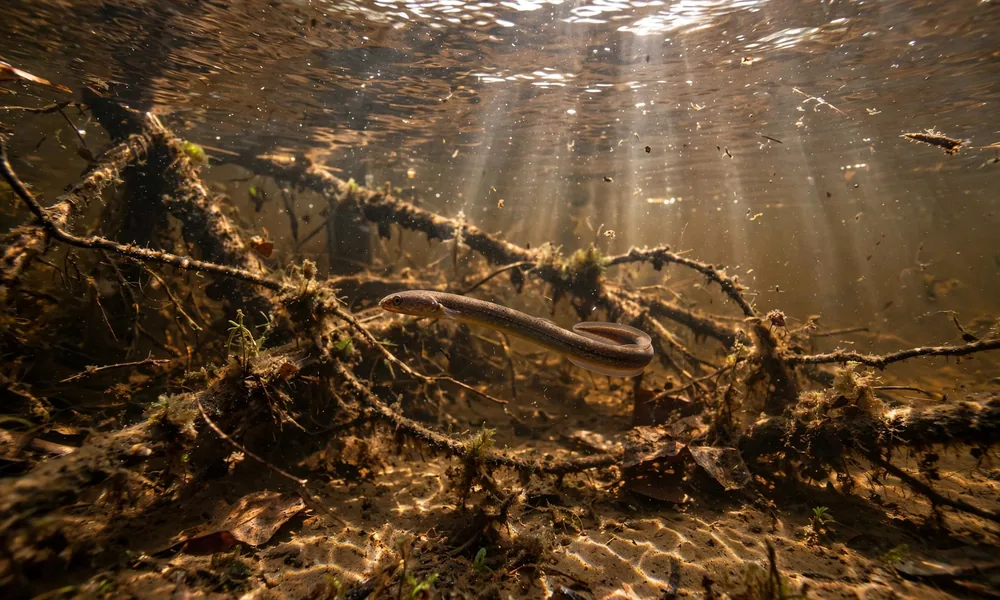
The habitat they choose is the quiet water, and they are rarely found far from it. Most electric eels live in water between 1 and 3 metres deep, in the swamps, the backwaters, the oxbow lakes and the flooded forests, where the water barely moves and the dead leaves settle on the bottom. They favour places with plenty of cover, such as tangled roots, fallen trees and thick vegetation, which give them both hunting ground and a place to hide from the caimans and the giant otters that hunt them, and they are less common in the main river channel, where the water runs fast and there is little to eat. An electric eel spends much of its life within a small stretch of swamp, and it knows every root tangle and every pool in that stretch.
The electric eel has stayed where it evolved, and it has not spread beyond its native rivers the way some fish have, because it needs the warm, muddy, oxygen-poor water of the Amazon and the Orinoco, and that water is found nowhere else. Like the sturgeon, the electric eel is a big, ancient fish of great rivers that can live for many years and grow to an extraordinary size, but the sturgeon is a fish of cold northern rivers that swims hundreds of kilometres upstream to spawn in fast, clear water, while the electric eel is a fish of warm, muddy backwaters that barely moves at all and breathes the air above the swamp.
What electric eels eat
Electric eels are hunters, and their diet is written on the swamp itself. The everyday food is fish, and an electric eel will eat almost any fish it can fit in its mouth, from small tetras and catfish to young piranhas, and it also eats frogs, crustaceans and other invertebrates that live in the mud. A swamp full of electric eels keeps the numbers of smaller fish in check, which is one reason they matter to the whole flooded forest, and a swamp without them soon fills with fish that nothing else will hunt in water so dark and so low in oxygen.
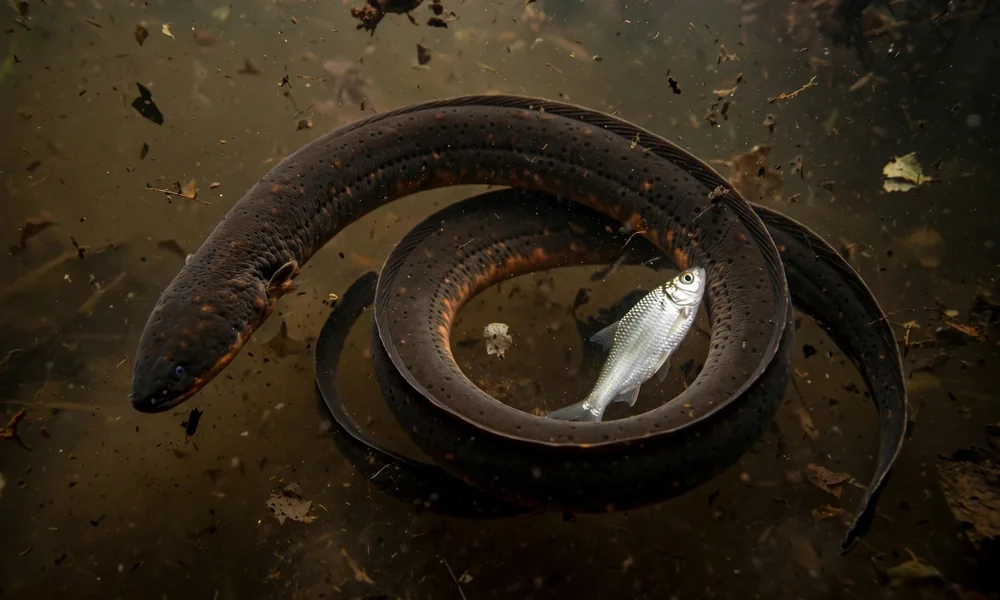
What sets the electric eel apart is how it hunts, and the hunt is a piece of electrical engineering. The eel sends out weak pulses of less than 10 volts from the Sachs’ organ, and the pulses bounce back off anything in the water, so the eel can map its surroundings like radar in water it cannot see through. When it finds a fish, it fires the Main organ and the Hunter’s organ together, and the high-voltage discharge, up to about 650 volts in the classic species and up to 860 volts in Volta’s electric eel, makes the muscles of the prey contract so hard that the fish cannot swim, and the eel then takes it in its mouth and swallows it whole. In recent years researchers have filmed electric eels curling their bodies around a prey fish to double the strength of the shock, a trick that turns the eel’s own body into a trap, and it is one of the most remarkable hunting behaviours of any fish.
How electric eels behave
Electric eels are night fish, and their day is a quiet round of resting, surfacing and feeding in the dark water. They wake at dusk, leave the root tangles where they spent the day, and move into the open pools to hunt, and they spend the night working the swamp in a slow, unhurried way, never rushing, never chasing far. They are solitary animals, and they keep their distance from each other, recognising one another by the rate of their low-voltage pulses and adjusting their spacing to avoid costly fights. When danger passes overhead, an electric eel will often freeze on the bottom and rely on its dull colouring to hide it, and if that fails it will fire a warning shock and dart into the nearest tangle.
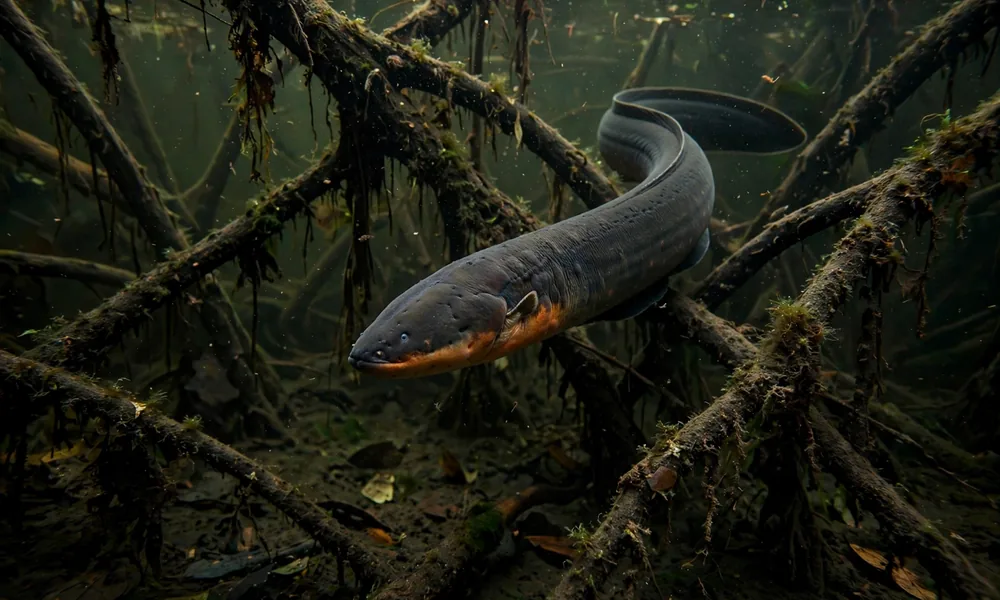
The most famous behaviour in the electric eel is the shock, and it is used for more than hunting. A threatened eel will fire its organs in a burst, and the shock is strong enough to make a predator let go, to knock a person off their feet, and to stop a caiman from pressing an attack. The shock is not usually deadly to a person, because the current is low even when the voltage is high, but it is painful, and it can cause a fall or a drowning if it happens in deep water, which is why the sensible rule is never to touch one. The eel fires its organs in pulses, not in a single long burst, and it can fire again and again, recharging its electrocytes between shocks, so a fish that has been shocked once is in no hurry to come back for more.

When an electric eel is threatened, its first response is to hide, relying on its colouring and its electric sense to keep it safe, and if that fails it will shock and run for cover. Electric eels have no venom and no bite that matters to a person, and their whole defence is built on being hard to see, hard to catch and hard to hold. An eel that is handled roughly will thrash and shock, which is why researchers who study them wear rubber gloves and handle them with insulated tools, and why an eel that is lifted from the water must never be held near the head, where the shock is strongest.
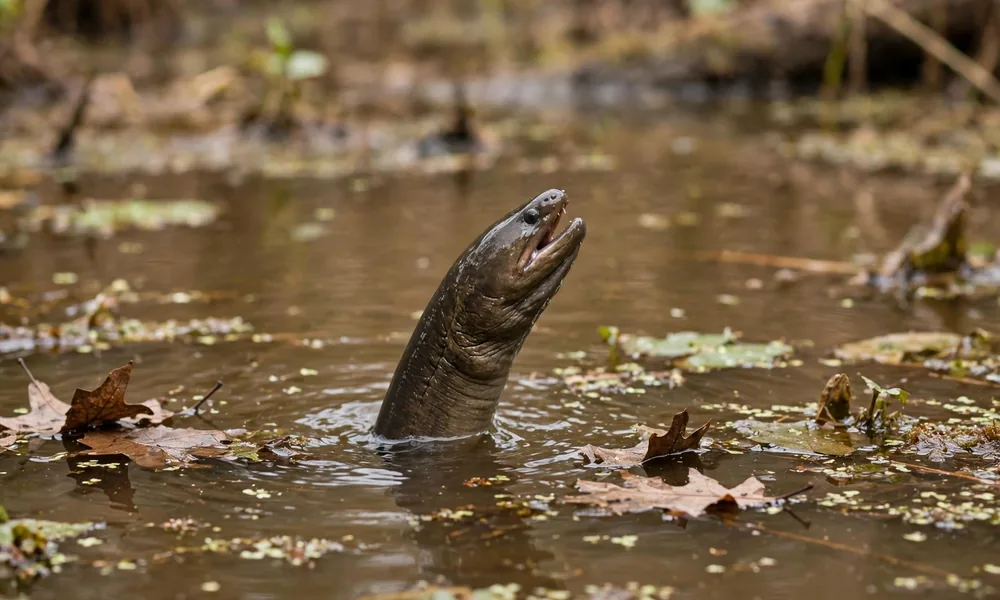
The breathing is the behaviour that surprises people most, because it is the one thing a fish famous for electricity should not need to do. The electric eel is an obligate air-breather: its gills are small and cannot supply enough oxygen to keep it alive, even in well-aerated water, and it takes about 80 per cent of its oxygen from the air, through the richly folded, blood-filled lining of its mouth. It must rise to the surface about every ten minutes to gulp air, and a fish held underwater would drown in its own home, which is why the eel’s life is a steady rhythm of sinking down to hunt and rising up to breathe, all day and all night.
Breeding and life cycle
Electric eels breed in the dry season, when the water is low and the pools are crowded, and the timing is set by the falling water rather than the calendar. The male builds a nest from his own saliva, a frothy mass of bubbles tucked into the roots or the vegetation at the edge of a pool, and he guards it fiercely, driving off any fish that comes near. A female electric eel may not breed until she is several years old, when she is about 1.5 metres long, and she may then lay thousands of eggs in a single spawning, more than most fish of her size.
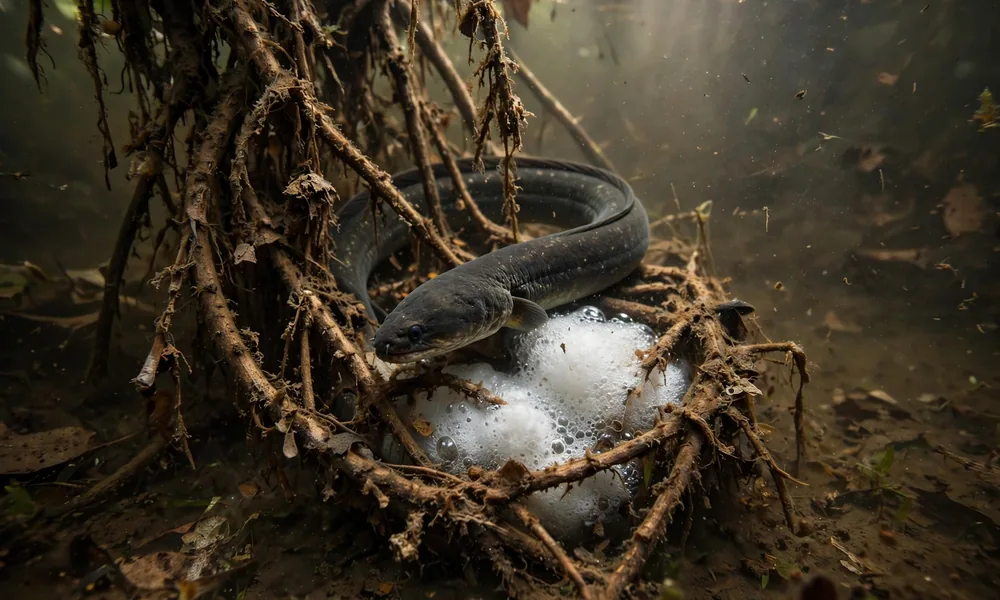
The female arrives at the nest and lays her eggs in the froth while the male fertilises them, and the eggs are small and pale, and they hatch within a week or so depending on the temperature. The male stays with the nest the whole time, guarding the eggs and the newly hatched fry, and he does not feed while he guards, living off his own reserves until the young are ready to leave. The young are independent from the day they leave the nest, able to feed and hide within hours, but most of them will never reach adulthood, eaten by fish and birds in their first weeks, and only a handful of each brood survives to breed.
Conservation status
The electric eel is listed as Least Concern by the International Union for Conservation of Nature, and the reasoning is straightforward: it has a huge range across the Amazon and Orinoco basins, its populations are stable across most of it, and it lives in remote flooded forests where few people go. The fish occurs in many protected areas, from national parks to nature reserves, where its swamps are safe from development, and it is not fished for food in any numbers, because a fish that can shock the person who catches it is not a fish most people want to handle.

That does not mean the group is free of pressure, and the flooded forest is the part at risk. When the forest is cleared for farming or for timber, the electric eel loses the root tangles where it hunts and the flooded trees where it breeds, and a swamp that loses its forest loses its eels within a season or two. Water pollution is a second pressure, and a river that loses its clean water to mining or to farm run-off loses the fish and the frogs the eel feeds on. Dams are a third pressure, and a river that is dammed loses the seasonal flood that fills the forest and brings the fish in to breed. The animal’s fame helps here too, and National Geographic lists the electric eel among the Amazon’s most famous animals, which brings visitors and researchers to the rivers it lives in.
Best seasons for electric eel watching
The best time to look for an electric eel is the dry season, when the water is low and the fish are crowded into the pools. From about September to December, when the rivers fall and the swamps shrink, the eels are out in the pools in numbers you can find if you know where to look, and they are feeding hard on the fish the shrinking water brings within reach. In the wet season the fish spread out into the flooded forest and are much harder to find, though they are present all year round, so there is no wrong season in the strict sense, but a warm, calm day in the dry season will show you far more eels than a wet day in mid-flood.

The best hours are the dawn and the dusk, when the electric eels are feeding actively and the light is good for seeing them. From about six o’clock until nine in the morning, and again from about five until eight in the evening, the eels are out in the pools, rising to the surface to gulp air and moving from root tangle to root tangle, and they are at their most approachable then. A slow drift in a canoe along the edge of a swamp, watching for a blunt head breaking the surface or a swirl on the water, is all you need, and the eels will often rise close enough to see the grey-brown back clearly, if you move gently and keep your distance.
Staying safe around electric eels
An electric eel is the one fish in this series that can hurt a person, and the safety rules are worth taking seriously. The shock of a large eel can reach 650 volts in the classic species and 860 volts in Volta’s electric eel, and while the current is low and the shock is not usually deadly, it is painful, and it can cause a fall, a muscle spasm or a drowning if it happens in deep water. Never touch an electric eel, never wade in water where one has been seen, and never reach into a root tangle or a pool with your bare hands.
There are a few practical points for the water itself. Watch from a boat or from the bank, never from the water, and keep your hands and feet out of the pool when an eel is near. If you are fishing, use a long-handled net and insulated gloves, and never lift an eel by hand. If someone is shocked, get them out of the water first, then check that they are breathing, and seek medical help if they are in pain or confused. An electric eel will not chase you, but the water can hurt you if you fall in it, and the sensible approach is to enjoy the fish from a distance and respect the shock it carries.
Electric eel watching checklist
A little preparation turns a morning on an Amazon backwater into a real chance of seeing electric eels at their best, rising to breathe in warm, still water.
- A visit in the dry season, when the water is low and the eels are crowded into the pools to feed.
- A dawn or dusk trip, when the electric eels are out feeding and rising to the surface to gulp air.
- A slow backwater or swamp with root tangles, fallen trees and flooded forest, where the eels hunt and shelter.
- A slow drift in a canoe along the swamp edge, watching for a blunt head breaking the surface or a swirl on the water.
- A local guide who knows the pools, so you can find the eels without wading into water where they live.
- Rubber boots and dry hands, and no wading at all, so that a day on the water stays safe from start to finish.
- Respect for the fish and the swamp, keeping your distance, never touching an eel, and leaving the bank as you found it.
Frequently asked questions
How strong is an electric eel’s shock?
The classic electric eel, Electrophorus electricus, can discharge up to about 650 volts, and its cousin Volta’s electric eel, Electrophorus voltai, has been measured at up to 860 volts, the strongest electric shock of any known animal. The current is low, up to about 1 ampere, so the shock is not usually deadly to a person, but it is painful, and it can cause a fall or a drowning in deep water. The eel also produces a weak field of less than 10 volts, which it uses like radar to find its way in muddy water.
Is an electric eel a true eel?
No, an electric eel is not a true eel at all. It is a knifefish of the order Gymnotiformes, more closely related to catfish and carp than to any eel, and it simply evolved the same long, cylindrical shape. True eels have a dorsal fin and a tail fin and a body that tapers to a point, while the electric eel has no dorsal fin at all, a blunt tail, and a long fin running the whole length of its belly that it ripples to swim.
Why do electric eels have to breathe air?
Electric eels are obligate air-breathers, which means their gills are too small to supply enough oxygen to keep them alive, even in well-aerated water. They take about 80 per cent of their oxygen from the air, through the richly folded, blood-filled lining of their mouth, and they must rise to the surface about every ten minutes to gulp air. A fish held underwater would drown in its own home, which is why the eel’s life is a steady rhythm of sinking down to hunt and rising up to breathe.
Are electric eels dangerous?
Yes, an electric eel can hurt a person, and it is the one fish in this series that deserves real respect. A large eel can deliver a shock of 650 to 860 volts, and while the low current means it is not usually deadly, the shock is painful and can cause a fall, a muscle spasm or a drowning in deep water. The safety rules are simple: never touch one, never wade where one has been seen, and watch from a boat or from the bank, with your hands and feet out of the water.
Can you keep an electric eel in an aquarium?
You can, but it is hard, and most people should not try. An electric eel grows to 2.5 metres, it needs a very large tank with clean, warm water and constant access to the surface so it can breathe, and it eats live fish, which makes it expensive and demanding to keep. It is also dangerous to handle, because a large eel can shock the person who cleans its tank, and an eel that outgrows its tank must never be released into waters where it does not belong. An electric eel belongs in the Amazon, not in a living room.
How is this guide different from the catfish guide?
This guide covers the electric eel, a knifefish of the Amazon that grows to 2.5 metres, breathes air at the surface and hunts with a shock of up to 860 volts, while our catfish guide covers a group of nearly 3,000 scaleless bottom-feeders with barbels that taste the riverbed, that hunt by night and grow from a few centimetres to 3 metres. One is a single shocking hunter you meet rising to breathe in a muddy backwater; the other is a family of whiskered fish you meet on a riverbed at night.
Conclusion
The electric eel species are a reminder that a fish does not need eyes or speed to be unforgettable. A long, dark body, a fin that ripples along the belly, and three electric organs that can stun a fish, knock a person down and light the way through muddy water have made the electric eel the most famous fish of the Amazon, at home in a swamp in Brazil, a backwater in Guyana and a flooded forest in Peru alike.
If you go looking for one, go in the dry season, go at dawn or dusk, and drift slowly in a canoe along a swamp edge with the sun behind you. Find the still pool, watch for a blunt head breaking the surface to gulp air, and wait for the water to move, and you will have met the electric eel that turns a quiet backwater into a place of sudden, shocking life.