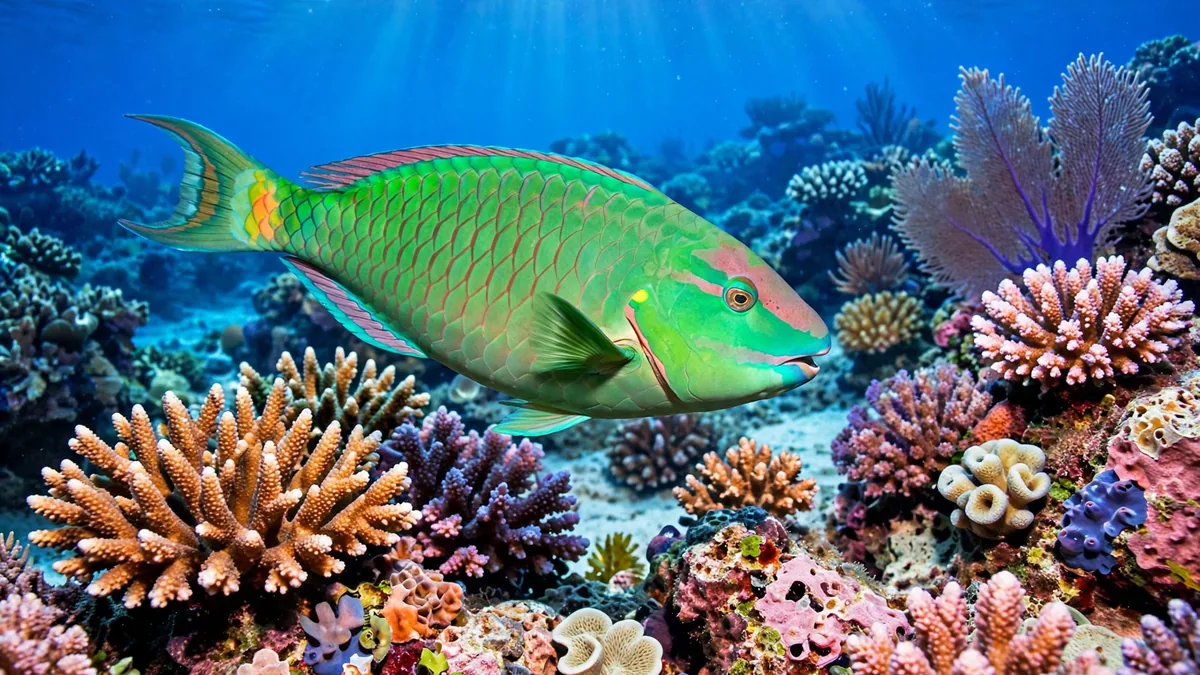
The parrotfish species are the gardeners of the coral reef, bright, beaked fish that spend their days scraping algae off the coral and, without meaning to, make the sand that tropical beaches are built from. If you are asking what a parrotfish is, the short answer is a member of the family Scaridae, a group of about 80 to 100 species found on tropical reefs all around the world, named for the hard beak formed by their fused teeth, which they use to scrape algae and fragments of dead coral from the reef and then grind in their throats. Most parrotfish are 30 to 60 centimetres long, the biggest, the bumphead parrotfish, reaches 1.3 metres and 46 kilograms, and a single large parrotfish can produce up to 800 pounds of fine white sand in a year, which is why so much of the sand on Caribbean beaches once passed through a parrotfish.
What makes parrotfish strange is not just the beak or the sand, but the way they live their lives. Many of them change colour as they grow, and many change sex as well, starting life as females and turning into brightly coloured males, so the same fish can look like two different species at different ages. At night, some of them wrap themselves in a bubble of mucus and sleep inside it, hidden from the moray eels that hunt by smell. This guide follows the family from the reef to the sand, through the stoplight parrotfish that leads it to the giant bumphead.
Key takeaways
- The parrotfish species belong to the family Scaridae, about 80 to 100 species of beaked grazers found on tropical reefs all around the world.
- Most parrotfish are 30 to 60 centimetres long, while the bumphead parrotfish reaches 1.3 metres and 46 kilograms, the largest of them all.
- Parrotfish scrape algae and dead coral from the reef with a beak of fused teeth, then grind it in their throats and release it as fine white sand.
- Many parrotfish change colour as they grow, and many change sex, starting life as females and turning into brightly coloured males.
- Most species are listed as Least Concern, but the bumphead parrotfish is Vulnerable, and several countries now protect parrotfish with fishing bans.
The parrotfish species and their relatives
Parrotfish belong to the family Scaridae, a group of reef fish that sits close to the wrasses, and some scientists treat them as a subfamily of the wrasse family Labridae rather than a family of their own. Parrotfish are believed to have evolved from within the wrasses, and the beak, the large scales and the bright colours are what set them apart. National Geographic puts the family at about 80 species, though some counts run to around 100, and they are divided among ten genera, of which Scarus is by far the largest, with about 53 species, followed by Chlorurus with about 18 and Sparisoma with about 15. The rest of the genera hold only one or two species each, including Bolbometopon, which holds a single fish, the bumphead.
The stoplight parrotfish, Sparisoma viride, is the lead species of this guide, and it is the parrotfish most divers meet first in the Caribbean. It is found on coral reefs from Florida and Bermuda through the Bahamas and the Caribbean Sea to Brazil, and it is a large, heavy-bodied fish that is typically 30 to 45 centimetres long but can reach up to 64 centimetres and 1.6 kilograms. Its name comes from the colours of the adult male, a green body, a yellow spot on the tail and a pinkish forehead, which reminded someone of a traffic light. If you have snorkelled a Caribbean reef and seen a big green fish crunching at the coral, there is a fair chance it was a stoplight parrotfish.

| Type | Animal | Where it lives | Best-known food | Length or Weight |
|---|---|---|---|---|
| Family | Parrotfishes (Scaridae) | Tropical reefs of the Atlantic, Pacific and Indian Oceans | Algae and coral | About 13 cm to 1.3 m long |
| Genus | Sparisoma parrotfishes (Sparisoma) | Reefs and seagrass beds of the Atlantic | Algae and coral | About 20 cm to 64 cm long |
| Species | Stoplight parrotfish (Sparisoma viride) | Caribbean and western Atlantic reefs | Algae and coral | About 30 cm to 64 cm long |
| Species | Rainbow parrotfish (Scarus guacamaia) | Caribbean and western Atlantic reefs | Algae and coral | Up to 1.2 m long |
| Species | Queen parrotfish (Scarus vetula) | Caribbean reefs | Algae and coral | About 50 cm to 61 cm long |
| Species | Bumphead parrotfish (Bolbometopon muricatum) | Indo-Pacific reefs | Live coral and algae | Up to 1.3 m long and 46 kg |
The closest relatives of the stoplight parrotfish are the other members of its genus, Sparisoma, a group of about 15 species that live in the Atlantic and are strongly tied to reefs and seagrass beds. The smallest of them is the bucktooth parrotfish, Sparisoma radians, which reaches only about 20 centimetres, while the stoplight is the largest of the genus at 64 centimetres. Some species scrape the surface clean, others bite deeper into the coral, and the stoplight is one of the excavators, the heavy biters that gouge into the reef and leave visible scars. Like the angelfish, the stoplight parrotfish is a bright reef fish that changes colour as it grows, but the angelfish is a small, disc-shaped fish of the reef face that picks at sponges and algae, while the stoplight is a big, heavy grazer that crunches coral and makes sand.
The wider family holds two fish that are worth knowing by name. The rainbow parrotfish, Scarus guacamaia, is the largest parrotfish in the Atlantic, growing to 1.2 metres, and it is a fish of green and orange with a blue beak that is now uncommon on many Caribbean reefs. The queen parrotfish, Scarus vetula, is usually about 50 centimetres long, with the largest reaching 61 centimetres, and the male is blue with green, red and orange markings while the female is reddish or purplish with a white stripe. At the other end of the family sits the bluelip parrotfish, Cryptotomus roseus, which reaches only about 13 centimetres, and the bumphead, which grows to 1.3 metres and 46 kilograms, though some sources report 1.5 metres and 75 kilograms.
What a parrotfish looks like
A parrotfish is a thick, heavy-bodied fish with large, obvious scales, a blunt head and a beak that looks like it belongs on a bird. Most parrotfish are 30 to 60 centimetres long, and the body is oblong and moderately compressed, deepest in the middle and tapering towards a tail that is rounded in young fish and becomes crescent-shaped in large males. The scales are large and heavy, set in neat rows over the head and body, and they give the fish an armoured look, as if it were wearing a coat of overlapping plates. The dorsal fin is continuous, with nine slender spines and ten soft rays, the anal fin has three spines and nine soft rays, and the colours are the first thing anyone notices: bright blues, greens, pinks and oranges that change completely as the fish grows.
The beak is the feature that gives the family its name, and it is a remarkable piece of engineering. Each fish has about a thousand teeth, lined up in about 15 rows that keep growing all its life, and the teeth are fused together into solid plates in each jaw, forming a hard, parrot-like beak that can scrape rock and bite into coral. The teeth are made of one of the hardest materials found in any living thing, and new rows grow in as the front ones wear down, so the beak is always sharp. Behind the beak, in the throat, sits a second set of teeth, the pharyngeal teeth, which grind what the beak has bitten off into a fine paste, and it is that grinding that turns coral into sand.

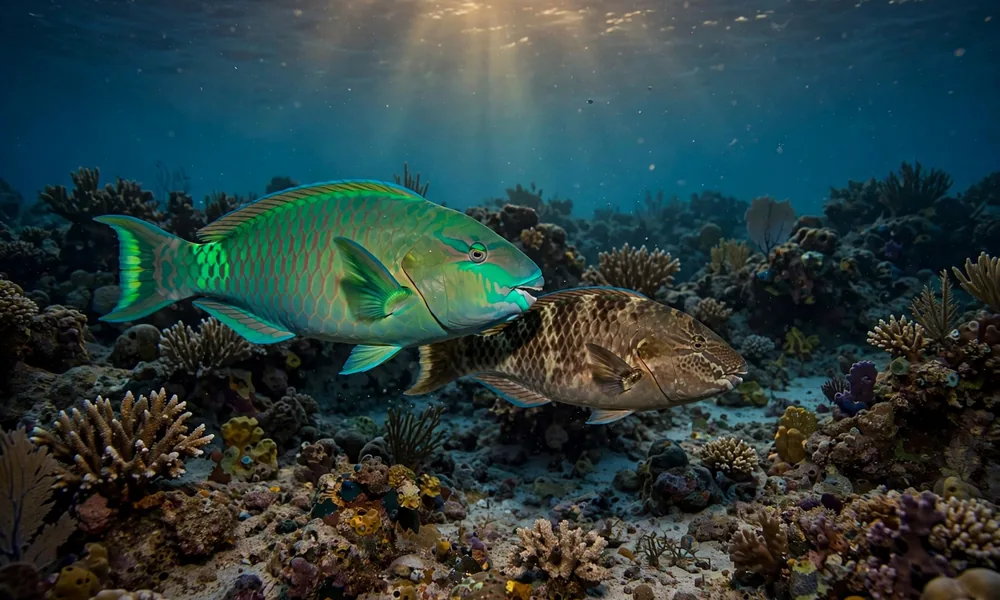
Colour is where parrotfish get confusing, because the same fish can wear three different outfits in its life. Young fish and females live in what scientists call the initial phase, and they are usually mottled brown, red or grey, with patterns that help them hide among the coral. When a female turns into a male, she enters the terminal phase, and the colours change completely: the stoplight male turns green with a yellow tail spot and a pink forehead, the queen male turns blue with green, red and orange, and the blue parrotfish turns solid blue as an adult. Males and females of the bumphead look alike, and juveniles are green-brown with five vertical white bands. Like the blue tang, the parrotfish is a reef fish that is recognised by its colour before anything else, but the blue tang is a thin, flat fish with a single yellow tail spine, while the parrotfish is a thick, heavy fish with a beak and a throat full of grinding teeth.
Where parrotfish live
Parrotfish live on tropical and subtropical reefs in the Atlantic, Pacific and Indian Oceans, and they are found wherever warm, shallow water meets coral. They thrive on sunlit reefs, usually between 1 and 30 metres deep, where the coral is dense and the algae plentiful, and some species go down to 80 metres. The Caribbean has some of the best-known parrotfish reefs, from the Mesoamerican Reef off Mexico and Belize to the Bahamas and Jamaica, and the family is just as common on the Great Barrier Reef, in the Red Sea and across the reefs of the Indo-Pacific. Wherever there is a healthy reef in warm water, there are parrotfish grazing on it.
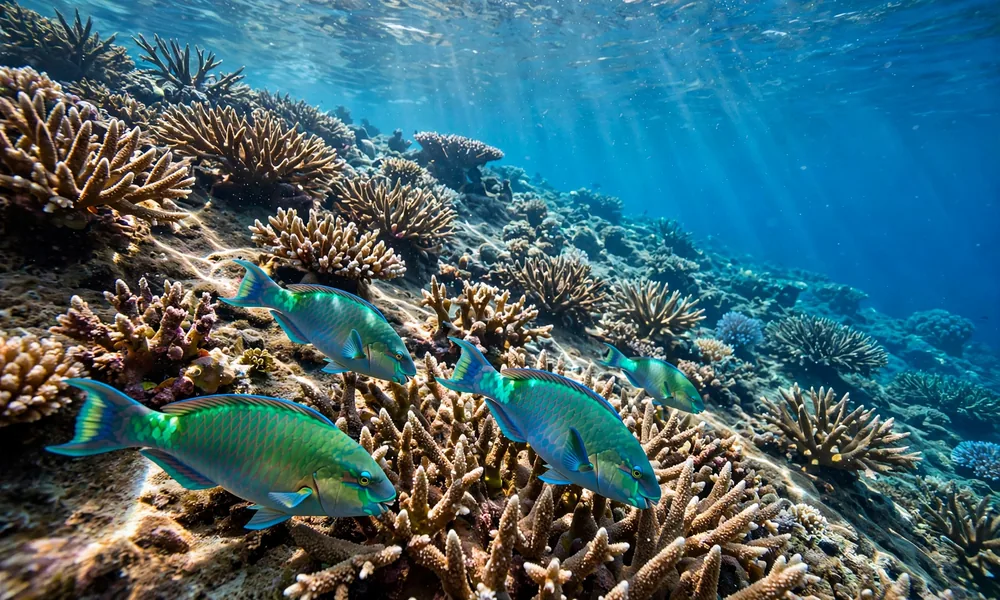
The habitat a parrotfish chooses is the reef itself, and different species divide the reef between them. The stoplight parrotfish is a fish of the reef face and the reef crest, where the coral is thickest, and it is normally found during the day at depths of 5 to 25 metres, though it can be found from 3 to 50 metres. The Sparisoma species are strongly tied to seagrass beds as well as reefs, and juveniles of many species hide among the seagrass and the rubble at the reef edge, where the small fish are safe from the predators that patrol the open reef. A parrotfish spends much of its life within a small stretch of reef, sometimes no larger than a few hundred metres.

Depth matters, but not in the way it does for a deep-water fish. Parrotfish are shallow-water animals, and most of them stay above 30 metres, where the sunlight reaches the algae they eat. The water temperature matters too: parrotfish need warm water, usually above 20 degrees Celsius, and they are absent from cold seas altogether. The stoplight parrotfish is found from southern Florida and Bermuda through the Caribbean to Brazil, and it also occurs along the eastern and western edges of the Gulf of Mexico. The parrotfish is a fish of place, tied to the reef it grazes, and it will spend its whole life within sight of the coral that feeds it.
What parrotfish eat
Parrotfish are grazers, and grazing takes up most of their waking hours. They eat the thin mat of algae and bacteria that grows on dead coral and rocks, along with seagrass, and a few of the larger species, above all the bumphead, eat living coral as well. They feed by biting at the reef with their beak, scraping the surface clean and taking a little of the coral with it, and then they grind what they have bitten off in their throat with the pharyngeal teeth, which separates the food from the rock. The rock is ground to a fine powder and passed out as sand, and it is that waste that builds the white beaches of the Caribbean and the Pacific.

The amount of sand a parrotfish makes is hard to believe until you see the numbers. A single large parrotfish can produce up to 800 pounds, about 360 kilograms, of sand in a year, and in some places up to 70 per cent of the white sand on the beach is ground-up coral that passed through parrotfish. Schools of parrotfish graze over a reef much like a herd of cattle over a grassy field, and in just one year one parrotfish may convert hundreds of pounds of coral into sand. Like the clownfish, the parrotfish is a reef fish that lives in close partnership with the coral, but the clownfish hides among the stinging tentacles of an anemone and eats what drifts past, while the parrotfish bites the reef itself and turns it into a beach.
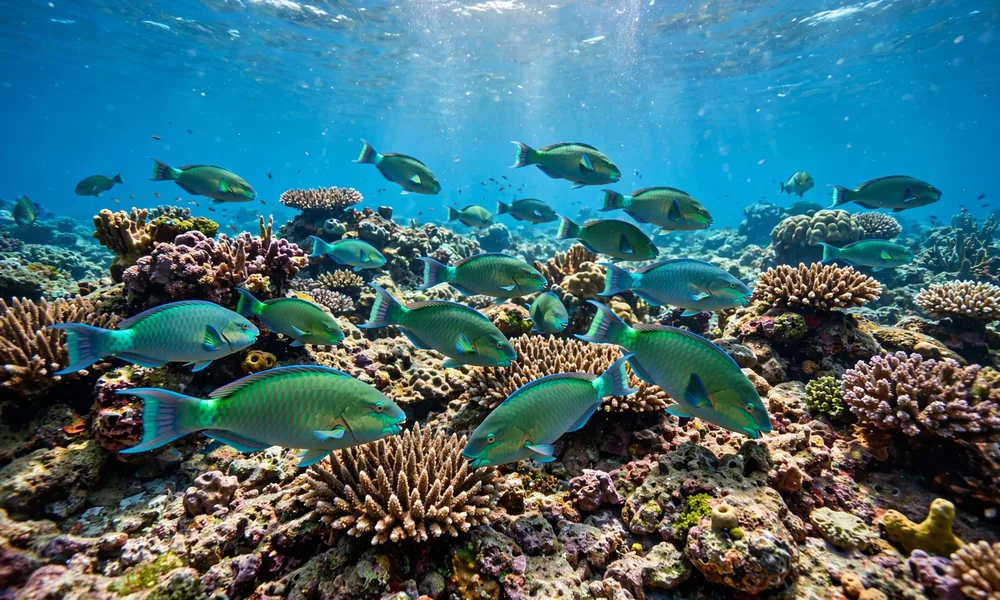
Feeding follows the rhythm of the day, and parrotfish feed almost all day long. They spend about 90 per cent of their waking hours snacking on algae, and they feed in schools of around 40 fish, sometimes in groups of several hundred. The schools move across the reef together, each fish taking its own bites, and the grazing keeps the algae in check so that the coral has room to grow. Without parrotfish, the algae would smother the coral and the whole reef would suffer, which is why the fish are called the gardeners of the reef. At night the feeding stops, the fish find a crevice or a hollow in the coral, and they settle down to sleep.
How parrotfish behave
Parrotfish are daytime fish, and their day is a slow, steady round of grazing, moving and grazing again. They wake at dawn, leave the crevice where they slept, and join the school on the reef, and they spend the day working across the coral in a loose group, never rushing, never chasing, each fish taking bite after bite from the reef face. They are social fish, and a school of 40 or more is common. When a predator passes, a parrotfish will often dart into the nearest coral head and wait, relying on its colours to break up its outline against the reef.
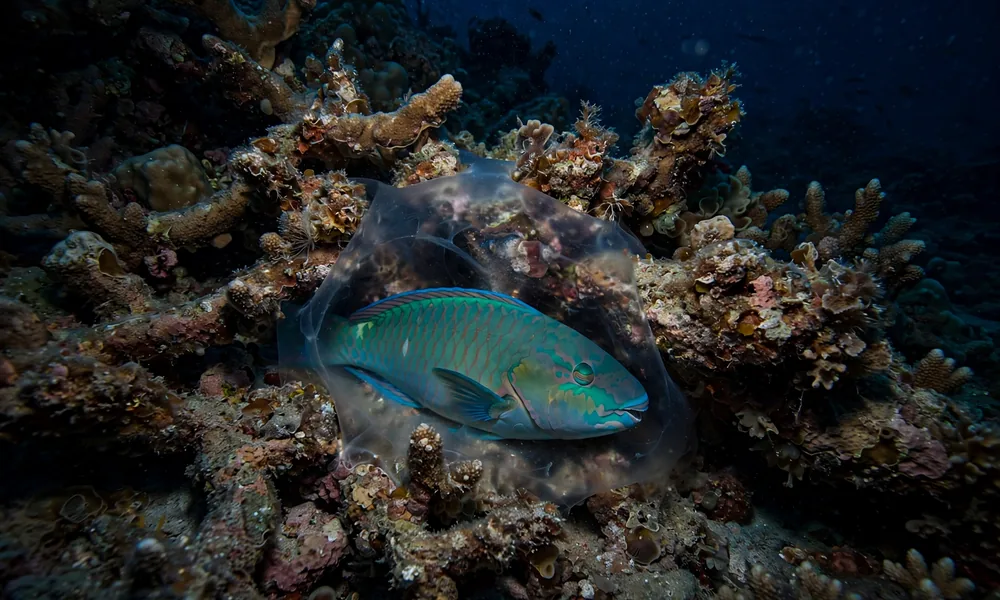
The most famous behaviour in the parrotfish is the night cocoon. Each night, certain species spend about an hour wrapping themselves in a near-invisible bubble of mucus, secreted from glands in the mouth, and they sleep inside it, tucked into a crevice in the coral. The cocoon is thought to hide the fish’s scent from moray eels and other predators that hunt by smell, and a predator that touches the bubble wakes the fish before it reaches the fish itself. In the morning the parrotfish swims out of the cocoon and leaves it behind, a faint, empty bubble drifting on the reef.
When a parrotfish is threatened, its first response is to flee, and it is a strong swimmer over short distances, fast enough to reach the nearest coral head before a predator closes in. Parrotfish have no venom and no bite that matters to a person, and their whole defence is built on being hard to see, hard to catch and hard to hold. The bumphead is the exception to the rule of flight: a big bumphead will stand its ground, and it uses the bump on its forehead to ram coral, breaking off chunks to eat, and it has been known to butt at divers who come too close. The rest of the family would rather swim away.
Breeding and life cycle
Parrotfish breed in the open water above the reef, and they do it in a way that is as strange as the rest of their lives. They are protogynous hermaphrodites, which means they first function as females and later transform into males, and the change is not just a matter of sex but of colour, size and behaviour as well. A young parrotfish starts life as a female in the initial phase, mottled and drab, and as she grows she may change into a terminal-phase male, brightly coloured and larger, who defends a territory and spawns with a group of females. In some species, including the stoplight parrotfish, some individuals develop directly into males without first being female, and these primary males usually look like initial-phase fish and spawn by sneaking into group spawnings.
Spawning itself is a group affair, and it usually happens at dusk, when the light is low and the predators are fewer. A group of females gathers with one or more males, and the fish rise together towards the surface, releasing eggs and milt into the water as they go. The eggs are small and buoyant, and they drift away on the current, hatching into larvae that float in the plankton for weeks before settling onto a reef as tiny juveniles. A large female can release thousands of eggs in a single spawning, but only a tiny fraction of the larvae survive the journey to the reef.
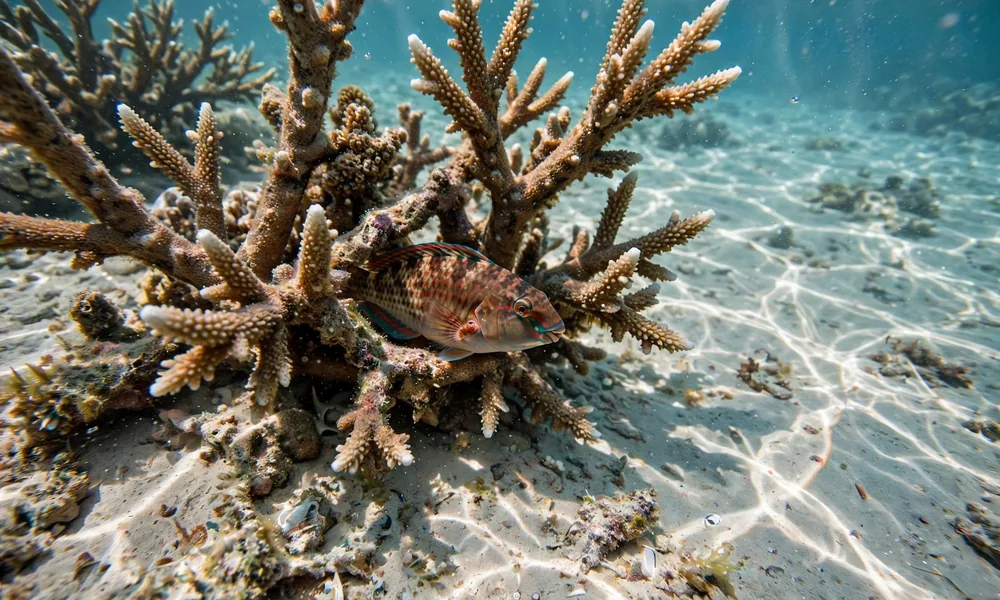
Growth is fast in the first year, and a young parrotfish can reach 10 to 15 centimetres by the end of its first summer, feeding on tiny invertebrates and algae before it turns to the reef itself. It reaches breeding size in its second or third year, when it is close to 30 centimetres long, and the average lifespan in the wild is up to 7 years, though the bumphead lives up to about 40 years and the stoplight parrotfish has been recorded living at least 9 years. The young are independent from the day they settle on the reef, able to feed and hide within hours.
Conservation status
The parrotfish family does not have a single conservation status, because the International Union for Conservation of Nature assesses each species separately, and the picture is mixed. Most parrotfish are listed as Least Concern, and they are still found in great numbers on reefs all around the world, but a few are in trouble: the bumphead parrotfish of the Indo-Pacific is listed as Vulnerable, hunted at night while it sleeps in groups, and the greenbeak parrotfish of Brazil is listed as Endangered. The rainbow parrotfish, once common in the Caribbean, is now uncommon on many reefs.

The main pressure is fishing. Parrotfish are caught in traps, nets and by spear, and they are commonly sold for food in the Caribbean and the Indo-Pacific, where a big parrotfish is a good meal. The bumphead is the most vulnerable of all, because it sleeps in groups in shallow water and whole schools can be taken by night spearfishers in a single visit. Habitat loss is a second pressure, because a parrotfish cannot live where the reef has been destroyed, and the loss of coral to bleaching, storms and coastal development takes the food and the shelter away at the same time.
The most useful conservation work is practical, and it is already happening in several places. Belize and other Caribbean countries now protect parrotfish with fishing bans, because the link between parrotfish grazing and reef health is now well understood: without the grazers, the algae takes over and the coral dies. Protecting the reef itself, from bleaching, pollution and destructive fishing, keeps the food and the shelter in place. A reef with plenty of parrotfish is a reef that can look after itself, and the fish are worth more alive on the reef than dead in a market.
Best seasons for parrotfish watching
The best time to look for parrotfish is any time of year, because the reef is warm all year round and the fish are always there, grazing in the shallows. In the Caribbean, the dry season from about December to April brings the calmest seas and the clearest water, which makes the fish easier to see. Parrotfish are present on the reef all year round, and they do not migrate, so there is no wrong season in the strict sense, but a calm, sunny day in the dry season will show you far more fish than a rough day after a storm.
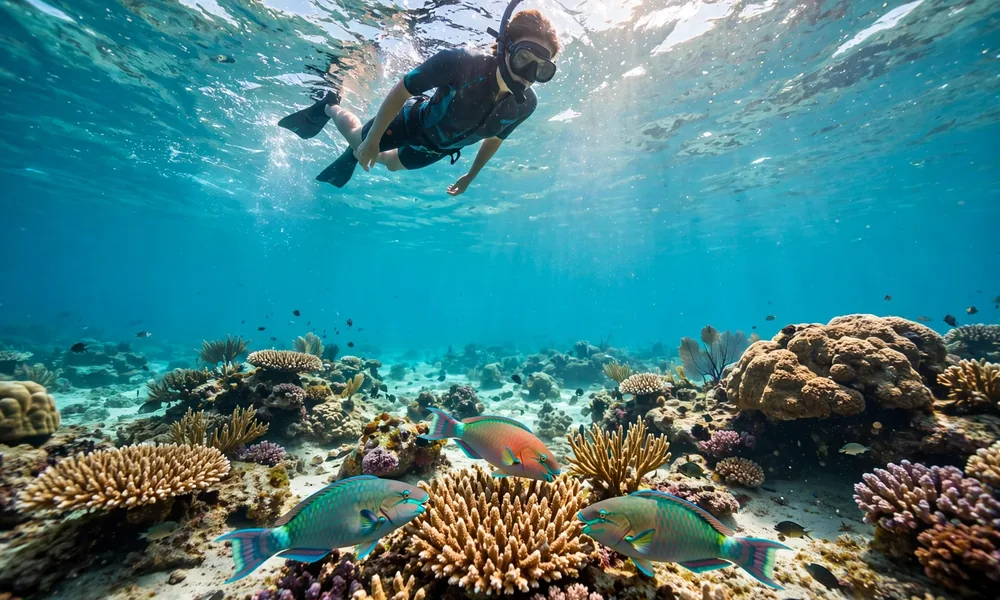
The best hours are the morning and the late afternoon, when the parrotfish are feeding actively and the light is good for seeing them. From about eight o’clock until eleven in the morning, and again from about three until five in the afternoon, the schools are out on the reef face, moving from coral head to coral head, and they are at their most approachable then. The bumphead is the exception: its schools gather in the early morning, so divers who want to see a herd should be in the water at first light. A slow swim over the reef, with the sun behind you and a mask that fits well, is all you need, and the fish will often come close enough to see the beak and the bright colours clearly, if you move gently and keep your distance.
Staying safe around parrotfish
A parrotfish is not dangerous to people, and there is no safety warning that belongs to the fish itself. It has no venom, it does not bite, and it will not chase or threaten a swimmer. The safety rules for watching parrotfish are the rules of the reef and the water: watch the water, watch the weather, and respect the fish that you came to see. Never stand on coral, never touch the reef, and never chase a fish into a crevice, because the reef is fragile and the fish need it intact.
There are a few practical points for the water itself. Snorkel with a buddy, stay within your depth, and keep an eye on the current, which can change fast on a reef, with waves rising in minutes. Wear a life jacket or a buoyancy vest if you are not a strong swimmer, and wear reef-safe sunscreen, because ordinary sunscreen damages the coral that the parrotfish feed on. One caution belongs to eating rather than watching: large reef fish, including some parrotfish, can carry ciguatera, a natural toxin that can make people ill. A parrotfish will not hurt you, but the reef can be hurt by you, and the sensible approach is to enjoy the fish and leave the coral as you found it.
Parrotfish watching checklist
A little preparation turns a morning on the reef into a real chance of seeing parrotfish at their best, grazing in the shallows in clear, warm water.
- A visit in the dry season, from about December to April, when the sea is calm and the water is at its clearest.
- A morning or late-afternoon swim, when the parrotfish are out feeding and the light is good.
- A healthy coral reef with branching corals and clear water, where the fish graze and shelter.
- A slow swim over the reef, watching for a flash of green or blue moving across the coral.
- A mask and snorkel that fit well, so you can watch the fish without surfacing every few seconds.
- A buddy and a buoyancy vest, so that a day on the water stays safe from start to finish.
- Respect for the fish and the reef, keeping your distance, never standing on coral, and leaving the reef as you found it.
Frequently asked questions
How big do parrotfish get?
Most parrotfish are 30 to 60 centimetres long, and the stoplight parrotfish is typically 30 to 45 centimetres, reaching up to 64 centimetres and 1.6 kilograms. The rainbow parrotfish grows to 1.2 metres, the queen parrotfish is usually about 50 centimetres with the largest reaching 61 centimetres, and the bumphead is the biggest of all at 1.3 metres and 46 kilograms, though some sources report 1.5 metres and 75 kilograms.
Do parrotfish really make sand?
Yes, and they make a great deal of it. A parrotfish bites algae and fragments of dead coral from the reef with its beak, grinds the material in its throat with its pharyngeal teeth, and passes the ground-up coral out as fine white sand. A single large parrotfish can produce up to 800 pounds, about 360 kilograms, of sand in a year, and in some places up to 70 per cent of the white sand on the beach is ground-up coral that passed through parrotfish.
Why do parrotfish change colour and sex?
Parrotfish are protogynous hermaphrodites, which means they first function as females and later transform into males, and the colour changes with the sex. A young fish starts life as a female in the initial phase, mottled brown, red or grey, and when she changes into a terminal-phase male the colours turn bright: the stoplight male turns green with a yellow tail spot, the queen male turns blue with green, red and orange, and the blue parrotfish turns solid blue.
Are parrotfish dangerous?
No, parrotfish are not dangerous to people. They have no venom, they do not bite, and they will not chase or threaten a swimmer, and their whole defence is built on being hard to see, hard to catch and hard to hold. The bumphead is the one exception to the rule of flight, and a big bumphead has been known to butt at divers who come too close. The safety rules for watching them are the rules of the reef itself: watch the water, watch the current, and never stand on coral.
Can you keep a parrotfish in an aquarium?
You can, but it is hard, and most people should not try. A parrotfish grows to 30 to 60 centimetres, it needs a very large tank with clean, well-oxygenated water, and it eats algae and coral, which makes it expensive and demanding to keep. The bumphead grows to 1.3 metres and is out of the question for any home tank, and a parrotfish that outgrows its tank must never be released onto a reef where it does not belong. A parrotfish belongs on a reef, not in a living room.
How is this guide different from the oarfish guide?
This guide covers the parrotfish, a bright reef fish of 30 to 60 centimetres that grazes algae from coral in warm shallow water, changes colour and sex as it grows, sleeps in a bubble of mucus and turns coral into sand, while our oarfish guide covers a deep-sea ribbon fish of about 3 metres that hangs upright in the open ocean, has no teeth at all and strains krill from the water. One is a gardener you meet on a sunny reef; the other is a silver ribbon you will almost certainly never see alive.
Conclusion
The parrotfish species are a reminder that the most important animals on a reef are not always the biggest predators. A bright, beaked fish that spends its day crunching coral has built the white sand of the Caribbean and kept the algae in check so the coral can grow, all while changing sex, changing colour and sleeping in a bubble of its own making.
If you go looking for one, go on a calm, sunny day in the dry season, go in the morning, and swim slowly over a healthy reef with the sun behind you. Find the flash of green or blue moving across the coral, watch the beak take its bite, and you will have met the gardener of the reef, the fish that eats the reef and gives it back as a beach.