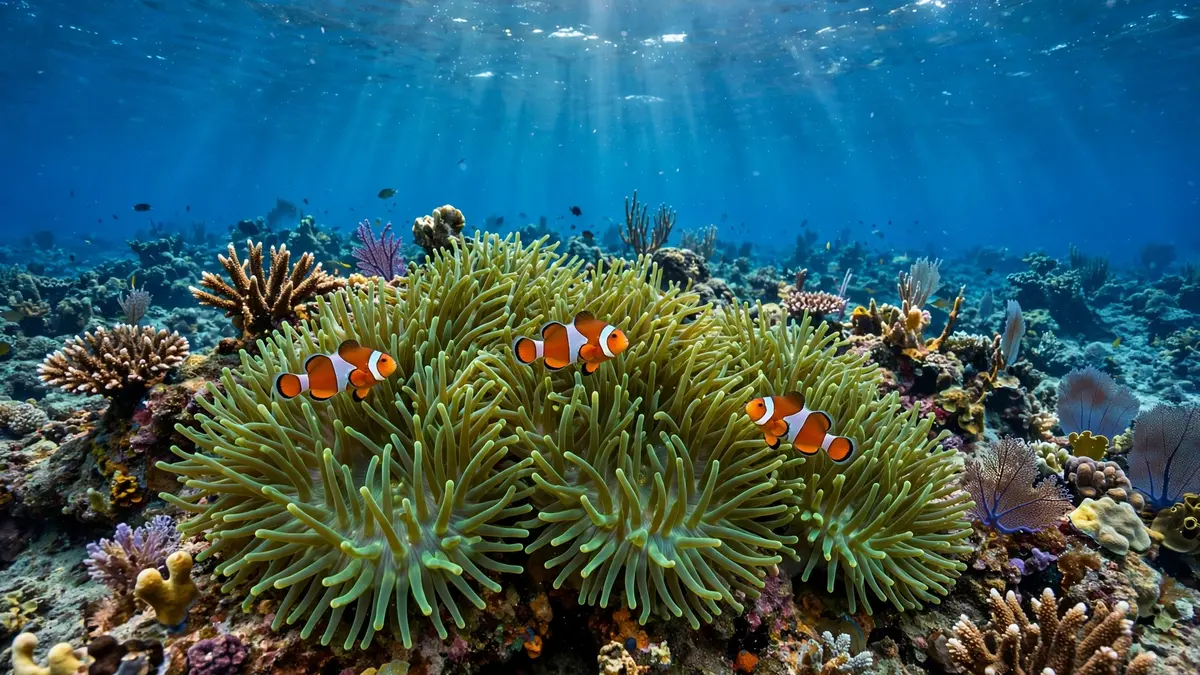
The clownfish species are thirty species, small bright orange fish that live among the stinging tentacles of sea anemones, where they are protected from predators and where they bring food to their host. If you are asking how many clownfish species there are, the answer is thirty: there are thirty recognised clownfish species in the world, grouped in two genera, and every clownfish alive today belongs to one of them.
The clownfish belongs to the damselfish family, Pomacentridae, and it is the only fish on Earth that lives permanently inside a sea anemone. Its bright orange body, its three white bars and its mucus coat that shields it from the anemone’s sting make it one of the most recognisable fish on Earth.
Key takeaways
- There are thirty clownfish species, in two genera, Amphiprion and Premnas, all living in the warm Pacific and Indian Oceans.
- Clownfish live inside sea anemones, and the fish and the anemone protect each other in a partnership.
- All clownfish are born male, and the largest fish in a group turns female when the old female dies.
- The common clownfish is the most familiar species, with three white bars and a bright orange body.
- Clownfish are not listed as threatened, but coral bleaching and aquarium collecting are the main risks to their future.
What makes a clownfish a clownfish
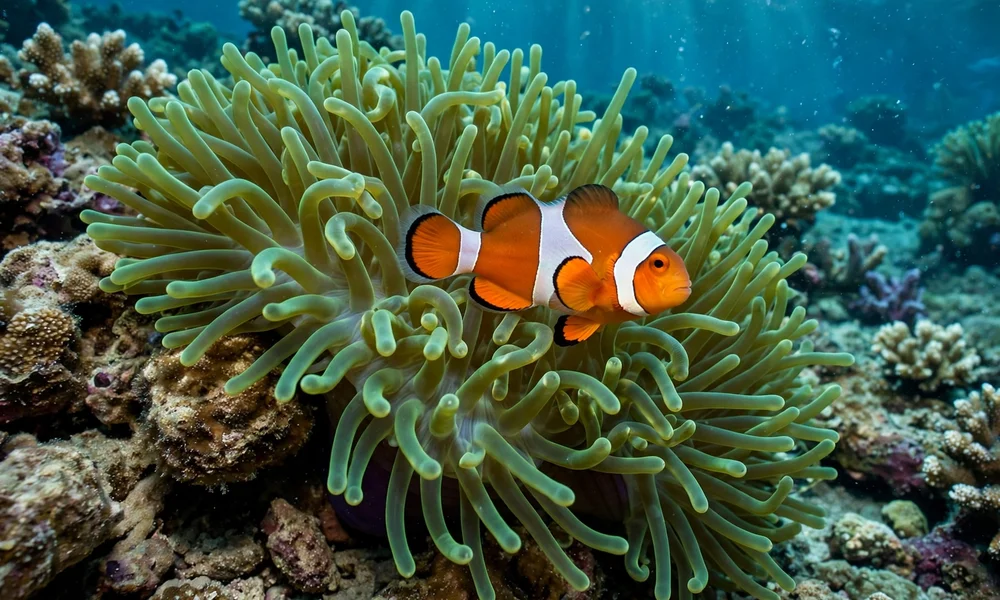
A clownfish is a small reef fish with a bright orange body, three white bars edged in black, and a mucus coat that protects it from the sting of its sea anemone. An adult measures roughly 7 to 11 centimetres long, and the female is usually larger than the male.
The anemone defines the clownfish: it lives inside the tentacles of a sea anemone, and the anemone’s sting, which would kill most fish, cannot hurt a clownfish, because the fish’s mucus coat hides its own smell. Its bright colours warn predators that the anemone is dangerous, and its small size lets it hide among the tentacles. Like other ocean animals, it depends on the reef, and it rarely swims more than a few metres from its anemone.
The clownfish species and their relatives
There are thirty clownfish species, in two genera: Amphiprion, with 29 species, and Premnas, with one species, the maroon clownfish. The common clownfish is the best-known species, and it lives in the warm waters of the eastern Indian Ocean and the western Pacific.
The maroon clownfish is the largest clownfish, with a deep red body and a single white bar, and it is the only species in its own genus. The ocellaris clownfish is the species made famous by the film Finding Nemo, and it lives in the same waters as the common clownfish. The pink skunk clownfish has a white stripe along its back, while the Clark’s clownfish has two white bars and a yellow tail. The damselfish is a close relative that also guards a small territory on the reef, and the blue tang is a blue reef fish that shares the clownfish’s coral home.
| Type | Animal | Where it lives | Best-known food | Length or Weight |
|---|---|---|---|---|
| Species | Common clownfish (Amphiprion ocellaris) | Indian and Pacific Oceans | Algae, zooplankton and anemone food | 7 to 11 cm |
| Close relative | Maroon clownfish | Western Pacific Ocean | Algae and zooplankton | Up to 17 cm |
| Close relative | Ocellaris clownfish | Eastern Indian and western Pacific | Algae and zooplankton | 7 to 11 cm |
| Close relative | Pink skunk clownfish | Western Pacific Ocean | Algae and zooplankton | 7 to 10 cm |
| Close relative | Clark’s clownfish | Indian and Pacific Oceans | Algae, zooplankton and small fish | 10 to 15 cm |
| Close relative | Damselfish | Tropical reefs worldwide | Algae and plankton | 5 to 15 cm |
| Close relative | Blue tang | Indian and Pacific Oceans | Algae | Up to 30 cm |
How clownfish live
Clownfish are creatures of the coral reef. A clownfish lives in a small group inside one anemone, with a single breeding female, a single breeding male and a few smaller males, and the group never leaves its host. Like other ocean animals, it depends on the reef, and it defends its anemone fiercely from intruders, even fish many times its size.
Algae and zooplankton make up most of the diet, along with undigested food from the anemone, and the clownfish eats by picking tiny morsels from the water and from the anemone’s tentacles. It also brings food to the anemone, dropping scraps into its tentacles, and the anemone’s waste feeds the algae that the clownfish eats. Clownfish are one of the few fish that change sex: all are born male, and when the breeding female dies, the largest male turns into a female.
Breeding happens all year round in the tropics, and the female lays her eggs on a flat rock close to the anemone, up to 1,000 eggs at a time. The male fans the eggs with his fins and guards them until they hatch, usually after six to ten days, and the tiny larvae drift in the open sea for a week or two before settling on a reef. Clownfish live for around 6 to 10 years in the wild, and longer in aquariums.
Where clownfish live
The clownfish lives in the warm shallow waters of the Indian and Pacific Oceans, from the Red Sea and the east coast of Africa to the islands of the western Pacific and northern Australia. It is most common on coral reefs, where sea anemones grow in the clear warm water, and it has spread to the Caribbean as an escaped aquarium fish. The common clownfish lives in the eastern Indian Ocean and the western Pacific, from the Andaman Sea to the Great Barrier Reef.
A sea anemone is the key requirement. A clownfish needs an anemone to live in, so it follows the anemones as they grow on the reef, and when the anemone dies or the reef is damaged the clownfish has nowhere to hide. It depends on the coral staying alive, like the anemone and the reef fish it shares its home with, and when the coral bleaches the anemones shrink and the clownfish lose their shelter.
The species are not listed as threatened, and their numbers are stable in most places. The main pressures are coral bleaching as the oceans warm, the collection of clownfish for aquariums, and the destruction of reefs by pollution and fishing. The common clownfish is common across its range, and it is bred in captivity in large numbers, which takes pressure off wild fish.
Best seasons for clownfish watching
There is no closed season, because clownfish are active all year round on the reef, but the best time to look for them depends on where you go. In the tropics the best months are often the dry season, when the sea is calm and the water is clear.
The dry season has its own rewards: the reef is at its brightest and the clownfish are easy to spot among the anemones, though the water is warm and the sun is strong. Good places to try include the Great Barrier Reef in Australia and the reefs of Indonesia and the Philippines.
Staying safe around clownfish
A clownfish is a wild fish with no sting and no bite worth fearing, and it cannot hurt a person, though it will nip a diver who puts a hand near its anemone. Keep your distance, never touch a clownfish or its anemone, and never try to catch one, because handling damages its mucus coat and leaves it open to the anemone’s sting. In clownfish country, watch from a short distance and use your eyes.
Admire from a distance, and never take a clownfish from the reef, because a wild clownfish belongs in its anemone.
Clownfish watching checklist
A little preparation turns a reef snorkel into a real chance of seeing a clownfish, so pack for sun, warm water and long quiet hours.
- A mask and snorkel that fit well, for watching a clownfish in its anemone without disturbing it.
- A camera with an underwater housing, because clownfish should always be watched from a short distance, never touched.
- Sun cream and a hat, because the best watching is in the sunny midday hours.
- Water and snacks for long days, because the best sightings come after hours of searching.
- A reef fish guide, for telling a common clownfish from an ocellaris at a glance.
- A plan to be out in the dry season, when the sea is calm and the water is clear.
- Patience and silence, because clownfish are shy fish and a noisy swimmer will send them into the anemone.
Frequently asked questions
How many clownfish species are there?
There are thirty clownfish species, in two genera: Amphiprion, with 29 species, and Premnas, with one species, the maroon clownfish. The common clownfish is the best-known species, and it lives in the eastern Indian Ocean and the western Pacific.
Why do clownfish live in sea anemones?
Clownfish live in sea anemones because the anemone’s stinging tentacles protect them from predators, and the clownfish brings food to the anemone and chases away fish that would eat it. Both animals benefit, and the partnership is one of the most famous in the sea.
Can clownfish change sex?
Yes. All clownfish are born male, and when the breeding female of a group dies, the largest male turns into a female. The change is permanent, and the new female is the largest fish in the group.
Can you keep a clownfish as a pet?
Yes, in many countries, but only a captive-bred clownfish from a breeder, never one taken from the reef, which harms wild populations. A pet clownfish needs a saltwater tank with an anemone or a substitute, clean water and live food, and it can live for 10 years or more. Wild clownfish belong on the reef.
How is this guide different from the axolotl species guide?
This guide covers thirty clownfish species, small orange reef fish that live inside stinging sea anemones, while our axolotl species guide covers the single axolotl species, a salamander that never leaves the water of one Mexican canal system. The clownfish lives on a coral reef in the sea, and the axolotl lives in a freshwater canal.
Are clownfish endangered?
Clownfish are not listed as threatened, so they are not classed as endangered, and their numbers are stable in most places. Coral bleaching and aquarium collecting are the main risks to their future.
Conclusion
The clownfish species show how much partnership one fish can hold: thirty species, with orange bodies and white bars, mucus coats that hide them from a sting, sex changes when the female dies, and lives spent inside a sea anemone on a coral reef. They are the most famous fish of the reef, and they have lived in the warm waters of the Indian and Pacific Oceans for thousands of years.
If you go looking for one, go in the dry season to the Great Barrier Reef or the reefs of Indonesia, go quietly, and go with patience. Watch a clownfish darting among the tentacles of its anemone and you will understand why it has earned its place as the little clown of the reef, and why keeping its coral alive matters most.