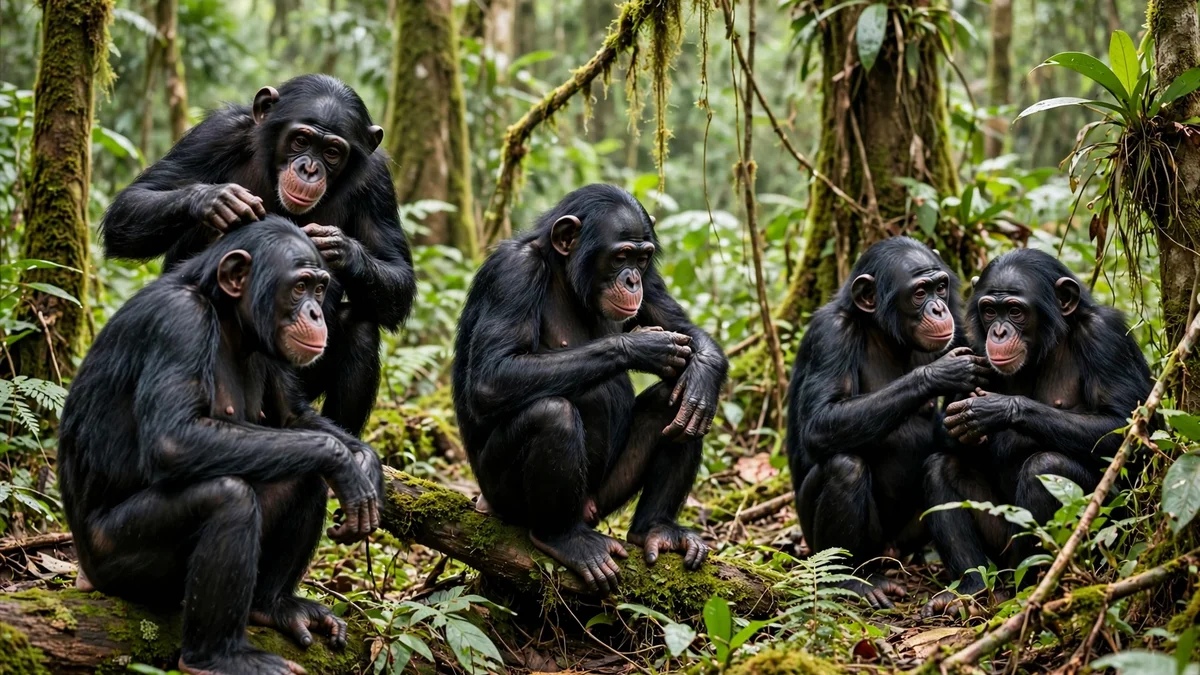
The bonobo species is a single species, Pan paniscus, a peaceful great ape of the Congo rainforest, and the only great ape whose society is led by females and whose conflicts are settled with grooming and play rather than fighting. If you are asking how many bonobo species there are, the answer is one: there is only one bonobo species in the world, and every bonobo alive today belongs to it.
The bonobo belongs to the great ape family, Hominidae, and it lives only in the rainforests south of the Congo River, in the Democratic Republic of Congo, where it has lived for hundreds of thousands of years. Its slender body, its dark face, its pink lips and its parted hair make it one of the most recognisable apes on Earth.
Key takeaways
- There is only one bonobo species, Pan paniscus, with a minimum of 15,000 to 20,000 animals left in the wild.
- Bonobos share 98.7 percent of their DNA with humans, and they are the closest living relatives of humans along with chimpanzees.
- Bonobo society is female-led, and females form strong bonds that keep the peace in the group.
- Bonobos eat mainly fruit, along with leaves, flowers, seeds and the occasional small animal.
- Bonobos are listed as Endangered, and hunting and habitat loss are the main threats to their future.
What makes a bonobo a bonobo
A bonobo is a slender great ape with a black face, pink lips, long legs and a parted hairdo, standing roughly 70 to 83 centimetres tall when upright and weighing between 30 and 45 kilogrammes, with females slightly smaller than males. It walks on its knuckles like a chimpanzee, but it also walks upright more often than any other ape.
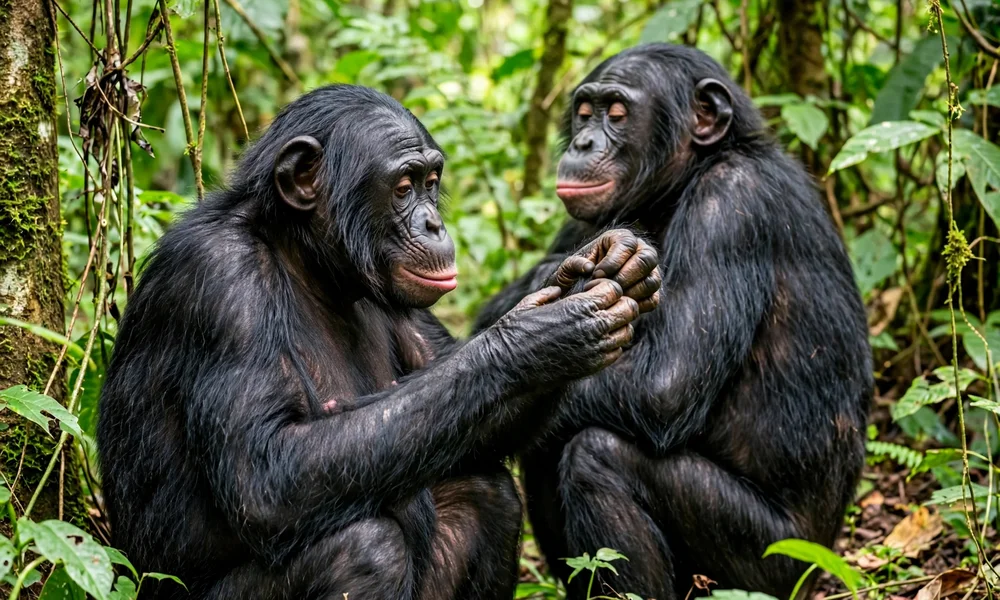
The peace defines the bonobo: it is the only great ape that settles conflicts with grooming, play and sex rather than with violence, and its groups are led by females who form close bonds and share food. Its long arms and legs let it swing through the trees, and its dark face and pink lips make it easy to tell from a chimpanzee. Like other chimpanzees, it uses tools and learns from watching others.
The bonobo species and its relatives
Pan paniscus is the only bonobo species, and it is not split into formally recognised subspecies. A 2024 study found that bonobos form three genetic lineages, but they are all the same species, and they live together in the rainforests south of the Congo River.
The common chimpanzee is the bonobo’s closest relative, and the two belong to the same genus, but the chimpanzee lives north of the Congo River and has a more aggressive, male-led society, while the bonobo is slimmer, more gracile and more peaceful. The gorilla is a much larger ape that lives in the same forests, and the orangutan, the gibbon and the siamang are Asian apes that share the bonobo’s love of fruit and trees. The human is the bonobo’s closest cousin of all, sharing 98.7 percent of its DNA.
| Type | Animal | Where it lives | Best-known food | Length or Weight |
|---|---|---|---|---|
| Species | Bonobo (Pan paniscus) | Rainforest south of the Congo River | Fruit, leaves and flowers | 70 to 83 cm, 30 to 45 kg |
| Close relative | Common chimpanzee | Central and West Africa | Fruit, leaves and meat | 70 to 96 cm, 40 to 60 kg |
| Close relative | Western lowland gorilla | Central Africa | Leaves, stems and fruit | 150 to 180 cm, 100 to 200 kg |
| Close relative | Bornean orangutan | Borneo | Fruit, leaves and bark | 120 to 140 cm, 50 to 90 kg |
| Close relative | Sumatran orangutan | Sumatra | Fruit, leaves and bark | 120 to 140 cm, 40 to 80 kg |
| Close relative | Lar gibbon | Southeast Asia | Fruit, leaves and flowers | 45 to 60 cm, 5 to 8 kg |
| Close relative | Human | Worldwide | Varied diet | 160 to 180 cm, 60 to 80 kg |
How bonobos live
Bonobos are creatures of the rainforest. A bonobo lives in a large group of 30 to 100 animals, splitting into smaller parties to feed during the day and coming together at night to sleep in nests high in the trees. Like other African animals, it follows the fruiting seasons, moving through the forest as different trees come into fruit.
Fruit makes up most of the diet, along with leaves, flowers, seeds, honey and the occasional small animal, and the bonobo eats by picking fruit from the trees and sharing it with others in the group. It also eats terrestrial herbs and the pith of stems, and it uses tools to reach food, cracking nuts with stones and fishing for termites with sticks. Bonobos are famous for their play: they wrestle, chase and groom each other for hours, and the females form strong bonds that keep the group peaceful.
Breeding happens all year round, and the female gives birth to a single baby after about eight months, carrying it on her belly for the first months and then on her back. The baby stays with its mother for four to five years, learning to find food and to live in the group, and it reaches adulthood at about 13 to 15 years. Bonobos live for around 40 years in the wild, and longer in captivity.
Where bonobos live
The bonobo lives only in the rainforests south of the Congo River, in the Democratic Republic of Congo, and nowhere else on Earth. It is most common in the lowland rainforest between the Congo and Kasai Rivers, where fruit trees are plentiful, and it has never crossed the Congo River to the north, where chimpanzees live. The bonobo is one of the most narrowly distributed great apes in the world, confined to a single country.
Rainforest is the key requirement. A bonobo needs tall trees to sleep in, fruit trees to feed from and thick forest to hide in, so it follows the fruiting trees as they come into season, and when the forest is cleared the bonobo has nowhere to live. It depends on the forest staying intact, like the chimpanzees and gorillas that share its home, and when the forest is logged the bonobos disappear. A minimum of 15,000 to 20,000 bonobos are estimated to live in the wild, but the true number may be higher.
The species is listed as Endangered, and its numbers are falling. The main pressures are hunting for bushmeat, the loss of forest to farming and logging, and the civil unrest that makes the forest hard to protect. Bonobos are protected by law in the Democratic Republic of Congo, and they live in several protected areas, including Salonga National Park, the largest tropical rainforest reserve in Africa.
Best seasons for bonobo watching
There is no simple watching season, because bonobos live in remote rainforest and are hard to reach even for experienced guides, and they move through the forest as the fruiting trees change. The best chance comes in the dry season, from about June to September, when the forest paths are passable and the bonobos are easier to find.
The dry season has its own rewards: the forest is at its most open and the bonobos are active in the morning, though they are shy and will flee if they sense a person. Good places to try include Salonga National Park and the Lomako Forest, always with a licensed guide and from a safe distance.
Staying safe around bonobos
A bonobo is a wild animal with strong arms and sharp teeth, and it can hurt a person, though bonobos are gentle and almost never aggressive. Keep your distance, never approach a bonobo, and never get between a mother and her baby, because a frightened mother can be dangerous. In bonobo country, watch from a safe distance and use your eyes.
Like other wild apes, bonobos can carry diseases that pass to people, and any bite or scratch should be washed at once and checked by a doctor without delay. Admire from a distance, and never feed a bonobo, because a fed ape becomes a danger to itself and to people.
Bonobo watching checklist
A little preparation turns a rainforest trek into a real chance of seeing a bonobo, so pack for heat, humidity and long quiet hours.
- Binoculars with good low-light performance, for picking a dark ape out of the green canopy.
- A camera with a long lens, because bonobos should always be watched from a distance, never approached.
- Sturdy boots and long trousers, because the forest floor is muddy and full of thorns.
- Water and snacks for long days, because the best sightings come after hours of searching.
- A licensed local guide who knows the forest, the bonobos and the safe routes.
- A plan to be out in the dry season, when the paths are passable and the bonobos are easier to find.
- Patience and silence, because bonobos are shy animals and a noisy group will send them away.
Frequently asked questions
How many bonobo species are there?
There is one bonobo species, Pan paniscus. A 2024 study found three genetic lineages within the species, but they are all the same species. No second bonobo species is recognised.
Why are bonobos called the peaceful ape?
Bonobos are called the peaceful ape because they settle conflicts with grooming, play and sex rather than with fighting, and their groups are led by females who form close bonds. Bonobos almost never kill each other, unlike chimpanzees, whose males fight for dominance.
How much DNA do bonobos share with humans?
Bonobos share 98.7 percent of their DNA with humans, the same as chimpanzees. Humans, bonobos and chimpanzees all descend from a common ancestor that lived about six million years ago.
Can you keep a bonobo as a pet?
No. A bonobo is a wild animal that needs rainforest, fruit trees and a large social group, and it is fully protected by law in the Democratic Republic of Congo. Bonobos in zoos need huge enclosures with trees and climbing frames, and they are not pets.
How is this guide different from the king cobra species guide?
This guide covers the single bonobo species, a peaceful great ape of the Congo rainforest with a female-led society, while our king cobra species guide covers four king cobra species, the world’s longest venomous snakes that eat other snakes and build nests. The bonobo lives in trees and eats fruit, and the king cobra lives on the forest floor and hunts snakes.
Are bonobos endangered?
Bonobos are listed as Endangered, so they are classed as endangered. A minimum of 15,000 to 20,000 bonobos remain in the wild, and hunting and habitat loss are the main threats.
Conclusion
The bonobo species shows how much peace one ape can hold: Pan paniscus, with female-led groups, grooming that settles every quarrel, fruit shared freely, and a life spent in the rainforest south of the Congo River. It is the gentlest of the great apes, and it has lived in the forests of the Congo for hundreds of thousands of years.
If you go looking for one, go in the dry season to Salonga National Park, go with a licensed guide, and go with patience. Watch a bonobo group grooming in the trees and you will understand why it has earned its place as the peaceful ape, and why keeping its rainforest matters most.