The lemon shark species is the yellow shark of the shallows, a broad-headed, calm-tempered animal that spends its life in warm, shallow water close to shore. If you are asking what a lemon shark is, the short answer is Negaprion brevirostris, a requiem shark 2.4 to 3 metres long and weighing 90 to 130 kilograms, coloured yellow-brown on its back and pale underneath, with two dorsal fins of almost equal size. It lives in mangrove lagoons, sandy bays and coral reefs on both sides of the Americas, it gathers in small social groups, and it has been studied at Bimini in the Bahamas for longer than almost any other shark on earth.
Most people meet the lemon shark through a photograph of a juvenile in a mangrove nursery, a small yellow shark nosing between the roots in water as clear as glass. The adult is a different animal in scale but not in temper: a large shark that behaves like a gentle one, cruising slowly over sand flats in the daytime and letting divers swim close without the nervous darting you see in most sharks. That calm has made it a favourite of researchers, and we now know more about how lemon sharks grow, learn and choose their friends than we know about almost any other shark.
Key takeaways
- The lemon shark species is Negaprion brevirostris, a yellow-brown requiem shark 2.4 to 3 metres long and weighing 90 to 130 kilograms.
- It lives in shallow tropical and subtropical waters on both sides of the Americas, from New Jersey to southern Brazil and from the Gulf of California to Ecuador.
- Juveniles spend their first years in mangrove nurseries, and females return to the nursery where they were born to give birth to 4 to 17 pups.
- It is one of the most social sharks, forming groups and preferring familiar companions, a habit revealed by decades of research at Bimini in the Bahamas.
- The species is listed as Vulnerable by the International Union for Conservation of Nature, with numbers falling across much of its range.
The lemon shark species and its relatives
Lemon sharks belong to the family Carcharhinidae, the requiem sharks, a large family of warm-water sharks with rounded snouts, and to the genus Negaprion, which holds just two species: the lemon shark of the Americas and the sicklefin lemon shark of the Indian and Pacific Oceans. The scientific name, Negaprion brevirostris, was given by the Cuban zoologist Felipe Poey in 1868, and the common name is simply a description. The shark is yellow, or yellow-brown, on its back, fading to a pale yellow belly, and in shallow sunlight the colour is unmistakable. No other shark in its home waters looks quite like it.
The genus Negaprion is a small one, and the two lemon sharks are easy to tell apart once you know where you are. The sicklefin lemon shark, Negaprion acutidens, lives in the Indian and Pacific Oceans, from East Africa to Australia and French Polynesia, and it grows larger than its American cousin, to about 3.8 metres, with more strongly curved fins. The two never meet in the wild: a lemon shark in the Bahamas or off Florida is always Negaprion brevirostris, and one in Australia is always the sicklefin.

| Type | Animal | Where it lives | Best-known food | Length or Weight |
|---|---|---|---|---|
| Family | Requiem sharks (Carcharhinidae) | Warm seas and coasts worldwide | Fish, squid and crustaceans | About 1 m to 5 m long |
| Genus | Lemon sharks (Negaprion) | Warm Atlantic and Indo-Pacific seas | Fish, rays and crustaceans | About 2.4 m to 3.8 m long |
| Species | Lemon shark (Negaprion brevirostris) | Shallow warm waters of the Americas | Fish, rays and crustaceans | About 2.4 m to 3.4 m long, 90 kg to 130 kg |
| Species | Sicklefin lemon shark (Negaprion acutidens) | Shallow warm waters of the Indo-Pacific | Fish, rays and crustaceans | Up to about 3.8 m long |
| Species | Bull shark (Carcharhinus leucas) | Warm coasts, rivers and lakes worldwide | Fish, sharks, rays, turtles and dolphins | About 2.1 m to 3.5 m long, 90 kg to 230 kg |
| Species | Blacktip reef shark (Carcharhinus melanopterus) | Shallow reefs of the Indo-Pacific | Small fish and squid | About 1.6 m to 2 m long |
The bull shark is the lemon shark’s stocky cousin, and the comparison shows how much temperament can vary inside one family. A bull shark grows 2.1 to 3.5 metres long and weighs 90 to 230 kilograms, with a blunt snout and a reputation for boldness in murky river mouths, and it will swim far up rivers into fresh water. The lemon shark stays in the sea, stays in the shallows, and stays calm. Put the two side by side and the difference is obvious: the bull shark is thick through the shoulders and grey, built for power, while the lemon shark is slimmer, yellower, and slower in its movements.
The blacktip reef shark is a smaller, quicker relative, about 1.6 to 2 metres long, a nervous shark of coral reefs that usually flees from divers at the first sign of trouble. The lemon shark does the opposite. It holds its ground, it circles slowly, and it comes back to look again. That difference in temper is not a small thing. It is the reason researchers can work with lemon sharks in a way they cannot work with most sharks, tagging the same animals year after year, following pups from birth to adulthood, and learning how a shark’s life actually unfolds. The tiger shark is another relative worth knowing, a much larger animal, up to about 5 metres long, with dark stripes and a habit of eating almost anything, from turtles to seabirds. Next to a tiger shark, the lemon shark looks like a quiet neighbour, and in a way it is.
What a lemon shark looks like
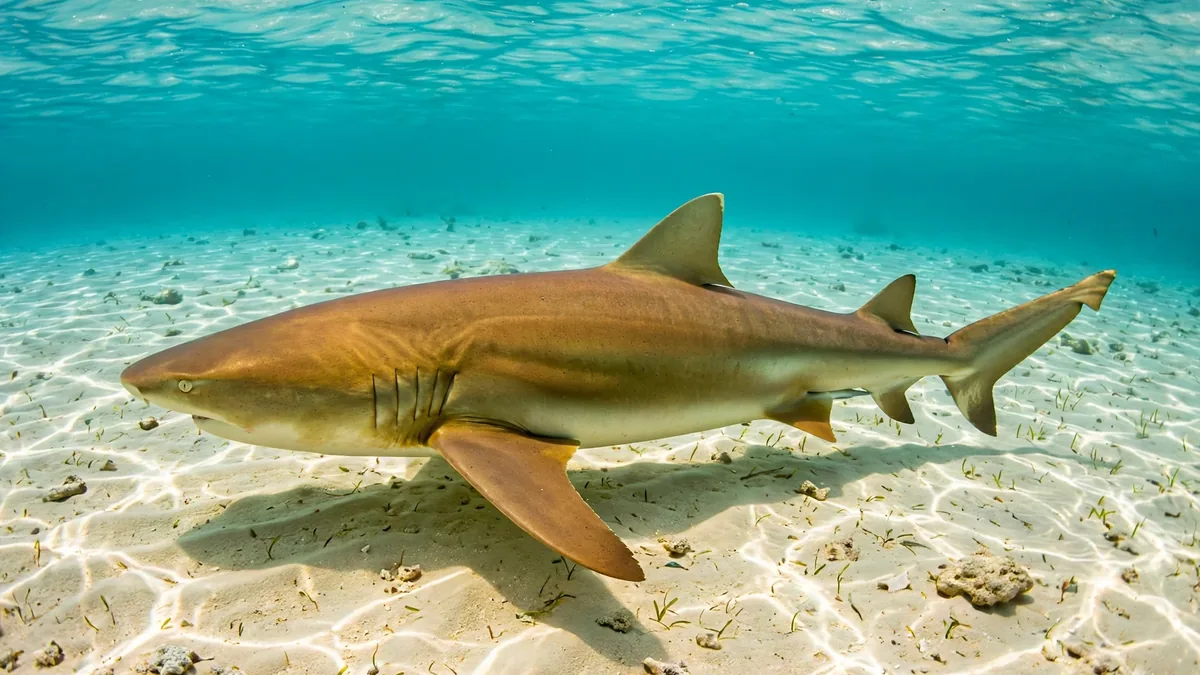
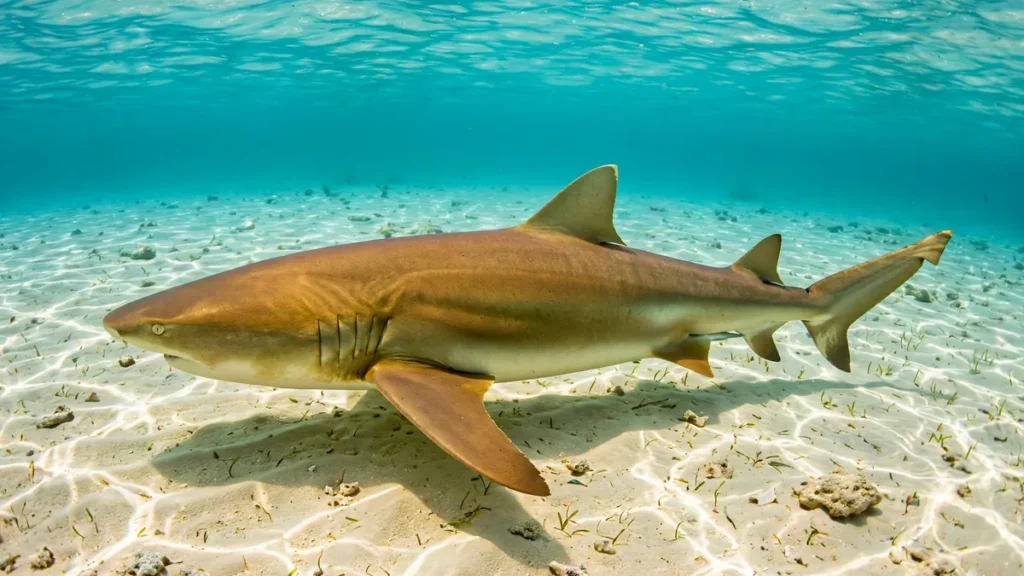
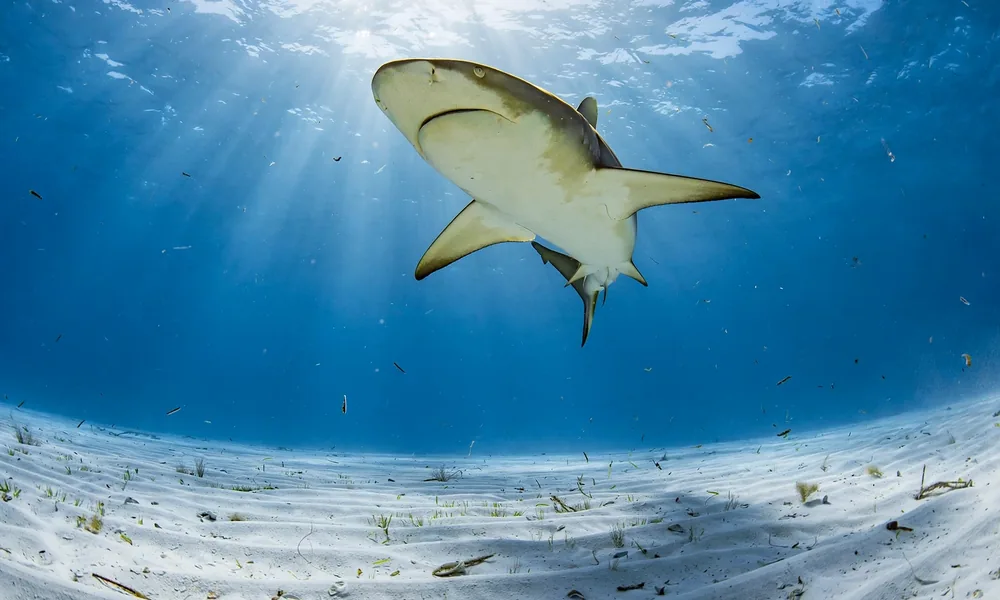
A lemon shark looks like a shark that has been dipped in pale yellow paint. The back is yellow-brown, sometimes olive, and the colour fades down the flanks to a pale yellow or white belly, a two-tone pattern that hides the shark from above, where it blends with the sand, and from below, where it blends with the bright surface. The body is stocky but not heavy, with a broad, flat back and a belly that looks full rather than swollen, and the whole animal moves with a slow, steady stroke that suits its life in water only a few metres deep. Most adults measure 2.4 to 3 metres long, and they weigh 90 to 130 kilograms, though a very large female can reach 3.4 metres, and the heaviest fish on record weighed close to 184 kilograms.
The head is the feature that gives the shark away. It is short, wide and blunt, with a rounded snout that looks almost square from above, and small, dark eyes that seem too small for the size of the head. The mouth is broad and full of teeth, and the teeth are narrow and slightly curved, built for gripping fish rather than for cutting through flesh and bone. There is one feature that identifies a lemon shark faster than any other, and it is the second dorsal fin. In most sharks the second dorsal fin is much smaller than the first, but in a lemon shark the two are almost the same size, and the second sits well back on the body, over the anal fin. Once you have seen it, you cannot mistake the animal for anything else.
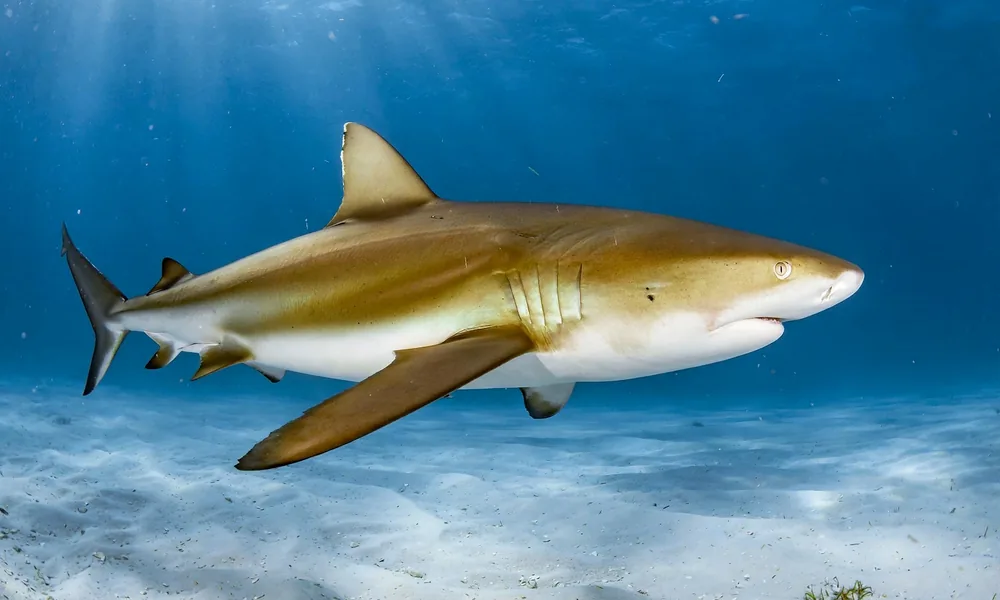
As the animal ages, the body thickens, the back darkens towards olive-brown, and old sharks often carry scars: bite marks from other sharks, scrapes from the bottom, and the nicks and cuts of a life spent in shallow, crowded water. Females grow slightly larger than males, but the difference is modest, and the biggest individuals in any population are old females. In deep water the yellow fades to grey, and in bright shallows it glows, so a shark that looks golden over white sand can look dull brown over a dark reef, which is exactly what camouflage should do.
Where lemon sharks live
Lemon sharks live on both sides of the Americas, in a band of warm water that runs through the tropics and subtropics. In the western Atlantic the range runs from New Jersey, where they appear only in summer, down the whole coast of the south-eastern United States to Florida, around the Gulf of Mexico to Texas and Mexico, through the Bahamas and the Caribbean islands, and along South America to southern Brazil. In the eastern Pacific the range runs from the Gulf of California and Baja California south to Ecuador. A small population also lives in the eastern Atlantic, off Senegal and the Ivory Coast, a reminder that the species once ranged more widely than it does today.

The habitat a lemon shark chooses is shallow, warm and sheltered, and that is what makes it different from most sharks. It likes water less than 30 metres deep, close to shore, in mangrove lagoons, enclosed bays, sandy flats and coral reefs, where the water is warm and the food is plentiful. It has been recorded down to about 92 metres, but that is the exception, not the rule. The lemon shark is a shark of the edge, where the land meets the sea, and it is happiest where a diver can stand on the bottom and look it in the eye. It does not travel far into fresh water the way a bull shark does, and it stays in the sea, close to the coast, for its whole life.
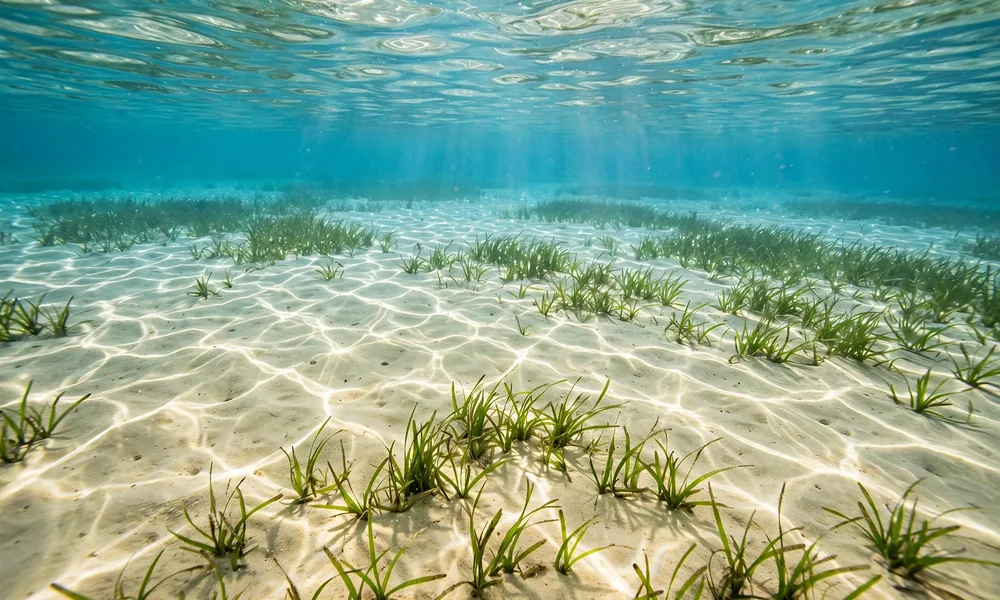
The mangrove nursery is the heart of the story. A female lemon shark returns to the mangrove lagoon where she was born, often the very channel where she spent her own first years, and she gives birth there in shallow water among the roots. The pups stay in the nursery for their first two to three years, rarely straying more than a kilometre or two from the spot where they were born, feeding on small fish and crustaceans among the roots and learning to avoid the larger sharks that patrol outside. The mangroves give them food, shade and hiding places, and the shallow water keeps the big sharks out. When the pups are big enough, they move out onto the nearby seagrass flats, and from there, years later, they join the adult population on the reefs.
The range is set by temperature as much as by water. Lemon sharks stay in water warmer than about 20 degrees Celsius, and they follow the warm currents as the seasons change, moving north in summer and south in winter. Adults roam further, and a single shark may travel hundreds of kilometres along a coast in a year, but most of them come home, and the tagging work at Bimini has shown the same females returning to the same mangrove channel year after year.
What lemon sharks eat
Lemon sharks are generalist hunters with a steady appetite, and they eat the fish of the shallows. The everyday diet is bony fish: mullet, jacks, croakers, catfish, porcupine fish and cowfish, and any other schooling fish that comes within reach in the clear water of a bay. They also eat rays, including stingrays, guitarfish and eagle rays, which they pin to the bottom and crush, and they eat crustaceans such as crabs and crayfish, and occasionally other small sharks. They are not fussy eaters, and like most sharks they will take carrion when they find it, but the heart of the diet is fish, and the hunting is done in daylight, in water shallow enough to see the bottom.
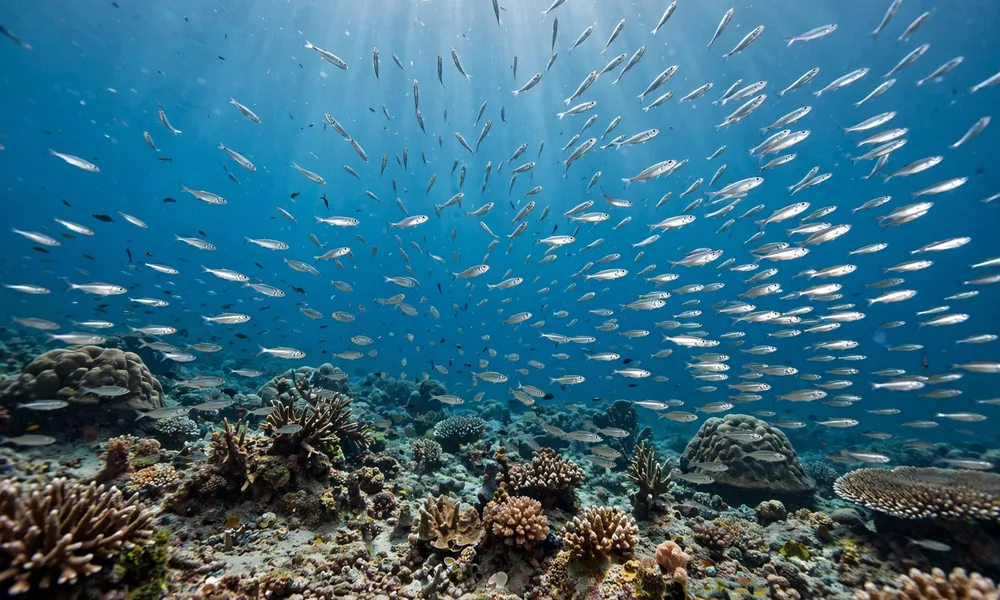
The hunting style is a mix of patience and sudden speed, and it is built around the animal’s eyesight in clear water. A lemon shark will cruise slowly over a sand flat, watching the fish below, and then it will strike in a short, powerful burst, seizing the fish in its jaws and shaking it. Laboratory work at Bimini has measured the strike at an acceleration of about 8 metres per second squared, faster than a family car pulling away from a standstill. The burst is short, though, and if the first rush misses, the shark usually gives up and goes back to cruising.
Young lemon sharks eat smaller food than adults do, because they hunt in the nursery where the prey is small. A pup in a mangrove lagoon will eat small fish, shrimps and crabs among the roots, and it will learn to hunt by watching the other pups and by trial and error. Adults eat bigger prey, and a big lemon shark on a sand flat may take a large fish, a ray or a crab in a single meal. Like the shark family as a whole, the lemon shark is an opportunist first and a specialist second, and it takes what the water offers.
Feeding is tied to the tide and to the time of day. Lemon sharks feed most in the morning and the late afternoon, when the light is good and the fish are moving, and they feed hard on a rising tide, when the water brings fresh fish into the lagoon and the bay. In the middle of the day they often rest, cruising slowly or lying on the bottom in a group. A lemon shark that has fed well can go for days without another meal, and it will not waste energy chasing prey it cannot catch.
How lemon sharks behave
Lemon sharks are among the most social sharks in the sea, and that one fact sets them apart from almost every other shark. Most sharks are solitary, meeting only to mate, but lemon sharks gather in small groups, rest together on the bottom, and cruise the same flats day after day in the company of the same animals. The groups are not random crowds. Work at the Bimini Biological Field Station has shown that juvenile lemon sharks prefer the company of familiar individuals over strangers, choosing to swim with sharks they know, and that the groups have a structure, with some animals bolder and some more cautious, and with the same animals together again and again.
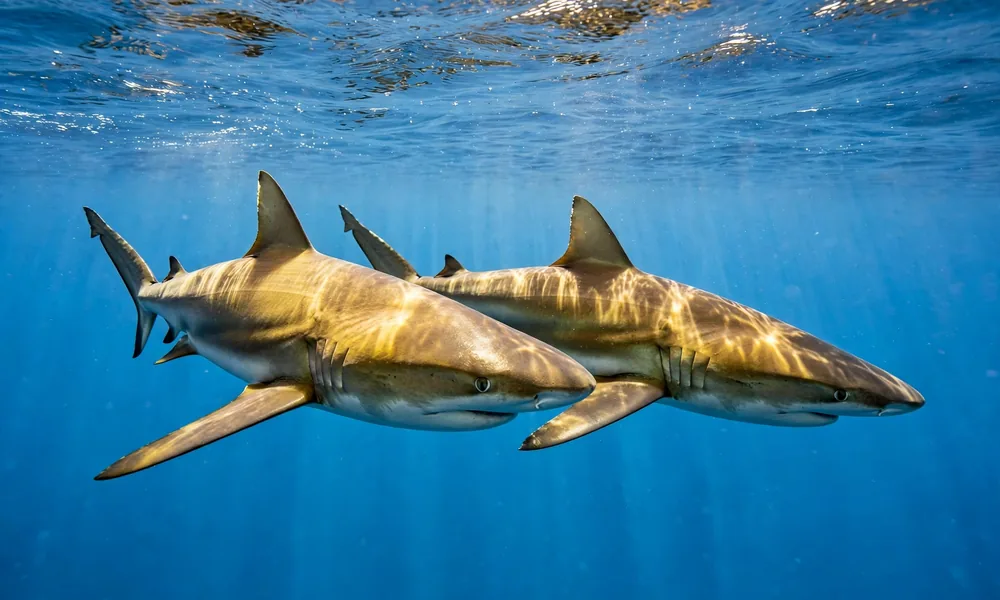
The behaviour that has made the lemon shark famous among researchers is its calm. Most sharks flee from people, but a lemon shark will often hold its ground, circle slowly, and come closer to look. It is not fearlessness. The shark is testing what it has found, the way it tests anything new in the water, and it does it slowly, with its eyes rather than its mouth. That is why bites are rare, and why the bites that do happen usually involve a diver or an angler who provoked the animal. A lemon shark that is left alone is a calm shark, and a calm shark is a shark you can watch.
Lemon sharks are also famous for what they have taught us about learning. At Bimini, researchers have trained lemon sharks to solve simple problems, to remember where food is hidden, and to tell one shape from another, and the sharks have learned quickly and remembered for months. Young sharks learn from watching older ones, and that capacity for learning is unusual in a fish, and it is one of the reasons the lemon shark has become the standard animal for studying how sharks think. It is not a mindless eating machine. It is an animal that watches, remembers and chooses.
Breeding and life cycle
Lemon sharks breed in the warm months, usually from late spring through the summer, when the water is warm and the fish are plentiful. Mating happens in shallow water, often near the same nursery grounds where the females will later give birth, and it is a rough affair: the male follows the female, nudges her, and bites her on the pectoral fin and flank to hold her during mating, and the female may carry the scars for months afterwards. Mating lasts only a few minutes, after which the two go their separate ways, and the female carries the pups for about 10 to 12 months before she gives birth. Females breed only every other year, which is one reason the species recovers slowly when numbers fall.

The female gives birth to live pups, usually 4 to 17 of them, in a shallow, sheltered nursery area: a mangrove lagoon, an enclosed bay or a quiet creek, where the water is warm, the food is small, and the big sharks stay out. The pups are born fully formed, about 60 to 65 centimetres long, and they can swim and hunt from the day they are born. There is no care after birth. The mother swims away, and the pups are on their own, feeding on small fish and crustaceans in the shallows and learning to avoid the larger sharks, including their own kind, that would eat them. The first year is the hardest, and as many as half of the pups may not survive it.

The pups stay in the nursery for two to three years, growing slowly on the small fish and crustaceans of the shallows, and they move out onto the nearby seagrass flats only when they are big enough to look after themselves. Growth is slow at first, about 5 centimetres a year in the nursery, and it slows further with age, and a lemon shark reaches breeding size at about 11 to 13 years old for males and 12 to 16 years old for females, when it is close to full length. The sex of a pup is set by its genes, not by the temperature of the water, which is one way sharks differ from turtles and crocodiles, and the ratio of males to females is roughly even.
A lemon shark that survives its first years can live a long time: 27 years or more in the wild is a fair estimate, and the Bimini work suggests some animals live into their late thirties. The first years are the dangerous ones, when the pups are small enough to be eaten by larger sharks, by barracuda, and by the big fish of the reef. The ones that survive grow into animals that few things will challenge, and a full-grown lemon shark has almost no natural enemies except people, and the occasional very large shark. The long childhood is the price of the long life, and it is also the reason the species is slow to recover when the nurseries are damaged.
The return to the nursery is the last great event of the cycle. A female lemon shark that was born in a particular mangrove channel will come back to that same channel, fifteen or twenty years later, to give birth to her own pups, and the tagging records at Bimini show it happening again and again. That homecoming, called natal philopatry, means the nurseries are not interchangeable. Lose one mangrove lagoon, and you lose the birthplace of a whole line of sharks.
Conservation status
The lemon shark is listed as Vulnerable by the International Union for Conservation of Nature, and the reasoning is straightforward: it has a large range, it is still common in a few places, but its numbers are falling in most of them, and its life makes it fragile in ways that are easy to miss. A shark that takes 12 to 16 years to start breeding, and gives birth to only a few pups every other year, cannot replace lost adults quickly, and a nursery that is damaged takes years to recover. The assessment, last reviewed in 2021, found a decreasing population.

The main pressure is fishing. Lemon sharks are caught for their meat, for their fins, and as bycatch in nets set for other fish, and because they live in shallow water close to shore, they are easy to catch. In the eastern Atlantic, off West Africa, they have been virtually wiped out from much of their former range, and they have been heavily depleted in the Gulf of Mexico and along most of the coastline of South America. The only region where they appear stable is the Bahamas and some parts of the Caribbean, where they are protected. Habitat loss is the second pressure, as mangroves are cleared for building and farming, cutting the sharks off from the nurseries they need.
The most useful conservation work is practical, and much of it is done in the nurseries. Protecting mangroves and lagoons, keeping the water clean so the pups can feed, and setting aside marine reserves where the sharks can feed and breed without nets all make a real difference. The Bahamas, which banned commercial shark fishing, shows what protection can do: the lemon sharks there are still common, and the research at Bimini has become the model for shark science worldwide.
Best seasons for lemon shark watching
The best time to look for a lemon shark is the warm season, from late spring through early autumn, when the water is warm, the sharks are feeding hard, and the females are moving into the mangrove nurseries to give birth. Summer is the best season of all, because the sharks are in the shallows, in the lagoons and the bays, and they are easier to see from a boat or from a pier than they are in the open sea. The pupping season also brings the animals together, and a shark that would be alone for most of the year may be one of several in the same lagoon.

The best hours are the morning and the late afternoon, when the light is good and the sharks come into the shallows to hunt. A calm, warm morning after a still night is ideal: the water is flat, the sharks are moving, and a fin or a yellow shape under the surface is easier to spot than it is at midday, when the sun is high and the sharks slip into deeper water. By winter they have moved towards the equator, and the lagoons are quiet until the warm water returns.
Staying safe around lemon sharks
A lemon shark is a wild animal that deserves real respect, and the safety rules are mostly about not putting yourself where it hunts, and not acting like food. The shark does not chase people, and most encounters end with the shark swimming away, but it is large and strong, and it hunts in the same shallow water where people swim, fish and snorkel. The rule is simple: do not swim alone, and do not swim near a fishing pier, a place where fish are being cleaned, or a spot where someone is chumming the water.
Do not wear shiny jewellery or bright clothing in the water, because the flash can look like a fish to a shark, and do not splash or thrash, because the noise and the movement can draw a shark in. If you are fishing from a boat, keep your catch in the boat, not trailing in the water beside it, and if a shark takes your line, cut it and let it go. If you see a lemon shark while you are in the water, stay calm, keep facing it, and move slowly and steadily towards the shore or the boat. Do not reach out to touch it, and never try to feed it. If you are bitten, get out of the water, apply pressure to the wound, and seek medical help at once.
Lemon shark watching checklist
A little preparation turns a boat trip into a warm lagoon into a real chance of seeing one of these yellow, calm-tempered sharks.
- A visit in the warm season, from late spring to early autumn, when the sharks are feeding and the females are moving into the mangrove nurseries.
- An early morning or late afternoon start, when the animals are hunting in the shallows in the good light.
- A warm mangrove lagoon, sandy bay or sheltered reef flat, with clear water, seagrass and plenty of fish for the sharks to hunt.
- A slow boat trip that scans the water surface, watching for a fin, a yellow shape, or a swirl where a shark has turned.
- Binoculars and polarised sunglasses, which cut the glare and let you see a shark under the surface from a distance.
- A reputable local guide, who knows the water, the tides and the sharks, and who keeps the boat at a safe distance.
- Respect for the animal and its ground, keeping your distance, never feeding it, and leaving the nurseries and mangroves as you found them.
Frequently asked questions
How big do lemon sharks get?
Most adult lemon sharks measure 2.4 to 3 metres long and weigh 90 to 130 kilograms, and a very large female can reach 3.4 metres. Females grow slightly larger than males, and young sharks are much smaller, at about 60 to 65 centimetres when they are born.
Why are lemon sharks yellow?
The lemon shark is yellow-brown on its back and pale yellow underneath, a colour that helps it blend with the sandy bottoms of the shallow bays and lagoons where it lives. In deep water the yellow fades to grey, and in bright shallows it glows, and the colour changes with the light and the ground below, which is exactly what camouflage should do.
Are lemon sharks dangerous?
Lemon sharks are large sharks and they deserve real respect, but they are calm animals and bites are rare. The bites that do happen usually involve a diver or an angler who provoked the animal, or a shark that mistook a hand for a fish. The sensible approach is to stay calm, keep facing the shark, and move slowly towards the shore or the boat.
What do lemon sharks eat?
A lemon shark eats bony fish such as mullet, jacks and croakers, as well as rays, crabs and crayfish, and occasionally other small sharks. It hunts by cruising slowly over sand flats in daylight, watching the fish below, and then striking in a short, powerful burst.
How many pups do lemon sharks have?
A female lemon shark gives birth to 4 to 17 live pups after about 10 to 12 months, in a shallow, sheltered mangrove nursery. The pups are born about 60 to 65 centimetres long, they can swim and hunt from the day they are born, and they stay in the nursery for two to three years before moving out onto the seagrass flats.
How is this guide different from the leafy seadragon guide?
This guide covers the lemon shark, a large yellow shark of warm coastal waters that hunts fish over sand flats, gathers in social groups, and returns to the mangrove lagoon where it was born to give birth, while our leafy seadragon guide covers a small, slow, leaf-shaped fish of southern Australian reefs that drifts with the weed and eats tiny crustaceans. One is a fast, live-bearing hunter of the tropics; the other is a gentle drifter of cold southern seas. The guide also goes well beyond our general shark guide, which covers sharks as a group: this one follows a single species into its mangrove nurseries, explains the yellow colouring and the two equal dorsal fins, draws on the decades of research at Bimini, and describes the social groups and the homecoming of the females, none of which a general guide can cover in this depth.
Conclusion
The lemon shark species is a reminder that a shark does not need to be frightening to be remarkable. A yellow-brown body, two dorsal fins of almost equal size, a calm temper, a habit of gathering in groups, and a life that begins and ends in the same mangrove lagoon have made Negaprion brevirostris one of the best-studied sharks on earth. It is a shark that watches, remembers and chooses, and it has taught us more about how sharks live than any other species.
If you go looking for one, go in summer, go in the morning, and take a boat into a warm lagoon with a good local guide and a pair of polarised sunglasses. Watch the surface for a fin or a yellow shape under the water, keep a respectful distance, and leave the shark exactly as you found it, and you will have met the shark that made Bimini famous, and the mangroves worth protecting.