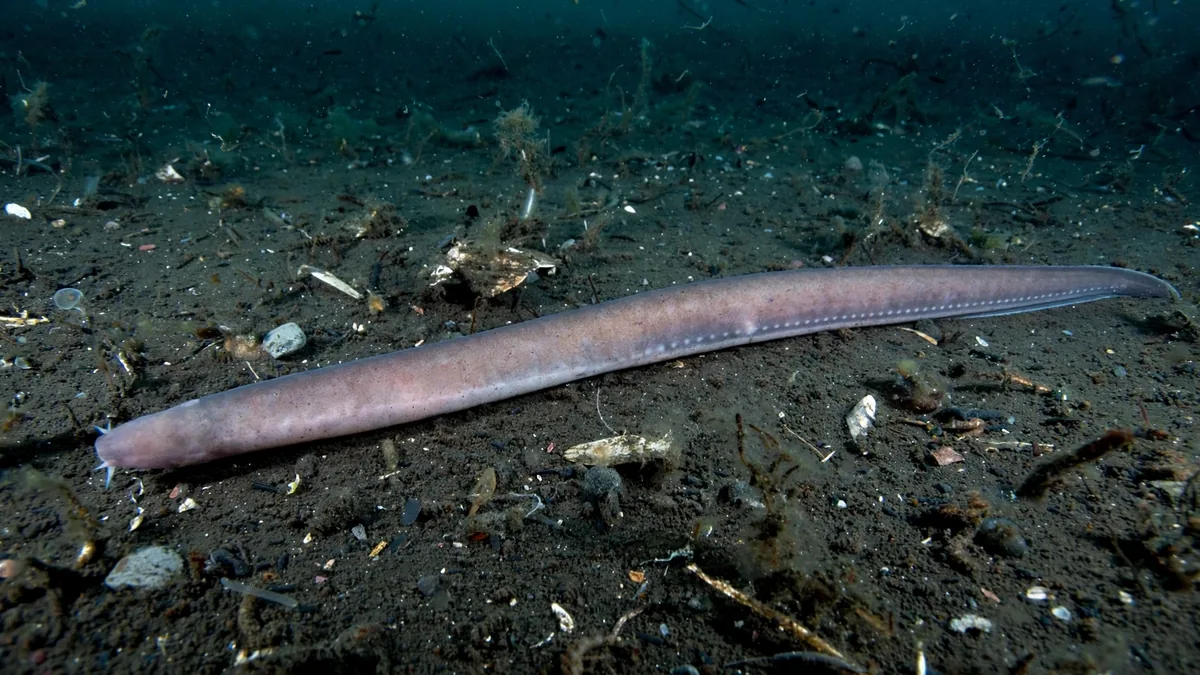
The hagfish species are the strangest fish in the sea, and the Atlantic hagfish is the one most people meet first, even if they never see it alive. If you are asking what a hagfish is, the short answer is a jawless, eel-shaped scavenger that lives on the cold, muddy seabed, makes astonishing quantities of slime when it is threatened, and can tie itself in a knot to scrape that slime off again. The Atlantic hagfish, Myxine glutinosa, is a pinkish-grey animal about 40 to 80 centimetres long, with no jaws, no scales, no paired fins and eyes so poorly developed that they are covered by skin, yet it has survived, almost unchanged, for hundreds of millions of years.
You will probably never meet a hagfish by accident, because it lives in deep, cold water on soft mud, often half-buried in the sediment, and it comes out mainly at night. Yet it is an animal worth knowing, because it does a job no other fish does quite so well: it cleans up the dead on the seabed, it turns a carcass into food for the whole deep-water community, and it does it with a toolkit that looks, at first glance, like a list of things it is missing. This guide covers the whole animal, from its family tree and its famous slime to where it lives, what it eats, how it ties itself in knots, how it breeds, and why fishermen and scientists both pay it close attention.
Key takeaways
- The hagfish species are jawless fish of the family Myxinidae, with the Atlantic hagfish, Myxine glutinosa, as the best-known species, most adults measuring 40 to 80 centimetres long.
- A Hagfish has no jaws, no scales and no paired fins, and its skeleton is made entirely of cartilage, yet it feeds, buries itself in mud and escapes predators with ease.
- When threatened, a hagfish releases slime from about 100 to 150 glands along its flanks, and a small amount swells in seawater into a thick, fibrous gel that can clog a predator’s gills.
- Hagfish live on soft, muddy bottoms in cold water, mostly at depths of 30 to 1,200 metres, and they feed chiefly on dead and dying fish, worms and small crustaceans.
- Hagfish are slow breeders with few, very large eggs, and the Atlantic hagfish is listed as Least Concern, though hagfish fisheries elsewhere have raised real worries about overfishing.
The hagfish species and its relatives
Hagfish belong to the family Myxinidae, the hagfishes, and to the class Myxini, a group of jawless fish that sits apart from every other living fish. The scientific name of the Atlantic hagfish, Myxine glutinosa, tells the story in two words: Myxine comes from the Greek for slime, and glutinosa means gluey, and both fit an animal whose whole defence is a sudden cloud of sticky mucus. It was described by Carl Linnaeus in 1758, and it has kept its name ever since, which is fitting for an animal that has changed so little over such a long time.
Hagfish as a family are a varied lot, and they range from animals barely 30 centimetres long to animals close to a metre, so the family spans roughly 30 centimetres to about 1 metre from end to end. What they share is a life on the cold seabed, a long, eel-shaped body with no scales, and a mouth that works by rasping rather than by biting. The Atlantic hagfish is the best studied of them, and it is also the one that lives closest to the shores of Europe and North America, in the cold North Atlantic where fishermen have known it, and cursed it, for centuries.

| Type | Animal | Where it lives | Best-known food | Length |
|---|---|---|---|---|
| Family | Hagfishes (Myxinidae) | Cold seas worldwide | Dead fish, worms and crustaceans | About 30 cm to 1 m long |
| Genus | Hagfishes (Myxine) | North Atlantic and other cold seas | Dead and dying fish | About 40 cm to 80 cm long |
| Genus | Hagfishes (Eptatretus) | Pacific and southern seas | Dead fish and invertebrates | About 30 cm to 90 cm long |
| Species | Atlantic hagfish (Myxine glutinosa) | North Atlantic | Dead and dying fish | About 40 cm to 80 cm long |
| Species | Pacific hagfish (Eptatretus stoutii) | North Pacific | Dead fish and crustaceans | About 40 cm to 64 cm long |
| Species | Broadgilled hagfish (Eptatretus cirrhatus) | New Zealand and southern seas | Dead fish and invertebrates | About 40 cm to 97 cm long |
The closest relatives of the Atlantic hagfish are the other Myxine species, and the most useful comparison is with the Pacific hagfish, Eptatretus stoutii, which reaches about 40 to 64 centimetres and lives on the muddy bottom of the North Pacific. Across the genus Myxine, adults run about 40 to 80 centimetres, while Eptatretus species run about 30 to 90 centimetres. The two are so alike in shape and habit that a fisherman pulling one up in a net would be hard pressed to tell them apart at a glance, and it took careful study of their gill openings and their slime pores to sort the genera out. The broadgilled hagfish, Eptatretus cirrhatus, at about 40 to 97 centimetres, is one of the largest of the family, and it lives in the seas around New Zealand and in southern waters, which makes the genus Eptatretus a mirror of Myxine: one group centred on the Atlantic, the other spread through the Pacific and the south.
There is one more relationship worth knowing, and it is the one that explains the hagfish’s place in the sea. Like the shark, a hagfish is a cartilaginous fish, with a skeleton made of cartilage rather than bone, but the two live very different lives: the shark is a fast, jawed hunter with keen senses, while the hagfish is a slow, jawless scavenger that finds its food by smell and touch in the dark. The shark is built for the chase; the hagfish is built for the clean-up, and that difference is written all over its body, from its missing jaws to its rows of slime glands.
What a hagfish looks like
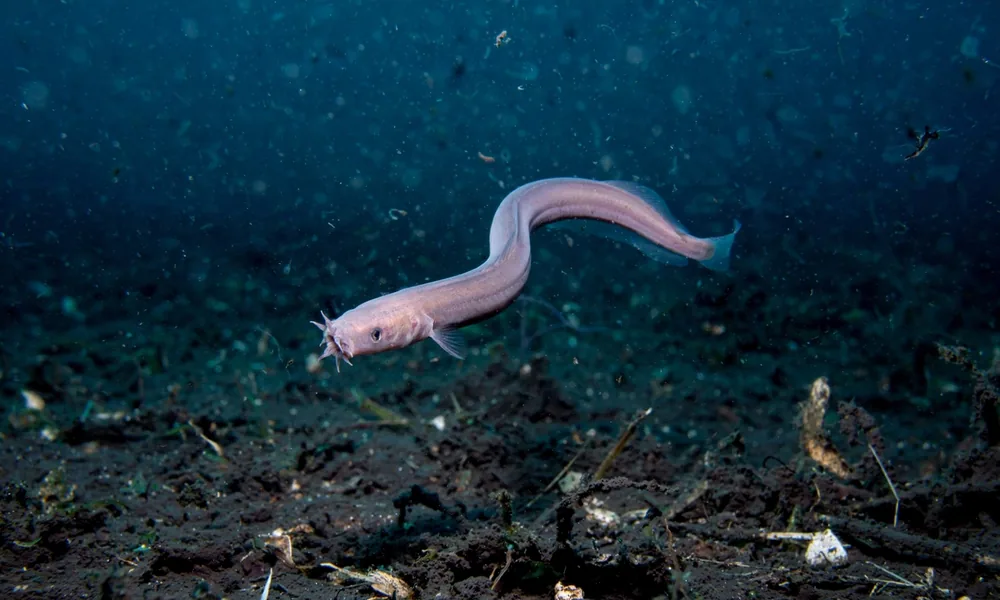
A Hagfish is a long, pinkish-grey, eel-shaped animal that looks more like a thick worm than like the fish most people picture. Most adult Atlantic hagfish measure 40 to 80 centimetres from snout to tail, and a big one can weigh several hundred grams, though the animal is so limp and flexible that it is hard to weigh neatly. The body is round in cross-section, almost the same width from the head to the tail, and the skin is soft and entirely scaleless, a mottled grey-brown or reddish-grey on the back fading to a paler grey or white underneath, with the colour often matching the mud it lives on.
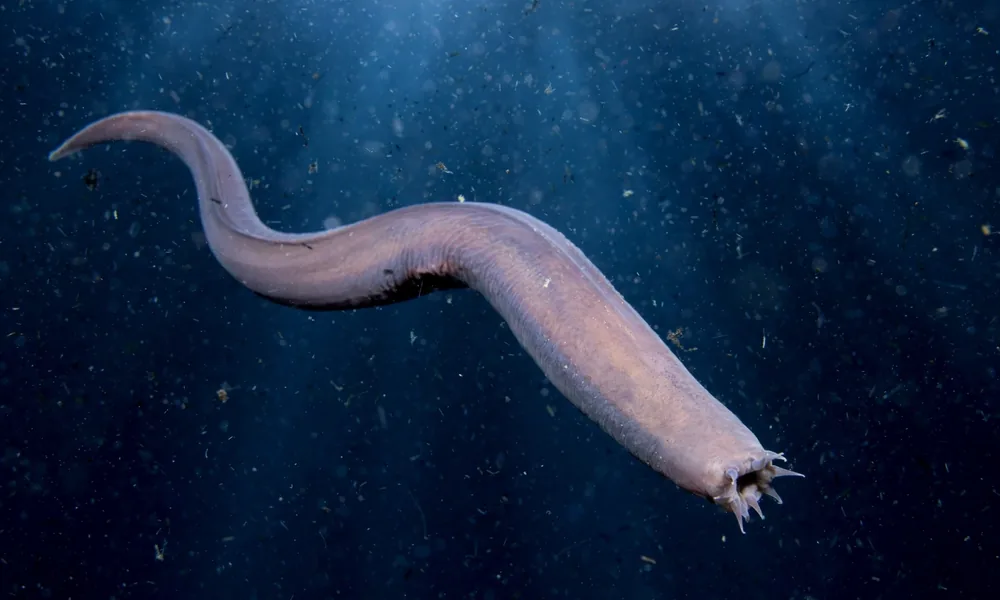
The head is small and blunt, with a mouth set underneath the snout, and the mouth is an oval slit ringed by four pairs of short barbels, fleshy feelers that probe the seabed for food. A single nostril sits at the tip of the snout, also ringed by barbels, and the eyes are small, poorly developed and covered by skin, so they are easy to overlook altogether. Inside the mouth are two rasping plates, each bearing rows of sharp, horny teeth, and these plates slide in and out on a cartilaginous tongue, letting the animal grip and tear at flesh it could never bite. Along each side of the body runs a line of slime pores, small pale dots that mark the mucus glands underneath, about 100 to 150 glands in all.

There are no paired fins on a hagfish at all, and only a low, rudimentary fin fold runs along the rear of the back and around the tail, which is one of the marks of a truly primitive fish. The gills are pouches inside the body, and in the Atlantic hagfish they open to the outside through a single pair of gill openings, one on each side, which is a useful clue for telling Myxine from Eptatretus, whose species have several separate gill openings on each side. The body is so flexible that it can tie itself in a knot, and that flexibility is not a party trick: it is how the animal scrapes slime off itself, pulls prey from a burrow, and levers flesh from a carcass without jaws to bite with.
Males and females look much alike, though females often outnumber males by a wide margin in Atlantic hagfish catches, sometimes by as many as a hundred females to one male, which is one of the stranger facts about the species. The best clue to a hagfish’s size is simply its length, because the animal grows steadily through life, and a fish of 60 centimetres is a solid adult, while a fish of 30 centimetres is still young. The skin feels limp and rope-like in the hand, and the animal will readily curl and knot itself, which is why fishermen who haul one up in a net often find it tangled in its own slime before they can get it free.
Where hagfish live
Hagfish live on the soft, muddy bottoms of cold seas around the world, in a range that runs through the Atlantic, Pacific, Indian, Arctic and Antarctic oceans, and into the Bering, Mediterranean and Caribbean seas. The Atlantic hagfish is found on both sides of the North Atlantic, from the western Mediterranean and Portugal north to the North Sea, the Skagerrak and the Kattegat, and across to the coasts of North America, and south into Arctic waters. It is a cold-water animal through and through, and it follows the cold, which is why it is found in water below about 12 degrees Celsius, and why it is almost never seen in warm, shallow seas.
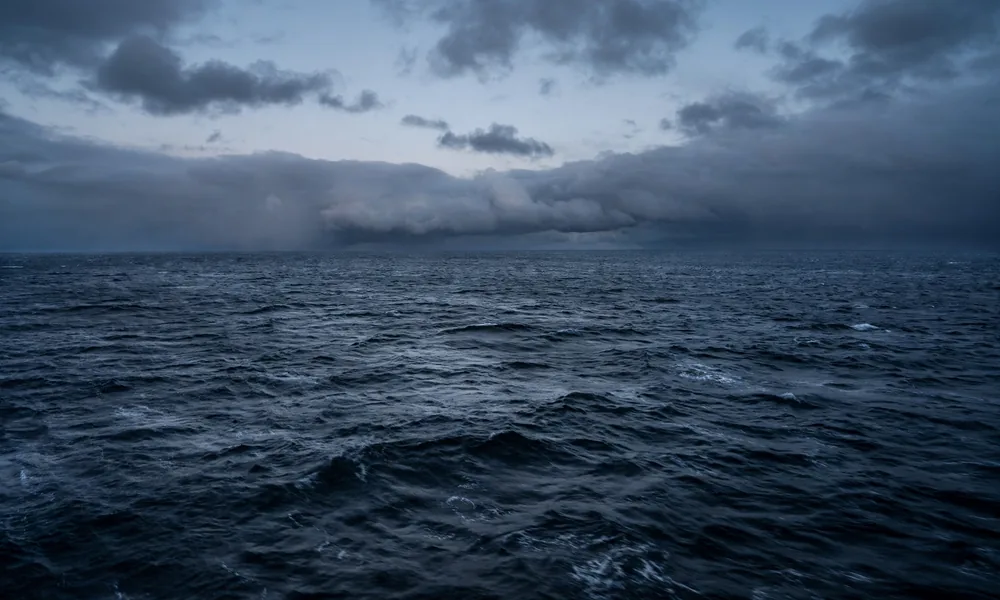
The habitat they choose is soft, dark and cold. An Atlantic hagfish spends most of its life at depths of 30 to 1,200 metres, on mud, clay and fine sediment, where it can burrow into the surface layer and hide. It needs salty water, at least about 30 parts per thousand, and low temperatures, and those conditions are usually found in deeper water, which is why the strongest concentrations are between about 100 and 500 metres on the continental shelf and slope. It is often found half-concealed in the bottom sediment, and it can disappear into the mud altogether when it is disturbed, which is one reason it is so seldom seen alive.

In the North Atlantic, the Atlantic hagfish is a creature of the continental shelf and slope, and it is most often caught where the bottom is soft enough to burrow in and the water is cold enough to suit it. It does not migrate far, and it does not roam the open water: it stays close to the seabed, moving slowly over the mud at night, and returning to the same patch of ground again and again. A diver would have to go far too deep to meet one in most places, and the people who know hagfish best are the fishermen who pull them up in trawls and the scientists who lower cameras and traps to the deep mud to watch them work.
What hagfish eat
Hagfish eat dead and dying fish, worms and small crustaceans, and they are not fussy about which kind, as long as it is soft enough to rasp and rich enough to be worth the effort. The everyday diet of the Atlantic hagfish is made up of the carcasses of fishes, which it bores into through the mouth, the gills or an existing wound, and eats from the inside, along with polychaete worms, shrimps, hermit crabs and other small bottom animals. It is a generalist of the mud, and its stomach has turned up a wide range of bottom life, which is exactly what you would expect from an animal that eats whatever the sea leaves on the seabed.
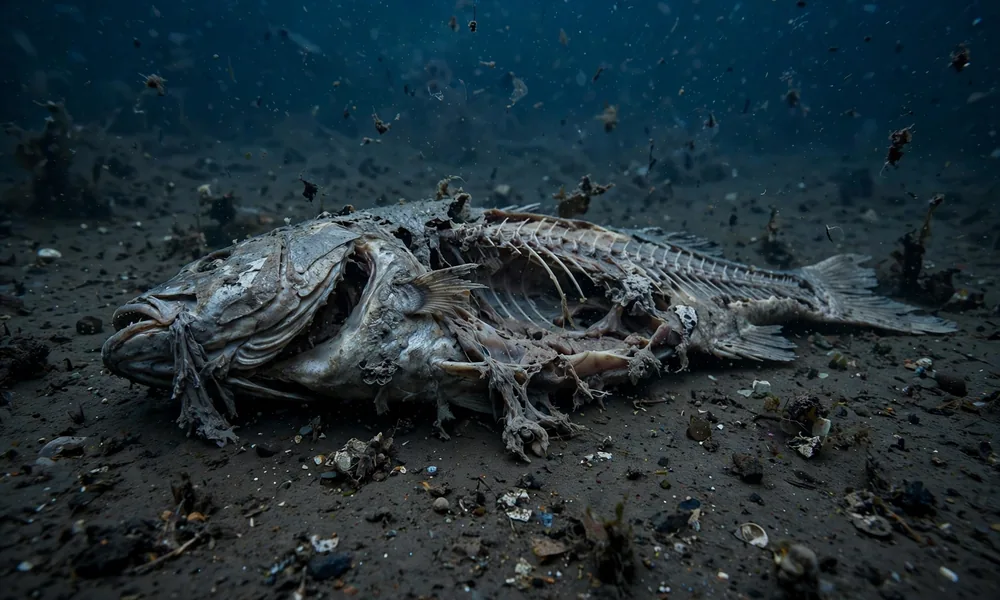
The feeding style is slow and thorough, and it works because the hagfish does not need to chase anything. A Hagfish finds a carcass by smell, following the scent through the dark water, and when it reaches the dead fish it works its way inside, using its rasping tongue to tear off pieces of flesh and viscera. Several hagfish may feed on one carcass at once, and they can strip a fish surprisingly quickly for animals that move so slowly. Like the Atlantic cod, a hagfish eats fish, but the cod is a hunter that chases live prey in the water above the seabed, while the hagfish is a scavenger that eats the dead on the mud below, and that difference shapes everything from its teeth to its daily rhythm.
Feeding is closely tied to what is dying in the water above, and to the seasons. When a fish dies and sinks to the seabed, the hagfish are among the first animals to find it, and they are also among the last to leave, working through the remains long after the faster scavengers have gone. Worms and small crustaceans are taken more steadily, day by day, as the hagfish probes the mud with its barbels, and the diet shifts with what is available locally, which is why hagfish in one patch of seabed may eat mostly worms, while hagfish in another eat mostly fish flesh. It is not a dramatic hunt, and there is no burst of speed, but in a world where food arrives as carrion, patience is worth more than speed.
How hagfish behave
Hagfish are solitary for most of their lives, and a single hagfish will usually be found alone, burrowed in the mud or moving slowly over the seabed, with no other hagfish in sight. They are not social animals, and they do not school or gather in groups, though several may be drawn to the same carcass, where the scent of food brings them together for a while. They are chiefly nocturnal, and they are most active at night, when they leave the mud and probe the seabed with their barbels, guided by a sense of smell and touch that is far better than their eyesight.

The slime is the behaviour people ask about most, and it is worth describing properly. A Hagfish has about 100 to 150 slime glands along its flanks, and when it is attacked or handled, it releases a small amount of mucus that swells in seawater into a thick, fibrous gel, expanding to many times its original volume in a fraction of a second. The slime is reinforced by tiny protein threads, which make it strong and difficult to remove, and it can clog the gills of a predator, forcing the attacker to let go. The Hagfish then escapes its own slime cocoon by tying itself in a knot and passing the knot down the length of its body, wiping the slime away as it goes, and it can do this again and again.
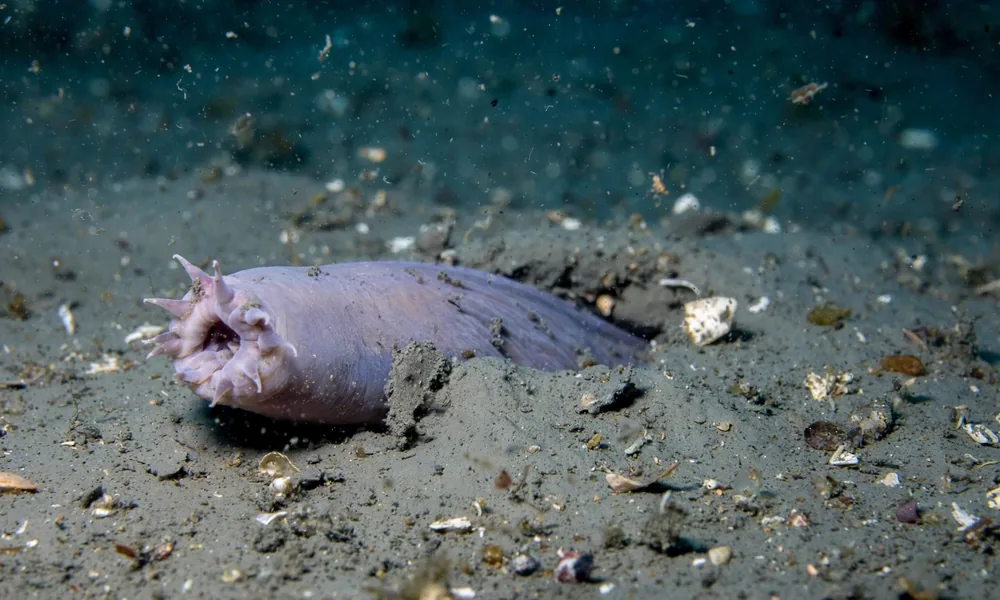
Young hagfish behave much like adults, which is unusual for a fish: there is no nursery ground and no school of youngsters, and a young hagfish simply lives the same slow life on the same muddy bottom, growing steadily year by year. The only real difference is size: the smallest hagfish are sometimes found in shallower water than the adults, and they move deeper as they grow, which may be a way of avoiding the bigger animals that would eat them. Even a young hagfish is a tough animal, and it has few enemies in the deep apart from sharks and other large predators that can cope with its slime.
Breeding and life cycle
Hagfish breed slowly, and that slowness is the heart of the animal’s story. They are among the slowest-breeding of all fish, and the Atlantic hagfish produces only a small number of very large eggs at a time, usually about 20 to 30 eggs, each about 20 to 70 millimetres long, which is enormous for a fish egg. The eggs are white and oval, with hooked filaments at either end that let them lock together in a cluster, and they are laid on the seabed, where they develop slowly in the cold water.
The details of how they breed are still poorly known, because nobody has watched a hagfish lay its eggs in the wild, and most of what we know comes from examining dead animals and from the few hagfish kept in aquaria. There is no copulatory organ, and fertilisation is thought to happen externally, after the eggs and sperm are released from the abdominal cavity through a large pore into the cloaca. The young hatch as small, fully formed hagfish, able to swim and feed, and they are on their own from the moment they hatch, with no parental care at all. It is a hard start, and the young grow slowly, taking years to reach adult size.

The age of a hagfish is hard to settle, because it has no bones and no scales to read like tree rings, and scientists have had to work it out from growth rates and from the size of animals caught at different times of year. What is clear is that hagfish grow slowly and live for many years, and that a female that produces only 20 to 30 eggs at a time cannot replace her numbers quickly. That slow arithmetic matters for conservation, and it is why a hagfish population that is fished hard can take a long time to recover, even if the fishing stops altogether.
Conservation status
The Atlantic hagfish is listed as Least Concern by the International Union for Conservation of Nature, and the reasoning is straightforward: it is widespread across the North Atlantic, it lives in deep water where it is not heavily fished, and there is no evidence that its numbers are falling fast. It is not a fish that is targeted heavily for food in the Atlantic, though it is caught as bycatch in trawls for other species, and many of the hagfish caught in nets do not survive being hauled up from the deep.
The real pressure on hagfish is not in the Atlantic but in the Pacific, where hagfish are fished for their skin, which is made into so-called eelskin leather, and for food in Korea and Japan. The Pacific hagfish fishery has grown fast, and because hagfish breed so slowly and produce so few eggs, a population that loses its big breeding females can take a long time to recover. That is why the conservation advice is practical: limit the catch in hagfish fisheries, protect the muddy habitats where the animals feed and breed, and treat the hagfish as an animal whose timescale is not ours. A Hagfish killed today was years in the making, and its replacement will not be ready to breed for years to come.
There is one more issue that matters to people who meet hagfish in a net, and it is worth stating plainly. A Hagfish that is hauled up alive will fill a net with slime, and fishermen have long regarded it as a nuisance, because the slime clogs nets and spoils the catch. Like the salmon, a hagfish is a fish that fishermen know well, but the salmon is a prized food fish that swims up rivers to breed, while the hagfish is a deep-water scavenger that most fishermen would rather not catch at all, and that difference shapes everything from how it is treated on deck to how little we still know about its life.
Best seasons for hagfish watching
The best time to look for a hagfish depends on where you are, because the animal lives in cold, deep water all year round and there is no single season for the whole North Atlantic. In the summer, from about June to September, research boats and fishing boats work the continental shelf, the sea is calmer, and the chances of seeing a hagfish brought up in a trawl are highest. It is also the time when the water is warmest at the surface, though the hagfish itself stays deep, in water below about 12 degrees Celsius, so the watching is done from boats working the deep water, not from the shore.
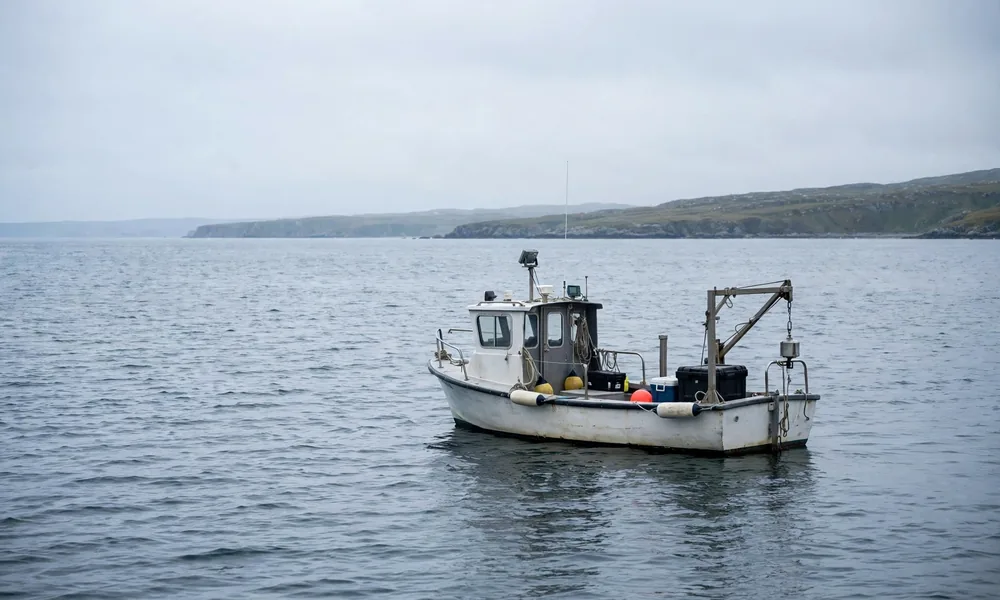
In the winter, the hagfish are still there, on the same muddy bottoms, but the sea is rougher and the boats go out less, which is why most of what we know about hagfish comes from summer work. A traveller who wants to meet one should go with a proper research trip or a fishing boat that works the deep water, in the summer for the journey and the calm sea, and should expect to wait: a hagfish is not an animal that performs on demand, and the meeting, when it comes, is usually a pinkish-grey shape in a net or in a trap, covered in slime and tied in a knot.
Staying safe around hagfish
A Hagfish is not a danger to people in the way a shark is, and there is no reliable record of one attacking a swimmer. It lives in deep, cold water, it has no jaws to bite with, and it has no interest in anything as large as a person. The safety rules are mostly about the sea itself: the cold, the deep water and the boats that work in it. Nobody should be in deep North Atlantic water without a drysuit, a proper boat and a crew that knows the sea, and nobody should try to handle a hagfish that has been brought up in a net without care, because a frightened animal will fill the deck with slime in seconds.
There is one practical point that matters more than the rest, and it is about the slime. Never put your hands near a hagfish’s gills or mouth when it is stressed, because the slime it releases can be hard to wash off, and it can clog a net or a bucket in moments. Like the seahorse, a hagfish is a small, harmless animal that deserves respect rather than fear, but the seahorse is a slow, shallow-water fish that clings to seagrass with its tail, while the hagfish is a deep-water scavenger whose real defence is a sudden cloud of slime, and that difference is worth remembering if you ever meet one on deck.
Hagfish watching checklist
A little preparation turns a deep-water trip into a real chance of meeting one of the oldest animals in the sea.
- A visit in the summer, from June to September, when research and fishing boats work the continental shelf and the sea is calmer.
- A proper boat with a crew that knows the deep water and the muddy bottoms where hagfish live, because the animal stays hundreds of metres down in cold water.
- Warm, waterproof clothing and a drysuit for any time in or near the water, since North Atlantic water can chill an unprotected person in minutes.
- Patience for a long wait, because a hagfish moves slowly and does not perform on demand, and the meeting may be a pinkish-grey shape in a trap or a net.
- A camera with a fast lens and a good light, since the hagfish lives in dim water and the light fades quickly with depth.
- A guide who knows the local waters, the weather and the seabed, and who can read the sea well enough to keep the boat safe.
- Respect for the animal and its sea, keeping your distance, never feeding it, and leaving the mud and the water as you found them.
Frequently asked questions
What is a hagfish?
A Hagfish is a jawless fish of the family Myxinidae, a long, eel-shaped scavenger that lives on the cold, muddy seabed. The Atlantic hagfish, Myxine glutinosa, is the best-known species, most adults measuring 40 to 80 centimetres long, with no jaws, no scales and no paired fins, and a skeleton made entirely of cartilage.
Why do hagfish make slime?
Hagfish make slime to defend themselves. When a hagfish is attacked or handled, it releases mucus from about 100 to 150 glands along its flanks, and the mucus swells in seawater into a thick, fibrous gel that can clog a predator’s gills. The Hagfish then escapes by tying itself in a knot and wiping the slime off as the knot passes down its body.
Are hagfish dangerous to people?
No, there is no reliable record of a hagfish attacking a person. It lives in deep, cold water, it has no jaws to bite with, and it has no interest in anything as large as a person. The real nuisance is the slime, which can fill a net or a bucket in seconds and is hard to wash off.
What do hagfish eat?
A Hagfish eats dead and dying fish, along with polychaete worms, shrimps, hermit crabs and other small bottom animals. It finds a carcass by smell, bores into it through the mouth, the gills or a wound, and rasps off pieces of flesh with the horny teeth on its tongue, often feeding alongside several other hagfish on the same carcass.
Can you eat hagfish?
Yes, hagfish are eaten in Korea and Japan, and their skin is made into so-called eelskin leather, but they are not a common food fish in the Atlantic. In the Atlantic they are mostly caught as bycatch, and fishermen regard them as a nuisance because the slime they release clogs nets and spoils the catch.
How is this guide different from the Greenland shark guide?
This guide covers the hagfish, a small, jawless scavenger of the cold, muddy seabed that makes slime, ties itself in knots and eats the dead, while our Greenland shark guide covers a huge, slow sleeper shark of freezing Arctic deep water that lives for centuries, is nearly blind and eats fish, squid and seals. One is a soft, finless cleaner of the mud; the other is one of the largest sharks in the cold dark.
Conclusion
The hagfish is proof that a fish does not need jaws, scales, fins or even proper eyes to make a living, only a good nose, a tough skin and a trick no other animal owns. A pinkish-grey scavenger that bores into dead fish, floods its enemies with slime and ties itself in a knot to wipe clean has survived, with barely a change, since long before the dinosaurs, and it still does its quiet work on the muddy seabed while the rest of the ocean hurries past above it.
If you go looking for one, go in the summer, go with a proper boat, and be ready to wait. Find the deep, muddy water, watch the traps and the nets, and when a pinkish-grey shape comes up covered in slime and tied in a knot, you will have met a fish whose family has scarcely changed in hundreds of millions of years.