The humphead wrasse species is the largest wrasse in the world, and the first time you meet one underwater you do not forget it. If you are asking what a humphead wrasse is, the short answer is Cheilinus undulatus, a huge, blue-green reef fish of the Indo-Pacific, also called the Napoleon wrasse, with a great bulging forehead, thick fleshy lips and a body that can grow to more than 2 metres long and 191 kilograms. It is a slow, deliberate fish that patrols the coral reef by day, rests in a cave by night, and eats animals that almost nothing else on the reef will touch, including the crown-of-thorns starfish.
You will probably never meet a humphead wrasse by accident, because it lives on coral reefs in warm tropical seas, often on the steep outer slopes where the reef drops away into deep blue water, and it is never common: on most reefs you would be lucky to find more than a handful. Yet it is an animal worth knowing, because it is one of the great characters of the reef, a fish that changes sex as it grows, that can live for more than 30 years, and that has become one of the most prized, and most threatened, reef fish in the world. This guide covers the whole animal, from its family tree and its famous hump to where it lives, what it eats, how it breeds, and why it is now listed as Endangered.
Key takeaways
- The humphead wrasse species is Cheilinus undulatus, also called the Napoleon wrasse or Maori wrasse, the largest member of the wrasse family Labridae, with males reaching more than 2 metres and 191 kilograms.
- It is a coral reef fish of the Indo-Pacific, from the Red Sea and East Africa to the Pacific islands, living mostly on steep outer reef slopes, channel slopes and lagoon reefs in water 2 to 60 metres deep.
- A Humphead wrasse eats molluscs, sea urchins, crustaceans and small fish, and it is one of the few predators that eats the toxic crown-of-thorns starfish, boxfish and sea hares.
- Humphead wrasses are protogynous hermaphrodites, which means most start life as females and some later change into males, and they do not breed until they are about 35 to 50 centimetres long.
- The species is listed as Endangered by the International Union for Conservation of Nature and is on Appendix II of CITES, because it is heavily fished for the live reef food trade.
The humphead wrasse species and its relatives
Humphead wrasses belong to the family Labridae, the wrasses, and to the genus Cheilinus, a group of large, heavy-bodied wrasses found on coral reefs across the Indo-Pacific. The scientific name, Cheilinus undulatus, tells the story in two words: Cheilinus comes from the Greek for lip, and undulatus means wavy, and both fit a fish with thick, fleshy lips and a body marked with wavy lines and blotches. It was described in 1835 by the German naturalist Eduard Ruppell, and it has kept its name ever since.
Wrasses as a family are a varied lot, and they range from tiny cleaner fish barely 10 centimetres long to giants more than 2 metres, so the family spans roughly 10 centimetres to over 2 metres from end to end. What they share is a life on the reef, a body built for manoeuvring through coral, and teeth made for crushing shells. The Humphead wrasse is the largest of them, and it is also the one that lives longest and grows slowest, which is why it is so vulnerable to fishing.
| Type | Animal | Where it lives | Best-known food | Length or Weight |
|---|---|---|---|---|
| Family | Wrasses (Labridae) | Coral reefs worldwide | Molluscs, crustaceans and small fish | About 10 cm to over 2 m long |
| Genus | Wrasses (Cheilinus) | Indo-Pacific coral reefs | Molluscs, sea urchins and crustaceans | About 40 cm to over 2 m long |
| Species | Humphead wrasse (Cheilinus undulatus) | Indo-Pacific coral reefs | Molluscs, sea urchins and crown-of-thorns starfish | Up to 2.29 m long and 191 kg |
| Species | Red-breasted wrasse (Cheilinus fasciatus) | Indo-Pacific coral reefs | Molluscs and crustaceans | Up to about 40 cm long |
| Species | Tripletail wrasse (Cheilinus trilobatus) | Indo-Pacific coral reefs | Molluscs and crustaceans | Up to about 45 cm long |
| Species | Floral wrasse (Cheilinus chlorourus) | Indo-Pacific coral reefs | Molluscs and small invertebrates | Up to about 45 cm long |
The closest relatives of the humphead wrasse are the other Cheilinus species, and the most useful comparison is with the red-breasted wrasse, Cheilinus fasciatus, which reaches only about 40 centimetres and lives on the same Indo-Pacific reefs. Across the genus Cheilinus, adults run about 40 centimetres to over 2 metres. The two share the thick lips and the heavy body, but the red-breasted wrasse is a modest reef fish that most divers swim past without a second look, while the humphead wrasse is a giant that stops divers in their tracks. The tripletail wrasse, Cheilinus trilobatus, at up to about 45 centimetres, and the floral wrasse, Cheilinus chlorourus, also up to about 45 centimetres, are the same story in miniature: the same shape, the same habits, and a fraction of the size.
There is one more relationship worth knowing, and it is the one that explains the humphead wrasse’s place on the reef. Like the clownfish, a humphead wrasse is a reef fish that lives its whole life among the coral, but the two live very different lives: the clownfish is a tiny fish that never leaves its anemone, while the humphead wrasse is a giant that roams the whole reef, and that difference is written all over its body, from its great size to its crushing teeth and its long, slow life.
What a humphead wrasse looks like
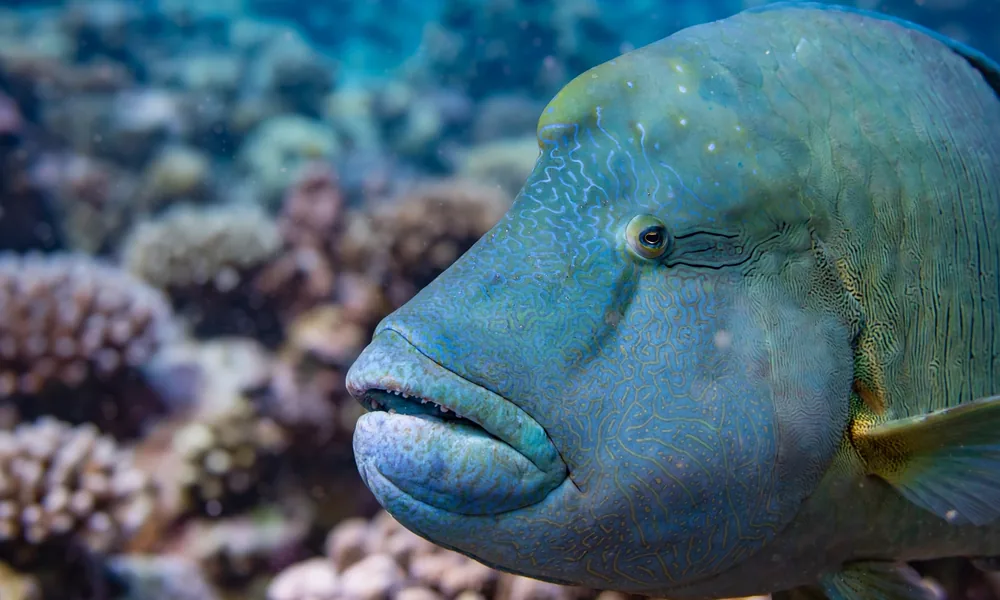
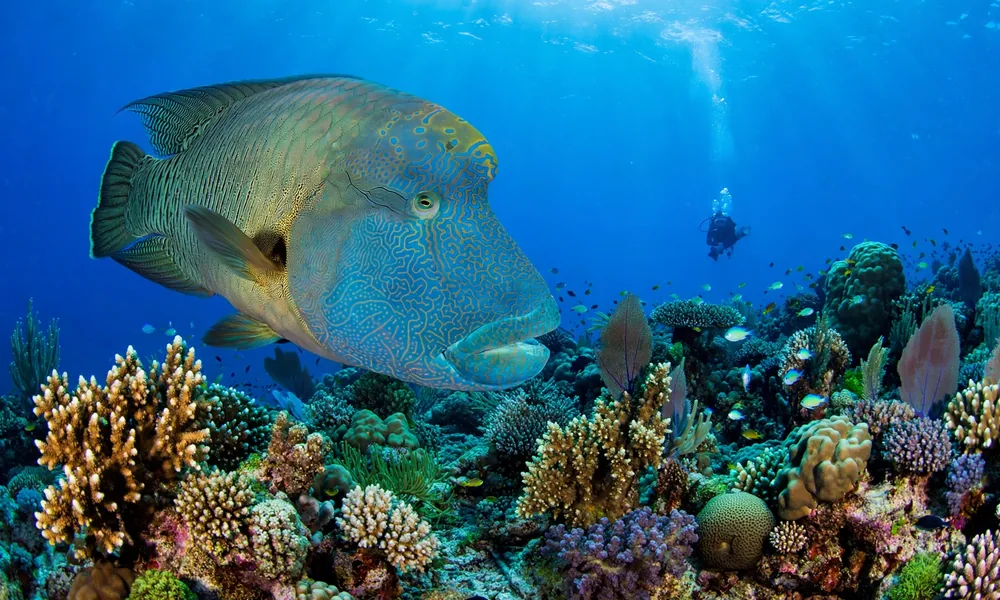
A Humphead wrasse is a huge, heavy, blue-green fish that looks more like a grouper than like the wrasses most people picture. Males are typically larger than females, and they can reach up to 2.29 metres long and 191 kilograms, though the average fish is much smaller, around 60 centimetres, and females rarely grow larger than 1 metre. The body is thick and deep, almost the same width from the head to the tail, and the skin is patterned with wavy lines and blotches, a blue-green on the back fading to a paler green underneath, with the males often brighter and bluer than the females.
The head is large and blunt, with a great bulging hump on the forehead that grows more prominent as the fish gets older, especially in males, and the lips are thick and fleshy, made for gripping and crushing shells. The teeth are tough and sharp, set in jaws strong enough to break through coral to get at the snails and sea urchins hiding inside, and the eyes are small and dark, set far forward on the head. The fins are rounded and strong, the tail is broad and fan-shaped, and there is a long dorsal fin running along the back, which is one of the marks of a wrasse.
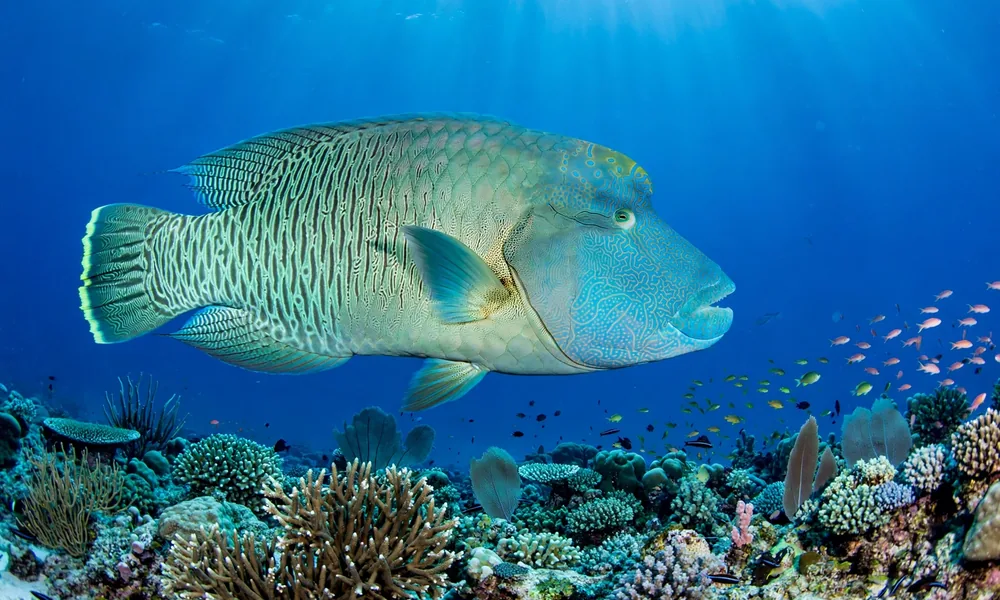
The most famous feature of the humphead wrasse is the hump itself, and it is worth describing properly. The hump is a great bulge of flesh on the forehead, and it grows as the fish ages, so a young fish has only a slight swelling, while an old male has a forehead that looks almost like a second head. The name Napoleon wrasse comes from the old story that the hump resembles the two-pointed hat worn by the French emperor Napoleon, and the Maori wrasse name comes from the fish’s importance in the Pacific, where it is a prized food fish and a cultural treasure. Young fish look very different from adults: they are smaller, paler and more reddish, and they hide among the coral, while the adults are bold, blue-green and impossible to miss.
Males and females look much alike when they are young, though females are usually smaller and more reddish, and males grow considerably larger and bluer as they age, which is common in wrasses that change sex. A male of 1 metre is a big fish; a female of the same length is already large for her sex, and the very largest humphead wrasses ever measured, close to 2.29 metres, have all been males. The best clue to a wrasse’s age is its length, because the animal grows slowly, and a fish of 1 metre may already be a decade old, while a fish of 2 metres may be more than 30 years old.
Where humphead wrasses live
Humphead wrasses live on coral reefs in the tropical waters of the Indo-Pacific, in a range that runs from the Red Sea and the east coast of Africa, through the Indian Ocean, to the Pacific islands, north to the Ryukyu Islands of Japan and south to New Caledonia. They are found in the reefs of about 50 countries, and they are most common where the coral is healthy and the reef is steep, which is why they are almost never seen on reefs that have been damaged or heavily fished. They are a warm-water fish, and they follow the warm, clear water, which is why they are found in water from about 24 to 30 degrees Celsius, and why they are almost never seen in cold seas.
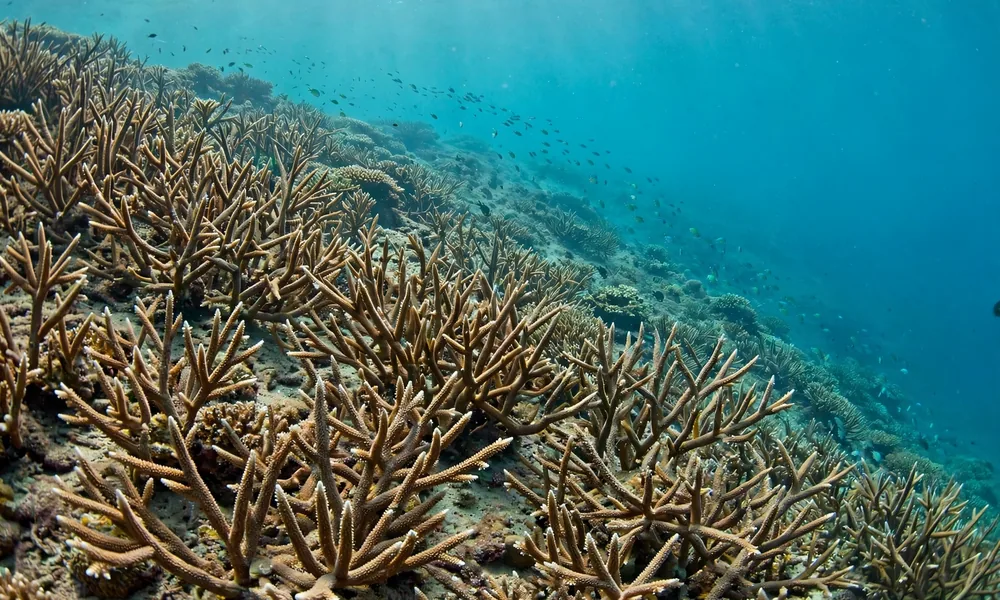
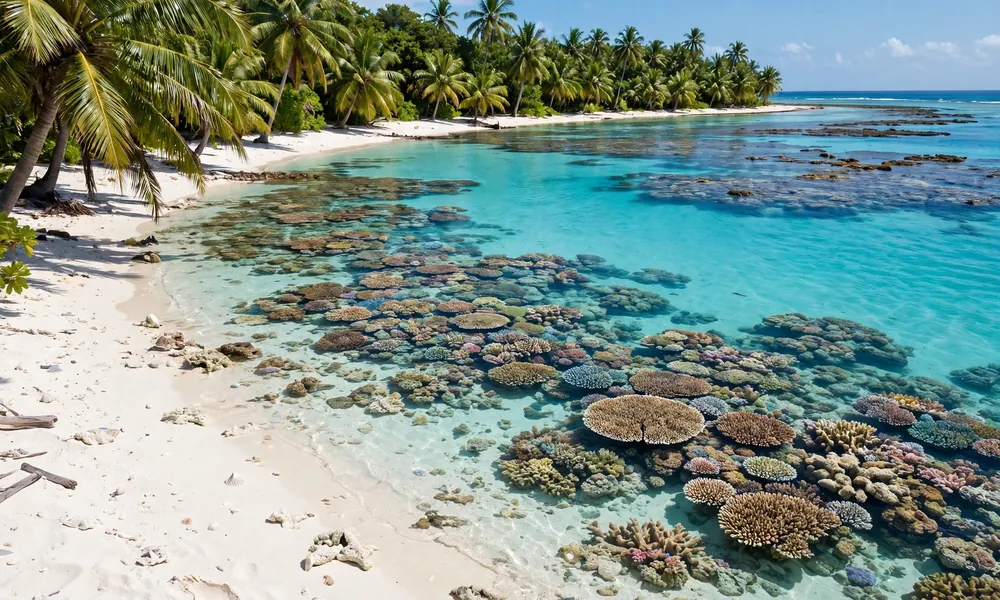
The habitat they choose is steep, clear and rich in coral. An adult Humphead wrasse spends most of its life at depths of 2 to 60 metres, on steep outer reef slopes, channel slopes and lagoon reefs, where the coral is dense and the water is clear. Juveniles are usually found in shallow, sandy ranges bordering coral reef waters, in dense branching corals, bushy algae and seagrass beds, where they can hide from predators. It is one of the most site-bound of reef fish, and an adult will often stay on the same reef for years, roaming a limited home range by day and returning to the same cave or ledge at night.
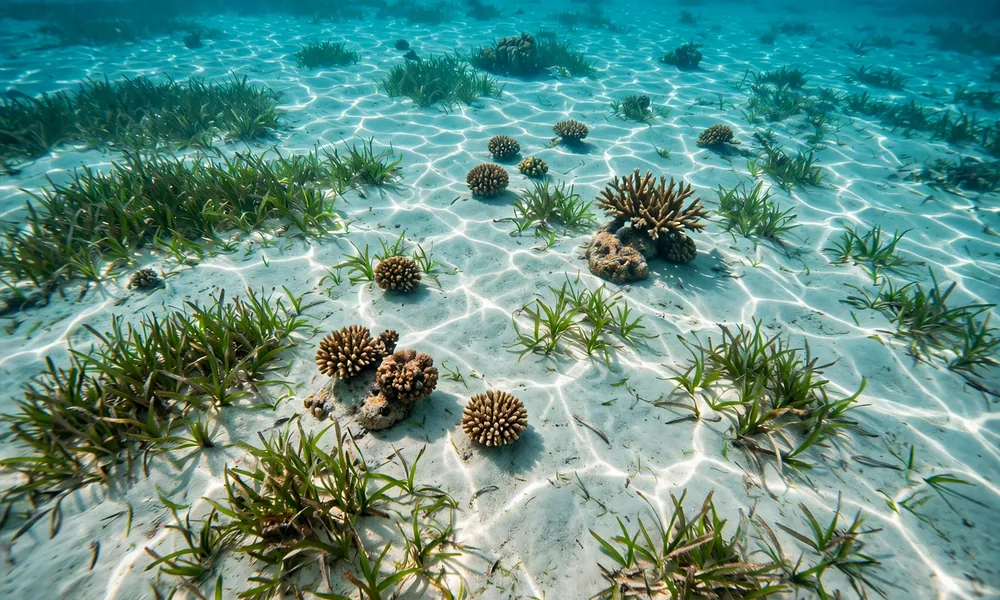
In the Indo-Pacific, the humphead wrasse is a creature of the outer reef, and it is most often seen where the reef drops away into deep blue water, on the steep slopes and passes where the current brings food and the coral grows thick. It does not migrate far, and it does not roam the open ocean: it stays close to the reef, moving slowly over the coral by day, and resting in a cave or under a ledge at night. A diver would have to go to a healthy, remote reef to meet one in most places, and the people who know humphead wrasses best are the divers and fishermen who work the reefs of Palau, the Great Barrier Reef and the Coral Triangle, where the fish are still common enough to be seen.
What humphead wrasses eat
Humphead wrasses eat molluscs, sea urchins, crustaceans and small fish, and they are not fussy about which kind, as long as it is hard-shelled enough to be worth crushing. The everyday diet is made up of snails, clams and other molluscs, along with sea urchins, crabs and shrimps, and the fish takes what is commonest on its own reef. It is a generalist of the reef, and its stomach has turned up a wide range of invertebrates, which is exactly what you would expect from an animal with jaws strong enough to crush almost anything it finds.

The feeding style is slow and deliberate, and it works because the humphead wrasse does not need to chase anything. A Humphead wrasse swims slowly over the reef, looking for shells and urchins, and when it finds one it uses its tough teeth to break through the shell or the coral around it, crushing the prey and swallowing the flesh. It is one of the few predators that eats the crown-of-thorns starfish, a spiny, toxic animal that destroys coral, and it also eats boxfish, pufferfish and sea hares, animals that most other fish leave alone because they are poisonous. Like the blue tang, a humphead wrasse eats on the reef, but the blue tang is a small fish that grazes on algae, while the humphead wrasse is a giant that crushes shells and eats starfish, and that difference shapes everything from its teeth to its daily rhythm.
Feeding is closely tied to the seasons and to what is living on the reef. In the warm months, when the reef is full of life, the wrasse feeds on molluscs and urchins, and in the cooler months it takes more crustaceans and small fish, as the reef changes with the seasons. Juveniles eat smaller prey, mostly small molluscs and crustaceans among the branching coral, while adults take larger prey, including the big snails and urchins that only a fish with jaws like theirs can crush. It is not a dramatic hunt, and there is no burst of speed, but on a reef where food is hidden in shells and under coral, patience and strong jaws are worth more than speed.
How humphead wrasses behave
Humphead wrasses are solitary for most of their lives, and a single humphead wrasse will usually be found alone, swimming slowly over the reef or resting under a ledge, with no other wrasse in sight. They are not social animals, and they do not school or gather in groups, though they may be seen in male-female pairs, or in small groups of one male, two to seven smaller adults and several juveniles, where the reef is rich enough to support them. They are active by day, and they rest at night in reef caves and under coral ledges, which is the opposite of the hagfish, and one reason they are so much easier for divers to see.
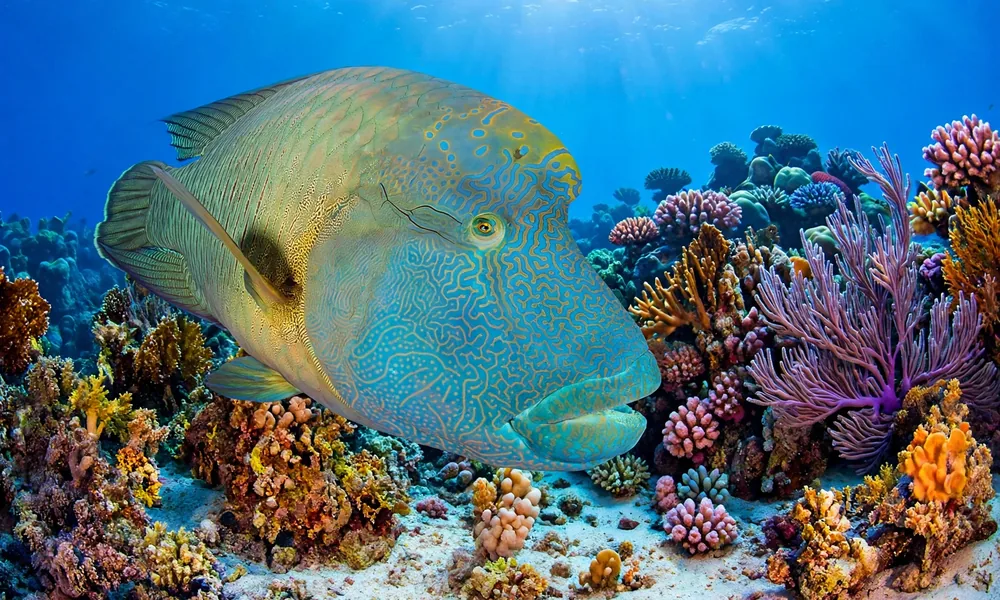
The daytime roaming is the behaviour people ask about most, and it is worth describing properly. A Humphead wrasse swims across the reef by day, moving slowly and deliberately, pausing to crush a shell or to nose under a coral head, and it can cover a surprising amount of reef in a day for a fish that never seems to hurry. The reason is the warm water: in water of 24 to 30 degrees Celsius, a wrasse’s muscles work well, and the humphead wrasse has turned that warmth into a strategy, spending its energy on strong jaws and a long life rather than on speed. It is not a lazy fish, and it is not a sick one: it is an animal that has matched its whole life to the pace of the reef, where food is hidden and patience pays.

Young humphead wrasses behave much like adults, which is unusual for a reef fish: there is no nursery ground far from the reef, and a young wrasse simply lives the same slow life among the branching coral, growing steadily year by year. The only real difference is where they live: the smallest wrasses are found in shallow, coral-rich lagoons and seagrass beds, and they move to deeper, outer reefs as they grow, which may be a way of avoiding the bigger fish that would eat them. Even a young humphead wrasse is a tough animal, and it has few enemies on the reef apart from sharks and the occasional large grouper.
Breeding and life cycle
Humphead wrasses breed slowly, and that slowness is the heart of the animal’s story. They are among the slowest-growing of all reef fish, and they do not reach breeding size until they are about 35 to 50 centimetres long, when they are less than five years old. They are protogynous hermaphrodites, which means that most fish start life as females, and some later change into males, so that most small adults are female, while mainly males exceed 1 metre. No other wrasse grows so large or lives so long, and it means that a humphead wrasse alive today may have been born before the reef it lives on was fished at all.
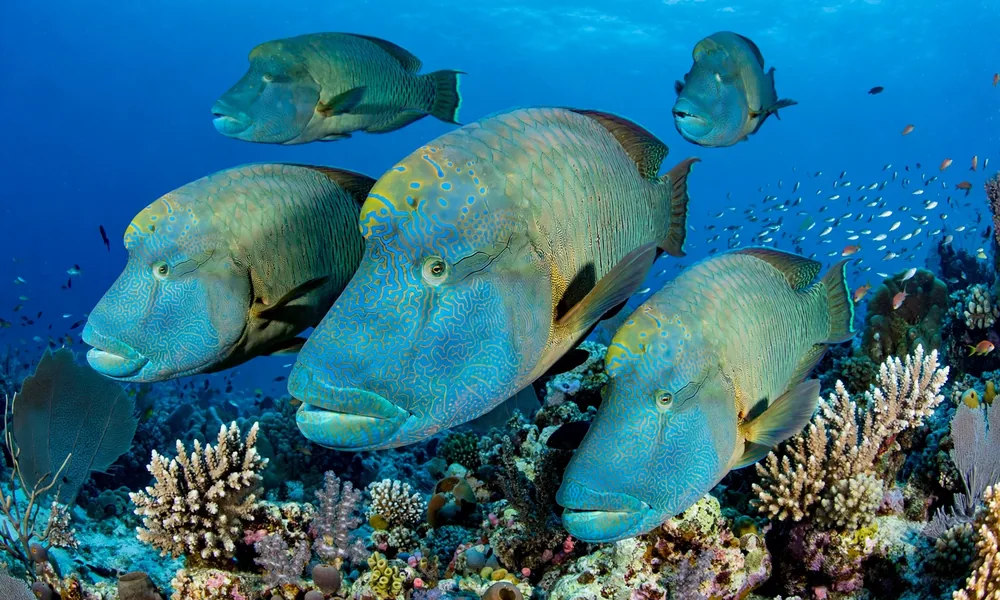
The details of how they breed are still poorly known, because nobody has watched a humphead wrasse spawn in the wild for long, and most of what we know comes from examining dead animals and from the few wrasses kept in aquaria. They are egg-layers, and the females release their eggs into the water, where they are fertilised by the males, and the eggs drift with the current until they hatch into tiny larvae. For reproduction the species forms small spawning aggregations, of tens to more than a hundred fish, gathering on the reef to spawn together, and the young settle on the reef as tiny juveniles, hiding among the branching coral and seagrass. It is a hard start, and the young grow slowly, taking years to reach adult size.
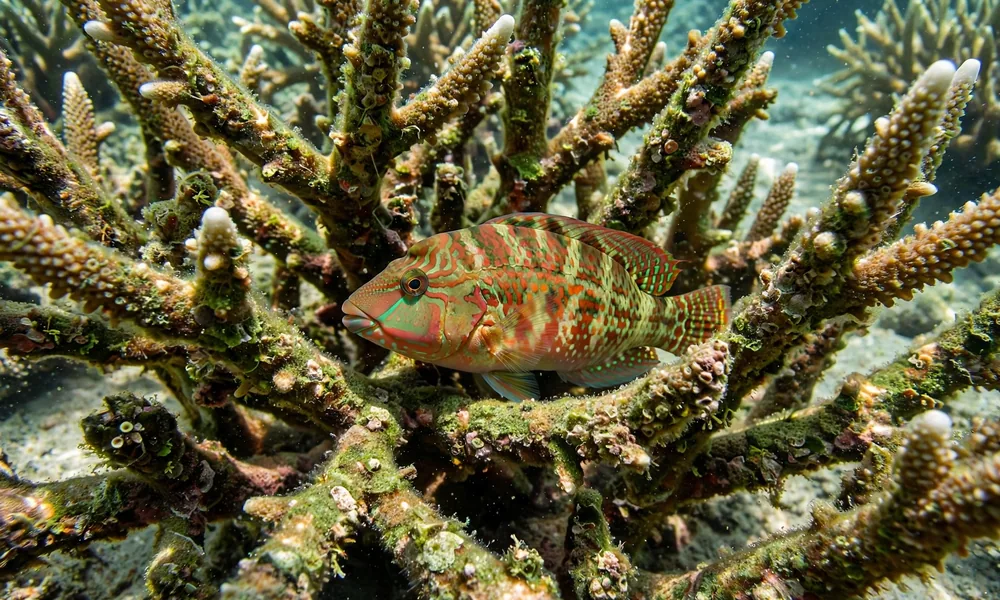
The age of the humphead wrasse was only settled by studying its ear bones, which grow in rings like a tree, and the oldest fish measured were at least 32 years old, with some thought to live longer still. The range matters, and it should not be quoted as a single number: 32 years is the oldest age measured, not a settled limit, and the honest way to put it is that humphead wrasses live for decades, with the best estimate for the oldest animals at more than 30 years. Even the lower end of that range makes them one of the longest-lived reef fish known to science, and it means that the wrasses swimming on Indo-Pacific reefs today may have been alive when those reefs were still untouched by the live fish trade.
Conservation status
The Humphead wrasse is listed as Endangered by the International Union for Conservation of Nature, and it is also listed in Appendix II of the Convention on International Trade in Endangered Species of Wild Fauna and Flora, and the reasoning is straightforward: it is a slow-growing, late-breeding animal that cannot replace its numbers quickly, and it is heavily fished for the live reef food trade, especially in Hong Kong, where live fish can fetch up to 100 dollars a kilogram. It is not a fish that is targeted for sport, but it is taken by hook and line and by spear, and many of the fish caught are juveniles, taken for grow-out to market size.
The real pressure on the humphead wrasse is not hunting for sport but the slow arithmetic of its life. A female that does not breed until she is 35 to 50 centimetres long, and then produces eggs only in spawning aggregations that fishermen can target, cannot make up for losses quickly, and a population that loses its big breeding males can take decades to recover. That is why the conservation advice is practical: limit the catch in the live reef food trade, protect the reefs where the wrasses feed and breed, and treat the wrasse as an animal whose timescale is not ours. A Humphead wrasse killed today was decades in the making, and its replacement will not be ready to breed for years to come.
There is one more issue that matters to people who eat wrasse, and it is worth stating plainly. The flesh of the humphead wrasse is highly regarded as food, and it is often found alive in the fish markets of Hong Kong, but eating it has resulted in cases of ciguatera poisoning, a food poisoning caused by toxins that build up in reef fish. Like the angelfish, a humphead wrasse is a beautiful reef fish that people love to see, but the angelfish is a small, common fish that is kept in aquaria, while the humphead wrasse is a giant, Endangered fish that is eaten as a luxury, and that difference shapes everything from how it is protected to how rarely it is now seen.
Best seasons for humphead wrasse watching
The best time to look for a humphead wrasse depends on where you are, because the fish lives in warm tropical water all year round and there is no single season for the whole Indo-Pacific. In the dry season, from about April to October in many parts of the Indo-Pacific, the sea is calmer, the water is clearer, and the diving is easiest, which makes it the best time to get out on the reef. It is also the time when the wrasses are most active, swimming across the reef by day and resting in caves at night, so the watching is done from boats working the outer reef slopes, not from the shore.
In the wet season, the wrasses are still there, on the same reefs, but the sea is rougher and the water is murkier, which is why most of what we know about humphead wrasses comes from dry-season diving. A traveller who wants to meet one should go with a proper dive operator, in the dry season for the journey and the clear water, and should expect to wait: a humphead wrasse is not an animal that performs on demand, and the meeting, when it comes, is usually a great blue-green shape passing slowly over the reef, with a diver watching from a respectful distance.
Staying safe around humphead wrasses
A Humphead wrasse is not a danger to people in the way a shark is, and there is no reliable record of one attacking a swimmer. It lives on coral reefs in warm, clear water, it moves slowly, and it has no interest in anything as large as a person. The safety rules are mostly about the reef itself: the currents, the coral, the deep water and the boats that work in it. Nobody should dive on a reef without proper training, a buddy and a crew that knows the currents, and nobody should try to approach a wrasse that is feeding, because a frightened animal of that size can injure a person with a single sweep of its tail.
There is one practical point that matters more than the rest, and it is about the flesh. Never eat humphead wrasse meat unless you are sure of its source, because eating it has resulted in cases of ciguatera poisoning, and the fish is also Endangered, so eating it at all is a conservation problem as well as a health risk. Like the betta fish, a humphead wrasse is a beautiful fish that people love to keep and to watch, but the betta is a tiny freshwater fish that lives in a tank, while the humphead wrasse is a giant reef fish that belongs on a coral reef, and that difference is worth remembering if you ever meet one underwater.
Humphead wrasse watching checklist
A little preparation turns a reef dive into a real chance of meeting one of the largest fish on the coral reef.
- A visit in the dry season, from about April to October, when the sea is calmer, the water is clearer and the diving is easiest.
- A proper dive operator with a crew that knows the outer reef slopes and the passes where humphead wrasses live, because the fish stays on healthy, remote reefs.
- Warm, comfortable dive gear and a wetsuit for the water, since even tropical water can chill a diver on a long dive.
- Patience for a long wait, because a humphead wrasse moves slowly and does not perform on demand, and the meeting may be a blue-green shape passing over the reef.
- A camera with a fast lens and a good light, since the wrasse lives in water where the light fades quickly with depth.
- A guide who knows the local waters, the currents and the reef, and who can read the sea well enough to keep the dive safe.
- Respect for the animal and its reef, keeping your distance, never feeding it, and leaving the coral as you found it.
Frequently asked questions
How big do humphead wrasses grow?
Males can reach up to 2.29 metres long and 191 kilograms, though the average fish is much smaller, around 60 centimetres, and females rarely grow larger than 1 metre. The Humphead wrasse is the largest member of the wrasse family, and the very largest fish ever measured have all been males.
Why is it called the Napoleon wrasse?
It is called the Napoleon wrasse because the great hump on its forehead is said to resemble the two-pointed hat worn by the French emperor Napoleon. It is also called the Maori wrasse, the giant wrasse and the humphead wrasse, and its scientific name is Cheilinus undulatus.
Are humphead wrasses dangerous to people?
No, there is no reliable record of a humphead wrasse attacking a swimmer. It lives on coral reefs in warm, clear water, it moves very slowly, and it has no interest in anything as large as a person. The real dangers are the currents and the coral of the reef itself, and the ciguatera poisoning that can come from eating its flesh.
What do humphead wrasses eat?
A Humphead wrasse eats molluscs such as snails and clams, along with sea urchins, crabs, shrimps and small fish. It is one of the few predators that eats the crown-of-thorns starfish, and it also eats boxfish, pufferfish and sea hares, animals that most other fish leave alone because they are poisonous.
Why are humphead wrasses Endangered?
Humphead wrasses are Endangered because they grow slowly, breed late and live for decades, so they cannot replace their numbers quickly, and they are heavily fished for the live reef food trade, especially in Hong Kong, where live fish can fetch up to 100 dollars a kilogram. Many of the fish caught are juveniles, taken for grow-out to market size.
How is this guide different from the hagfish guide?
This guide covers the humphead wrasse, a huge, blue-green reef fish of warm tropical seas that grows to more than 2 metres, changes sex as it ages and eats crown-of-thorns starfish, while our hagfish guide covers a small, jawless scavenger of the cold, muddy seabed that makes slime, ties itself in knots and eats the dead. One is a giant of the sunlit reef; the other is a soft, finless cleaner of the dark mud.
Conclusion
The humphead wrasse is proof that a reef fish can be both a gentle giant and a keystone of its reef, a slow swimmer with crushing jaws that keeps the crown-of-thorns in check and the coral alive. A blue-green fish that grows past 2 metres, changes sex as it ages, waits decades to breed and still swims the same reef slope year after year has earned its place among the most remarkable fish in the sea, and its slow life is exactly what makes it so hard to replace.
If you go looking for one, go in the dry season, go with a proper dive operator, and be ready to wait. Find the healthy reef, watch the blue water over the coral, and when a great blue-green shape passes slowly underneath, you will have met a fish that was already old when the reef trade first reached its home.