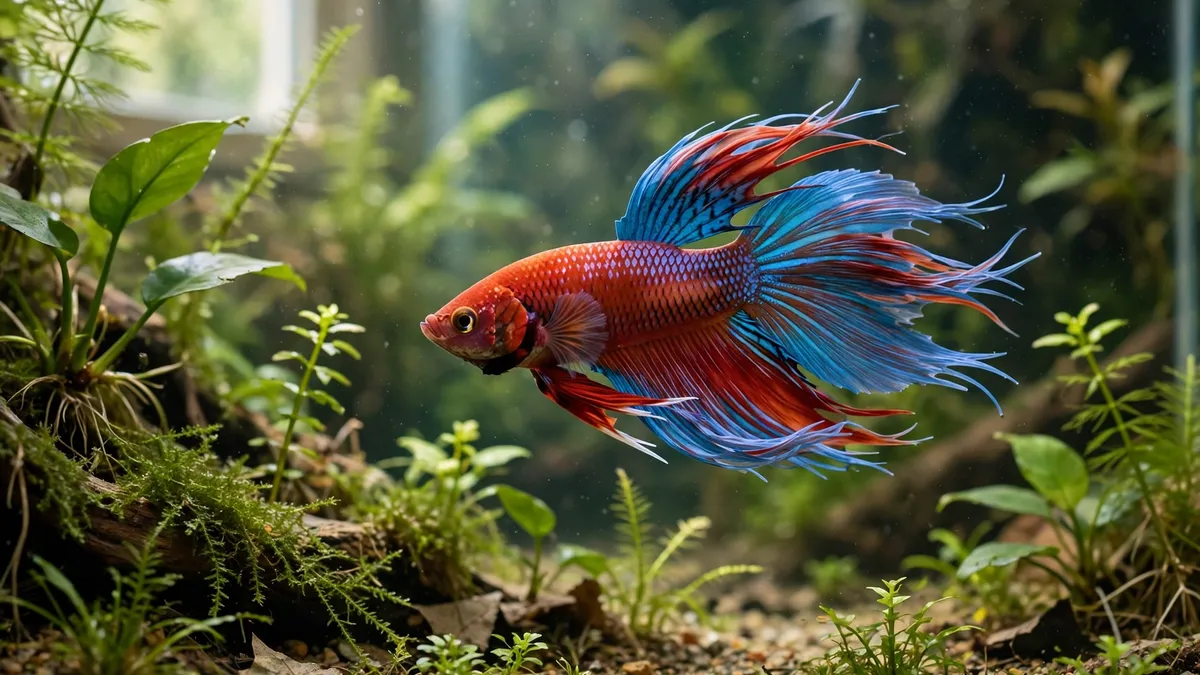
The betta fish species most people know is a single fish, the Siamese fighting fish Betta splendens, and it is one of the most popular aquarium fish in the world, a small fish with flowing fins in red, blue and turquoise that can breathe air at the surface of warm, still water. If you are asking how many betta fish species there are, the answer is larger than most people expect: the genus Betta holds 78 recognised species, and Betta splendens is only the best known of them, a wild fish of the rice paddies of Southeast Asia that people have bred for centuries into the brightly coloured fish sold in pet shops today.
Wild bettas look nothing like the fish in the shop window. A wild Betta splendens is a small, olive-brown fish about 6 centimetres long, with short fins and flashes of red and blue when a male flares. The domestic betta has been bred into veiltails, halfmoons and crowntails in almost every colour, yet it keeps the wild fish’s most remarkable gift: a labyrinth organ that lets it gulp air at the surface and survive in warm, oxygen-poor water where most fish would suffocate.
Key takeaways
- The genus Betta holds 78 recognised species, and the Siamese fighting fish Betta splendens is the best known of them.
- Wild Betta splendens grow to about 6 to 7 centimetres long, live in shallow rice paddies in Southeast Asia, and are listed as Vulnerable by the IUCN.
- Bettas breathe air at the surface through a labyrinth organ, which lets them live in oxygen-poor water.
- Male bettas build bubble nests at the surface, guard the eggs themselves, and flare their fins and gills at rival males.
- Bettas are insect eaters in the wild, feeding on mosquito larvae, small crustaceans and insects that fall onto the water.
What makes a betta fish a betta fish
A betta is a small, deep-bodied freshwater fish with an upturned mouth, a long dorsal fin and a rounded tail, built for life at the surface of still, warm water. The body is usually about 6 centimetres long in the wild, though domestic males with their long fins look far larger. Males are larger and more colourful than females, with longer fins, while females are plainer and often carry a small white egg spot near the belly.
What truly sets a betta apart is its labyrinth organ, a folded, blood-rich chamber above the gills that works like a simple lung. A betta rises to the surface, gulps a mouthful of air and absorbs oxygen straight from it, so it can live in rice paddies, stagnant ponds and marshes where the water holds almost no dissolved oxygen. Like goldfish, which also thrive in still garden ponds, a betta is a hardy freshwater fish, but no other common aquarium fish breathes air quite so obviously.
The betta fish species and their relatives
The genus Betta belongs to the gourami family Osphronemidae, and its 78 recognised species are grouped into about a dozen species complexes, clusters of close relatives that share body shape and breeding behaviour. The best known is the splendens complex, the bubble-nesting fighting fish of Thailand, Laos, Cambodia and Malaysia, which holds Betta splendens alongside close relatives such as the peaceful betta Betta imbellis, the emerald betta Betta smaragdina and the Mahachai betta Betta mahachaiensis.
Bettas fall into two breeding groups: bubble-nesters such as Betta splendens build a nest of bubbles at the surface, while mouthbrooders such as Betta picta carry the eggs in the male’s mouth until they hatch. The smallest bettas reach only about 2.5 centimetres, while the largest, the Brunei beauty Betta macrostoma, can reach 9 to 10 centimetres.
| Type | Animal | Where it lives | Best-known food | Length or Weight |
|---|---|---|---|---|
| Family | Gouramis (family Osphronemidae) | Fresh waters of Asia and Africa | Insects, larvae and small crustaceans | About 3 to 30 cm long |
| Species | Siamese fighting fish (Betta splendens) | Rice paddies of Thailand and neighbours | Mosquito larvae and small crustaceans | About 6 to 7 cm long |
| Species | Peaceful betta (Betta imbellis) | Swamps of Thailand and Malaysia | Insects and small crustaceans | About 5 to 6 cm long |
| Species | Emerald betta (Betta smaragdina) | Rice paddies and swamps of Thailand and Laos | Insects, larvae and zooplankton | About 6 to 7 cm long |
| Species | Mahachai betta (Betta mahachaiensis) | Coastal swamps near Bangkok | Small insects and crustaceans | About 5 to 6 cm long |
| Species | Brunei beauty (Betta macrostoma) | Forest streams of Brunei and Borneo | Insects and small invertebrates | About 9 to 10 cm long |
How betta fish live
Wild bettas are insect eaters that feed at or near the surface, snapping up mosquito larvae and pupae, small crustaceans such as copepods and water fleas, and insects that fall onto the water. They are not plant eaters: a wild betta ignores vegetation and hunts small animal prey, taking it with a quick upward snap of its upturned mouth. In captivity they do well on small pellets and frozen foods such as bloodworms, daphnia and brine shrimp, fed in small amounts twice a day, because a betta’s stomach is only about the size of its eye.
Bettas are solitary and fiercely territorial, above all the males. A male defends a patch of shallow water, and when another male appears he flares his gill covers and spreads his fins in a display meant to settle the contest without a fight. Wild sparring usually lasts only a few minutes before one fish backs away, though domestic males bred for aggression will fight far longer, which is why two males must never share a tank.
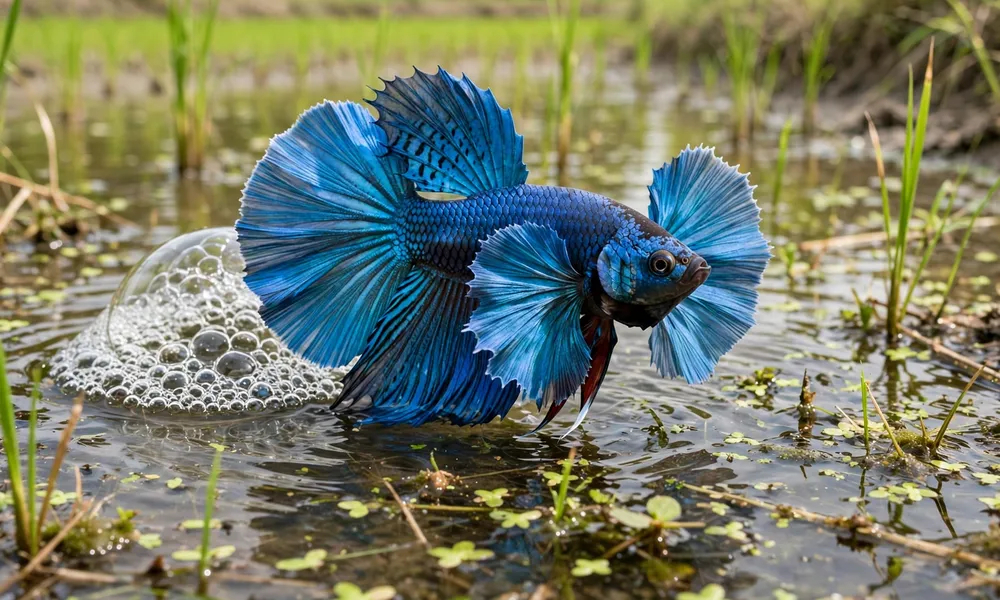
Breeding is the male’s work. Before mating he spends hours blowing mucus-coated bubbles into a floating nest anchored to a leaf. When a female is ready she darkens and shows pale vertical breeding bars, and after spawning the male gathers the eggs in his mouth, places them in the nest and guards them alone until the fry swim free. Mouthbrooding bettas do the same job differently, with the male carrying the eggs in his mouth instead of building a nest.
Where betta fish live
Bettas are freshwater fish of Southeast Asia, native to Thailand, Laos, Cambodia, Vietnam, Malaysia, Indonesia and Myanmar, with different species in different corners of the region. Betta splendens itself comes from the Mekong basin, living in canals, rice paddies, floodplains and stagnant ponds, while its relatives occupy peat swamps, blackwater streams, forest pools and even brackish coastal swamps, as Betta mahachaiensis does near Bangkok. Almost all of them share one preference: shallow, slow or still water, thick with plants.
Escaped pet bettas now live in warm waters in many tropical countries. The wild fish, meanwhile, is in trouble at home. Betta splendens is listed as Vulnerable by the IUCN, threatened by pollution from urban wastewater and farm chemicals running off into its paddies and ponds, and by the draining of wetlands for building and farming. Several relatives are in worse shape: Betta mahachaiensis and Betta simplex are Critically Endangered, and Betta pi is Endangered, each confined to a handful of shrinking swamps. Like seahorses, which also depend on fragile shallow-water habitats, wild bettas need clean, undisturbed water.
Best seasons for betta fish watching
The best time to see wild bettas is the wet season, roughly from May to October in Thailand, when the rice paddies flood and the shallow waters are full of fish. Males are easiest to spot in the early morning, when they rise to the surface to gulp air and tend their bubble nests. Look for the nest first: a small raft of bubbles tucked against a floating leaf is the surest sign a male is nearby.
Staying safe around betta fish
A betta is harmless to people and has no bite worth worrying about, but it is a delicate wild animal that should be watched without being handled. Never catch a wild betta with bare hands, never lift it out of the water for a photograph, and never release a pet-shop betta into a local pond or river, where it can spread disease and compete with native fish. In an aquarium, keep the water warm and clean, and keep the tank covered, because bettas are strong jumpers and will leave an open tank overnight.
Betta fish watching checklist
A little preparation turns a morning at a rice paddy into a real chance of seeing a betta flare, feed and build its bubble nest.
- A shallow rice paddy or slow pond in Southeast Asia in the wet season, when the paddies are flooded.
- An early morning visit, when males rise to the surface to gulp air and tend their bubble nests.
- Sharp eyes for a raft of bubbles against a floating leaf, the surest sign a male betta is nearby.
- Polarised sunglasses, which cut the glare on the water and make a small fish easier to spot.
- Patience and stillness at the water’s edge, because a betta will vanish into the plants at the first footstep.
- A warm, planted aquarium with floating plants, for watching a pet betta at home.
- A field guide to Southeast Asian freshwater fish, for telling Betta splendens from Betta imbellis.
Frequently asked questions
How many betta fish species are there?
There are 78 recognised species in the genus Betta, grouped into about a dozen species complexes. The count has risen from about 73 a few years ago, so the safest figure is more than 70.
What is a bubble nest?
A bubble nest is a floating raft of mucus-coated bubbles that a male betta blows at the surface, usually anchored to a floating leaf. After spawning, the male places the eggs in the nest and guards them until the fry swim free.
What do betta fish eat?
Wild bettas are insect eaters that feed at the surface on mosquito larvae, small crustaceans and insects that fall onto the water. In captivity they do well on small pellets and frozen foods such as bloodworms, daphnia and brine shrimp, fed in small amounts twice a day.
Why do betta fish fight?
Male bettas defend a patch of shallow water, and when another male appears they flare their gill covers and spread their fins in a display that usually settles the contest without a fight. Wild sparring lasts only a few minutes, but domestic males will fight far longer, which is why two males must never share a tank.
How is this guide different from the basking shark species guide?
This guide covers the betta fish, a genus of 78 small freshwater species from Southeast Asia, whose best-known member breathes air and builds a bubble nest, while our basking shark species guide covers a single enormous filter-feeding shark in cold open ocean. Bettas live in ankle-deep water, and basking sharks cruise the open sea.
Are betta fish endangered?
Betta splendens is listed as Vulnerable by the IUCN, threatened by pollution and the loss of its wetland habitat, and several relatives are in worse shape: Betta mahachaiensis and Betta simplex are Critically Endangered, and Betta pi is Endangered. The domestic betta is enormously common in captivity, but the wild fish needs clean, undisturbed shallow water to survive.
Conclusion
The betta fish species show how much variety can hide inside one small genus: 78 recognised species, from the tiny wine-red bettas of the peat swamps to the Brunei beauty, and one famous fish, Betta splendens, that learned to breathe air and build a nest of bubbles.
If you go looking for one, go to a flooded rice paddy in the wet season, go early, and go quietly. Watch for a raft of bubbles against a leaf, wait for the male to rise and flare, and you will see why a fish barely longer than your thumb has been admired for centuries.