The basking shark species is a single fish, Cetorhinus maximus, and it is the second-largest living fish in the world, a huge, slow, gentle shark that can reach 12 metres and six tonnes. If you are asking how many basking shark species there are, the answer is one: there is a single basking shark species, Cetorhinus maximus, the only member of the family Cetorhinidae, found in the cool temperate seas of the Atlantic and the Pacific, where it swims slowly at the surface with its enormous mouth open, filtering plankton from the water.
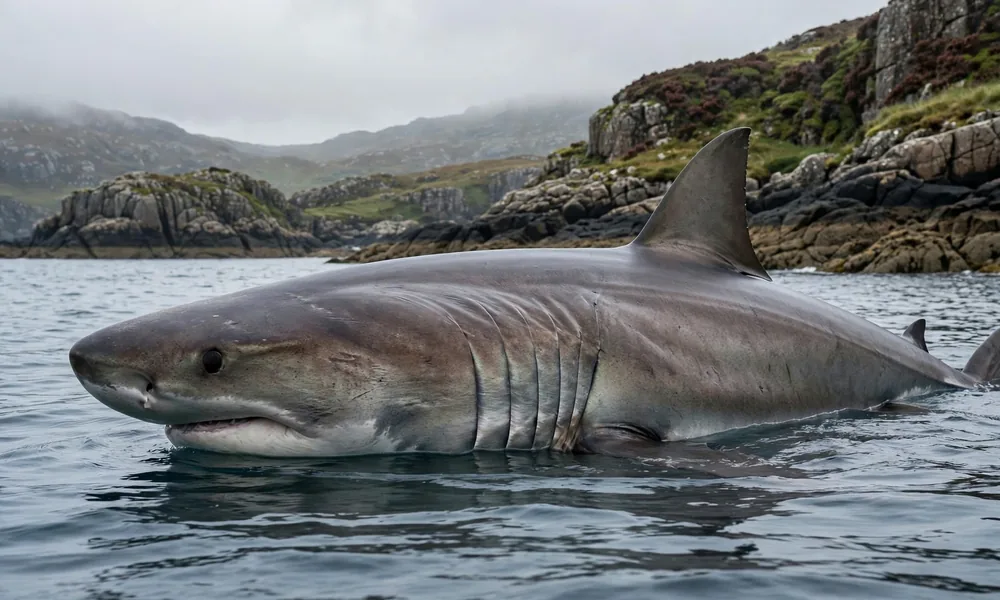
At first glance a basking shark looks alarming: a great grey-brown body, a dorsal fin like a sail, and a mouth up to a metre wide. In reality it is harmless. It has about 1,500 tiny, hooked teeth that it does not use for feeding, and it lives entirely on zooplankton, strained from the sea with comb-like gill rakers. Its name comes from cruising just below the surface, as if basking in the sun, when it is really feeding in the warm, plankton-rich top layer.
Key takeaways
- There is one basking shark species, Cetorhinus maximus, the only member of the family Cetorhinidae.
- Basking sharks are the second-largest living fish, reaching up to 12 metres and six tonnes, second only to the whale shark.
- Basking sharks are filter feeders that eat zooplankton, above all copepods, strained from the water with comb-like gill rakers.
- They swim slowly at the surface in spring and summer, then move into deeper water in winter, diving to more than 1,200 metres.
- Basking sharks are listed as Endangered, because they were hunted for liver oil and fins and recover very slowly.
What makes a basking shark a basking shark
A basking shark is a massive, bulky shark with a blunt, rounded snout, a huge mouth, and gill slits that almost meet under the throat. Its skin is grey-brown or blackish above and paler below, and its first dorsal fin is tall and triangular. Most adults are 7 to 9 metres long. The mouth can open up to a metre wide, and inside it are gill rakers, long, dark, comb-like structures that trap plankton as water flows over the gills.
The teeth tell the story of what this shark really is. A basking shark has about 1,500 tiny, hooked teeth, six rows above and nine below, but they are not used in feeding; scientists believe they play a part in mating instead. Unlike the great white shark, a fast predator with large, serrated teeth for cutting prey, the basking shark is a passive filter feeder: it does not suck water in, as a whale shark does, but swims forward with its mouth open, at about 3 to 4 kilometres per hour.
The basking shark species and their relatives
There is one basking shark species, Cetorhinus maximus, in the family Cetorhinidae, a family with only this one living species. It is a mackerel shark, in the order Lamniformes, which also includes the great white shark and the shortfin mako, but it gave up biting prey and became a filter feeder instead.
Only two other sharks feed the same way. The whale shark is the largest fish in the world, and the megamouth shark is a rare deep-water filter feeder discovered only in 1976. The three are not close relatives: the whale shark sucks water in, the megamouth gulps it, and the basking shark swims through it with its mouth open.
| Type | Animal | Where it lives | Best-known food | Length or Weight |
|---|---|---|---|---|
| Family | Basking sharks (family Cetorhinidae) | Cool temperate seas worldwide | Zooplankton, above all copepods | Up to about 12 m long |
| Species | Basking shark (Cetorhinus maximus) | Temperate Atlantic and Pacific | Copepods and fish eggs | Up to 12 m long and 6 tonnes |
| Species | Whale shark (Rhincodon typus) | Tropical and warm seas worldwide | Plankton and small fish | Up to about 12 m long |
| Species | Megamouth shark (Megachasma pelagios) | Deep tropical and temperate seas | Plankton, krill and jellyfish | Up to about 5.5 m long |
| Species | Great white shark (Carcharodon carcharias) | Coastal temperate and subtropical seas | Seals and large fish | Up to about 6 m long |
| Species | Shortfin mako shark (Isurus oxyrinchus) | Open tropical and temperate seas | Tuna and squid | Up to about 4 m long |
How basking sharks live
Basking sharks eat zooplankton, above all the small copepod Calanus, which blooms in cool shelf seas in spring and summer, together with fish eggs and larvae. A basking shark can filter around 2,000 tonnes of seawater an hour through its gills. It feeds where tidal fronts pile up plankton, swimming slowly through the densest patches with its mouth wide open.
Basking sharks are usually solitary, but they gather where food is rich, sometimes in schools of up to a hundred or more. They cruise at about two miles per hour, yet they can migrate across whole ocean basins. They are also the biggest sharks that can breach, propelling their huge bodies clear of the water.
Very little is known about basking shark reproduction: only one pregnant female has ever been studied, off Norway in 1943. They are believed to be ovoviviparous, with pups born at 1.5 to 2 metres long after hatching inside the mother. Males mature at about 12 to 16 years and females at about 18 to 20, and gestation may last up to three and a half years. Basking sharks are thought to live for about 50 years.
Where basking sharks live
Basking sharks live in the cool temperate seas of both hemispheres, in water of 8 to 24 degrees Celsius. In the North Atlantic they range from Iceland and Norway to the Mediterranean and West Africa, and from Newfoundland to Florida; in the North Pacific from Japan to Alaska and Baja California; and in the south off Australia, New Zealand, South America and South Africa. They are found from the surface to more than 1,200 metres deep, and are most often seen in summer in shallow shelf waters where plankton blooms.
In Britain and Ireland they are summer visitors, seen between May and October, most often around Cornwall, western Scotland, the Isle of Man and the Hebrides. In winter they were once thought to hibernate on the seabed, but satellite tags show they simply move deeper and keep feeding. A shark tagged off the Isle of Man in 2007 was later recorded off Newfoundland, having swum more than 9,500 kilometres across the Atlantic.
Basking sharks are listed as Endangered, after the global population fell by more than half. They were hunted for centuries for liver oil, rich in squalene and used for lamps, cosmetics and lubricants, and for meat, fins and skin. In the northeast Atlantic alone more than 100,000 mature basking sharks were killed between 1946 and 1997, and the Achill Island fishery, which took about 1,475 sharks a year in the early 1950s, had almost collapsed by 1962. Hunting has now largely ceased and the species is protected in many countries, but sharks are still taken as bycatch, and recovery is slow because they mature late and have few young.
Best seasons for basking shark watching
The best time to watch basking sharks is late spring and summer, from May to September, when they gather at the surface to feed. The best-known hotspots are the Sea of the Hebrides, the Isle of Man, Cornwall and the west coast of Ireland. Boat trips run from harbours in western Scotland and Cornwall in summer, and the sharks are most often seen on calm, sunny days, cruising just below the surface. Early morning and late afternoon, when the sea is flat, give the best chance.
Staying safe around basking sharks
A basking shark is harmless to people: it has never bitten anyone. Even so, it is a huge wild animal and must be treated with respect. Keep a good distance, never try to touch one, and never block its path or chase it with a boat. In Scotland, boat operators follow a code of conduct that keeps boats at least 100 metres away. If you are kayaking near a feeding shark, stay still, keep clear of its mouth and tail, and let it pass.
Basking shark watching checklist
Watching a basking shark means a summer day on a boat in cool northern seas, so pack for wind, sun and long hours of looking at the water.
- A boat trip from western Scotland, Cornwall or the Isle of Man in May to September.
- Warm layers, a waterproof jacket and sun cream, for a long day at sea.
- Binoculars, for spotting a dorsal fin breaking the surface at a distance.
- A camera with a zoom lens, for photographing the shark from a distance.
- A calm, sunny day, when basking sharks feed at the surface and are easiest to see.
- A licensed wildlife boat operator who follows the basking shark code of conduct.
- Patience, because the sharks move with the plankton, and a sighting is never guaranteed.
Frequently asked questions
How many basking shark species are there?
There is one basking shark species, Cetorhinus maximus. It is the only member of the family Cetorhinidae and one of only three filter-feeding sharks, alongside the whale shark and the megamouth shark.
How big can a basking shark get?
Basking sharks can reach up to 12 metres and six tonnes, making them the second-largest living fish, second only to the whale shark. Most adults are 7 to 9 metres long.
What does a basking shark eat?
Basking sharks eat zooplankton, above all the small copepod Calanus, together with fish eggs and larvae. They filter about 2,000 tonnes of seawater an hour, and their tiny teeth are not used in feeding.
Are basking sharks dangerous to people?
No. Basking sharks are completely harmless to people: slow, gentle filter feeders with tiny teeth that have never bitten anyone. They are large animals with very rough skin, so keep your distance.
How is this guide different from the atlantic halibut species guide?
This guide covers the basking shark, a single giant shark species that swims at the surface of cool temperate seas and filters plankton through its gills, while our atlantic halibut species guide covers the Atlantic halibut, a single flatfish species that lies on the seabed of the cold North Atlantic and hunts other fish by ambush.
Are basking sharks endangered?
Yes. Basking sharks are listed as Endangered, after their global population fell by more than half, largely because they were hunted for liver oil and fins. They mature at about 18 to 20 years, may carry their young for up to three and a half years, and have very few pups, so recovery is slow even though hunting has largely ceased.
Conclusion
The basking shark species shows how gentle a giant can be: a single species, Cetorhinus maximus, the second-largest fish in the world, that swims slowly through cool seas with its great mouth open, living entirely on animals too small to see.
If you go looking for one, go to western Scotland or Cornwall in summer, by boat on a calm, sunny day, with a licensed operator who keeps a respectful distance. Watch the surface for a tall dorsal fin, wait for the huge grey back to rise beside it, and remember that the animal you are watching may be fifty years old.