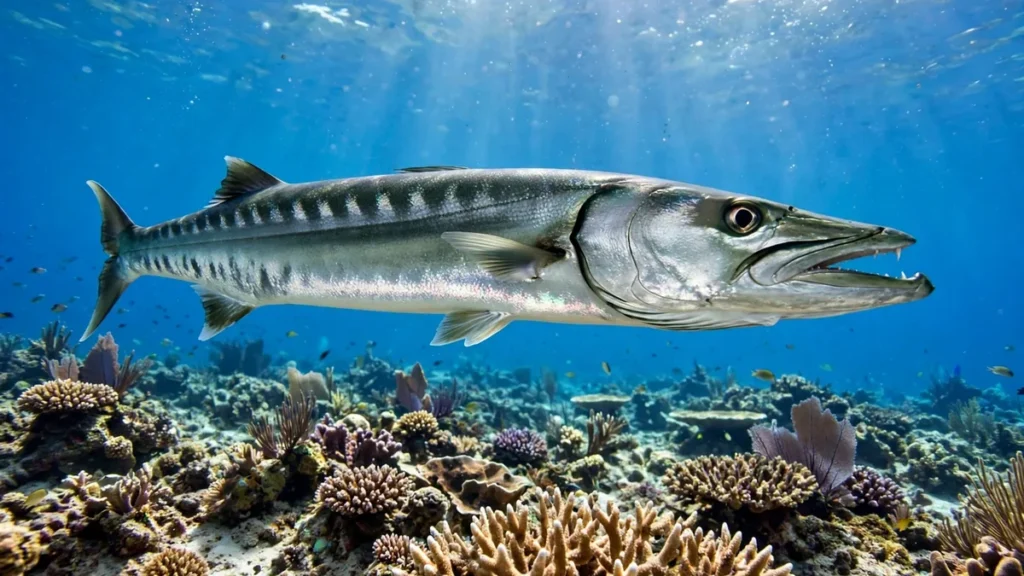
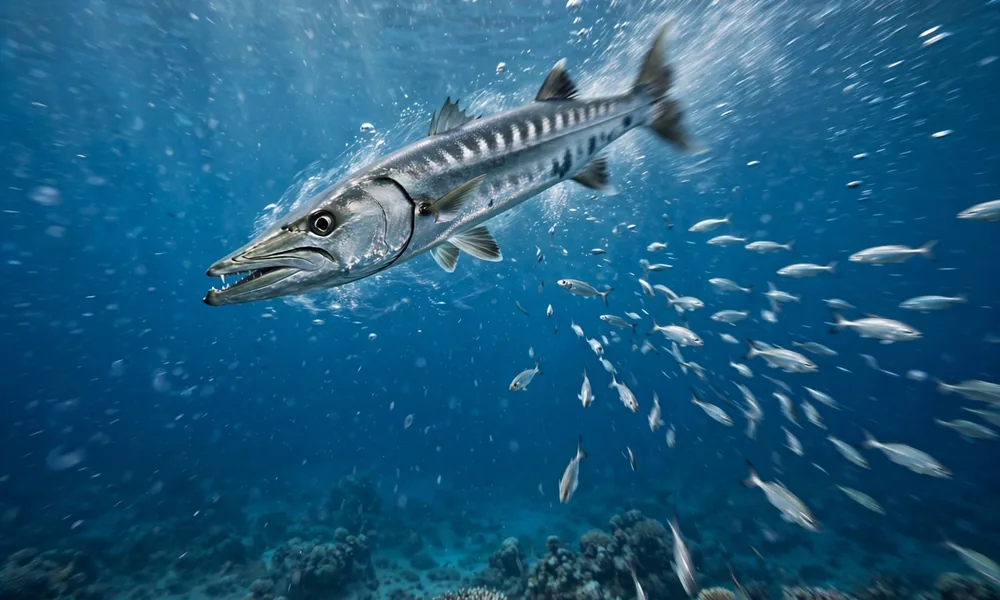
The great barracuda species is the silver torpedo of the tropical reef, a long, lean hunter with a jutting lower jaw and a mouth full of fang-like teeth. If you are asking what a great barracuda is, the short answer is Sphyraena barracuda, the largest of the barracudas, a fish that most adults meet at 60 to 100 centimetres long, though the biggest reach about 1.8 metres and 50 kilograms. It does not chase its dinner across the reef the way a tuna does. It hangs in the water, barely moving, watching, and then it strikes in a burst of speed that leaves most fish with no time to react at all.
You will usually meet a great barracuda the same way divers do: as a shape that seems to have appeared out of nowhere, hanging in the blue a few metres away, watching you back. It is not a fish that hides. A big one will hold its place over a reef edge or under a boat, its dark bars breaking up its silver flank, and it will let you come close enough to see the teeth before it slides away. This guide covers the whole animal, from its family tree and its hunting style to where it lives, what it eats, how it breeds, and the one good reason never to eat a large reef barracuda.
Key takeaways
- The great barracuda species is Sphyraena barracuda, the largest barracuda, with most adults measuring 60 to 100 centimetres and the biggest reaching about 1.8 metres and 50 kilograms.
- It is a torpedo-shaped ambush hunter with a prominent underbite, a single row of fang-like teeth in the lower jaw and smaller sharp teeth above.
- Great barracudas live on tropical and subtropical reefs and in open water nearby, from the western Atlantic and Caribbean to the Indo-Pacific, and young fish shelter in seagrass and mangroves.
- They eat fish and squid, striking in short bursts of speed, and they often hunt alone, though young fish sometimes gather in small schools.
- The species is listed as Least Concern, but large reef barracudas can carry ciguatera poison, so eating one is a real health risk in some regions.
The great barracuda species and its relatives
Great barracudas belong to the family Sphyraenidae, the barracudas, and to the genus Sphyraena, a group of about 28 species of long, fast, sharp-toothed hunters. The scientific name, Sphyraena barracuda, is a straightforward one: Sphyraena comes from the Greek word for a hammer or a pike, and barracuda is the name Spanish sailors gave the fish when they first met it in the Caribbean. It was described in 1771 by the English naturalist George Edwards, and it has kept its name ever since, even as the smaller barracudas around it were sorted and re-sorted.
Barracudas as a family are easy to recognise, and they are found in tropical and subtropical seas all over the world. The smallest species are barely over 30 centimetres long, while the largest, the great barracuda, reaches about 1.8 metres, so the family spans roughly 30 centimetres to 1.8 metres from end to end. All of them share the same basic design: a long, round, torpedo-shaped body, a pointed snout, a lower jaw that juts forward, and two dorsal fins set well back on the body, with a forked tail that drives the burst of speed. They are built for short, violent rushes, not for long-distance cruising.
| Type | Animal | Where it lives | Best-known food | Length or Weight |
|---|---|---|---|---|
| Family | Barracudas (Sphyraenidae) | Tropical and subtropical seas worldwide | Fish and squid | About 30 cm to 1.8 m long |
| Genus | Barracudas (Sphyraena) | Tropical and subtropical seas worldwide | Fish, squid and shrimp | About 30 cm to 1.8 m long |
| Species | Great barracuda (Sphyraena barracuda) | Tropical Atlantic, Caribbean and Indo-Pacific reefs | Fish and squid | About 60 cm to 1 m long, up to 1.8 m |
| Species | Yellowtail barracuda (Sphyraena flavicauda) | Indo-Pacific reefs | Small fish | About 30 cm to 60 cm long |
| Species | European barracuda (Sphyraena sphyraena) | Eastern Atlantic and Mediterranean | Small fish and squid | About 30 cm to 60 cm long |
| Species | Pickhandle barracuda (Sphyraena jello) | Indo-Pacific coastal waters | Fish and squid | About 60 cm to 1.5 m long |
The closest relatives of the great barracuda are the other large Sphyraena species, and the most useful comparison is with the pickhandle barracuda of the Indo-Pacific, which reaches about 1.5 metres and looks so similar that divers often confuse the two. The yellowtail barracuda is a much smaller reef fish at 30 to 60 centimetres, and it spends more of its life in tight schools, while the European barracuda, also about 30 to 60 centimetres, lives in the eastern Atlantic and the Mediterranean, where the great barracuda is now also turning up as the sea warms. Telling them apart in the water usually comes down to size and markings: the great barracuda is the big one, with dark bars along its flank and a dark blotch on the lower lobe of its tail.
There is one more relationship worth knowing, and it is the one that explains the barracuda’s shape. Like the tiger shark, a great barracuda is a top predator on its reef, but the two hunt in very different ways: the tiger shark patrols wide and takes what it finds, while the barracuda waits, watches, and strikes once, and that difference is written all over its body. The pike-like shape, the rear-set fins and the forked tail are all about one thing, a burst of speed from a standing start, and a barracuda can hit about 40 kilometres an hour in a rush that lasts only a few seconds.
What a great barracuda looks like
A great barracuda is a long, round, silver tube of a fish, built like a pike and coloured like polished metal. Most adults measure 60 to 100 centimetres from snout to tail, and a big fish can weigh 20 to 30 kilograms, with the largest on record reaching about 1.8 metres and 50 kilograms. The back is a dark green-grey that fades to silver on the flanks and white on the belly, and the sides carry a row of dark crossbars that break up the outline in dappled reef light. Young fish show the bars more boldly than adults, and the bars fade a little as the fish grows, though they never disappear entirely.
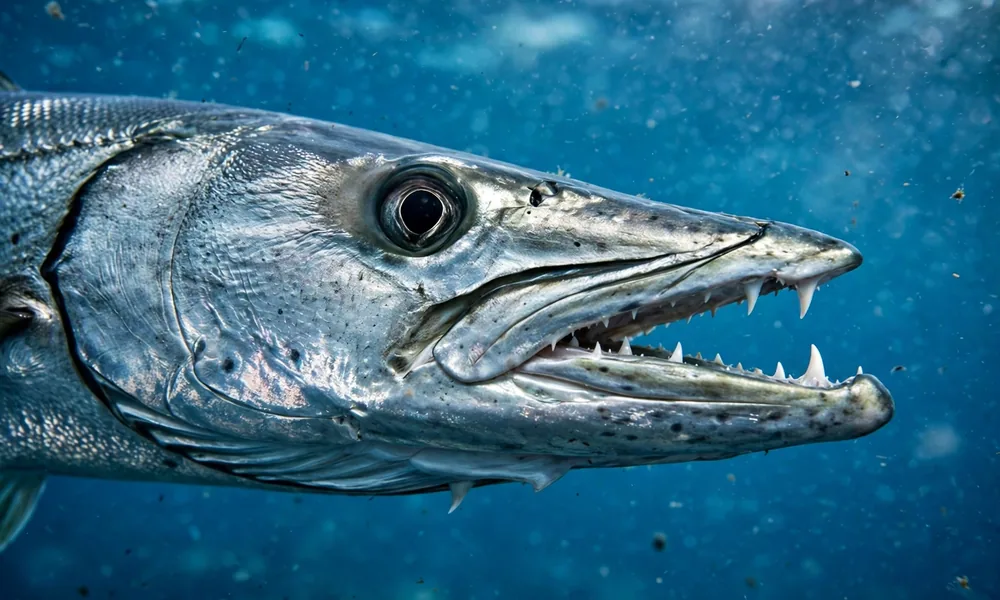
The head is the part you remember. The snout is long and pointed, and the lower jaw juts well past the upper one, giving the fish a permanent underbite that looks almost like a grin. The mouth is wide and set low, and it carries two kinds of teeth: a single row of large, fang-like teeth in the lower jaw, each one set in its own socket and pointing slightly backwards, and smaller, sharper teeth in the upper jaw. The fangs are made for gripping and tearing, not for chewing, and a barracuda swallows its prey whole or in large chunks, working it down head first.

The fins are set far back on the body, which is the key to the barracuda’s hunting style. Two dorsal fins sit well apart on the back, the first spiny one about midway along the body and the second above the anal fin near the tail, and the tail itself is deeply forked and powerful. The pectoral fins are small and sit low on the body, and they are used for steering and for holding still in the water rather than for driving the fish forward. When a barracuda is waiting in ambush, it often holds itself with tiny flicks of those pectoral fins, barely moving at all, and when it strikes, the tail does the work.
Males and females look much alike, and there is no reliable way to tell them apart by eye in the water. Females tend to grow a little larger than males, which is common in fish that produce large numbers of eggs, but the overlap is so wide that size alone proves nothing. The best clue to a fish’s age is its length and the boldness of its bars: young fish are smaller, slimmer and more strongly barred, while a very large, plain-sided fish with faded bars is almost certainly an old adult.
Where great barracudas live
Great barracudas live in tropical and subtropical seas around the world, in a range that covers the western Atlantic from the south-eastern United States and Bermuda through the Caribbean to Brazil, the eastern Atlantic off West Africa, and the whole Indo-Pacific from the Red Sea and East Africa to Hawaii and the eastern Pacific. They are a warm-water fish, and they follow the warm currents, which is why they are now appearing more often in the Mediterranean, where the sea has warmed enough for them to settle.
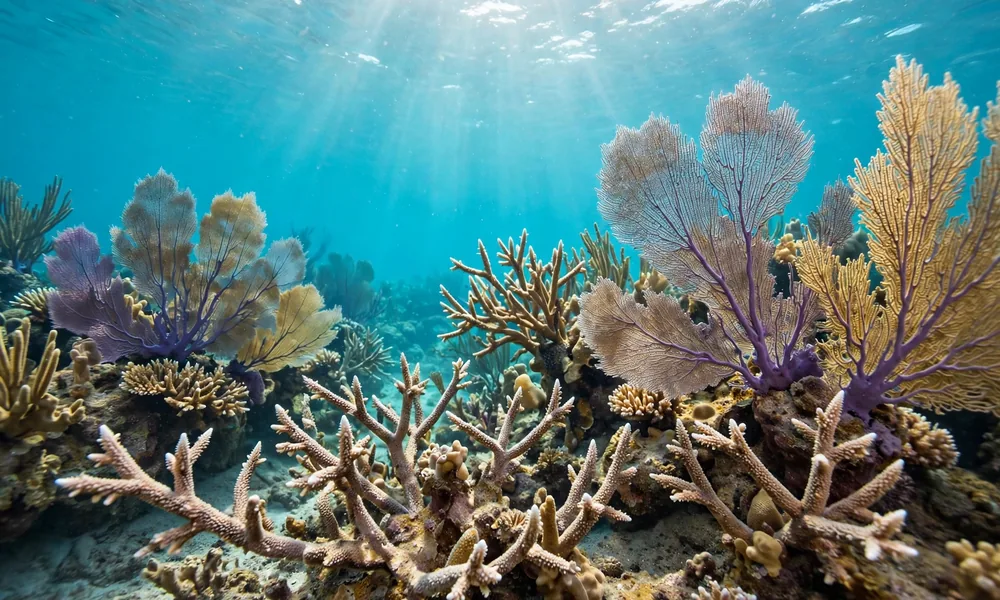
The habitat they choose is the reef edge and the open water just beyond it. An adult great barracuda spends its day around coral reefs, rocky outcrops, wrecks and the edges of drop-offs, usually in water from a few metres down to about 100 metres, though it is most often seen in the top 30 metres. It likes a vantage point: the end of a reef spur, a channel between two coral heads, or the shade under a boat or a pier, where it can hang in the current and watch the smaller fish come and go. It is not a fish that hides in holes. It hangs in open water and relies on being still.

Young barracudas live somewhere quite different, and that split is one of the most important facts about the species. Juveniles shelter in shallow seagrass meadows, mangrove roots and sheltered lagoons, where the water is warm and murky and the bigger predators cannot easily follow. They stay in the shallows for their first year or two, growing fast on small fish and shrimps, and they move out to the reef as they grow, trading the safety of the mangroves for the richer hunting of the reef edge. Protecting those nursery grounds matters as much as protecting the reef itself, because without them there are no young fish to replace the adults.
What great barracudas eat
Great barracudas eat fish and squid, and they are not fussy about which kind, as long as it fits in the mouth and is slower than they are. The everyday diet is made up of reef fish such as grunts, snappers, small jacks and herring, along with squid when it is in season, and the fish takes what is commonest in its own patch of reef. A barracuda will eat a fish half its own length if it can get its jaws around it, and it will take a bite out of a fish too big to swallow whole, which is why anglers sometimes pull in a catch with a clean, crescent-shaped chunk missing.

The hunting style is a mix of waiting and stalking, and it changes with the prey. A barracuda often hangs motionless in the water, sometimes in the odd head-down posture that divers find so strange, watching a school of small fish and waiting for one to stray. When it moves, it moves slowly, drifting closer with tiny flicks of its tail, and then it strikes: a burst of speed, a snap of the jaws, and the prey is gripped by the fangs and swallowed head first. The whole attack takes a second or two, and if it misses, the barracuda does not chase. It drifts back to its waiting place and starts again.
Feeding is closely tied to the light. Great barracudas hunt most actively at dawn and dusk, when the reef fish are moving between their night shelters and their daytime feeding grounds and are easiest to catch. They also hunt on a bright moonlit night, and they will gather around lights on a pier or a boat, picking off the small fish drawn in by the glow. Like the bluefin tuna, a great barracuda is a fast, warm-water predator of fish, but the tuna hunts by cruising great distances at speed, while the barracuda hunts by waiting and striking, and that difference shapes everything from its body to its daily rhythm.
How great barracudas behave
Great barracudas are solitary for most of their lives, and a big adult will usually be found alone, hanging in the water at the edge of a reef or under a boat, watching the world go by. They are not shy, and they are not aggressive either: a barracuda’s usual response to a diver is to watch, hold its place, and then slide away if the diver comes too close. They are curious animals, though, and a diver who stays still will often find a barracuda drifting closer, close enough to see the eye move and the gills working.
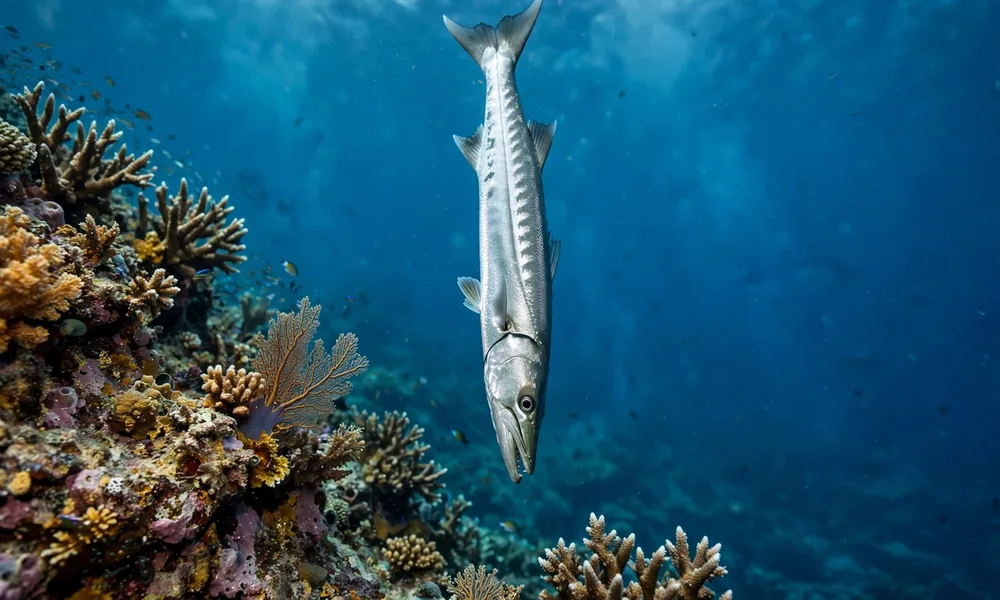
The head-down posture is the behaviour divers ask about most, and it is worth describing properly. A barracuda will sometimes hang vertically in the water, nose down and tail up, for minutes at a time, barely moving, and it does this while watching the reef below. Nobody knows exactly why it works, but the likeliest explanation is that it lets the fish blend into the vertical lines of the reef and the water column, so that prey below does not notice it until it is too late. It is not a sign of illness, and it is not a fish in trouble: a barracuda in this posture is hunting, and it will snap back to horizontal and strike in a fraction of a second.
Young barracudas behave very differently from adults, and they are far more social. Juveniles gather in small schools in the shallows, sometimes dozens together over a seagrass bed, and they hunt as a loose group, each fish taking what it can catch. As they grow, the schools break up, and by the time a fish reaches about 60 centimetres it is usually hunting alone. That shift from schooling youngster to solitary adult is one of the clearest signs that a barracuda has grown up, and it is also why the big fish on the reef are almost always found on their own.
Breeding and life cycle
Great barracudas breed in the warm months, when the water is at its warmest and food is plentiful for the young. Spawning takes place in open water, away from the reef, where the adults gather in small groups and release their eggs and sperm into the current. A large female can release tens of thousands of eggs in a season, and the eggs are tiny, buoyant and transparent, drifting with the plankton until they hatch within a day or two of being laid.
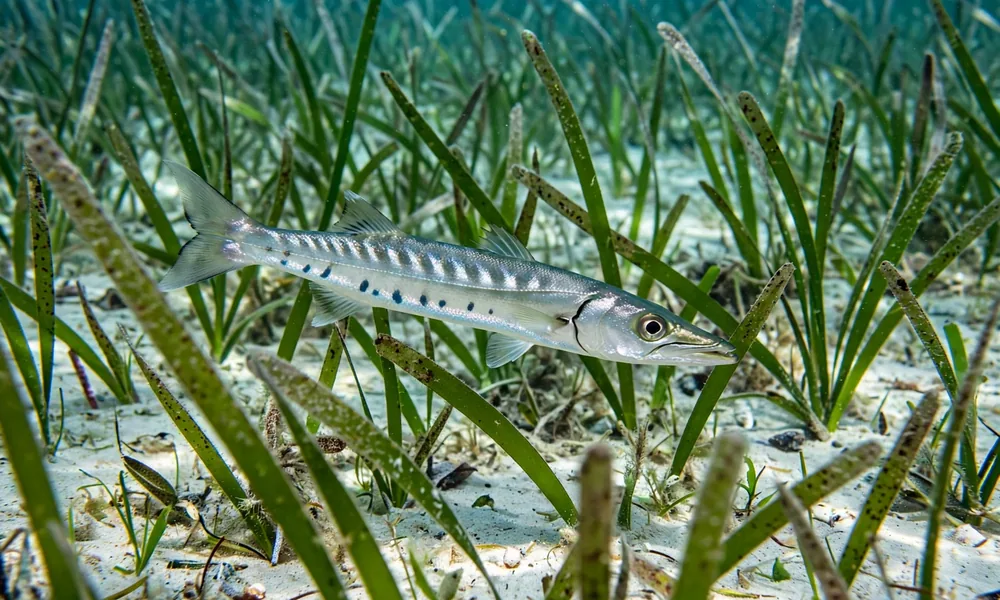
The larvae are tiny and defenceless, and most of them are eaten within days, which is why the numbers are so large. Those that survive drift into shallow water and settle in seagrass meadows and mangrove roots, where they grow fast on small shrimps and tiny fish. A young barracuda grows quickly in its first year, reaching 20 to 30 centimetres, and it keeps growing through its second and third years, moving out to deeper water as it gains size. It reaches breeding size at about two to three years old, when it is roughly 60 centimetres long, and from then on it lives on the reef as a solitary hunter.
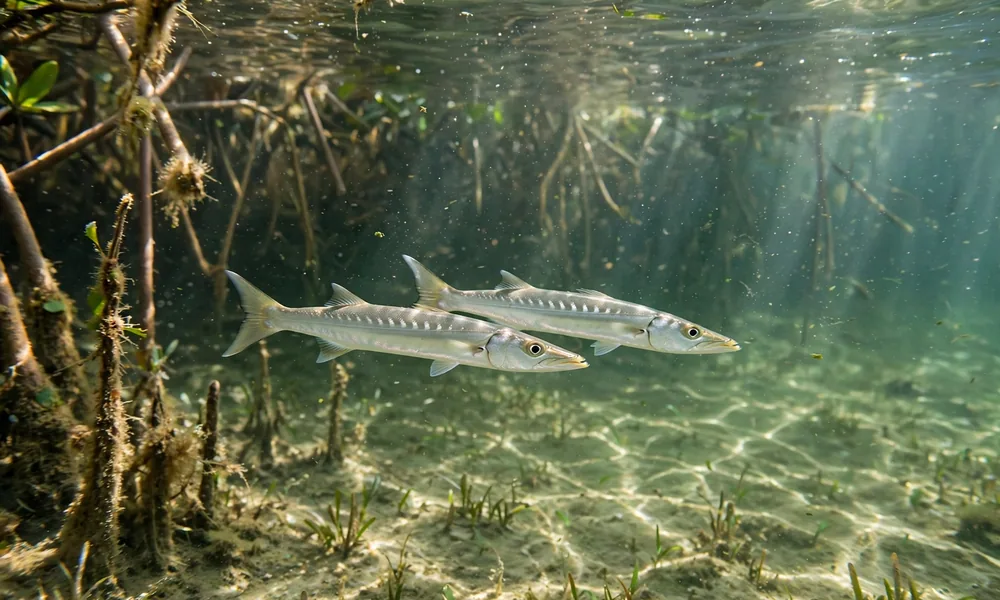
Growth slows once a barracuda reaches adult size, and the fish keeps growing slowly for the rest of its life, which is thought to last about 14 years in the wild, though very large fish may be older. There is no parental care at all: once the eggs are released, the adults swim away, and the young are on their own from the moment they hatch. It is a hard start, and the survival rate is low, but the fish that make it through the first year in the mangroves have a good chance of a long life on the reef.
Conservation status
The great barracuda is listed as Least Concern by the International Union for Conservation of Nature, and the reasoning is straightforward: it has a very large range, it is still common across much of that range, and it is not a fish that is targeted heavily by commercial fishing. It is caught for food and for sport in many places, and it is sometimes taken as bycatch, but the numbers taken do not appear to be driving the population down, and the species is found on reefs from the Atlantic to the Pacific.
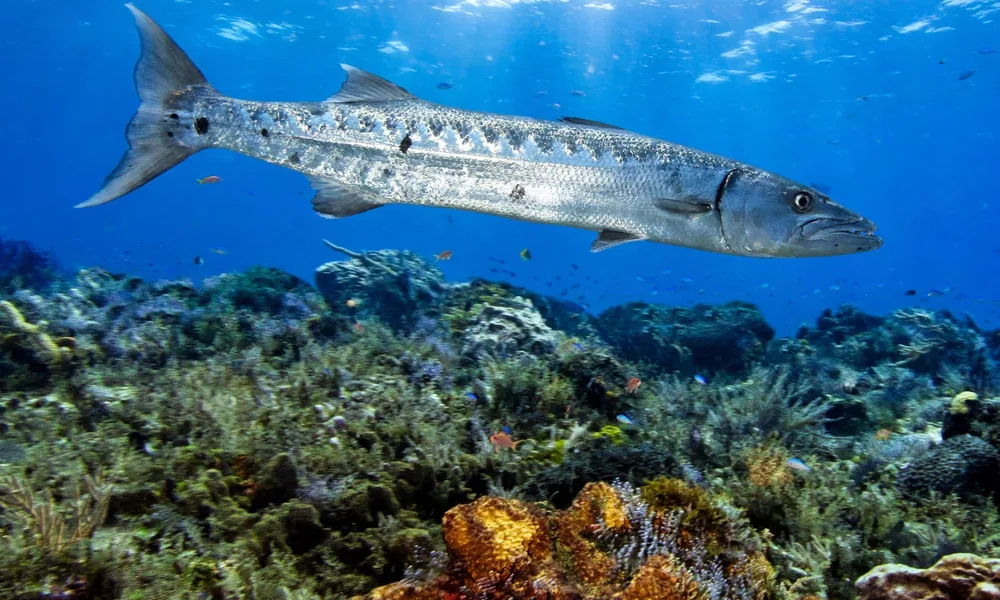
The real pressure on the great barracuda is not fishing but the health of its home. Coral reefs are under strain from warming seas, bleaching, pollution and coastal building, and a barracuda needs a healthy reef to hunt on, as well as healthy seagrass and mangroves for its young. When a reef dies, the small fish go first, and the barracudas follow, even if nobody is catching them. The most useful conservation work is practical: protecting reefs and mangroves, keeping coastal water clean, and managing the sport and food fisheries so that the big breeding fish are not all taken.
There is one more issue that matters to people who eat barracuda, and it is worth stating plainly. Large reef barracudas can carry ciguatera poison, a toxin that builds up in the fish from the algae on the reef, and eating a large barracuda from a reef known for ciguatera can cause serious food poisoning, with stomach pain, vomiting, and tingling or numbness that can last for weeks. The risk is highest with the biggest fish from warm reef areas, and local advice should always be followed: in many Caribbean islands, eating barracuda is simply not done, and that caution is well founded.
Best seasons for great barracuda watching
The best time to look for a great barracuda depends on where you are, because the fish lives in warm water all year round and there is no single season for the whole range. In the Caribbean and Florida, the calmest seas and clearest water come in the late spring and early summer, from about April to July, when the trade winds ease and the visibility on the reef is at its best. In the Indo-Pacific, the dry season is usually the better bet, and the fish are there all year, so the question is more about sea conditions than about the fish itself.
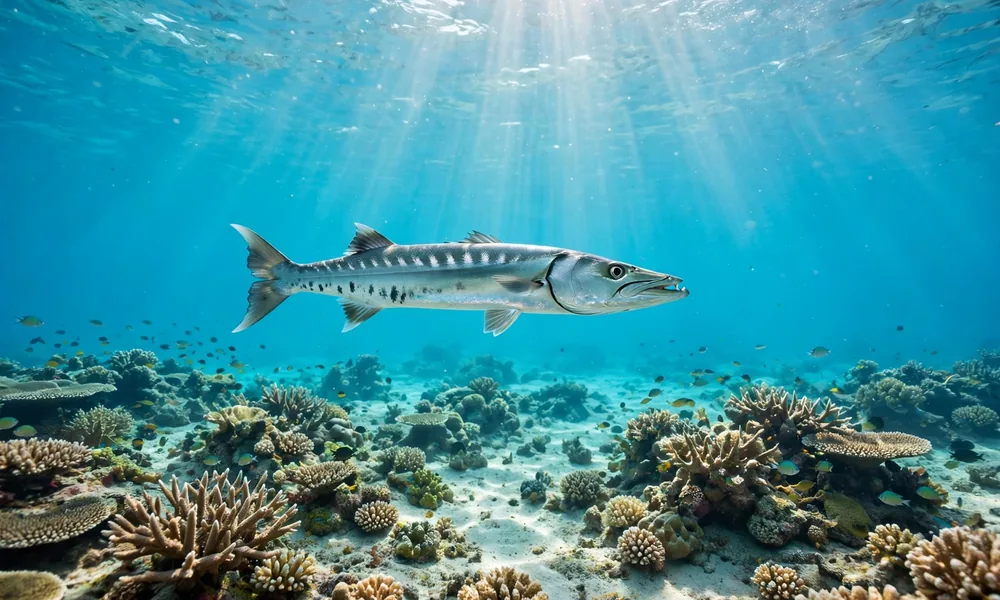
The best hours are the early morning and the late afternoon, when the barracuda is hunting and the reef fish are on the move. At midday, a big barracuda will often be hanging in deeper water or under a boat, resting in the shade, and it is still worth looking for, but it is less likely to be active. A snorkeller who stays near a reef edge or a wreck, moves slowly, and watches the blue water beyond the coral has a good chance of meeting one, and a diver who hangs still in the current will often find that the barracuda comes to look at them.
Staying safe around great barracudas
A great barracuda is not a fish that hunts people, and attacks are very rare, but it is a large predator with sharp teeth, and the safety rules are simple and worth following. The main risk is mistaken identity: a barracuda hunts by sight, and it is drawn to bright, flashing things, so shiny jewellery, a glittering watch, a bright knife handle or a camera flash can all look like a small fish. Take off the shiny things before you get in the water, and keep your hands still and your fingers tucked away when a barracuda is close.
There are a few practical points for the water itself. Never spearfish with dead fish on a belt or a stringer near your body, because a barracuda will come for the catch and it will not check what else is attached, and never feed a barracuda or wave food at one, because a fish that learns to associate divers with food loses its caution. If a barracuda follows you, stay calm, keep facing it, and swim slowly away: it is almost certainly curious, not aggressive, and it will lose interest. Like the marlin, a great barracuda is a powerful fish that deserves respect rather than fear, but the marlin is an open-ocean giant that rarely comes near a swimmer, while the barracuda is a reef fish that will come close enough to look you in the eye.
Great barracuda watching checklist
A little preparation turns a swim over a tropical reef into a real chance of meeting one of these silver hunters face to face.
- A visit in the calm season, from about April to July in the Caribbean and Florida, when the sea is flat and the reef visibility is at its best.
- An early morning or late afternoon swim, when the barracudas are hunting and the reef fish are on the move.
- A reef edge, a wreck or a drop-off, where a big barracuda can hang in the current and watch the smaller fish come and go.
- A slow approach that keeps you still in the water, because a barracuda that is not startled will often drift closer to look at you.
- No shiny jewellery, watches or bright metal on your body, so nothing flashes like a small fish in the sunlight.
- A mask, snorkel and fins in good order, and a buddy beside you, because the reef edge is open water and the current can pick up fast.
- Respect for the animal and its reef, keeping your distance, never feeding it, and leaving the coral and the seagrass as you found them.
Frequently asked questions
How big do great barracudas get?
Most adult great barracudas measure 60 to 100 centimetres long, and a big fish can weigh 20 to 30 kilograms. The largest on record reach about 1.8 metres and 50 kilograms, which makes the great barracuda the biggest of all the barracudas, and a fish that can be as long as a person is tall.
Are great barracudas dangerous to swimmers?
Attacks on people are very rare, and a great barracuda does not hunt humans. Most incidents involve a fish mistaking something shiny, such as jewellery or a flashing watch, for a small fish, or a fish coming after a speared catch. Taking off shiny things, keeping your hands still and never feeding a barracuda makes an encounter safe.
What do great barracudas eat?
A great barracuda eats fish and squid, especially reef fish such as grunts, snappers, small jacks and herring, along with squid when it is in season. It hunts by waiting in ambush and then striking in a short burst of speed, gripping its prey with fang-like teeth and swallowing it head first.
Can you eat great barracuda?
You can, and it is eaten in many places, but it carries a real risk of ciguatera poisoning, especially in large fish taken from warm reefs. The toxin builds up from algae on the reef and cannot be cooked away, and it can cause stomach pain, vomiting and tingling that lasts for weeks. Local advice should always be followed, and in many Caribbean islands barracuda is simply not eaten.
Why do barracudas hang head-down in the water?
A barracuda hanging vertically, nose down and tail up, is hunting, not sick. The posture is thought to help it blend into the vertical lines of the reef and the water column, so that prey below does not notice it until it strikes. A fish in this posture will snap back to horizontal and attack in a fraction of a second.
How is this guide different from the goliath grouper guide?
This guide covers the great barracuda, a long, silver ambush hunter that hangs in open water, strikes in a burst of speed and eats fish and squid, while our goliath grouper guide covers a huge, slow reef fish that waits in holes and wrecks, swallows whole fish and crustaceans in one gulp and can weigh more than a person. One is a fast, slender striker of the reef edge; the other is a massive, patient giant of the reef itself.
Conclusion
The great barracuda species is a reminder that a hunter does not need to be the biggest fish on the reef to be the one the others watch. A silver body built for a burst of speed, a jaw full of fangs, a patience that lets it hang motionless for minutes and a strike that takes a second have made Sphyraena barracuda the most recognisable predator of the tropical reef, at home on a reef edge, under a boat and over a seagrass bed alike.
If you go looking for one, go on a calm morning, go to the edge of the reef, and move slowly with your eyes on the blue water beyond the coral. Find the shape hanging there, watch it watch you, and you will have met the fish that the whole reef keeps an eye on.