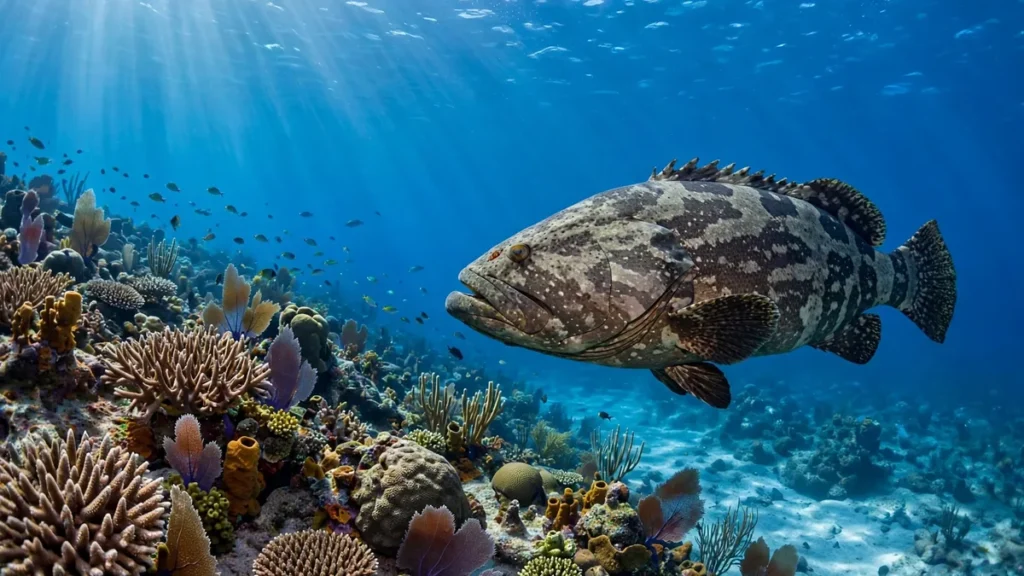
The goliath grouper species is the heavyweight of the Atlantic reef, a fish so large that divers meeting one for the first time often think they are looking at a boulder that has learned to swim. If you are asking what a goliath grouper is, the short answer is Epinephelus itajara, one of the largest bony fishes on any coral reef, growing to 2.5 metres long and weighing 360 to 450 kilograms. It is a slow, deliberate animal with a huge mouth, a mottled brown body and a habit of hovering motionless in the shadow of a wreck or a reef ledge, watching the world go by.
There is nothing else quite like it in the Atlantic. A full-grown goliath grouper outweighs most people by four or five times, it can swallow a lobster whole, and it can make a sound, a deep boom that you feel in your chest as much as hear, that carries through the water for a long way. And yet it is a gentle fish, curious rather than aggressive, and one that was fished almost to nothing before it was protected. Meeting one underwater is a reminder of how big a reef fish can get when it is left alone to grow old.
Key takeaways
- The goliath grouper species is Epinephelus itajara, the Atlantic goliath grouper, one of the largest reef bony fishes in the world.
- It grows to 2.5 metres long and weighs 360 to 450 kilograms, with a massive mottled brown body, a broad head and a huge mouth.
- It is slow-growing and long-lived, taking 6 to 7 years to mature, and it gathers in large spawning aggregations in late summer.
- It eats crustaceans, fish and rays, swallowing its prey whole, and it can produce a loud boom that divers can feel through the water.
- The Atlantic population is listed as Critically Endangered, and the fish has been protected in United States waters since 1990.
The goliath grouper species and their relatives
Goliath groupers belong to the family Epinephelidae, the groupers, and to the genus Epinephelus, a large group of heavy-bodied reef predators found in warm seas around the world. The scientific name, Epinephelus itajara, comes from a local name used for the fish in Brazil, and the common name tells the story plainly enough: goliath, for its size. The Atlantic goliath grouper was once lumped together with its Pacific cousin, the Pacific goliath grouper, Epinephelus quinquefasciatus, but the two are now recognised as separate species, one on each side of the Americas, divided by the land bridge of Panama.
The groupers are a big family, with more than 150 species, and they range from small coral-reef fish no longer than your hand to giants like the goliath. The closest relatives of the goliath grouper are the other large Epinephelus species of the Atlantic and the Indo-Pacific, including the Nassau grouper, the red grouper and the black grouper, all of which share the goliath’s heavy build, its mottled pattern and its habit of living on reefs and rocky bottoms. None of them comes close to the goliath’s size, and that is the point: the goliath is the family taken to its extreme.

| Type | Animal | Where it lives | Best-known food | Length or Weight |
|---|---|---|---|---|
| Family | Groupers (Epinephelidae) | Tropical and subtropical reefs worldwide | Fish and crustaceans | About 10 cm to 2.5 m long |
| Genus | Groupers (Epinephelus) | Tropical and subtropical seas worldwide | Fish, crustaceans and squid | About 20 cm to 2.5 m long |
| Species | Atlantic goliath grouper (Epinephelus itajara) | Western Atlantic, Florida to Brazil | Crustaceans, fish and rays | Up to 2.5 m long and 360 to 450 kg |
| Species | Nassau grouper (Epinephelus striatus) | Western Atlantic and Caribbean reefs | Fish, crabs and lobsters | Up to about 1 m long |
| Species | Red grouper (Epinephelus morio) | Western Atlantic, Gulf of Mexico | Fish, crabs and shrimp | Up to about 1 m long |
| Species | Black grouper (Mycteroperca bonaci) | Western Atlantic and Caribbean reefs | Fish, squid and crustaceans | Up to about 1.3 m long |
The goliath grouper’s size is not just a matter of growing longer than its cousins. It grows differently, piling on bulk year after year, so that an old fish is not only long but enormously thick through the body, with a head like a bucket and a mouth that can open wide enough to take in a spiny lobster. A Nassau grouper grows to about 1 metre, a red grouper to about 1 metre, and a black grouper to about 1.3 metres, and all three are fine, respectable reef fish. The goliath grouper is more than twice as long as any of them and many times their weight, which puts it in a class of its own.
The family resemblance is clear in the shape. Like the angelfish of the same reefs, the goliath grouper is a fish of warm, clear water and coral structure, but the resemblance ends there: the angelfish is a small, bright, disc-shaped grazer that picks at sponges and algae, while the goliath grouper is a huge, mottled predator that swallows whole crabs and fish. One is a jewel of the reef, and the other is its heavyweight, and they share the same coral city without ever competing for the same food.
What sets the goliath grouper apart from its relatives is not only its size but its pace of life. Most groupers grow fast and breed young, but the goliath grows slowly, matures late, at 6 to 7 years old, and can live for decades, with some fish thought to reach 30 to 40 years or more. That slow life is a strength when the fish is left alone, because it lets the animal grow to a size no predator can touch, but it is a weakness when the fish is hunted, because a population that takes seven years to replace a breeding adult cannot recover quickly from heavy fishing.
What a goliath grouper looks like
A goliath grouper is a massive, bulky fish, broad through the body and heavy in the head, with a shape that looks built for power rather than speed. Adults commonly measure 1.2 to 1.8 metres long and weigh 100 to 200 kilograms, and the biggest fish reach 2.5 metres and 360 to 450 kilograms, which makes the goliath one of the largest bony fishes on any reef. The body is covered in small, rough scales, and the skin feels coarse to the touch, more like sandpaper than like the smooth skin of a smaller reef fish. The fins are rounded and powerful, built for short bursts of movement rather than for sustained swimming, and the tail is broad and fan-shaped.
The colouring is mottled brown, grey and olive, with dark blotches and spots scattered across the body, the head and the fins, and paler patches between them. The pattern breaks up the outline of the fish against the reef, so that a goliath grouper lying still on the bottom can look like a rock or a piece of coral rubble, and it changes a little with the surroundings, darker on a dark reef and paler over sand. The belly is lighter, a yellowish brown, and the inside of the mouth is pale. Young fish are more strongly marked, with dark vertical bars and spots that fade as they grow, and juveniles in the mangroves are often a rich, dark brown with bold blotches.
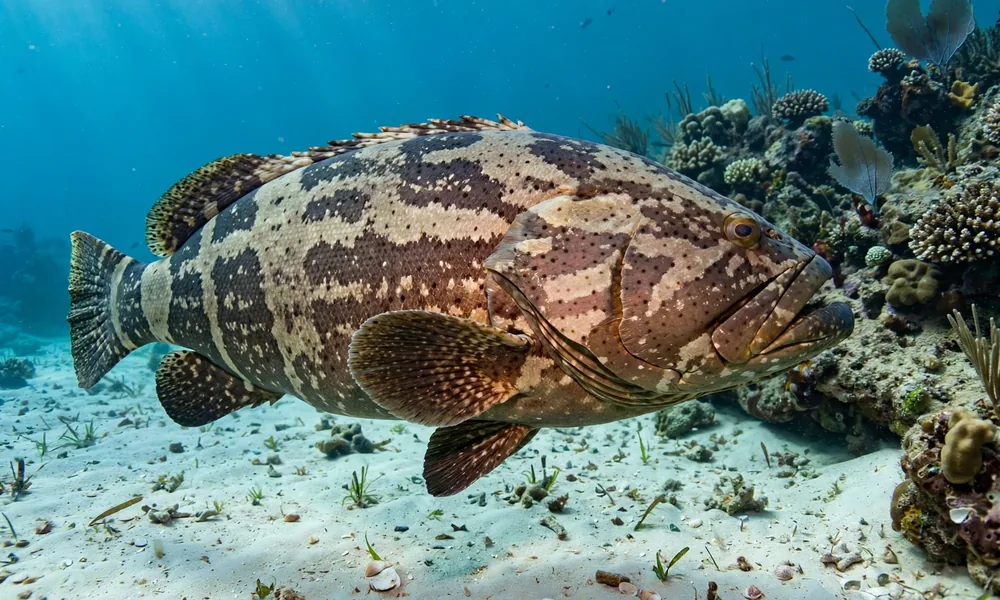
The head is the most striking part of the animal. It is broad and blunt, with a huge mouth set low and wide, thick lips, and small eyes placed high on the sides. The mouth is built for suction: the fish opens it suddenly, creating a rush of water that pulls prey straight in, and the prey is swallowed whole, with no chewing at all. The teeth are small and numerous, set in bands inside the jaws, and they are made for gripping rather than cutting, because a goliath grouper does not bite pieces off its food, it takes the whole thing in one gulp.
Males and females look much alike, and there is no reliable way to tell them apart by eye underwater. Females tend to grow a little larger than males, and during the spawning season a female’s belly swells with eggs, but the difference is small, and divers and researchers rely on size, season and behaviour rather than on any mark on the body. The fish changes its colours a little with mood, darkening when it is alarmed or excited, and paling when it is calm, and a fish that has been handled or chased will often show a darker, more strongly blotched pattern for a while afterwards.
Where goliath groupers live
Goliath groupers live in the warm waters of the western Atlantic, in a range that runs from Florida and the Gulf of Mexico down through the Caribbean to southern Brazil, and across to the coast of West Africa. They are most common around Florida, where the protected population has recovered strongly, and around the reefs and wrecks of the Gulf of Mexico, but they are found wherever there is warm, shallow water with structure to hide in. The Pacific goliath grouper, a separate species, lives on the other side of the Americas, from the Gulf of California to Peru.
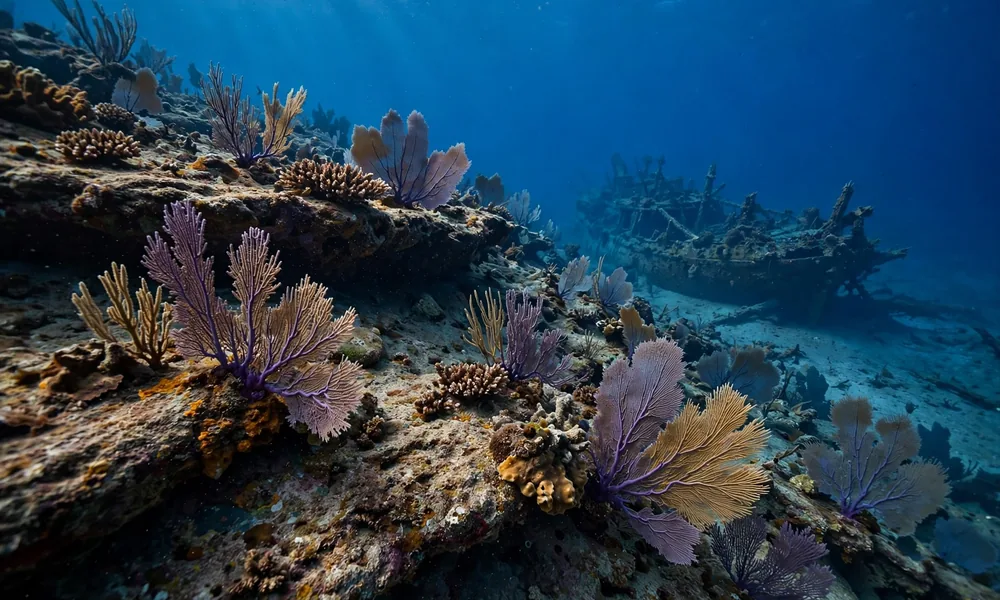
The habitat they choose is structure, and the more of it the better. Adult goliath groupers live on coral reefs, rocky ledges, artificial reefs and shipwrecks, usually in water from 5 to 50 metres deep, though they have been seen much deeper. A single wreck can hold dozens of them, each fish holding its own ledge or corner, and a reef with good cover will hold fish for years, the same individuals returning to the same spot season after season. They are not wanderers, and once a fish has found a good home it tends to stay there, which is why divers can visit the same wreck year after year and meet the same fish.

Young goliath groupers live in a different world from the adults. The juveniles settle in shallow mangrove forests, in the tangled roots and murky water of estuaries and lagoons, where they are safe from the big predators of the reef. They stay there for several years, growing slowly in the shelter of the roots, and they move out to the reef only when they are large enough to hold their own, usually at about a metre long. That dependence on mangroves is one of the fish’s great weaknesses, because when the mangroves are cut down or filled in, the young fish have nowhere to go.
The water has to be warm, and the fish are rarely found where the temperature falls below about 20 degrees Celsius. In Florida they are most common in the summer and autumn, when the water is warmest, and they move into deeper water or into sheltered spots when a cold snap comes through. They do best where the water is clear, warm and full of the crabs, lobsters and fish they eat.
What goliath groupers eat
Goliath groupers are ambush predators with a simple method: wait, open the mouth, and swallow. The everyday diet is crustaceans, and spiny lobsters and crabs make up the largest part of what an adult eats, along with shrimp, molluscs and the occasional octopus. The fish takes them whole, shell and all, and crushes them with the strong plates in its throat, so that a lobster that looked far too big and too spiny to eat goes down in a single gulp. Fish are the second part of the diet, and a goliath grouper will take grunts, snappers, parrotfish and any other reef fish that comes too close, along with rays, which it swallows whole when it can catch them lying on the sand.

The hunting style is a mix of waiting and stalking, and it changes with the prey. For crabs and lobsters, the goliath grouper often hunts at night, moving slowly along the reef and using its sense of smell and its lateral line to find prey hidden in cracks and under ledges. It will push its huge head into a crevice, open its mouth, and suck the animal out, and if the prey tries to run, the fish can follow it in a short, powerful burst. For fish, the method is simpler: lie still in the shadow of a ledge, wait for a fish to swim past, and open the mouth. The suction is strong enough to pull a fish in from a surprising distance, and the whole strike takes less than a second.
Feeding is closely tied to the tide and the time of day. Goliath groupers feed most actively at dawn and dusk, when the reef fish are moving and the lobsters are out of their holes, and they rest through the middle of the day, hovering motionless in the shade. A big meal can keep an adult going for days, and in the cooler months a goliath grouper may feed only once or twice a week. Young fish feed more often, on small crabs, shrimp and tiny fish in the mangroves, because they are growing fast and they need the energy.
The goliath grouper has a reputation among fishermen for stealing fish off hooks and out of traps, and the reputation is earned. A hooked fish struggling on a line is an easy meal, and a goliath grouper will take it without hesitation, sometimes taking the hook as well, and a fish trap left on the reef will be visited by a goliath grouper that has learned where the food is. Like the clownfish of the same reefs, the goliath grouper is a fish that has learned the shape of its home, but the clownfish is a tiny fish that never leaves its anemone, while the goliath grouper is a giant that patrols a whole wreck and takes what it wants.
How goliath groupers behave
Goliath groupers are slow, solitary and territorial, and those three habits shape almost everything they do. By day they hover, almost motionless, in the shadow of a ledge or inside a wreck, their mottled pattern blending into the rock so well that a diver can swim past without noticing a fish the size of a person. They move in short, powerful bursts, a few strokes of the tail and then stillness again, and they rarely swim far from their home. A fish that has found a good ledge will hold it for years, and it will chase off other goliath groupers that come too close.
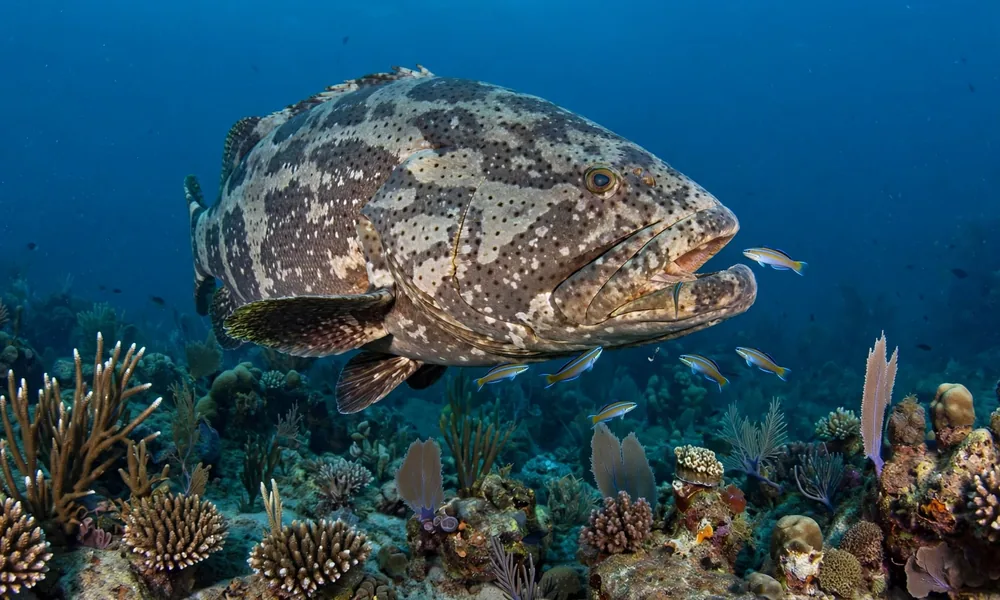
The behaviour most people remember is the boom. A goliath grouper can produce a deep, resonant sound, a low thump that divers feel in their chests as much as hear, and it makes the sound by contracting the muscles around its swim bladder, the gas-filled sac that helps it stay buoyant. The boom is a warning, made when the fish is alarmed or when another fish comes too close, and it is also used during the spawning season, when the males boom to attract females and to warn off rivals. It is one of the loudest sounds any fish makes, and it carries a long way through the water, which is why a diver can hear a goliath grouper before seeing it.
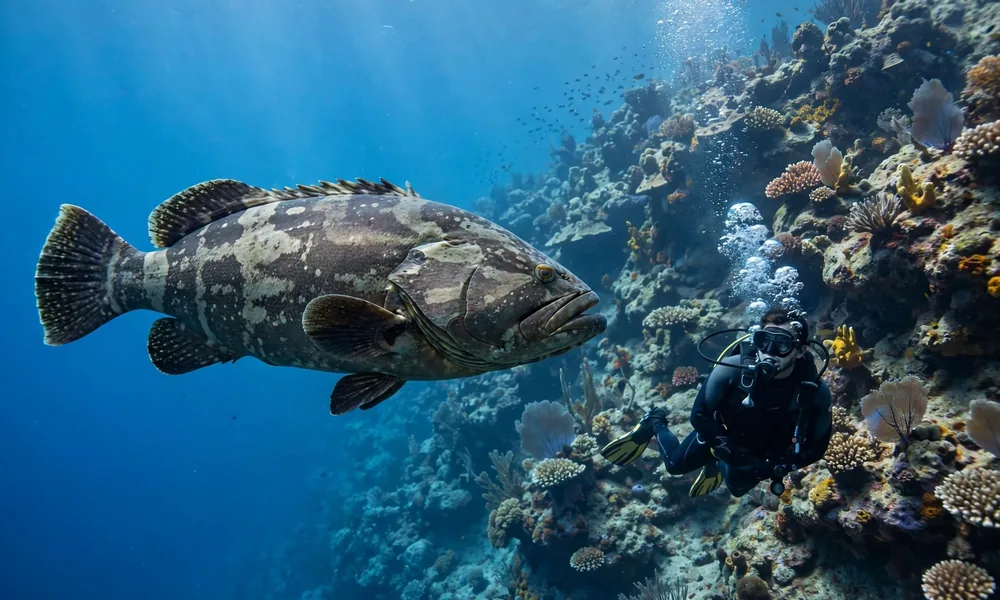
Goliath groupers are curious about divers, and they will often approach, hover close, and watch, sometimes following a diver around a wreck for the whole dive. They are not aggressive, and there are no reliable records of a goliath grouper attacking a person, but they are enormously strong, and a fish that decides to take a speared fish or a catch bag can be hard to argue with. The sensible approach is to keep your distance, keep your catch out of reach, and enjoy the encounter, because a fish this size, this calm and this close is a privilege, not a threat.
The comparison with the blue tang shows how different two reef fish can be. A blue tang is a small, bright, fast-moving grazer that darts about the reef in schools, eating algae and never staying still. A goliath grouper is a huge, slow, solitary predator that hovers in the shade and waits for its food to come to it. One is a flash of colour that never stops moving, and the other is a boulder that breathes, and they share the same reef without ever getting in each other’s way.
Breeding and life cycle
Goliath groupers breed in late summer, usually from July to September in Florida, when the water is at its warmest and the days are long. They gather in large spawning aggregations, dozens of fish coming together at the same reef or wreck, year after year, to breed. The aggregations form at particular sites, often on the edge of a reef or over a wreck in deep water, and the same sites are used again and again, which makes them both a wonder and a weakness: a fisherman who finds an aggregation can catch a large part of the breeding population in a single night.
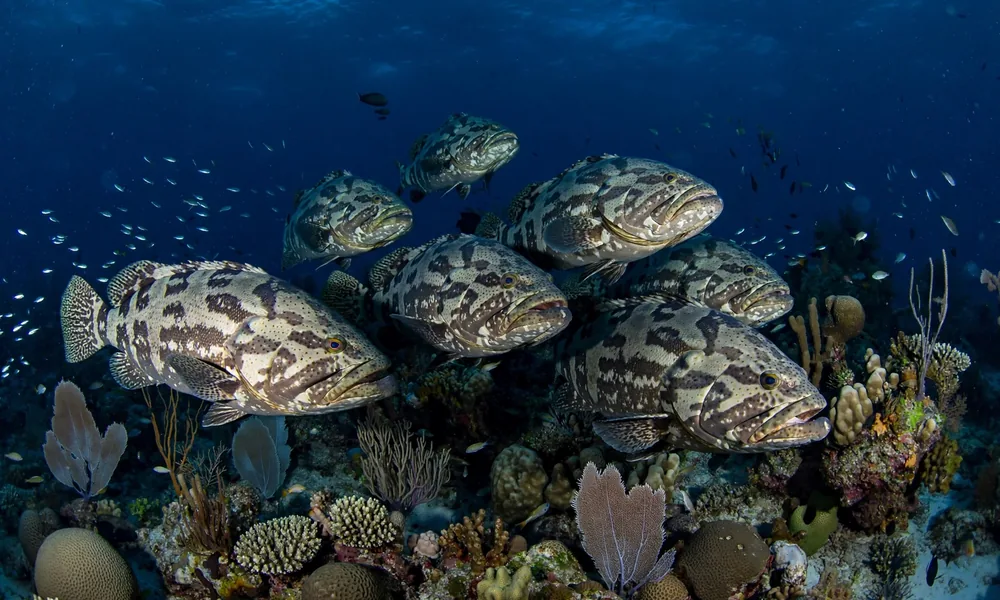
Courtship is a slow, deliberate affair. The males boom, the females move among them, and the fish pair off in the water column above the reef, releasing their eggs and milt together in the open water. A single female can release millions of eggs in a season, tiny, clear spheres that drift with the current, and the males shed their milt over them as they rise. The eggs hatch in a day or two, and the larvae drift in the plankton for a month or more, carried by the currents far from where they were spawned, before they settle in the mangroves as tiny juveniles.
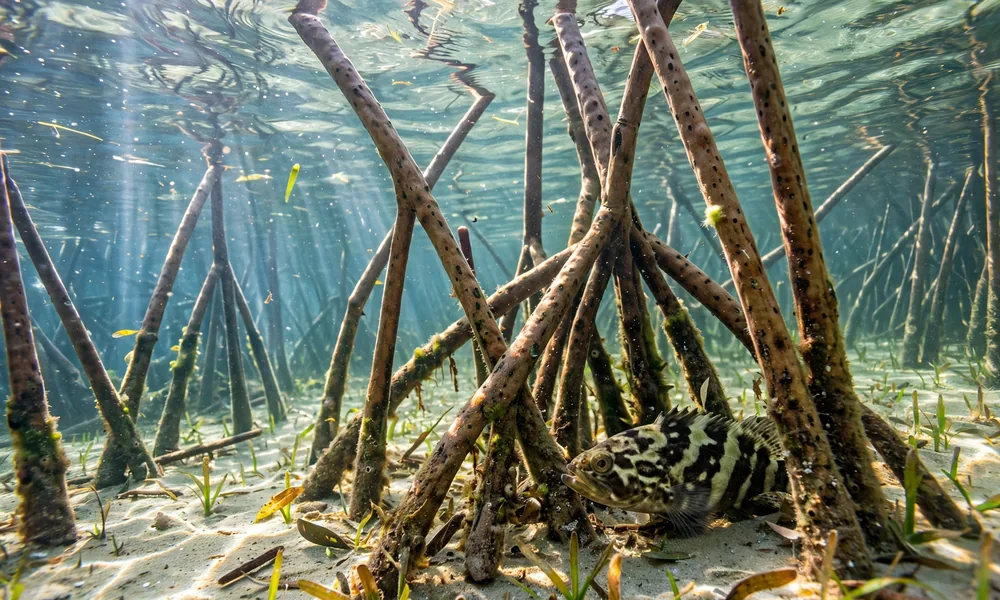
The juveniles grow slowly in the mangroves, feeding on small crabs, shrimp and tiny fish, and they stay there for several years, until they are about a metre long and strong enough to hold their own on the reef. They reach breeding size at 6 to 7 years old, when they are close to a metre long, and they go on growing for the rest of their lives, adding bulk year after year. The lifespan is long for a reef fish, with animals thought to live for 30 to 40 years or more, and the oldest fish are the largest, the ones that have survived decades of fishing, storms and cold snaps, and that carry the future of the population in their millions of eggs.
Growth is slow at every stage, and that slowness is the heart of the goliath grouper’s story. A fish that takes seven years to mature cannot replace itself quickly, and a population that loses its big, old breeders loses the animals that produce the most eggs. Protecting the aggregations, along with the mangrove nurseries, is the single most important thing that can be done for the fish.
Conservation status
The Atlantic population of the goliath grouper is listed as Critically Endangered by the International Union for Conservation of Nature, which is the highest category of threat short of extinction in the wild, and that listing is for the Atlantic population, not for the species as a whole, because the Pacific goliath grouper is a separate species with its own status. The Atlantic listing reflects what happened in the twentieth century, when the fish was hunted so hard that it nearly vanished from Florida and the Gulf of Mexico, and it also reflects how slowly the fish recovers, because a population that takes seven years to breed cannot bounce back in a season.

The main pressure was fishing. Goliath groupers were easy to catch, because they are slow, curious and loyal to a single spot, and a fisherman who found one could come back to the same ledge again and again. They were taken by spear, by hook and by trap, and prized for their size. By the 1980s the catch had collapsed, and the fish had become rare on reefs where it had once been common. In 1990 the United States banned all harvest of goliath groupers in its waters, a ban kept in place ever since, with only a very limited, tightly controlled harvest allowed in Florida in recent years, and the fish has come back strongly on the reefs and wrecks of Florida and the Gulf.
The second pressure is the loss of habitat. Mangrove forests, the nurseries where the young fish grow, have been cut down and filled in for development across the Caribbean and Florida, and coral reefs, the homes of the adults, have been damaged by warming water, disease and pollution. A goliath grouper needs both, and losing either one takes away a stage of its life. The most useful conservation work is practical: keep the harvest ban in place, protect the spawning aggregations, leave the mangroves standing, and protect the reefs and wrecks where the adults live, so that a fish that takes seven years to breed has somewhere to grow up and somewhere to breed.
Best seasons for goliath grouper watching
The best time to see goliath groupers is the late summer, from July to September, when the spawning aggregations form and dozens of fish gather at the same reef or wreck. In Florida the aggregations are best known off the east coast, around Jupiter and West Palm Beach, and in the Gulf of Mexico, where wrecks in 20 to 40 metres of water can hold a dozen or more fish at once. The fish are also present for the rest of the year, and a wreck dive in winter can still produce a meeting with a single huge fish on its ledge, but the summer aggregations are the spectacle, and they are what divers travel for.
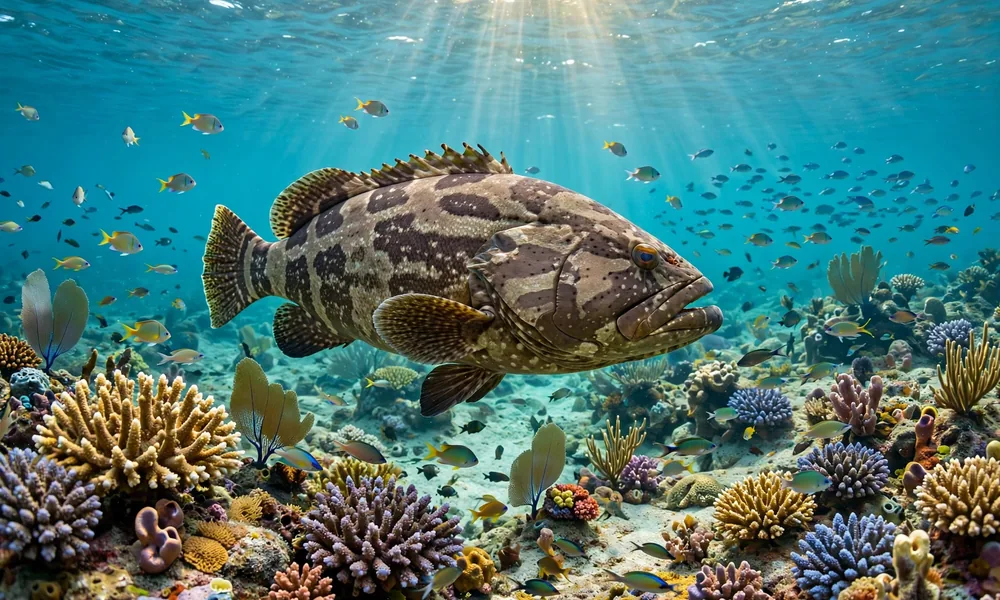
The best hours are the morning and the late afternoon, when the fish are most active and the light is best for seeing them, and the best conditions are calm, clear water with good visibility, so that you can see the fish from a distance and approach slowly. A dive on a wreck or a reef ledge is the way to find them, and a slow, quiet approach is essential, because a fish that is startled will retreat into the wreck and stay there. Listen for the boom, too: a low thump that you feel in your chest is often the first sign that a goliath grouper is nearby, long before you see it.
Staying safe around goliath groupers
A goliath grouper is not dangerous to people, and there are no reliable records of one attacking a diver, but it is an animal to treat with respect, because it is enormously strong and it has a mouth that can swallow a lobster whole. The safety rules are mostly about not frightening it and not getting between it and its food. Never try to feed one by hand, never put your hand into a crevice where a goliath grouper is hiding, and never try to take a fish from a goliath grouper that has already taken it, because the fish will not let go and you will lose the argument.
There are a few practical points for diving with them. Keep your distance, at least a couple of metres, and let the fish come to you if it is curious. Keep your catch bag and your speared fish out of reach, and if a goliath grouper takes an interest in them, let it have the fish rather than fighting for it. Watch your air and your depth, because it is easy to get distracted by a fish this size and forget the basics, and remember that the wreck itself is the real danger, so dive within your training and never enter a wreck without the right skills.
Goliath grouper watching checklist
A little preparation turns a dive on a Florida wreck into a real chance of meeting a goliath grouper face to face.
- A visit in late summer, from July to September, when the spawning aggregations gather dozens of fish at the same reef or wreck.
- A dive on a wreck or a reef ledge in 20 to 40 metres of water, where the fish hold their home spots year after year.
- Morning or late afternoon light, when the fish are most active and the visibility is at its best.
- A slow, quiet approach, so the fish is not startled into retreating deep inside the wreck.
- An ear out for the boom, the low thump you feel in your chest, which often gives the fish away before you see it.
- A catch bag kept out of reach, and no hand feeding, so the fish is not tempted to take food from you.
- Respect for the fish and its ground, keeping your distance, diving within your training, and leaving the wreck as you found it.
Frequently asked questions
How big do goliath groupers get?
Goliath groupers grow to 2.5 metres long and weigh 360 to 450 kilograms at their largest, which makes them one of the largest bony fishes on any reef. Most adults are smaller, commonly 1.2 to 1.8 metres long and 100 to 200 kilograms, and they go on growing for their whole lives, so the oldest fish are the biggest.
Are goliath groupers dangerous?
No, goliath groupers are not dangerous to people, and there are no reliable records of one attacking a diver. They are curious and calm, and they will often approach a diver to have a look. They are enormously strong, though, and they can take a speared fish or a catch bag without hesitation, so the sensible approach is to keep your distance and keep your catch out of reach.
What do goliath groupers eat?
A goliath grouper eats crustaceans such as spiny lobsters, crabs and shrimp, along with fish, molluscs, octopus and rays, all swallowed whole. It hunts by ambush, lying still in the shade of a ledge and opening its huge mouth to suck prey in, and it feeds most actively at dawn and dusk.
Why are goliath groupers protected?
They are protected because they were fished almost to nothing in the twentieth century, and because they grow slowly and take 6 to 7 years to mature, so the population recovers very slowly. The United States banned all harvest in its waters in 1990, and the Atlantic population is listed as Critically Endangered, though the fish has come back strongly on the reefs of Florida since the ban.
What is the booming sound a goliath grouper makes?
The boom is a deep, low thump made by contracting the muscles around the swim bladder, the gas-filled sac that helps the fish stay buoyant. It is a warning to other fish and a call used during the spawning season, and it is one of the loudest sounds any fish makes, felt in the chest as much as heard.
How is this guide different from the flying fish guide?
This guide covers the goliath grouper, a huge, slow, solitary reef predator of the western Atlantic that grows to 2.5 metres, swallows lobsters whole and booms like a drum, while our flying fish guide covers a small, fast, schooling fish of the open ocean that escapes its hunters by gliding through the air on wing-like fins. One is a giant that waits in the shadows of a wreck; the other is a sprinter that leaves the water altogether.
Conclusion
The goliath grouper species is a reminder that the sea can still produce giants, and that a fish given time and protection can grow to a size that seems impossible. A mottled brown animal the size of a person, hovering in the shadow of a wreck, booming softly through the water and swallowing lobsters whole, is a creature from another scale of life, and it is one of the great sights of the Atlantic reef.
If you go looking for one, go in late summer, go to a wreck off Florida, and listen for the boom before you look for the fish. Find the ledge, wait quietly, and let the giant come to you, and you will have met the heavyweight of the reef, a fish that was nearly lost and is now, slowly and surely, coming back.