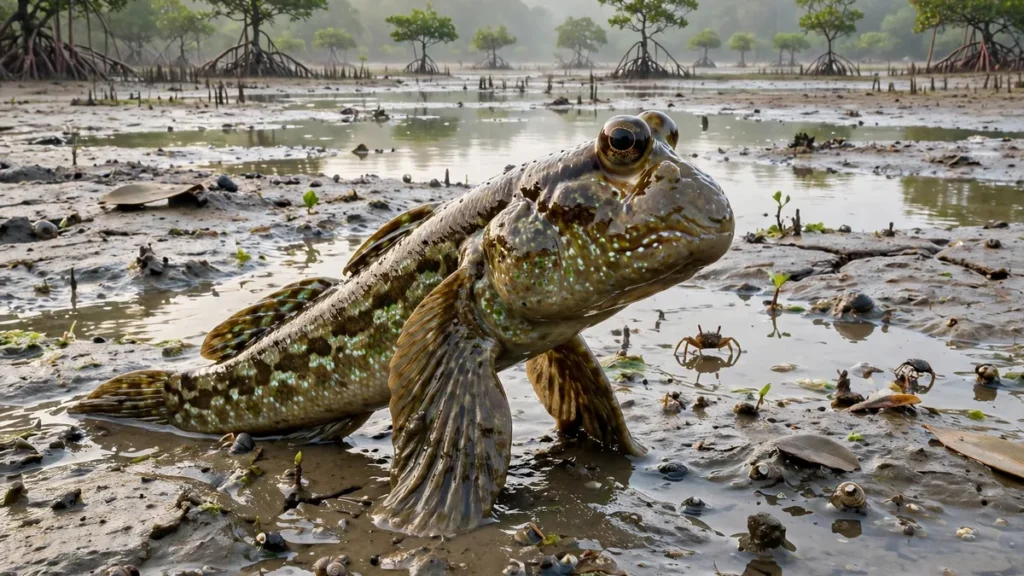
The mudskipper species is the fish that walked out of the water, a small, mottled goby that spends most of its life on land, hopping across mudflats on its fins and breathing through its skin. If you are asking what a mudskipper is, the short answer is a member of the goby subfamily Oxudercinae, an amphibious fish that lives on the muddy shores of mangrove swamps and estuaries, and it is as much a land animal as a fish. Most species measure 10 to 20 centimetres long, the largest reach about 30 centimetres, and the whole animal, from its bulging eyes on top of its head to its muscular pectoral fins, is built for a life lived half in the water and half out of it.
You will usually meet a mudskipper the way visitors to a mangrove shore do: as a small fish that seems to be standing on the mud at low tide, watching you with eyes that sit on stalks, and then hopping away in a series of short jumps when you come too close. It is not a fish that hides under the water. It sits out in the open, perched on the mud, breathing the air, and it will climb a mangrove root or a rock to get a better view. This guide covers the whole animal, from its family tree and its remarkable way of breathing to where it lives, what it eats, how it breeds, and why the mudflat it calls home is one of the most important habitats on Earth.
Key takeaways
- The mudskipper species belongs to the goby subfamily Oxudercinae, a group of more than 30 amphibious fish that live on mudflats and in mangrove swamps.
- It is a true amphibious fish: it breathes through its moist skin and by holding water in its gill chambers, and it can stay out of the water for hours.
- Mudskippers walk, hop and climb on their muscular pectoral fins, and their bulging eyes sit high on top of the head so they can see while sitting on the mud.
- They eat small crabs, insects, worms and algae on the mudflat, and the males dig burrows, guard their eggs and display with raised dorsal fins.
- Most mudskippers are listed as Least Concern, but the mangrove mudflats they depend on are shrinking fast, and protecting them matters more than anything else.
The mudskipper species and its relatives
Mudskippers belong to the goby family Oxudercidae, and to the subfamily Oxudercinae, a group of more than 30 species of amphibious fish spread across the muddy shores of the Indo-Pacific and the Atlantic coast of Africa. The best-known genus is Periophthalmus, whose name comes from Greek words meaning around the eye, a nod to the bulging eyes that sit on top of the head, and the group was described by the German naturalist Marcus Elieser Bloch in the late eighteenth century. The mudskippers are true gobies, and like other gobies they are small, bottom-living fish, but they have taken the goby way of life further than any of their cousins, out of the water and onto the land.
The mudskipper group is a varied one, and that is part of what makes it so interesting. Some species, such as the giant mudskipper, grow to about 30 centimetres and live in the lower reaches of rivers, while others, such as the barred mudskipper, are barely 10 centimetres long and spend their whole lives on a single mudflat. Some graze on the thin film of algae that covers the mud, while others hunt crabs and insects, and some climb mangrove roots while others never leave the ground. All of them share the same basic design: a long, mottled body, eyes on top of the head, and pectoral fins that work like little arms.
| Type | Animal | Where it lives | Best-known food | Length or Weight |
|---|---|---|---|---|
| Family | Mudskippers and allies (Oxudercidae) | Mudflats and mangroves of the Indo-Pacific and West Africa | Small crabs, insects and algae | About 10 cm to 30 cm long |
| Genus | Mudskippers (Periophthalmus) | Mudflats and mangroves of the Indo-Pacific and West Africa | Small crabs, insects and worms | About 10 cm to 25 cm long |
| Species | Giant mudskipper (Periophthalmodon schlosseri) | Mangrove mudflats of South-East Asia and northern Australia | Small crabs and fish | About 20 cm to 30 cm long |
| Species | Barred mudskipper (Periophthalmus argentilineatus) | Mudflats and mangroves from East Africa to the Pacific | Small crabs, insects and worms | About 10 cm to 15 cm long |
| Species | Blue-spotted mudskipper (Boleophthalmus boddarti) | Mudflats of South and South-East Asia | Algae and tiny creatures on the mud | About 15 cm to 20 cm long |
| Species | Atlantic mudskipper (Periophthalmus barbarus) | Mudflats and mangroves of West Africa | Small crabs, insects and worms | About 15 cm to 25 cm long |
The species are easy to tell apart once you know what to look for, and size and markings are the simplest clues. The giant mudskipper is the big one, reaching about 30 centimetres and living in the lower rivers and mangroves of South-East Asia, while the barred mudskipper is a smaller fish of 10 to 15 centimetres with pale bars along its sides, and the blue-spotted mudskipper is marked with bright blue spots and spends more of its time grazing on algae. The Atlantic mudskipper is the only common species on the west coast of Africa, and it is the one most often kept in aquariums, because it is hardy and easy to watch. In practice, any mudskipper you meet on a mudflat in Asia or Australia is likely to be a barred or a giant mudskipper, and that is the fish this guide is about.
There is one more relationship worth knowing, and it is the one that explains why mudskippers matter far beyond their size. A mudskipper is a goby, and gobies are one of the largest families of fish in the sea, with thousands of species living on reefs, in rivers and in the open ocean. Like the angelfish, a mudskipper is a small, bright-eyed fish of the shallows, but the angelfish is a reef fish that never leaves the water, while the mudskipper is a fish that has learned to live on land, and that difference is written all over its body, from its fins to its eyes.
What a mudskipper looks like
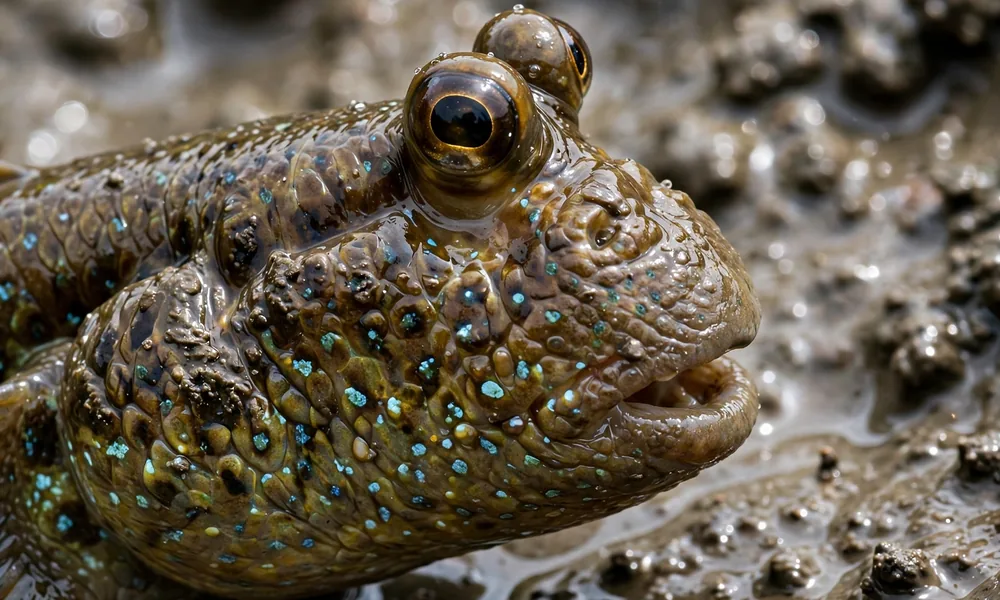
A mudskipper is a small, mottled fish that looks as if it was built from spare parts, and its appearance is the reason it stops people in their tracks. The body is long and cylindrical, coloured in mottled browns, greens and greys that match the mud it lives on, and many species carry bright blue or green spots along their sides and on their fins. Most species measure 10 to 20 centimetres from snout to tail, and a good fish weighs only a few dozen grams, with the largest, the giant mudskipper, reaching about 30 centimetres. The colours are not fixed, though: a mudskipper can darken or lighten its skin to match the mud, and a male showing off will raise a brightly coloured dorsal fin that flashes blue, red or yellow in the sunlight.
The head is the part that sets a mudskipper apart from every other fish. The eyes sit on top of the head on short stalks, bulging upwards like a pair of periscopes, and they can move independently, so the fish can look in two directions at once. The eyes can also be pulled down into sockets in the head, which keeps them moist and safe, and the fish blinks by rolling them down into the sockets, a trick no other fish can manage. The mouth is wide and set low, with small sharp teeth, and the lower jaw juts slightly forward, which suits an animal that snatches crabs and insects off the surface of the mud.
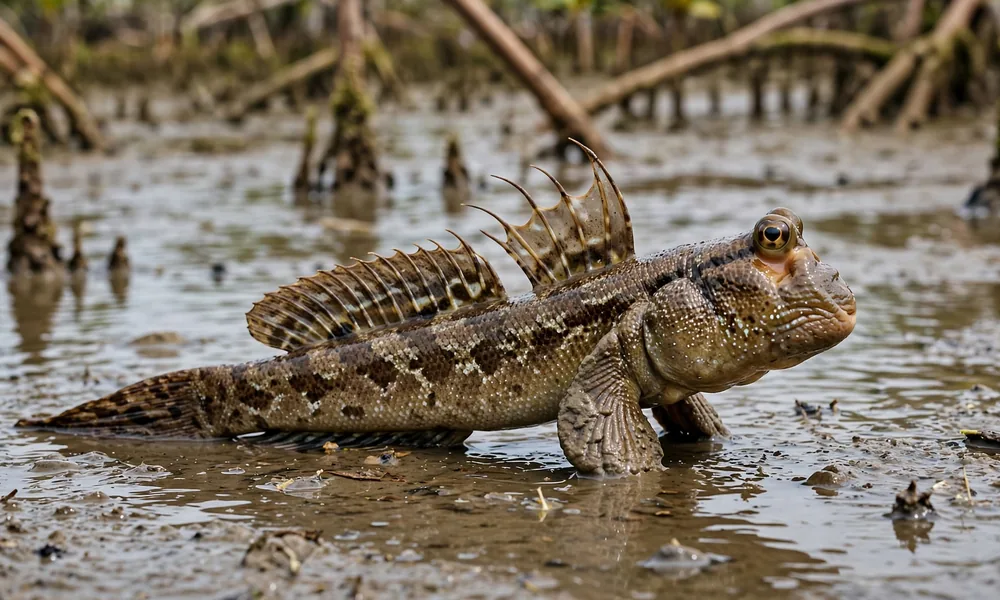
The fins are the key to how a mudskipper moves, and they are unlike the fins of any other fish. The pectoral fins are large, muscular and set low on the body, and they work like a pair of crutches, propping the fish up and pushing it forward in a series of hops and skips. The pelvic fins are joined together into a small sucker underneath the body, and the fish uses it to grip the mud and to climb, while the tail is long and flattened and works like a paddle when the fish is in the water. There are two dorsal fins: a tall, spiny first fin that the male raises when he is showing off, and a longer, softer second fin that runs along the back.
Males and females look much alike, and there is no reliable way to tell them apart by eye on the mudflat. Males tend to have a taller first dorsal fin and brighter colours when they are displaying, and they are usually the ones you see perched on the highest spot, showing off to rivals and to females. Females are a little plainer and a little less bold, and they spend more of their time feeding and less of it displaying. The best clue to a fish’s age is its size: a fish under about 5 centimetres is still a youngster, and a fish of 15 centimetres or more is a full adult, though the giant mudskipper can grow much bigger than that.
Where mudskippers live
Mudskippers live on the intertidal mudflats, mangrove swamps and estuaries of the tropical and subtropical world, in a range that covers the Indo-Pacific from East Africa and India through South-East Asia to northern Australia and Japan, with one common species on the Atlantic coast of West Africa. They are a fish of the edge between land and sea, and they follow the tides, which is why they are found where the sea comes in twice a day and goes out again, leaving behind a world of mud, pools and mangrove roots. They need warm water and warm air, and they are most common where the mud is soft, the mangroves are thick and the tide is strong.

The habitat a mudskipper chooses is the mudflat itself, and the fish spends most of its life there, out of the water. At low tide the mudflat is a wide, flat world of soft mud, shallow pools and crab holes, and the mudskippers are spread across it, perched on the mud, hopping between pools and digging their burrows. When the tide comes in, the mudflat disappears under a metre or more of water, and the mudskippers either swim up into the mangrove roots or retreat into their burrows, where they wait out the high tide in a pocket of air. It is a life ruled by the tide, and a mudskipper that cannot read the tide will not live long.

Young mudskippers live in the same mudflat world, and they depend on it even more than the adults do. The juveniles stay close to the water’s edge, where the mud is wettest and the small creatures they eat are thickest, and they hide in the shallow pools and among the mangrove roots when a heron or a larger fish comes near. As they grow, they range further across the mudflat and spend more time out of the water, and by the time a fish reaches about 10 centimetres it is living the full amphibious life, hopping, climbing and breathing air like an adult. Protecting the mudflat matters as much as protecting the mangroves themselves, because without the mud there are no young fish to replace the adults.
What mudskippers eat
Mudskippers eat the small creatures of the mudflat, and they are not fussy about which kind, as long as it is small enough to catch and slow enough to swallow. The everyday diet is made up of small crabs, insects, worms and tiny fish, along with the thin film of algae that coats the surface of the mud, and the fish takes whatever is commonest on its own patch of mud. A mudskipper will snap up a fiddler crab half its own size if it can get its jaws around it, and it will pick insects off the surface of a tidal pool with a quick flick of the head. Stomach studies have found dozens of different prey species in a single fish, which tells you how opportunistic a hunter this is.
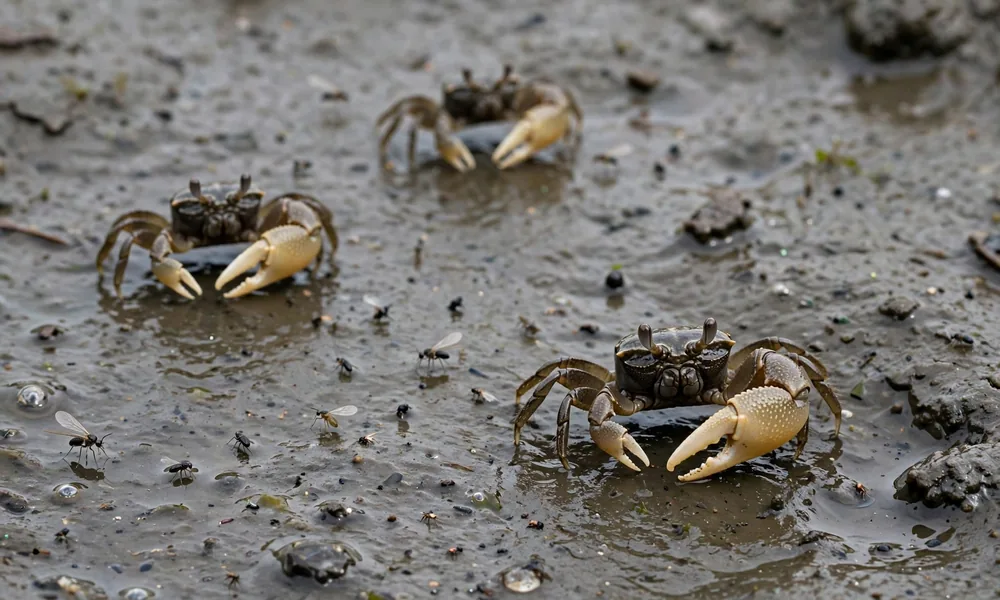
The hunting style is a mix of waiting and stalking, and it changes with the prey. A mudskipper will often perch on a small rise in the mud, watching the crabs and insects around it, and then it will hop forward in a quick series of jumps, snatch its prey in a snap of the jaws, and swallow it whole. When it hunts in a tidal pool, it will swim just below the surface, watching for small fish and shrimps, and then strike from below. The fish also grazes on algae, scraping the green film off the surface of the mud with its lower jaw, and some species get most of their food this way, which makes them gardeners of the mudflat as well as hunters.
Feeding is closely tied to the tide. Mudskippers feed most actively at low tide, when the mudflat is exposed and the crabs and insects are out in the open, and they will feed through the whole low-tide period, barely pausing between catches. When the tide comes in, they stop feeding and retreat to their burrows or to the mangrove roots, and they do not feed again until the water goes out. Like the seahorse, a mudskipper is a small fish that feeds on tiny creatures, but the seahorse is a slow, upright swimmer that sucks its food out of the water, while the mudskipper is a fast, hopping hunter that chases its food across the mud, and that difference shapes everything from its fins to its daily rhythm.
How mudskippers behave
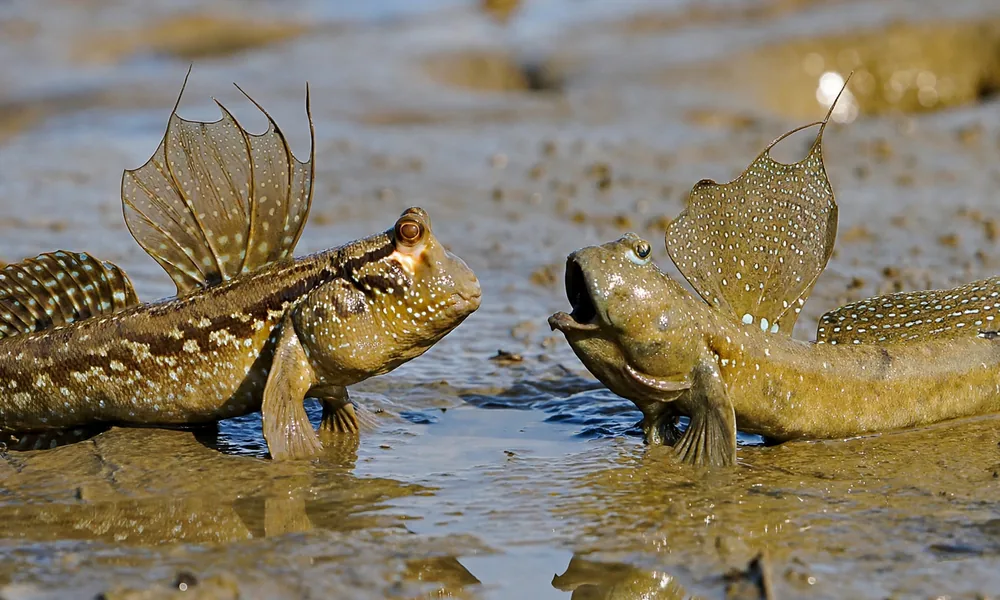
Mudskippers are territorial for a small fish, and a male will defend his patch of mudflat and his burrow against any other male that comes near. The defence is mostly show: the male raises his tall dorsal fin, puffs himself up, and hops towards the intruder in a series of stiff-legged jumps, and if the intruder does not back off, the two will push and bite at each other until one gives way. They are not shy, and they are curious about people, perching on the mud and watching a visitor with their stalked eyes, and a person who stays still will often find a mudskipper hopping closer to look at them.
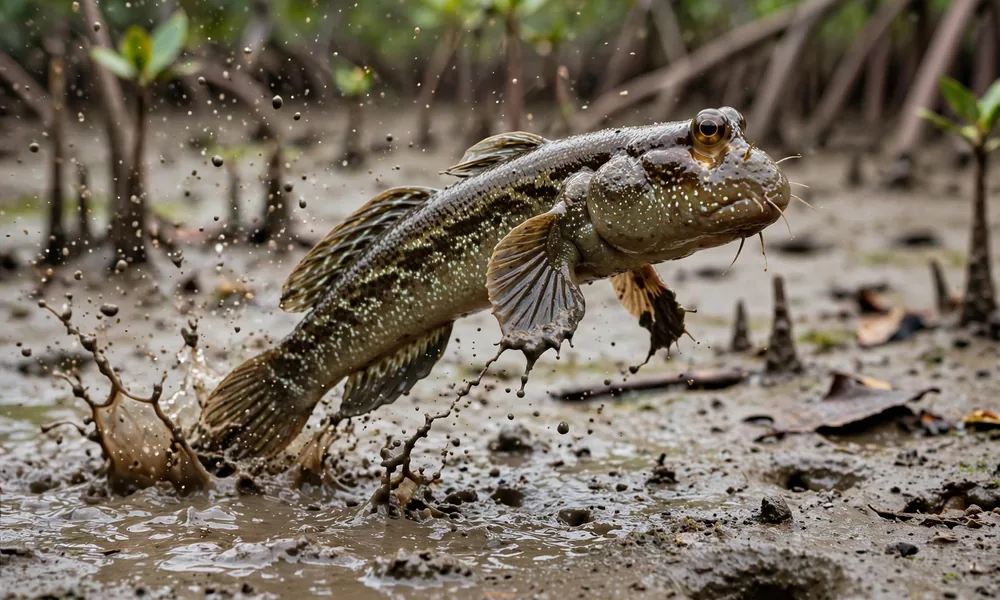
The hop is the behaviour people ask about most, and it is worth describing properly. A mudskipper moves on land by planting its pectoral fins on the mud and pushing with its tail, lifting its body clear of the ground in a short jump, and then landing and doing it again, and it can cover a surprising distance this way, hopping across the mudflat in a series of quick skips. The fish can also climb, using its pelvic sucker and its pectoral fins to grip a mangrove root or a rock, and it will climb a metre or more up a root to get a better view or to escape a predator. A hopping mudskipper is not struggling and it is not in trouble: it is moving the way it was built to move, and it is faster on land than most people expect.
Young mudskippers behave differently from adults, and they are far less bold. Juveniles stay close to the water and to cover, hiding among the mangrove roots and in the shallow pools, and they feed in short bursts, darting out to snatch a small insect and then darting back. As they grow, they range further across the mudflat and spend more time in the open, and by the time a fish reaches about 10 centimetres it is defending a patch of mud and digging a burrow of its own. That shift from a shy youngster hiding in the roots to a bold adult holding a territory is one of the clearest signs that a mudskipper has grown up, and it is also why the biggest fish on the mudflat are the ones found furthest from the water.
Breeding and life cycle
Mudskippers breed in the warm months, when the tides are at their strongest and food is plentiful for the young. Breeding starts with the burrow: the male digs a J-shaped tunnel in the mud, with a chamber at the bottom and a single entrance at the top, and he piles the dug-out mud in little pellets around the mouth. The female lays her eggs on the walls of the chamber, in the air above the water, and the male stays to guard them, fanning fresh air into the burrow with his fins and keeping the eggs moist. A female can lay hundreds of eggs at a time, and the male may look after more than one batch over the course of a season.

The eggs are tiny and defenceless, and most of them are eaten or washed away, which is why the male guards them so carefully. Those that survive hatch into larvae that swim out with the tide and drift in the coastal waters, feeding on plankton for several weeks before they return to the mudflat as tiny juveniles. A young mudskipper grows quickly in its first months, reaching 5 centimetres or so, and it keeps growing through its first year, moving further across the mudflat as it gains size. It reaches breeding size at about a year old, when it is roughly 10 centimetres long, and from then on it lives on the mudflat as a territorial adult, digging its own burrow and defending its own patch of mud.
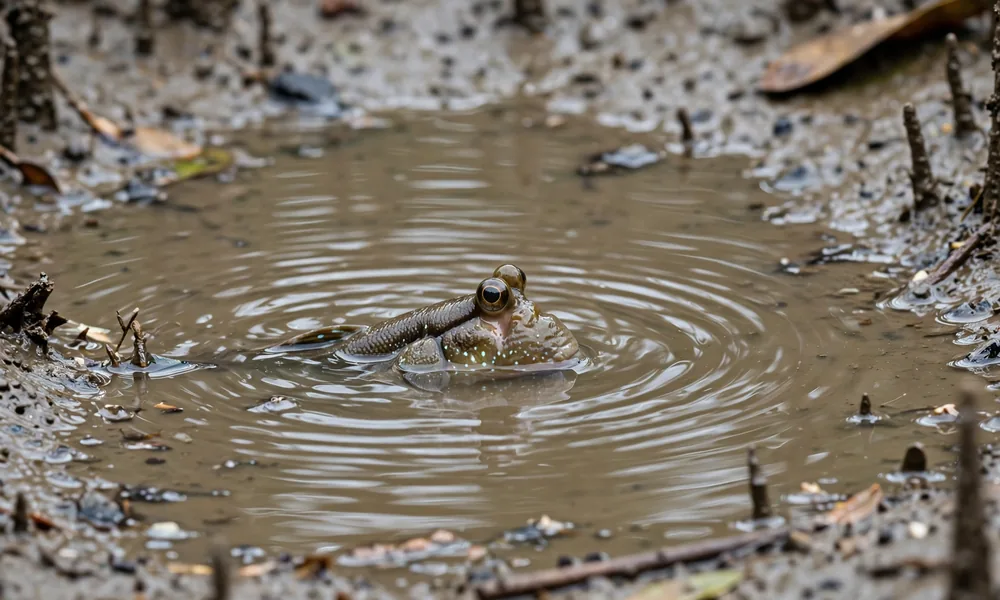
Growth slows once a mudskipper reaches adult size, and the fish keeps growing slowly for the rest of its life, which is thought to last about five years in the wild, though few fish live that long on a mudflat full of herons, crabs and larger fish. There is more parental care here than in most fish: the male guards the eggs in his burrow until they hatch, and he keeps the chamber aired and moist the whole time, which is a lot of work for a fish the size of a finger. It is a hard start, and the survival rate is low, but the fish that make it through the first months on the mudflat have a good chance of a long life hopping across the mud.
Conservation status
Most mudskippers are listed as Least Concern by the International Union for Conservation of Nature, and the reasoning is straightforward: they have a large range, they are still common across much of that range, and they breed quickly enough to replace their numbers. Some species have not been assessed at all, and a few local populations are under pressure, but the group as a whole is not a fish that is fished heavily or traded in large numbers, and it is found on mudflats from East Africa to the Pacific.

The real pressure on the mudskipper is not fishing but the loss of its home. Mangrove forests are being cleared for shrimp ponds, for building and for firewood, and mudflats are being drained, dredged and polluted, and a mudskipper needs a healthy mangrove and a clean mudflat to live on, as well as clean water for its young. When a mangrove is cut down, the mudflat erodes, the small crabs go first, and the mudskippers follow, even if nobody is catching them. The most useful conservation work is practical: protecting mangroves and mudflats, keeping coastal water clean, and making sure that the burrows and the breeding grounds are left alone at low tide.
There is one more issue that matters to people who visit mudflats, and it is worth stating plainly. Mudskippers are harmless to people, and they do not bite or sting, but the mudflat itself can be dangerous: the mud is soft and deep in places, the tide comes in fast, and a person who walks too far out can find themselves cut off by the rising water. Local advice should always be followed, and a mudflat should never be crossed alone or without knowing the tide times, and that caution is well founded.
Best seasons for mudskipper watching
The best time to look for a mudskipper depends on where you are, because the fish lives in the tropics all year round and there is no single season for the whole range. In South-East Asia, the dry season from about November to April is usually the best bet, when the days are sunny, the mudflats are firm underfoot and the low tides fall in the middle of the day. In northern Australia, the dry season from May to October is the time to go, and in West Africa the best months are the dry months from December to March, when the rain has stopped and the mudflats are at their most open.
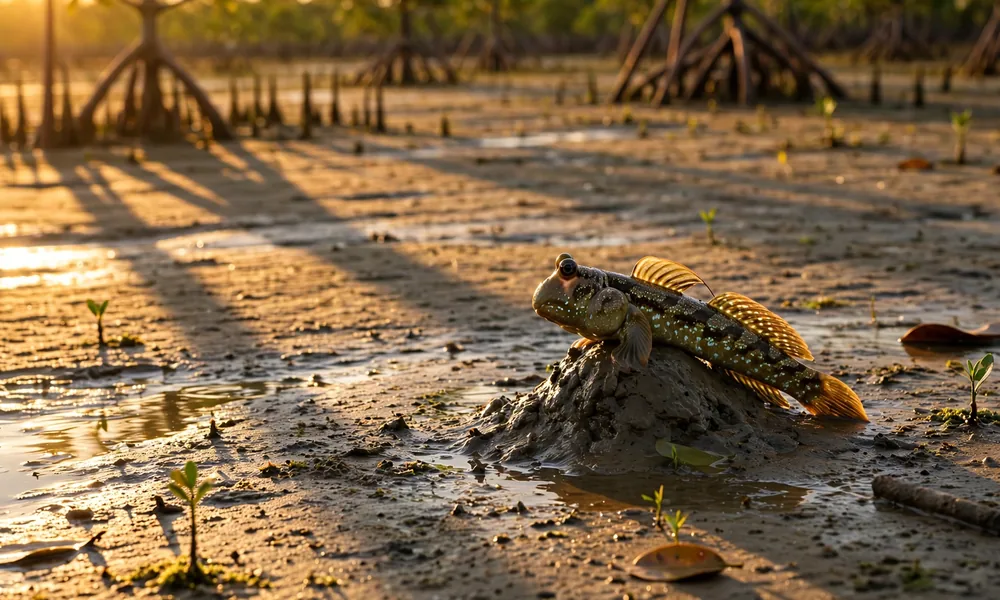
The best hours are the hours around low tide, when the mudflat is exposed and the mudskippers are out in the open, feeding and displaying. At high tide the mudflat is under water and the fish are hidden in their burrows or up in the mangrove roots, and there is nothing to see. A visitor who checks the tide times, arrives an hour or two before low water, walks slowly and quietly, and watches the mud ahead has a good chance of meeting one, and a visitor who stays still will often find that the mudskippers come hopping closer to look at them.
Staying safe around mudskippers
A mudskipper is not a fish that threatens people, and it is a safe animal to meet on the mudflat. It has no venom, it does not bite, and its teeth are small, made for gripping crabs and insects rather than for biting anything large. The fish itself is harmless, and the only real risk comes from the mudflat: the mud is soft and deep in places, and a person can sink to the knees in it, and the tide comes in faster than it looks. Wear boots that you do not mind losing, walk on the firmest mud, and never walk out further than you can walk back in the time before the tide turns.
There are a few practical points for the mudflat itself. Never pick a mudskipper up by its body, because its skin is covered in a delicate layer of mucus that keeps it moist and lets it breathe, and handling it can damage that layer and dry the fish out. If you want a closer look, crouch down and stay still: the fish will come to you. Like the blue tang, a mudskipper is a small fish that deserves respect rather than fear, but the blue tang is a reef fish that lives in the water and warns intruders with a sharp spine, while the mudskipper is a gentle land fish that will hop away rather than fight, and it will come back to look at you once you have stopped moving.
Mudskipper watching checklist
A little preparation turns a walk on a mangrove mudflat into a real chance of meeting one of these remarkable fish face to face.
- A visit in the dry season, from about November to April in South-East Asia, when the days are sunny and the mudflats are firm underfoot.
- A tide table checked in advance, so you arrive an hour or two before low water, when the mudflat is exposed and the fish are out.
- A mudflat with mangroves behind it, where the mudskippers can perch, feed and dig their burrows.
- A slow, quiet approach that keeps you still on the mud, because a mudskipper that is not startled will often hop closer to look at you.
- Boots you do not mind getting muddy, because the mud is soft and deep in places and the tide comes in fast.
- A pair of binoculars or a camera with a good zoom, so you can watch the fish without getting close enough to scare them.
- Respect for the animal and its mudflat, keeping your distance, never picking a fish up, and leaving the burrows and the mangroves as you found them.
Frequently asked questions
How big do mudskippers get?
Most mudskippers measure 10 to 20 centimetres long, and a good fish weighs only a few dozen grams. The largest, the giant mudskipper, reaches about 30 centimetres, which makes it one of the biggest fish that lives part of its life on land.
How do mudskippers breathe out of water?
A mudskipper breathes out of water in two ways: through its moist skin, which takes in oxygen from the air as long as it stays wet, and by holding a mouthful of water in its enlarged gill chambers, which keeps the gills working. It must keep its skin damp, so it rolls in the mud and dips into pools to stay moist.
What do mudskippers eat?
A mudskipper eats small crabs, insects, worms and tiny fish on the mudflat, along with the thin film of algae that coats the surface of the mud. It hunts by perching on the mud, watching its prey, and then hopping forward in a quick series of jumps to snatch it.
Can mudskippers climb trees?
Yes, mudskippers can climb. They use their muscular pectoral fins and the sucker formed by their joined pelvic fins to grip mangrove roots and rocks, and they will climb a metre or more up a root to get a better view, to escape a predator or to rest above the water.
How long can a mudskipper stay out of water?
A mudskipper can stay out of the water for hours, as long as its skin stays moist and its gill chambers stay full of water. It rolls in the mud and dips into tidal pools to keep itself damp, and it retreats into its burrow, where the air is moist, when it needs to rest.
How is this guide different from the mahi-mahi guide?
This guide covers the mudskipper, a small amphibious fish that lives on mangrove mudflats, walks on its fins, breathes through its skin and digs a burrow in the mud, while our mahi-mahi guide covers a bright, fast hunter of the warm open ocean that chases flying fish near the surface, leaps clear of the water and grows to nearly a metre in its first year. One is a walker of the mudflat; the other is a sprinter of the open sea.
Conclusion
The mudskipper species is a reminder that a fish does not need to stay in the water to be a fish. Eyes on top of its head, fins that work like arms, skin that breathes air and a burrow dug in the mud have made this small goby the most remarkable animal of the mangrove shore, at home on the mudflat, in a tidal pool and up a mangrove root alike.
If you go looking for one, go at low tide, go to the edge of the mangroves, and walk slowly with your eyes on the mud ahead. Find the small fish perched there, watch it watch you, and you will have met the fish that walked out of the sea.