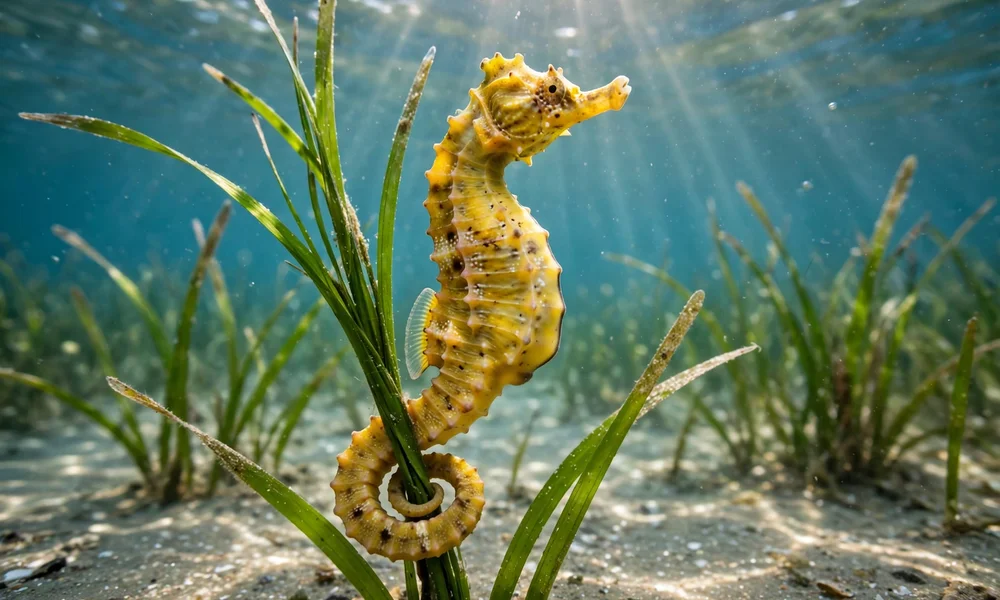
The seahorse species number more than forty, upright swimmers of the seagrass meadows, and they are among the strangest fish in the sea, with horse-shaped heads, curled tails and males that carry the babies. If you are asking how many seahorse species there are, the answer is more than forty: there are more than forty recognised seahorse species in the world, in the genus Hippocampus, and every seahorse alive today belongs to one of them.
The seahorse belongs to the family Syngnathidae, along with the pipefish and the seadragons, and it lives in shallow tropical and temperate seas around the world, from seagrass meadows to coral reefs. Its upright posture, its prehensile tail, and its armour of bony rings make it one of the most recognisable fish on Earth.
Key takeaways
- There are more than forty seahorse species, in the genus Hippocampus, from the dwarf seahorse at 1.5 centimetres to the big-belly seahorse at 35 centimetres.
- Male seahorses carry the babies in a brood pouch, and a single male can give birth to hundreds of young at once.
- Seahorses swim upright and are poor swimmers, so they anchor themselves to seagrass with their curled tails.
- Seahorses change colour to match their surroundings, and their eyes move independently of each other.
- Many seahorse species are listed as Vulnerable or Endangered, and all seahorses are protected by international trade law.
What makes a seahorse a seahorse
A seahorse is a small fish with a horse-shaped head, a tubular snout, a curled prehensile tail and a body covered in bony rings instead of scales, and it measures roughly 1.5 to 35 centimetres long, depending on the species. The dwarf seahorse is the smallest, at about 1.5 centimetres, while the big-belly seahorse is the largest, at up to 35 centimetres.
The tail defines the seahorse: a curled prehensile tail that grips seagrass and coral like a hand, holding the animal still in the current while it hunts. The seahorse swims upright, beating its tiny dorsal fin up to 70 times a second, and it is one of the slowest fish in the sea. Like other clownfish, the seahorse lives among the reef, but it has no scales, and its body is covered in rings of bony armour instead.
The seahorse species and their relatives
There are more than forty seahorse species, in the genus Hippocampus. The common seahorse lives in the shallow seas of Europe and the Mediterranean, and it is the best-known of all. The big-belly seahorse lives around Australia and New Zealand, and it is the largest of all, while the dwarf seahorse lives in the seagrass beds of the Caribbean, and it is the smallest of all.
The lined seahorse is a seahorse of the western Atlantic, with pale lines across its body, while the leafy seadragon is a seahorse relative of southern Australia that looks like floating seaweed. The weedy seadragon is another seadragon of southern Australia, and the pipefish is a long thin cousin that swims horizontally. The pot-bellied seahorse is a seahorse of New Zealand and Australia, and the thorny seahorse is a spiny seahorse of the Indo-Pacific.
| Type | Animal | Where it lives | Best-known food | Length or Weight |
|---|---|---|---|---|
| Species | Common seahorse (Hippocampus hippocampus) | Shallow seas of Europe and the Mediterranean | Plankton and tiny crustaceans | 10 to 15 cm |
| Close relative | Big-belly seahorse | Coasts of Australia and New Zealand | Plankton and tiny crustaceans | Up to 35 cm |
| Close relative | Dwarf seahorse | Seagrass beds of the Caribbean | Plankton and tiny crustaceans | About 1.5 to 2.5 cm |
| Close relative | Lined seahorse | Western Atlantic, from Canada to Brazil | Plankton and tiny crustaceans | Up to 19 cm |
| Close relative | Leafy seadragon | Southern Australia | Plankton and tiny crustaceans | 20 to 24 cm |
| Close relative | Weedy seadragon | Southern Australia | Plankton and tiny crustaceans | Up to 45 cm |
| Close relative | Pipefish | Shallow seas worldwide | Plankton and tiny crustaceans | Up to 60 cm |
How seahorses live
Seahorses are creatures of the seagrass meadow. A seahorse lives alone or in a pair, holding on to seagrass by day and hunting tiny prey in the water around it, and it stays in the same small patch of seagrass for its whole life. Like other tuna, it is a fish, but it is a terrible swimmer, and it would be swept away in open water, so it clings to the seagrass instead.
Plankton and tiny crustaceans make up most of the diet, along with small shrimp and fish larvae, and a seahorse eats by sucking its prey through its tubular snout like a straw. It has no stomach, so it must eat almost constantly, snapping up dozens of tiny animals every hour, and its eyes move independently, one watching for food while the other watches for danger.
Breeding happens in the warm months, and the female places her eggs in a pouch on the male’s belly, where he fertilises them and carries them for ten days to six weeks, depending on the species. The male gives birth to the young, pumping his pouch until hundreds of tiny seahorses burst out, and the young are on their own from the moment they are born, drifting in the plankton until they find seagrass to hold. Seahorses live for around one to five years in the wild, depending on the species.
Where seahorses live
The seahorse lives in shallow tropical and temperate seas around the world, from the seagrass meadows of Europe to the coral reefs of Southeast Asia and the mangroves of Australia, and it is most common in the seagrass beds of the Mediterranean and the Indo-Pacific, where the water is calm and the food is thick. The common seahorse lives in the shallow seas of Europe, while the lined seahorse lives along the coasts of the Americas.
Seagrass is the key requirement. A seahorse needs calm shallow water with seagrass or coral to hold on to, and plenty of plankton to eat, so it stays in the same meadow all its life, and when the seagrass is dredged the seahorses have nowhere to live. It depends on the meadow staying intact, and it clings to the same stems year after year, changing colour to match them.
Many species are listed as Vulnerable or Endangered, and all seahorses are listed on Appendix II of CITES, which controls their international trade. The main pressures are the loss of seagrass to dredging and pollution, and the trade in dried seahorses for traditional medicine and the aquarium trade, which takes millions of animals every year. Seahorses are slow breeders, and a meadow that loses its seahorses may take years to recover.
Best seasons for seahorse watching
There is no closed season, because seahorses are active all year, but the best time to look for them depends on where you go. In the Mediterranean the best months are often June to September, when the water is warm and clear and the seahorses are breeding. In Australia the best months are often November to March, when the seahorses gather in the shallow bays.
Staying safe around seahorses
A seahorse is a wild animal with delicate skin and a fragile body, and it can be killed by a single touch, though seahorses cannot hurt people at all. Keep your distance, never pick up a seahorse, and never try to touch or feed one, because a seahorse that is handled may die of stress, and its protective slime coat may be damaged. If you see seahorses while diving, stay still, watch with a mask, and never stir up the sand, because seahorses that are disturbed may leave their meadow for good.
Seahorse watching checklist
A little preparation turns a snorkelling trip into a real chance of seeing a seahorse, so pack for sun, salt water and long quiet hours.
- A mask and snorkel with good visibility, for picking a tiny seahorse out of the seagrass.
- A camera with a macro lens, because seahorses are small and should always be watched from a distance.
- Sun cream and a hat, because the best watching is in the bright midday sun.
- A booked dive with a guide who knows the seahorse meadows and the safe routes.
- A plan to be out in the morning, when the seahorses are most active and feeding.
- Patience and silence, because seahorses are shy animals and a noisy group will send them away.
- A field guide to reef fish, for telling a common seahorse from a lined seahorse at a glance.
Frequently asked questions
How many seahorse species are there?
There are more than forty seahorse species, in the genus Hippocampus. New species are still being found, and the count changes as scientists study them, but the dwarf seahorse and the big-belly seahorse are the smallest and largest of all.
Do male seahorses really give birth?
Yes. The female places her eggs in a pouch on the male’s belly, where he fertilises them and carries them until they hatch. The male gives birth to the young, pumping his pouch until hundreds of tiny seahorses burst out, and the young are on their own from the moment they are born.
Why do seahorses swim upright?
Seahorses swim upright because their backs are stiff with bony rings, and their bodies are built to stand upright among the seagrass. They beat their tiny dorsal fin up to 70 times a second to stay upright, and they steer with even tinier fins behind their heads.
Can you keep a seahorse as a pet?
No. A seahorse is a wild animal that needs seagrass, eats plankton almost constantly, and is protected by international trade law. Seahorses in aquariums need specialist care with live food and clean water, and they are not pets for beginners.
How is this guide different from the dingo species guide?
This guide covers more than forty seahorse species, tiny upright fish that cling to seagrass and whose males carry the babies, while our dingo species guide covers the single dingo species, a wild dog that hunts kangaroos in packs in the Australian outback. The seahorse is up to 35 centimetres long and eats plankton through a straw-like snout, and the dingo weighs up to 24 kilogrammes and howls across the desert.
Are seahorses endangered?
Many seahorse species are listed as Vulnerable or Endangered, and all seahorses are protected by international trade law. The loss of seagrass and the trade in dried seahorses for medicine and aquariums are the main threats.
Conclusion
The seahorse species show how much strangeness one fish can hold: more than forty species of upright swimmer, with horse-shaped heads, curled tails, and males that carry the babies, living in the seagrass meadows of the world.
If you go looking for one, go in the summer to the Mediterranean or the Indo-Pacific, go quietly, and go with patience. Watch a seahorse cling to seagrass in the shallows and you will understand why it has earned its place as the strangest fish in the sea, and why keeping its meadows matters most.