The blue-tongued skink species are a small group of large, heavy-bodied lizards from Australia, New Guinea and Indonesia, and there are about eight of them in the genus Tiliqua. If you are asking how many blue-tongued skink species there are, the answer is about eight, though some lists count seven, because a few island forms are treated as subspecies rather than full species, and every one of them shares the same startling defence: a broad, vivid blue tongue that it flashes at anything that gets too close.
Blue-tongued skinks are slow, ground-dwelling lizards with short legs, smooth overlapping scales and a big head, and they are among the most familiar reptiles in Australian gardens, where they patrol lawns and flower beds eating snails and slugs. They are active by day, basking in the sun to warm their bodies.
Key takeaways
- There are about eight blue-tongued skink species in the genus Tiliqua, though some lists count seven.
- Most blue-tongued skinks grow to about 45 to 60 centimetres long and weigh roughly 300 to 500 grams, while the pygmy blue-tongued skink is only 9 to 15 centimetres long.
- Every blue-tongued skink flashes a vivid blue tongue to startle predators, and it can also drop its tail to escape, growing a new one afterwards.
- Blue-tongued skinks are omnivores that eat snails, slugs, insects, flowers, fruit, berries and carrion, and they are welcome visitors in gardens because they eat pests.
- Most blue-tongued skink species are listed as Least Concern, but the pygmy blue-tongued skink is Endangered, with only about 5,000 to 7,000 animals left.
What makes a blue-tongued skink a blue-tongued skink
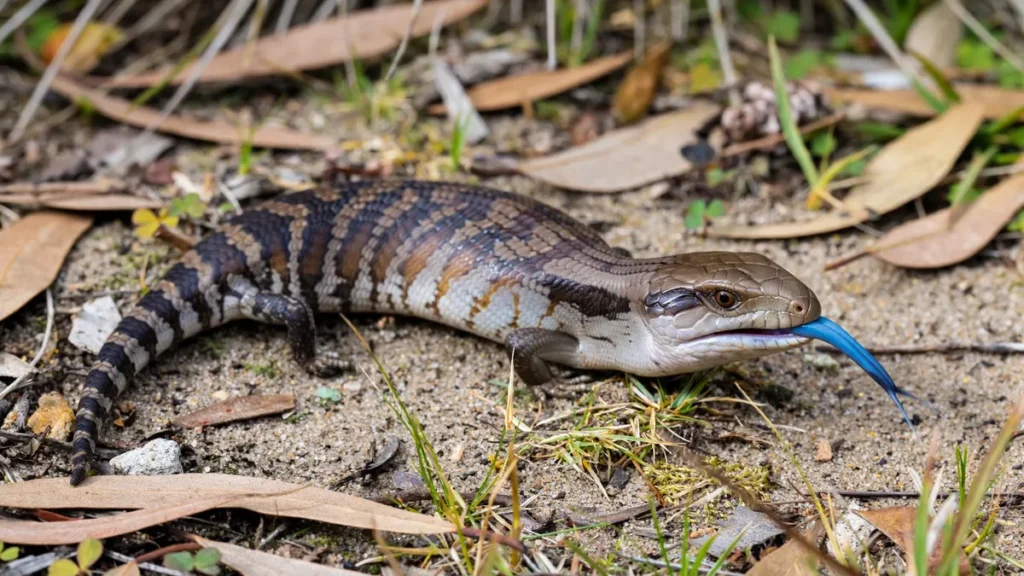
A blue-tongued skink is built low and heavy, with a cylindrical body, a large triangular head, short sturdy legs and smooth, glossy scales that overlap like roof tiles. Most species wear bands or blotches of brown, grey, black and cream, and the eastern blue-tongue has broad dark crossbands over a grey or silvery body.
The feature that gives the whole group its name is the tongue. It is broad, flat and a startling shade of blue, and when a blue-tongued skink feels threatened it opens its mouth wide, puffs up its body and shows the tongue, which makes the lizard look bigger and stranger than a predator expects. The tongue also tastes the air, and it is not venomous. Like the Argentine tegu, another large ground-dwelling lizard, a blue-tongued skink relies on its size, its tough scales and its bold display rather than speed to stay safe.
The blue-tongued skink species and their relatives
Blue-tongued skinks belong to Tiliqua, a genus in the skink family Scincidae, and the best-known member is the common blue-tongued skink, Tiliqua scincoides, which includes the eastern blue-tongue of southern and eastern Australia and the northern blue-tongue of northern Australia, as well as a third form on the Tanimbar and Babar islands of Indonesia. The northern blue-tongue is the largest of all, reaching about 45 to 60 centimetres, and the eastern blue-tongue is the species most often seen in Sydney gardens.
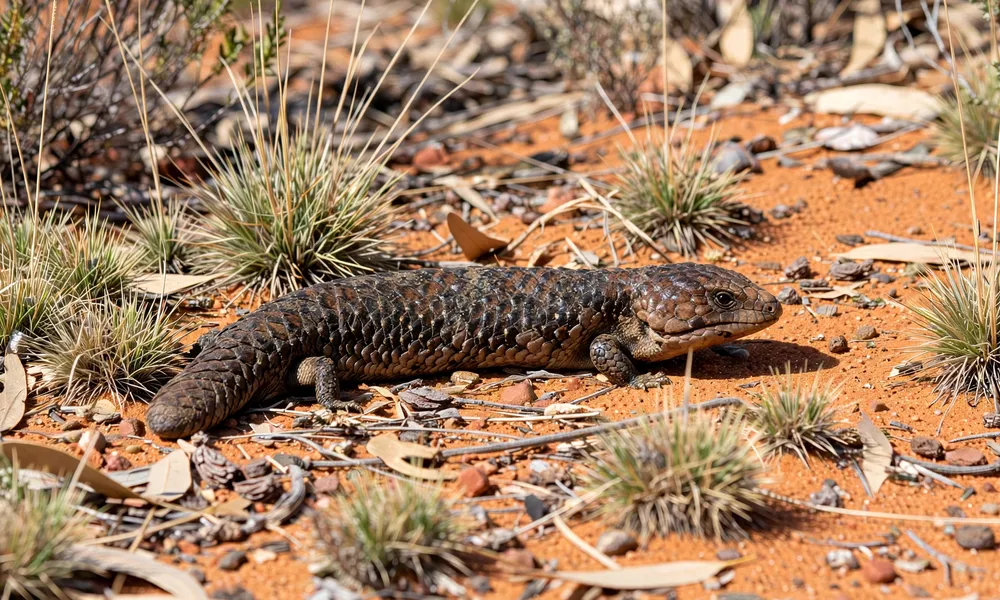
The other members of the genus are just as distinctive. The blotched blue-tongued skink, Tiliqua nigrolutea, lives in south-eastern Australia and Tasmania and wears cream, yellow or pink blotches on a dark body. The centralian blue-tongued skink, Tiliqua multifasciata, lives in the red-sand country of central Australia. The Indonesian blue-tongued skink, Tiliqua gigas, lives in New Guinea and Indonesia and grows to about 50 to 60 centimetres. The shingleback, Tiliqua rugosa, also called the bobtail or sleepy lizard, has huge rough scales and a short blunt tail that looks like a second head. The pygmy blue-tongued skink, Tiliqua adelaidensis, of South Australia measures only about 9 to 15 centimetres.
| Type | Animal | Where it lives | Best-known food | Length or Weight |
|---|---|---|---|---|
| Genus | Blue-tongued skinks (genus Tiliqua) | Australia, New Guinea and Indonesia | Snails, insects and fruit | About 45 to 60 cm long |
| Species | Common blue-tongued skink (Tiliqua scincoides) | Eastern and northern Australia | Snails, insects and berries | About 45 to 60 cm long |
| Species | Blotched blue-tongued skink (Tiliqua nigrolutea) | South-eastern Australia and Tasmania | Snails, flowers and fruit | About 35 to 50 cm long |
| Species | Western blue-tongued skink (Tiliqua occipitalis) | Southern and western Australia | Insects, flowers and seeds | About 30 to 45 cm long |
| Species | Centralian blue-tongued skink (Tiliqua multifasciata) | Central Australia | Seeds, insects and carrion | About 30 to 45 cm long |
| Species | Shingleback (Tiliqua rugosa) | Southern and western Australia | Flowers, fruit and insects | About 30 cm long |
| Species | Indonesian blue-tongued skink (Tiliqua gigas) | New Guinea and Indonesia | Fruit, flowers and insects | About 50 to 60 cm long |
How blue-tongued skinks live
Blue-tongued skinks are omnivores, and they eat almost anything they can find on the ground. Snails and slugs are a favourite food, along with insects, worms, spiders, flowers, leaves, berries and fallen fruit, and they will also eat carrion when they find it. Gardeners welcome them because a single blue-tongue can clear a flower bed of snails. Shinglebacks eat mostly flowers, fruit and leaves.
Blue-tongued skinks are diurnal, so they are out and about in daylight, and they need to keep their body temperature at about 30 to 35 degrees Celsius to stay active. They bask in the morning, hunt through leaf litter by day, and shelter under logs and rocks at night. In winter they shelter in burrows and hollow logs, coming out only on sunny days to bask.
Blue-tongued skinks give birth to live young rather than laying eggs, and a female gives birth to a litter of live babies in late summer. The babies are miniature copies of the adults and can fend for themselves at once. Blue-tongued skinks can live for about 15 to 18 years in the wild and for 20 years or more in captivity, and they are generally solitary animals that only come together to mate. If a predator grabs one by the tail, the tail breaks off and the lizard escapes, growing a new tail over time.
Where blue-tongued skinks live
Blue-tongued skinks live across Australia, from the tropical north to cool Tasmania, and in New Guinea and Indonesia as well. They use a wide range of habitats, including open grassland, scrubland, woodland, coastal heath, semi-desert and the edges of towns and gardens, with plenty of leaf litter, fallen logs and rocks to hide under.
Each species has its own country. The blotched blue-tongue lives in wet and dry forest and mountain woodland in the south-east and Tasmania, the centralian blue-tongue lives on red-sand plains, dunes and stony hills with spinifex grass, and the western blue-tongue lives in mallee woodland, shrubland and heath in the south and west. Shinglebacks live in the drier south, in open woodland, scrub and farmland. The Indonesian blue-tongue lives in the forests and gardens of New Guinea and the islands of eastern Indonesia.
Most blue-tongued skink species are listed as Least Concern, because they are widespread and adaptable, and several have learned to live in suburbs and gardens. The pygmy blue-tongued skink is the exception: it is listed as Endangered, it lives only in native grassland in South Australia, and its population is estimated at only about 5,000 to 7,000 animals, threatened by the loss of its grassland habitat to farming and by the removal of the spider burrows it shelters in. Like the Komodo dragon, another large lizard that depends on a small home range, the pygmy blue-tongue shows how quickly a lizard can become rare when its habitat disappears.
Best seasons for blue-tongued skink watching
The best time to watch blue-tongued skinks is in the warm months, from spring to early autumn, when the lizards are out basking and hunting every day. In Australia that means roughly September to April. Mornings are the best time of day, because the lizards come out onto warm paths and rocks to bask.
Staying safe around blue-tongued skinks
A blue-tongued skink is harmless and not venomous, but it is a wild animal and should be watched from a distance rather than picked up. A frightened blue-tongue can bite, and its jaws are strong enough to give a painful nip, so never corner one or try to handle it. Keep dogs on a lead near them, and wash your hands after touching anything a reptile has been in contact with.
Blue-tongued skink watching checklist
A little preparation turns a morning walk into a real chance of seeing a blue-tongue basking in the open.
- A warm spring or summer morning, when blue-tongued skinks come out to bask on paths and rocks.
- A garden, park or grassland edge with leaf litter, logs and rocks for the lizards to shelter under.
- Quiet feet and patience, because a blue-tongue will freeze or slip away if it feels footsteps.
- A camera with a zoom lens, for close views without getting close enough to frighten the lizard.
- A field guide to Australian lizards, for telling an eastern blue-tongue from a blotched blue-tongue.
- Sun protection and water, because the best basking spots are open and sunny.
- A dog kept on a lead, so it cannot chase or injure a slow-moving blue-tongued skink.
Frequently asked questions
How many blue-tongued skink species are there?
There are about eight blue-tongued skink species in the genus Tiliqua, though some lists count seven, because a few island forms are treated as subspecies rather than full species.
Why do blue-tongued skinks have blue tongues?
The blue tongue is a warning display. When a blue-tongued skink feels threatened, it opens its mouth wide and shows its vivid blue tongue, which startles predators and makes the lizard look bigger and stranger than expected. The tongue also tastes the air, and it is not venomous.
What does a blue-tongued skink eat?
Blue-tongued skinks are omnivores that eat snails, slugs, insects, worms, spiders, flowers, leaves, berries and fallen fruit, as well as carrion when they find it.
Do blue-tongued skinks lay eggs?
No. Blue-tongued skinks give birth to live young rather than laying eggs, which is unusual among lizards. The female carries her babies inside her body for several months and gives birth to a litter of live young in late summer.
How is this guide different from the gazelle species guide?
This guide covers the blue-tongued skink, about eight species of slow, ground-dwelling lizards from Australia, New Guinea and Indonesia that eat snails and fruit and flash a vivid blue tongue when threatened, while our gazelle species guide covers the gazelle, about 19 species of swift grazing antelopes that live on the grasslands and deserts of Africa and Asia. Blue-tongued skinks bask on warm rocks and slip through leaf litter, and gazelles run in herds across open plains.
Are blue-tongued skinks endangered?
Most blue-tongued skink species are listed as Least Concern, because they are widespread and adaptable, and several live happily in gardens and suburbs. The pygmy blue-tongued skink is the exception: it is Endangered, with only about 5,000 to 7,000 animals left in native grassland in South Australia.
Conclusion
The blue-tongued skink species show how much variety can fit into one small group of lizards: about eight species in the genus Tiliqua, from the tiny pygmy blue-tongue of South Australian grassland to the great northern blue-tongue.
If you go looking for one, go on a warm spring morning, go quietly, and look for a heavy lizard basking on a sunny path. Watch it flick its blue tongue and move slowly through the leaf litter, and you will see why gardeners welcome these gentle lizards.