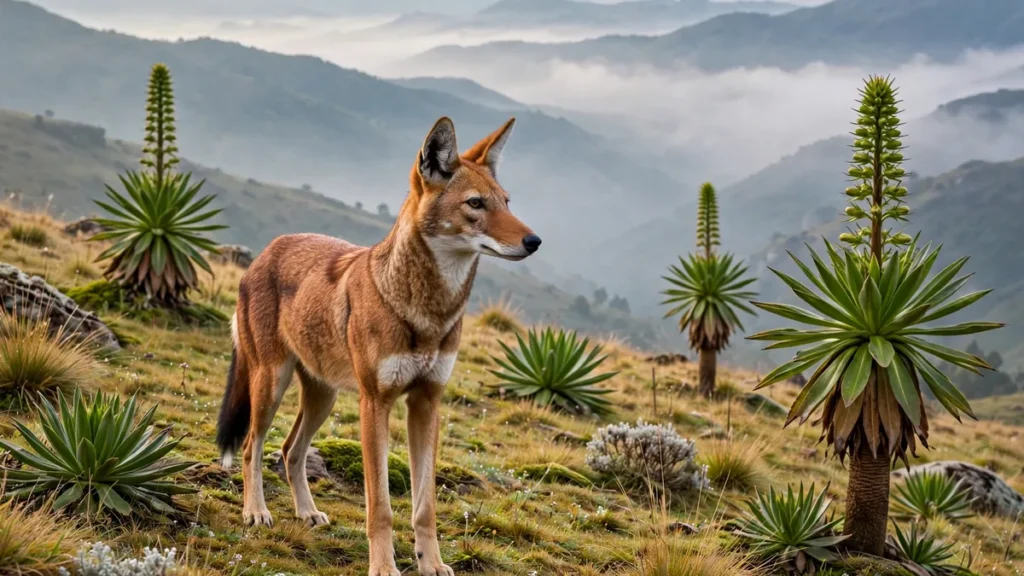
The Ethiopian wolf species is a single species, Canis simensis, and it is Africa’s most endangered carnivore and the rarest canid on Earth, with fewer than 500 adults left in the wild. If you are asking how many Ethiopian wolf species there are, the answer is one: there is just one Ethiopian wolf species, Canis simensis, found nowhere on Earth except the high moorlands of Ethiopia, above 3,000 metres.
An Ethiopian wolf looks like a large fox with the long legs of a wolf, wearing a reddish-ochre coat with a white chest and throat, and it lives a life unlike any other wolf. It hunts alone in daylight, stalking giant mole-rats through the tussock grass of the Afroalpine moorlands.
Key takeaways
- There is one Ethiopian wolf species, Canis simensis, found only in the highlands of Ethiopia.
- Fewer than 500 adults remain, making it Africa’s most endangered carnivore and the world’s rarest canid.
- Ethiopian wolves live only above about 3,000 metres, in Afroalpine moorland and grassland.
- They hunt alone in daylight, and giant mole-rats are their most important prey.
- The species is listed as Endangered, threatened by disease from domestic dogs, habitat loss and hybridisation.
What makes an Ethiopian wolf an Ethiopian wolf
An Ethiopian wolf is a medium-sized canid, about the size of a coyote, with a long, narrow skull, a slender muzzle, very long legs and a bushy tail tipped with white. Its coat is reddish-ochre on the back and sides, with white on the throat, chest and belly and a pale band across the face, and the ears are pointed and upright. Adults stand about 62 centimetres at the shoulder, measure 62 to 80 centimetres from nose to tail base, and weigh about 14 to 19 kilograms.
The long legs and narrow muzzle are the marks of a rodent hunter. An Ethiopian wolf does not chase down large prey like other wolves, which hunt in packs and bring down deer and elk; it stalks alone through the grass, listening and watching for the rustle of a mole-rat, then pounces with its forepaws and digs it out.
The Ethiopian wolf species and their relatives
There is only one Ethiopian wolf species. It belongs to the dog family, Canidae, and its closest relatives are the other members of the genus Canis, the grey wolf, the coyote and the golden jackal. Genetic studies place the Ethiopian wolf closest to the grey wolf and the coyote, and it is thought to have reached Africa from Eurasia in the recent past.
The best-known members of the family are the grey wolf, the largest wild canid, which ranges across the Northern Hemisphere; the coyote of North America, a smaller hunter of rabbits and rodents; the golden jackal of Africa, Asia and Europe; the dingo of Australia; and the African wild dog, a pack hunter of the savannas that is not a true wolf at all. The Ethiopian wolf is the only Canis species that lives only in Africa and nowhere else, and the only one that hunts rodents alone in daylight as its way of life.

| Type | Animal | Where it lives | Best-known food | Length or Weight |
|---|---|---|---|---|
| Family | Canids (family Canidae) | Almost worldwide, on every continent except Antarctica | Meat, rodents and small mammals | About 40 to 160 cm long |
| Species | Ethiopian wolf (Canis simensis) | Afroalpine highlands of Ethiopia | Giant mole-rats and grass rats | About 62 to 80 cm long, 14 to 19 kg |
| Relative | Grey wolf (Canis lupus) | North America, Europe and Asia | Deer, elk and moose | About 105 to 160 cm long, 30 to 50 kg |
| Relative | Coyote (Canis latrans) | North America | Rabbits, rodents and carrion | About 75 to 100 cm long, 7 to 20 kg |
| Relative | Golden jackal (Canis aureus) | Africa, Asia and southeastern Europe | Small mammals, fruit and carrion | About 60 to 100 cm long, 6 to 14 kg |
| Relative | Dingo (Canis familiaris dingo) | Australia | Wallabies, rabbits and rodents | About 90 to 120 cm long, 13 to 24 kg |
| Relative | African wild dog (Lycaon pictus) | Sub-Saharan Africa | Antelope and small mammals | About 75 to 110 cm long, 18 to 36 kg |
How Ethiopian wolves live
Ethiopian wolves are social animals that hunt alone. They live in packs of up to about 13 adults, with an average pack of around seven, and the pack defends a territory together, but each wolf goes out hunting by itself during the day. A wolf may spend most of its active hours stalking rodents in the grass, moving slowly with its ears pricked, listening for movement underground, then pouncing and digging with its forepaws. Giant mole-rats make up most of the diet in the Bale Mountains, with grass rats, brush-furred rats and highland hares as the other main prey.
Only the dominant female in a pack normally breeds, and she gives birth to a litter of two to six pups in a den dug into the ground, after a pregnancy of about two months. The pups are cared for by the whole pack, with the other adults bringing food to the den and guarding the young while the mother hunts. Young wolves stay with their pack for a year or more. A wild Ethiopian wolf that survives its first year may live for around a decade.
The pack is a noisy, close-knit family, and wolves greet each other with tail wagging and face licking, and defend their territory with scent marks and choruses of howls. Ethiopian wolves are active mostly in the morning and late afternoon, resting at midday when the high-altitude sun is strongest, and they sleep in dens or in sheltered hollows in the grass. Researchers have also watched Ethiopian wolves drinking nectar from red hot poker flowers, dusting their muzzles with pollen as they feed.
Where Ethiopian wolves live
Ethiopian wolves live only in Ethiopia, in the Afroalpine moorlands and grasslands above about 3,000 metres, and they range up to about 4,500 metres. Their world is a cold, open landscape of tussock grass, giant lobelia and heath, with sharp nights and strong sun by day, and it is the only place in Africa where this kind of high moorland exists. The wolves need open ground with plenty of rodents, and they avoid forests and farmland, so their range is broken into isolated mountain islands.
Six populations survive today, scattered across the Bale Mountains, the Simien Mountains, the Wollo highlands and a few smaller ranges, and more than half of all the wolves live in the Bale Mountains. The Bale population is the largest and most studied, and the smaller populations are cut off from each other by deep valleys of farmland that wolves rarely cross.
Every population is fragile, and the species is listed as Endangered because its numbers are so small and its range so broken up. Disease is the sharpest threat: rabies and canine distemper spread from domestic dogs, and a single outbreak can kill most of a population in weeks, as rabies did in Bale in the early 2000s before the population recovered. Habitat is lost as high pastures are ploughed or overgrazed, and wolves that mate with domestic dogs produce hybrids that dilute the wild gene pool. Conservation teams now vaccinate domestic dogs around the parks, and vaccinate wolves themselves against rabies.
Best seasons for Ethiopian wolf watching
The best time to look for Ethiopian wolves is the dry season, from about October to March, when the grass is short, the skies are clear and the wolves hunt in the open for long hours. Mornings are the best time of day, when the wolves leave their dens and begin stalking rodents in the soft light. The Bale Mountains, especially the Sanetti Plateau, is the most reliable place in the world to see one.
Staying safe around Ethiopian wolves
An Ethiopian wolf is a wild carnivore, but it is not dangerous to people, and it is far more likely to trot away from you than to come close. Keep your distance, never try to feed a wolf or approach a den, and never let a pet dog run free near wolf country, because dogs can carry disease to the wolves. If you are watching wolves in the Bale or Simien Mountains, stay with a guide, keep quiet, and let the wolves hunt undisturbed.
Ethiopian wolf watching checklist
Pack for altitude, cold and long quiet hours on a high plateau.
- Warm layers and a windproof jacket, for cold mornings above 3,000 metres.
- Binoculars, because Ethiopian wolves hunt alone in open grass and are best watched from a distance.
- A camera with a zoom lens, for the reddish coat and the pounce without getting close.
- A local guide, who knows the packs, the territories and the safest routes across the plateau.
- Sun protection and a hat, because the high-altitude sun is fierce even on a cold morning.
- Patience and silence, because a wolf that hears a noisy group will simply move away.
- A field guide to Ethiopian wildlife, for the giant mole-rats, raptors and other highland animals you will see on the way.
Frequently asked questions
How many Ethiopian wolf species are there?
There is one Ethiopian wolf species, Canis simensis. It is found nowhere on Earth except the highlands of Ethiopia, and it is the only Canis species that lives only in Africa.
How many Ethiopian wolves are left?
Fewer than 500 adults remain in the wild, in about six separate populations. The most recent surveys count around 450 animals in total, with more than half of them living in the Bale Mountains.
What do Ethiopian wolves eat?
Ethiopian wolves eat mainly Afroalpine rodents, above all the giant mole-rat, along with grass rats, brush-furred rats and highland hares. They hunt alone in daylight, stalking and pouncing on their prey in the grass.
Where do Ethiopian wolves live?
Ethiopian wolves live only in the Afroalpine moorlands of Ethiopia, above about 3,000 metres and up to about 4,500 metres. The largest population is in the Bale Mountains, with others in the Simien Mountains, the Wollo highlands and a few smaller ranges.
How is this guide different from the colobus monkey species guide?
This guide covers the Ethiopian wolf, a single rare species, Canis simensis, that hunts rodents alone in the high moorlands of Ethiopia, while our colobus monkey species guide covers the colobus monkeys, five black-and-white leaf-eating monkeys that live in troops in the forests of Africa. The Ethiopian wolf is a high-altitude rodent hunter, and the colobus monkeys are forest leaf-eaters that rarely come down from the trees.
Are Ethiopian wolves endangered?
Yes. The Ethiopian wolf is listed as Endangered, and it is Africa’s most endangered carnivore and the world’s rarest canid. Disease from domestic dogs, habitat loss, overgrazing and hybridisation with dogs are the main threats, and conservation teams vaccinate dogs and wolves against rabies to protect the remaining populations.
Conclusion
The Ethiopian wolf species is a single, extraordinary animal: one species, fewer than 500 adults, living only on the cold roof of Ethiopia and hunting mole-rats alone in the thin air. It is a wolf that became a rodent hunter, and a social animal that hunts by itself.
If you go looking for one, go to the Bale Mountains in the dry season, go early, go quietly, and go with a guide who knows the packs. Watch an Ethiopian wolf stalk through the tussock grass, pounce and dig out a mole-rat, and you will understand why this rare, red-coated hunter is worth every effort to keep alive.