The howler monkey species are about 15 large, slow-moving monkeys in the genus Alouatta, and they are the loudest land animals on Earth. If you are asking how many howler monkey species there are, the answer is about 15, though some lists count 14, and every one of them can roar loud enough to be heard up to five kilometres away through dense rainforest.
Howler monkeys live in the rainforests of Central and South America, from southern Mexico to northern Argentina, and spend almost their whole lives high in the trees. They are the largest New World monkeys, with heavy bodies, thick beards and long prehensile tails, and they are famous for the dawn chorus that rolls through the forest at sunrise.
Key takeaways
- There are about 15 howler monkey species in the genus Alouatta, though some lists count 14.
- Howler monkeys make the loudest call of any land animal, reaching about 140 decibels and carrying up to five kilometres through forest.
- Most howler monkeys measure about 56 to 92 centimetres in head and body length, with a tail about as long again, and weigh roughly 4 to 10 kilograms.
- Howler monkeys eat mostly leaves, with fruit, flowers, buds and nuts, and gut bacteria help them digest tough plant matter.
- Howler monkey species range from Least Concern to Endangered, with the Guatemalan black howler listed as Endangered.
What makes a howler monkey a howler monkey
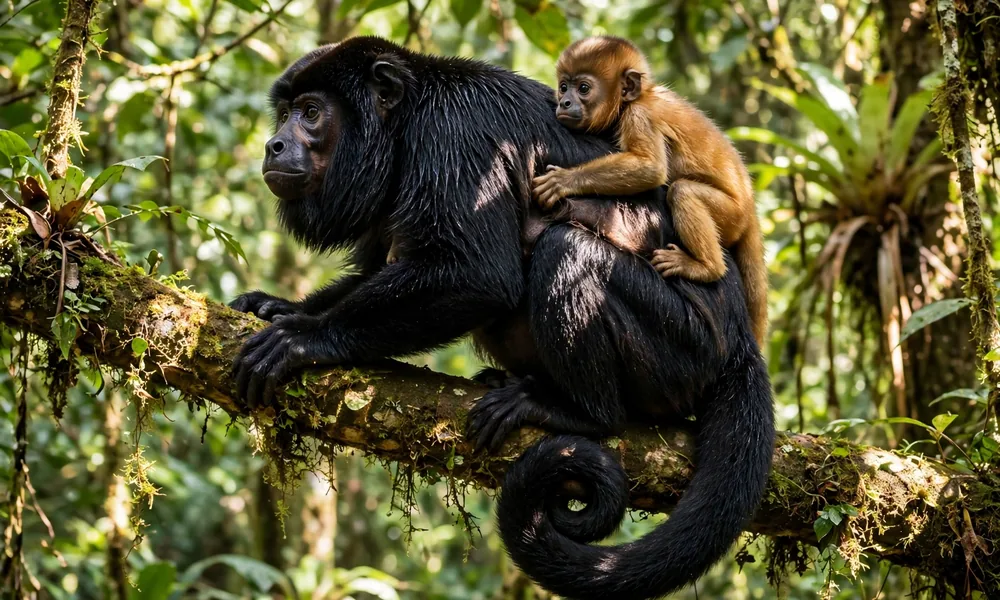
A howler monkey is built heavy and slow, with a stocky body, a large head, a thick beard and a long tail that works like a fifth hand. The tail is prehensile, which means it can grip branches, and the bare underside of its tip holds on like a hand, even supporting the monkey’s whole weight while it feeds.
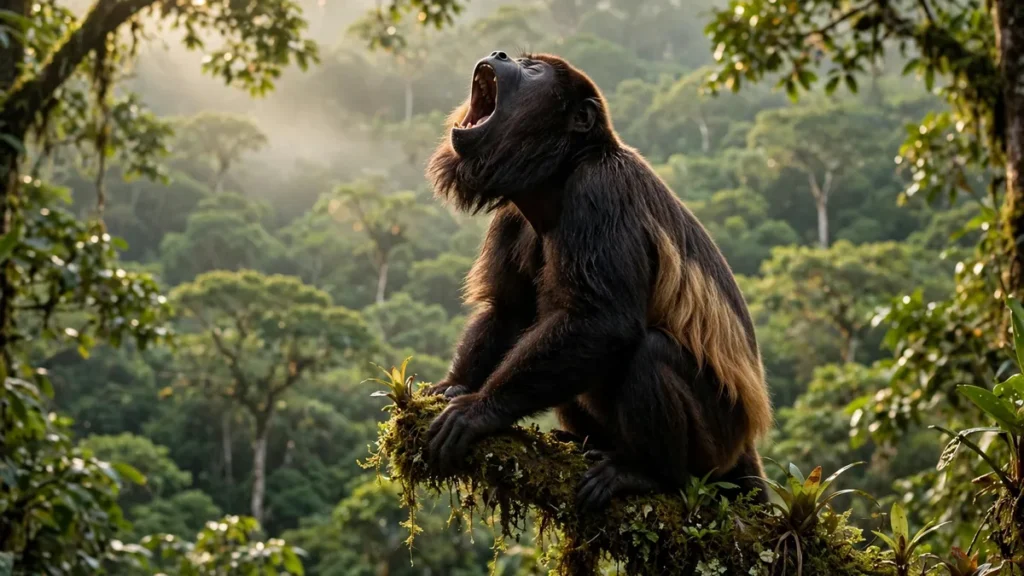
The feature that gives the whole group its name is the voice. Both males and females have an enlarged hyoid bone in the throat, a hollow bone that works like a resonating chamber, and the males have a much larger throat, so their roars are deeper and louder. When a howler calls, it opens its mouth wide, tilts its head back and lets out a long, guttural roar that other troops answer from far away. Like the colobus monkey, another leaf-eating monkey, a howler monkey lives slowly to save energy, because leaves give very little energy for their bulk.
The howler monkey species and their relatives
Howler monkeys belong to Alouatta, a genus in the family Atelidae, the same family as spider monkeys and woolly monkeys, and the best-known member is the mantled howler, Alouatta palliata, of Mexico and Central America, the monkey most visitors hear in Costa Rica. It wears dark brown or black fur with a fringe of long golden hair along its flanks.
The black howler, Alouatta caraya, of Argentina, Paraguay, Bolivia and southern Brazil shows striking differences between the sexes, with jet-black males and golden-brown females. The red howler, Alouatta seniculus, is the most widespread of all, ranging across the Amazon and Orinoco basins in reddish-brown fur. The brown howler, Alouatta guariba, lives in the Atlantic forest of Brazil and Argentina and has been hit hard by yellow fever. The Guatemalan black howler, Alouatta pigra, lives in Belize, Guatemala and southern Mexico and is listed as Endangered. The red-handed howler, Alouatta belzebul, of eastern Brazil has black fur with reddish-brown hands, feet and tail tip. Like the capuchin monkey, a howler monkey uses its prehensile tail every day, but unlike the quick, curious capuchin, a howler spends most of its day resting and digesting leaves.
| Type | Animal | Where it lives | Best-known food | Length or Weight |
|---|---|---|---|---|
| Genus | Howler monkeys (genus Alouatta) | Central and South America | Leaves, fruit and flowers | About 56 to 92 cm long |
| Species | Mantled howler (Alouatta palliata) | Mexico to Ecuador | Leaves, figs and flowers | About 51 to 68 cm long |
| Species | Black howler (Alouatta caraya) | Argentina, Paraguay and Bolivia | Leaves, fruit and flowers | About 50 to 65 cm long |
| Species | Red howler (Alouatta seniculus) | Amazon and Orinoco basins | Leaves, figs and flowers | About 46 to 72 cm long |
| Species | Brown howler (Alouatta guariba) | Atlantic forest of Brazil | Leaves, fruit and buds | About 45 to 67 cm long |
| Species | Guatemalan black howler (Alouatta pigra) | Belize, Guatemala and Mexico | Leaves, fruit and flowers | About 52 to 64 cm long |
How howler monkeys live
Howler monkeys are leaf-eaters first and foremost, and leaves make up about half to three quarters of what they eat. They prefer young leaves, which are softer, richer in protein and less full of toxins than old leaves, and they add ripe fruit, especially figs, flowers, buds and seeds whenever they are available. Leaves are hard to digest, so howlers have a long gut where bacteria ferment the tough plant matter, and they rest for long stretches to let that slow digestion work.
Howler monkeys live in troops of about 6 to 15 animals, usually with one to three adult males, several adult females and their young, and mantled howler troops can reach 10 to 20 animals or more. The troop moves slowly through the canopy, feeding in one tree, then crossing to the next, and each troop defends a home range with its roars rather than with fights. Males call most at dawn and dusk, and rival troops answer each other for many minutes.
Female howler monkeys give birth to a single baby after a pregnancy of about 180 to 190 days, and the baby clings to its mother’s belly for the first weeks, then rides on her back for most of its first year. Howler monkeys can live for about 15 to 20 years in the wild and for 20 years or more in captivity. Like the squirrel monkey, a much smaller and quicker New World monkey, a howler monkey lives its whole life in the trees, but where squirrel monkeys dart about, howlers move slowly and save their energy for the dawn chorus.
Where howler monkeys live
Howler monkeys live across the forests of Central and South America, from southern Mexico to northern Argentina, and they use many forest types, including lowland rainforest, cloud forest, dry forest, flooded forest and mangroves. They need tall trees with a closed canopy, because they almost never come down to the ground, and they can also live in forest fragments and river-edge woodland where big trees survive.
Each species has its own country. The mantled howler ranges from southern Mexico through Central America to Ecuador and Colombia, the red howler covers the Amazon and Orinoco basins, and the black howler lives further south, in Argentina, Paraguay, Bolivia and southern Brazil. The brown howler is confined to the Atlantic forest of eastern Brazil and north-eastern Argentina, and the Guatemalan black howler lives only in the forests of Belize, Guatemala and southern Mexico.
The conservation picture is mixed, because each species faces different pressures. The red howler is listed as Least Concern, because it is widespread across the Amazon, but the mantled howler, the brown howler and the red-handed howler are all listed as Vulnerable, and the Guatemalan black howler is listed as Endangered. The main threats are forest loss to farming and ranching, hunting, and disease, especially yellow fever, which has killed large numbers of brown howlers in the Atlantic forest.
Best seasons for howler monkey watching
The best time to hear and see howler monkeys is at dawn, when the troops wake and call, and again at dusk. In Central America the dry season, roughly December to April, is the easiest time to visit, because the trails are passable and the canopy is thinner, and in the Amazon the dry season runs from June to October, but howlers call all year round.
Staying safe around howler monkeys
A howler monkey is a wild animal and should be watched from a distance and never fed, because human food can make monkeys ill and teach them to beg. A male defending his troop may charge or drop branches, so never stand directly underneath a calling troop. Howlers can also carry diseases such as yellow fever, so never touch one, alive or dead, and wash your hands after a forest walk.
Howler monkey watching checklist
A little preparation turns a dawn walk into a real chance of hearing the loudest call in the forest.
- An early start, so you are in the forest before the dawn chorus begins.
- A forest with tall trees and a closed canopy, where howler monkey troops feed and rest.
- Binoculars, for picking out a dark, bearded monkey among the leaves high above you.
- Quiet feet and patience, because a howler troop will fall silent and hide if it feels watched.
- A field guide to the monkeys of Central and South America, for telling the species apart.
- Long sleeves, insect repellent and water, because the best listening spots are hot and humid.
- A local guide, who knows which trees the local troops use.
Frequently asked questions
How many howler monkey species are there?
There are about 15 howler monkey species in the genus Alouatta, though some lists count 14, because a few forms are treated as subspecies rather than full species. The best-known are the mantled howler, the black howler, the red howler, the brown howler, the Guatemalan black howler and the red-handed howler.
How loud is a howler monkey?
A howler monkey’s call can reach about 140 decibels at close range, as loud as a jet engine at take-off, and it can be heard up to five kilometres away through dense forest. The sound is made louder by an enlarged hyoid bone in the throat, which works like a resonating chamber.
What does a howler monkey eat?
Howler monkeys eat mostly leaves, which make up about half to three quarters of their diet, along with ripe fruit, especially figs, flowers, buds and seeds. Gut bacteria ferment the tough leaves, and the monkeys rest for long stretches to let that slow digestion work.
Why do howler monkeys howl?
Howler monkeys howl to defend their home range and to keep in touch with other troops. The dawn and dusk chorus advertises which trees a troop is using, so rival troops can avoid a fight, and males also call to attract mates and warn off rivals.
How is this guide different from the harbor seal species guide?
This guide covers the howler monkey, about 15 species of large, leaf-eating monkeys from the rainforests of Central and South America that roar at dawn and spend their lives in the trees, while our harbor seal species guide covers the harbor seal, a single species of marine mammal that hauls out on rocky shores and swims in cold coastal waters. Howler monkeys call through the canopy, and harbor seals rest on rocks between dives.
Are howler monkeys endangered?
It depends on the species. The red howler is listed as Least Concern, because it is widespread across the Amazon, but the mantled howler, the brown howler and the red-handed howler are listed as Vulnerable, and the Guatemalan black howler is listed as Endangered.
Conclusion
The howler monkey species show how much variety can fit into one loud family: about 15 species in the genus Alouatta, from the golden-fringed mantled howler of Costa Rica to the red howler of the Amazon, all sharing the same deep roar and the same slow, leaf-eating life in the trees.
If you go looking for one, go before dawn, go quietly, and listen for the chorus rolling through the forest. Watch a dark, bearded monkey tilt its head back and roar from a mossy branch, and you will understand why it is called the loudest land animal on Earth.