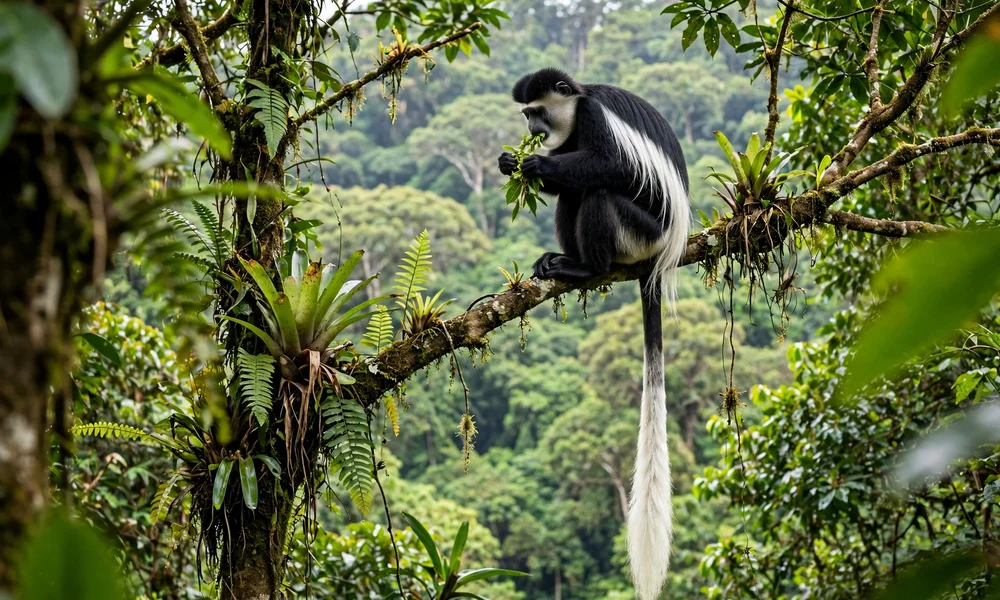
The colobus monkey species number five, in the genus Colobus, and they are some of the most striking monkeys in Africa, with glossy black coats, long white mantles of fur and white tail tufts, and hands with no thumbs at all. If you are asking how many colobus monkey species there are, the answer is five: there are five black-and-white colobus monkey species in the genus Colobus, all of them leaf-eaters that live in the forests of central and eastern Africa.
A colobus monkey is a quiet, graceful animal of the treetops, spending its days eating leaves that other monkeys cannot digest, thanks to a multi-chambered stomach that ferments tough foliage like the stomach of a cow. The best-known of the five is the mantled guereza, with its flowing white mantle and white tail tuft.
Key takeaways
- There are five colobus monkey species in the genus Colobus, all black-and-white leaf-eaters.
- Colobus monkeys have no thumbs, only a small stub, and the name colobus comes from a Greek word meaning mutilated.
- They eat mostly leaves, using a multi-chambered stomach with bacteria that ferment tough, fibrous foliage.
- Colobus monkeys measure about 45 to 70 centimetres in body length, with tails up to about 100 centimetres, and weigh about 5 to 14 kilograms.
- The king, black and ursine colobus are listed as Vulnerable, while the guereza and Angolan colobus are listed as Least Concern.
What makes a colobus monkey a colobus monkey
A colobus monkey is a medium-sized, slender monkey with a long tail, a black coat marked with white, and a hand missing its thumb. The five species are told apart by the amount of white in their fur and where the long silky strands grow: the mantled guereza has a long white mantle and a large white tail tuft, the king colobus has a white chest and white whiskers, the Angolan colobus has long white hairs around the face, the ursine colobus has white thigh patches and a white mane, and the black colobus is almost entirely black and glossy.
The missing thumb is the trait that gives the genus its name. Colobus comes from the Greek word kolobos, meaning mutilated, and the thumb is reduced to a small stub. The hand still works well in the trees: a colobus grips a branch between its palm and its four hooked fingers, and the stub makes its hand-over-hand swinging swift and graceful. Like baboons, which are also Old World monkeys, a colobus has close-set nostrils and a tail that cannot grip, but it has no cheek pouches, and its stomach is built for leaves, not fruit.
The colobus monkey species and their relatives
There are five colobus monkey species. They belong to the genus Colobus, in the subfamily Colobinae of the Old World monkey family Cercopithecidae, and they live in central and eastern Africa. The five are the mantled guereza, Colobus guereza, of East and central Africa; the king colobus, Colobus polykomos, of West Africa; the Angolan colobus, Colobus angolensis, of central and East Africa; the black colobus, Colobus satanas, of the Congo Basin; and the ursine colobus, Colobus vellerosus, of West Africa.
Their closest relatives are the red colobus monkeys of the genus Piliocolobus, which live in the rainforests of equatorial Africa, and the olive colobus, the only member of Procolobus. The wider leaf-monkey family also holds the langurs and leaf monkeys of Asia and the proboscis monkey of Borneo, and all of them share the same leaf-eating way of life. The mantled guereza is the best known of the five, because it lives in the high forests that visitors can reach.
| Type | Animal | Where it lives | Best-known food | Length or Weight |
|---|---|---|---|---|
| Family | Old World monkeys (family Cercopithecidae) | Africa and Asia | Leaves, fruit and seeds | About 40 to 90 cm long |
| Species | Mantled guereza (Colobus guereza) | East and central Africa | Young leaves and fruit | About 45 to 70 cm long |
| Species | King colobus (Colobus polykomos) | West Africa | Leaves, fruit and seeds | About 50 to 70 cm long |
| Species | Angolan colobus (Colobus angolensis) | Central and East Africa | Leaves, fruit and flowers | About 50 to 70 cm long |
| Species | Black colobus (Colobus satanas) | Congo Basin forests | Leaves and seeds | About 50 to 70 cm long |
| Species | Ursine colobus (Colobus vellerosus) | West Africa | Leaves and fruit | About 50 to 65 cm long |
| Relative | Western red colobus (Piliocolobus badius) | West African rainforests | Young leaves and fruit | About 45 to 65 cm long |
How colobus monkeys live
Colobus monkeys are animals of the treetops and the quiet hours. A colobus spends much of the day sitting in the canopy, eating leaves, and it must eat almost constantly, up to a quarter of its body weight each day, because leaves hold little nourishment. The stomach is the secret: it is large and divided into chambers, where bacteria ferment the cellulose in the foliage, so a colobus can live for months on mature or even toxic leaves that other monkeys cannot eat. Like capuchin monkeys, which are clever and busy foragers, a colobus is a social animal, but its days are slow and calm, with long rests between feeding bouts while the stomach works.
Young leaves, buds, flowers, fruit and seeds are eaten when they are available, and colobus monkeys also eat bark and soil. Their large salivary glands send copious saliva into the fermenting food, and the big stomach makes colobus monkeys look pot-bellied. When food is scarce, digesting tough leaves is a great advantage, because leaves are available all year, while fruit comes and goes with the seasons.
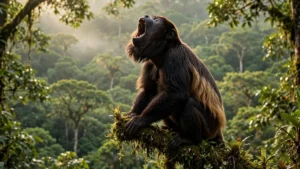
Colobus monkeys live in troops, usually of about 5 to 15 animals, though Angolan colobus troops can number in the hundreds. A troop is usually one adult male with several females and their young, and the male defends the group with loud roaring calls. A single infant is born after a gestation of about five to six months, and it is born completely white. Over several months the infant slowly gains its adult colours. Colobus monkeys are preyed on by leopards, crowned eagles, chimpanzees and snakes, and a troop that spots a leopard will call loudly and move away.
Where colobus monkeys live
Colobus monkeys live in the forests of central and eastern Africa, from the rainforests of the Congo Basin to the montane forests of the East African highlands. They live deep in many kinds of forest, including lowland rainforest, montane forest, gallery forest along rivers, bamboo stands and coastal forest, and they are almost entirely arboreal. The mantled guereza lives in the high forests of Ethiopia, Kenya, Uganda, Rwanda and Tanzania, and it is the colobus most often seen by visitors.
Because they eat leaves, colobus monkeys can live in a wider range of habitats than fruit-eating monkeys, though they still need tall trees to move and feed in. Forest loss is their greatest threat: when the forest is cut for farms and timber, the troops lose their food and their shelter, and hunting for meat and fur takes more animals, especially the king colobus and the black colobus. The king, black and ursine colobus are listed as Vulnerable, while the guereza and Angolan colobus are listed as Least Concern, though all five face pressure where their forests shrink.
Colobus monkeys play an important part in the forest. They prune the trees they feed in, they spread the seeds of the fruit they eat, and they are food for leopards and eagles. In protected forests such as the mountain parks of East Africa, troops are common and easy to watch.
Best seasons for colobus monkey watching
The best time to look for colobus monkeys is the dry season, when the forest trails are passable and the monkeys feed in the canopy above the paths. In the East African highlands that usually means June to September and December to February, when the mornings are clear and the troops are active early in the day. A guided walk in a montane forest is the surest way to find them.
Staying safe around colobus monkeys
A colobus monkey is a wild animal with sharp teeth, but it is calm and shy, and it almost never comes close to people. Keep your distance from a troop, never feed a colobus monkey, and never stand directly beneath a feeding group. If you watch colobus monkeys in a forest, stay on the trail, keep your voice low, and let them come to you.
Colobus monkey watching checklist
A little preparation turns a walk through a montane forest into a real chance of seeing a colobus monkey, so pack for rain, mud and long quiet hours.
- Rain gear and a hat, for sudden showers in the forest canopy.
- Binoculars, because colobus monkeys feed high in the trees.
- A camera with a zoom lens, for the black-and-white fur without getting close.
- A visit to a montane or rainforest reserve, where colobus troops live in the canopy.
- A plan to be out in the morning, when the troops are most active.
- Patience and silence, because colobus monkeys are shy and a noisy group will send them away.
- A field guide to African primates, for telling a guereza from an Angolan colobus at a glance.
Frequently asked questions
How many colobus monkey species are there?
There are five colobus monkey species in the genus Colobus: the mantled guereza, the king colobus, the Angolan colobus, the black colobus and the ursine colobus. The red colobus monkeys belong to a different genus, Piliocolobus, and the olive colobus to the genus Procolobus.
Why do colobus monkeys have no thumbs?
Colobus monkeys have thumbs reduced to a small stub, and the name colobus comes from the Greek for mutilated. The stub makes their hand-over-hand swinging through the trees swift and graceful, and they grip branches between the palm and the four hooked fingers.
What do colobus monkeys eat?
Colobus monkeys eat mostly leaves, along with buds, flowers, fruit and seeds when they are available. Their multi-chambered stomachs hold bacteria that ferment the cellulose in tough leaves, so they can digest mature and even toxic foliage, and they may eat up to a quarter of their body weight in leaves each day.
Where do colobus monkeys live?
Colobus monkeys live in the forests of central and eastern Africa, in lowland rainforest, montane forest, gallery forest, bamboo stands and coastal forest. They are almost entirely arboreal, spending their lives in the canopy and rarely coming to the ground.
How is this guide different from the eastern bluebird species guide?
This guide covers the colobus monkey, a leaf-eating primate of African forests with no thumbs and a multi-chambered stomach, while our eastern bluebird species guide covers the eastern bluebird, a small thrush of North American meadows that hunts insects from fence posts and nests in tree cavities. The colobus lives in the treetops of Africa, and the bluebird lives in the open meadows of North America.
Are colobus monkeys endangered?
The king colobus, the black colobus and the ursine colobus are listed as Vulnerable, because their forests are being cut and they are hunted for meat and fur, while the mantled guereza and the Angolan colobus are listed as Least Concern. All five need their forests protected to survive.
Conclusion
The colobus monkey species show how much elegance one monkey genus can hold: five black-and-white leaf-eaters, with flowing mantles of fur, no thumbs at all, and a stomach that turns tough leaves into a living.
If you go looking for one, go to a montane forest in the dry season, go quietly, and go with patience. Watch a guereza troop feeding in the treetops, its white mantles swaying as it moves, and you will understand why it is one of the most loved monkeys of Africa, and why keeping its forests standing matters most.