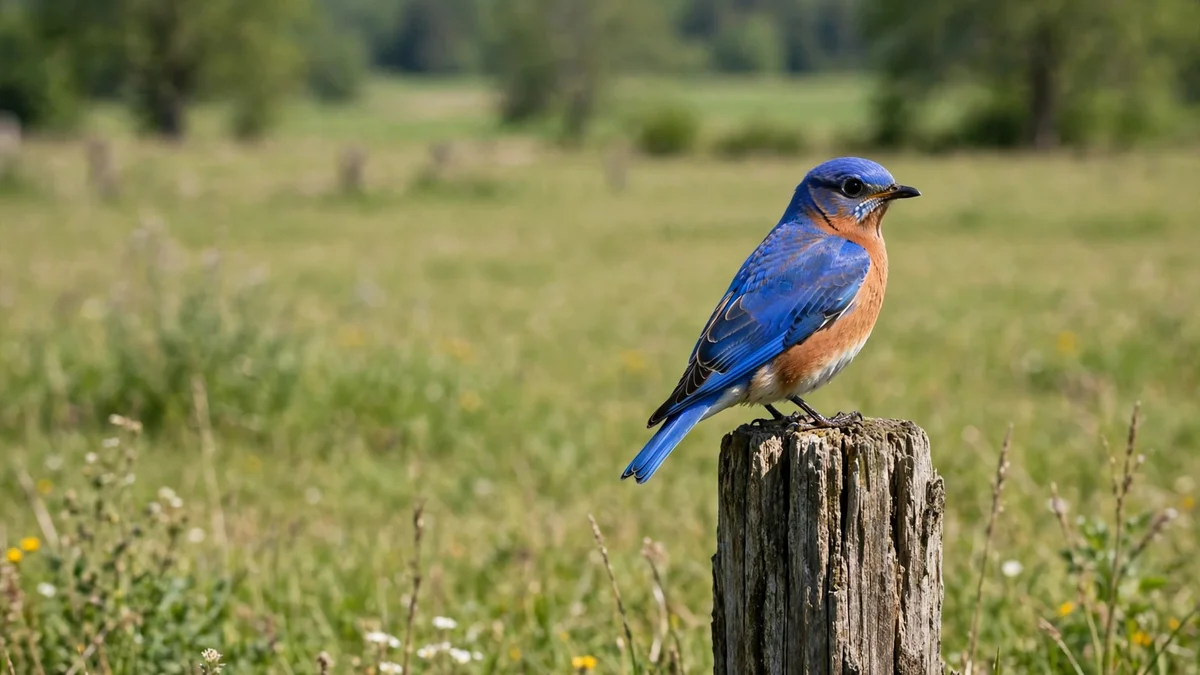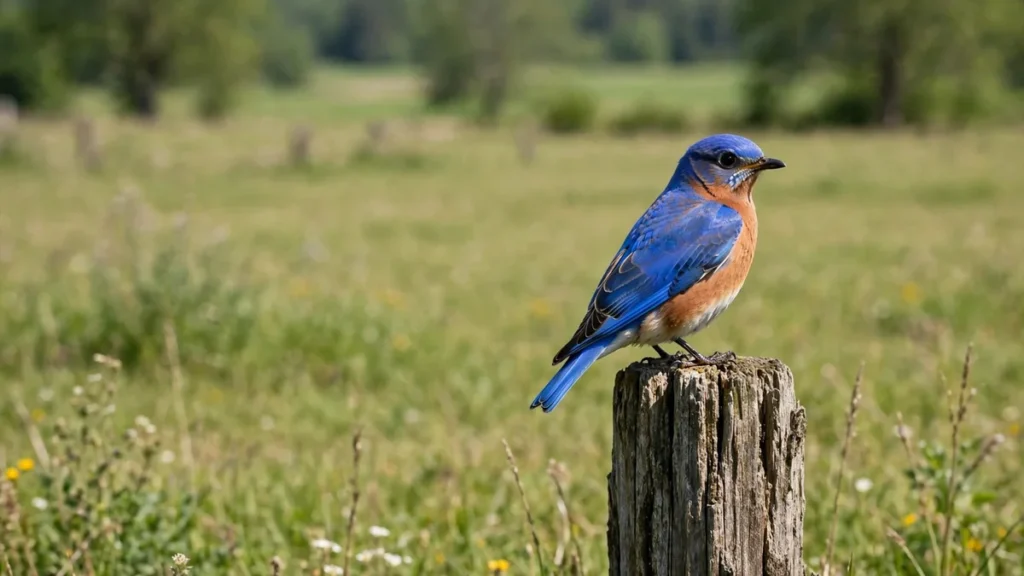
The eastern bluebird species is a single species, Sialia sialis, and it is one of the most loved birds in North America, a small thrush with a bright blue back and a warm rusty breast that perches on fence posts and wires in open meadows. If you are asking how many eastern bluebird species there are, the answer is one: there is just one eastern bluebird species, Sialia sialis, though it has two close cousins, the western bluebird and the mountain bluebird, in the same small genus.
An eastern bluebird is a bird of open country, not deep forest. It hunts by sitting on a low perch and scanning the grass below, then dropping down to snatch a cricket or a caterpillar, and in winter it switches to berries, gathering in small flocks that drift through orchards and hedgerows. It nests in holes in trees and in wooden nest boxes, and its recovery from near-disappearance is one of the great success stories of garden birdwatching.
Key takeaways
- There is just one eastern bluebird species, Sialia sialis, in the thrush family.
- Males are bright blue above with a rusty breast, while females are a softer grey-blue with a paler breast.
- Eastern bluebirds measure about 16 to 21 centimetres long, with a wingspan of about 25 to 32 centimetres.
- They nest in tree cavities and nest boxes, laying three to seven pale blue eggs and raising two or three broods a year.
- They eat insects in summer and berries in winter, and they are listed as Least Concern.
What makes an eastern bluebird an eastern bluebird
An eastern bluebird is a small, plump thrush, about 16 to 21 centimetres long, with a round head, large dark eyes and a short, straight bill. The male is unmistakable: a vivid blue back, wings and tail, a rusty throat, breast and flanks, and a clean white belly. The female wears the same pattern in softer tones, grey-blue above with a warm wash of orange-brown on the breast, and young birds are speckled with pale spots on the back and breast.
The song is a soft, musical warble, often written as chur-lee or chur chur-lee, and the bird also gives a short, rising call note while in flight. Like other American robins, which belong to the same thrush family, an eastern bluebird is a bird that people notice and remember, and it is the state bird of both Missouri and New York.
The eastern bluebird species and their relatives
There is one eastern bluebird species. It belongs to the genus Sialia, which holds just three bluebirds: the eastern bluebird of the east and centre of North America, the western bluebird of the far west, and the mountain bluebird of the high open country of the west. All three are thrushes, members of the family Turdidae, and the eastern bluebird is the only bluebird found in the eastern half of the continent.
The best-known relatives are the American robin, the most familiar thrush of North American gardens; the western bluebird, which replaces the eastern bluebird west of the Rocky Mountains; the mountain bluebird, a sky-blue bird of high meadows that often nests in nest boxes too; the varied thrush of the Pacific forests; and the wood thrush, a shy brown forest thrush with a flute-like song.
| Type | Animal | Where it lives | Best-known food | Length or Weight |
|---|---|---|---|---|
| Family | Thrushes (family Turdidae) | Worldwide, mostly northern forests and gardens | Insects, worms and fruit | About 16 to 28 cm long |
| Species | Eastern bluebird (Sialia sialis) | Eastern North America to Central America | Insects and berries | About 16 to 21 cm long |
| Species | Western bluebird (Sialia mexicana) | Western North America | Insects and berries | About 16 to 19 cm long |
| Species | Mountain bluebird (Sialia currucoides) | High open country of western North America | Insects and berries | About 16 to 20 cm long |
| Relative | American robin (Turdus migratorius) | North America, from Alaska to Mexico | Earthworms, insects and fruit | About 23 to 28 cm long |
| Relative | Varied thrush (Ixoreus naevius) | Pacific forests of North America | Insects and berries | About 20 to 26 cm long |
| Relative | Wood thrush (Hylocichla mustelina) | Eastern North American forests | Insects, snails and fruit | About 19 to 21 cm long |
How eastern bluebirds live
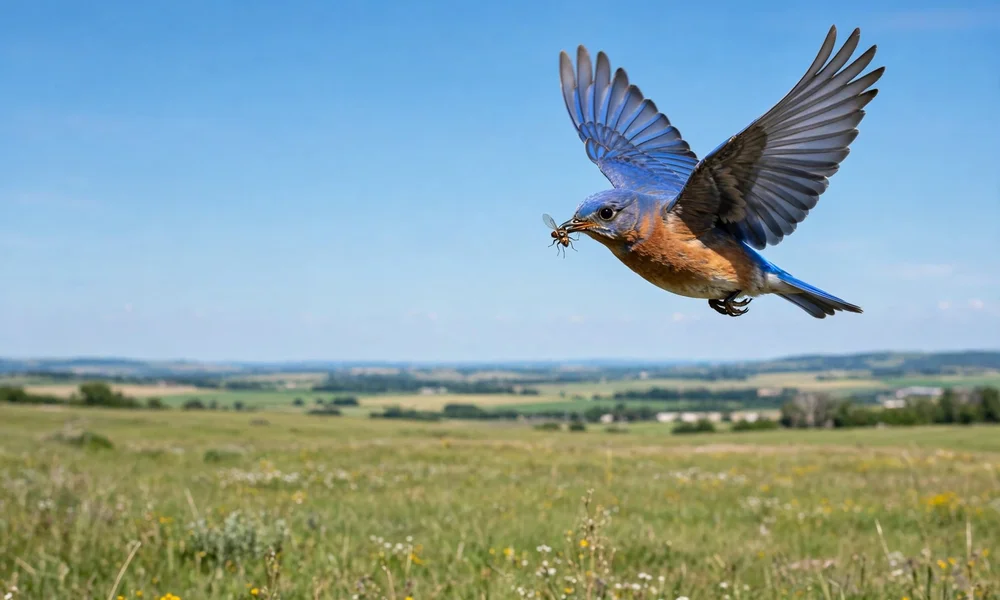
Eastern bluebirds are birds of open country and sunny days. A bluebird spends much of the day on an exposed perch, a fence post, a wire or a low branch, watching the ground below, and when it spots an insect it drops down to catch it, then returns to a perch to eat. Like barn swallows, which hunt insects on the wing, a bluebird is a skilled hunter, but it hunts from a lookout perch rather than feeding endlessly in flight.
Caterpillars, beetles, crickets, grasshoppers and spiders make up most of the summer diet, along with snails and earthworms. In autumn and winter the diet changes, and berries become the main food: dogwood, sumac, black cherry, juniper, holly, bayberry and mistletoe are all eaten, and a bluebird must feed almost constantly on cold days to survive the long nights.
Breeding starts in early spring, when the male finds a nesting cavity and sings and flutters his wings to attract a female. The nest is a neat cup of dry grasses and pine needles, built by the female inside a hole in a dead tree, an old woodpecker hole or a nest box, usually 1 to 15 metres above the ground. She lays three to seven pale blue eggs, and she does most of the incubation for about 13 to 14 days. Both parents feed the nestlings, which leave the nest at about 17 to 18 days old, and the pair usually raises two broods a year, sometimes three. Wild bluebirds can live up to about ten years, though many live only a few.
Where eastern bluebirds live
Eastern bluebirds live across the eastern half of North America, from southern Canada south through the United States to Florida and Texas, and on through Mexico into Central America, as far as Nicaragua. They are birds of open ground with scattered trees and short grass, and they are commonest in meadows, pastures, orchards, parks, golf courses, large gardens and along country roads, where fence posts and wires give them hunting perches.
They are not birds of deep forest, and they avoid dense woodland, though they often forage along woodland edges and in clearings. In the north of their range they are partly migratory, moving south for the winter, while in the south they stay in one place all year, gathering in small flocks in winter.
Eastern bluebirds nearly disappeared in the twentieth century. Starlings and house sparrows, two introduced birds that take over nesting holes, the loss of old trees with natural cavities, and the use of pesticides all cut their numbers sharply. The recovery came from ordinary people: the building of nest box trails, rows of wooden boxes on posts in open country, gave bluebirds safe places to nest, and today the species is common again and listed as Least Concern. A nest box with a predator guard is far safer than an open hole.
Best seasons for eastern bluebird watching
The best time to look for eastern bluebirds is spring, from March to June, when the males are at their brightest and singing from fence posts, and when pairs are busy carrying food to nest boxes. In the northern states the birds return from mid-February onwards, and a nest box trail in a meadow is the surest place to find them.
Staying safe around eastern bluebirds
An eastern bluebird is a small, gentle bird with a short bill, and it is not dangerous to people. Keep your distance from nest boxes during the breeding season, never open a box while the female is sitting on eggs, and never stand close to a nest for long, because a bluebird that is disturbed may leave its nest and its eggs may chill. If you watch bluebirds at a meadow, stay on the path and let them come to you.
Eastern bluebird watching checklist
A little preparation turns a walk through an open meadow into a real chance of seeing an eastern bluebird, so pack for sun, grass and long quiet hours.
- Sun protection and a hat, for standing in open country in the heat of the day.
- Binoculars, because bluebirds hunt from perches and are best watched from a distance.
- A camera with a zoom lens, for the bright blue plumage without getting close.
- A visit to a meadow, orchard or nest box trail, where bluebirds hunt and nest.
- A plan to be out in the morning, when the birds are most active and the insects are moving.
- Patience and silence, because bluebirds are shy birds and a noisy group will send them away.
- A field guide to birds, for telling an eastern bluebird from a western or mountain bluebird at a glance.
Frequently asked questions
How many eastern bluebird species are there?
There is just one eastern bluebird species, Sialia sialis. It has two close cousins in the same genus, the western bluebird and the mountain bluebird, and it is the only bluebird found in the eastern half of North America.
What do eastern bluebirds eat?
Eastern bluebirds eat insects in the warm months, including caterpillars, beetles, crickets, grasshoppers, spiders and earthworms, and they switch to berries in autumn and winter, eating dogwood, sumac, black cherry, juniper, holly and mistletoe. A bluebird must feed almost constantly on cold days to survive the night.
Where do eastern bluebirds nest?
Eastern bluebirds nest in cavities, such as old woodpecker holes, hollow limbs, holes in fence posts and wooden nest boxes. The female builds a cup of dry grasses and pine needles inside the cavity and lays three to seven pale blue eggs, which hatch after about 13 to 14 days.
Do eastern bluebirds migrate?
Some do. Eastern bluebirds in the northern part of their range move south for the winter, while birds in the southern states stay in one place all year. In winter they gather in small flocks and sometimes huddle together in a nest box to keep warm.
How is this guide different from the crowned eagle species guide?
This guide covers the eastern bluebird, a single small thrush that hunts insects from fence posts in North American meadows and nests in tree cavities and nest boxes, while our crowned eagle species guide covers the crowned eagle, a powerful forest eagle of Africa that hunts monkeys and antelope in the treetops. The bluebird weighs about 30 grams, and the crowned eagle is one of the strongest eagles in the world.
Are eastern bluebirds endangered?
No. Eastern bluebirds are listed as Least Concern, because they are widespread and common again after a sharp decline in the twentieth century. The recovery came largely from nest box trails built by volunteers, and the birds still need old trees, open meadows and safe nest boxes to thrive.
Conclusion
The eastern bluebird species shows how much colour and charm one small bird can hold: a single thrush with a bright blue back and a rusty breast, a soft warbling song, a life spent between a sunny perch and a nest box in an open meadow, and a comeback that ordinary people made happen.
If you go looking for one, go to a meadow in spring, go quietly, and go with patience. Watch a bluebird drop from its fence post, snatch a cricket from the grass and carry it back to its nest, and you will understand why it is one of the most loved birds of North America, and why keeping its meadows and nest boxes standing matters most.