The American robin species number one, a single species called Turdus migratorius, and it is the orange-breasted thrush of the North American garden, one of the most familiar birds on the continent. If you are asking how many American robin species there are, the answer is one: there is one recognised American robin species in the world, and every American robin alive today belongs to it.
The American robin lives across North America, from Alaska and Canada to Mexico, in gardens, parks, woodlands and farmland, and its song is one of the first sounds of spring. Its brick-red breast, its blue eggs, its habit of pulling worms from the lawn and its cheerful dawn chorus make it one of the best-loved birds in the world.
Key takeaways
- There is one American robin species, Turdus migratorius, a thrush of North America.
- American robins measure 23 to 28 centimetres long and weigh between 77 and 85 grammes, with a brick-red breast.
- American robins lay bright blue eggs, three to five in a nest, and raise two or three broods a year.
- American robins eat earthworms, insects and berries, and they hunt by sight, cocking their heads to listen and look.
- American robins are listed as Least Concern, and they are one of the most abundant birds in North America.
What makes an American robin an American robin
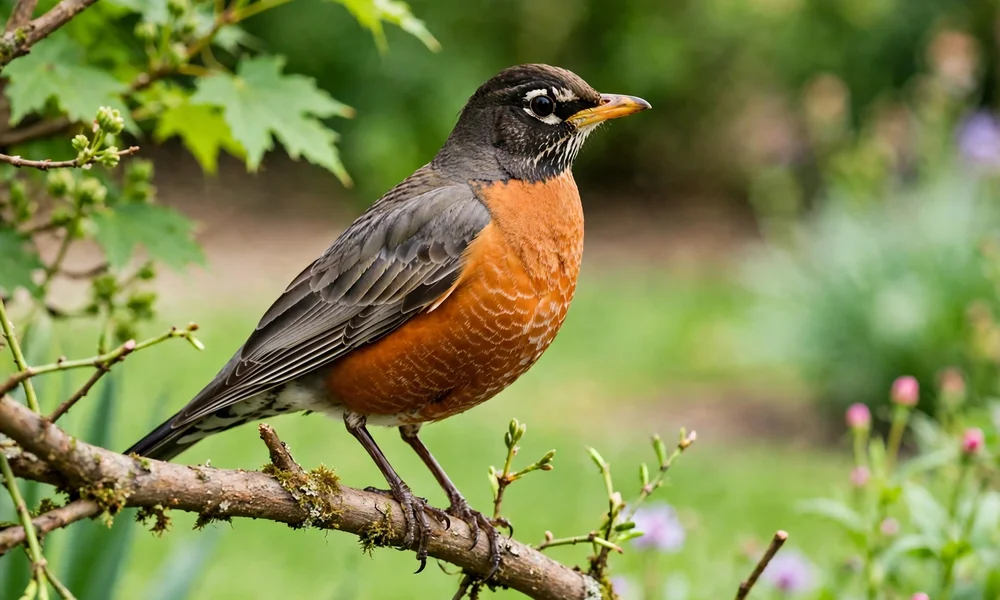
An American robin is a medium thrush with a dark grey head and back, a brick-red breast, a white throat with dark streaks, and a white patch around the eye, and it measures 23 to 28 centimetres long, with a wingspan of 31 to 41 centimetres, and usually weighs between 77 and 85 grammes. The male has a darker head and a brighter breast than the female, and the young birds are spotted, with pale spots on their breasts that fade as they grow.
The name comes from the European robin, a much smaller bird with a red breast that the early settlers thought this bird resembled, though the two are not close relatives. Like other barn owls, the American robin is a bird of open ground and woodland edge, but it is a thrush, not an owl, and it sings at dawn, hunts by day, and sleeps in trees at night.
The American robin species and their relatives
There is one American robin species. It belongs to the genus Turdus, the true thrushes, and it shares that genus with the Eurasian blackbird and the song thrush, both of which live in Europe. The American robin is the most widespread thrush in North America, and it is also one of the most abundant birds on the continent, with hundreds of millions of birds.
The varied thrush is the American robin’s closest relative, a bird of the Pacific Northwest with an orange eyebrow and a black breast band, while the hermit thrush is a small brown thrush with a spotted breast and a reddish tail. The wood thrush is a forest thrush with a bold spotted breast, the eastern bluebird is a small blue thrush of open fields, and the mountain bluebird is a sky-blue thrush of the western mountains.
| Type | Animal | Where it lives | Best-known food | Length or Weight |
|---|---|---|---|---|
| Species | American robin (Turdus migratorius) | North America from Alaska to Mexico | Earthworms, insects and berries | 23 to 28 cm long, 77 to 85 g |
| Close relative | Varied thrush | Pacific Northwest forests | Insects, berries and seeds | 19 to 26 cm long, 65 to 100 g |
| Close relative | Hermit thrush | North American forests | Insects and berries | 16 to 18 cm long, 18 to 37 g |
| Close relative | Wood thrush | Eastern North American forests | Insects, snails and berries | 19 to 21 cm long, 40 to 50 g |
| Close relative | Eastern bluebird | Eastern North American fields | Insects and berries | 16 to 21 cm long, 27 to 34 g |
| Close relative | Mountain bluebird | Western North American mountains | Insects and berries | 16 to 20 cm long, 24 to 37 g |
| Close relative | European robin | Europe and western Asia | Insects, worms and berries | 12 to 14 cm long, 16 to 22 g |
How American robins live
American robins are creatures of the garden and the woodland edge. An American robin lives alone or in small groups in spring and summer, and in large flocks in autumn and winter, and it is often the first bird to sing at dawn, starting its song before sunrise. Like other hummingbirds, the American robin is a bird that people see every day, but it is a thrush, not a hummingbird, and it sings a rich fluting song that people often remember as cheerily, cheer up, cheerio.
Earthworms make up much of the diet in spring and summer, along with insects, grubs and berries, and an American robin hunts by running across the lawn, stopping, and cocking its head to one side to look and listen for a worm. It feeds mostly at dawn and dusk, when the worms come to the surface, and in autumn and winter it switches to berries and fruit, eating holly, juniper and hawthorn berries in large flocks.
Breeding is a busy season, and the female builds a cup nest from grass, twigs and mud in a tree or on a ledge, and she lays three to five bright blue eggs, which gave rise to the phrase robin’s egg blue. She sits on the eggs for about 12 to 14 days, and both parents feed the chicks, which leave the nest after about two weeks. A pair may raise two or three broods in a single year, and the young birds are spotted for their first few months. American robins live for about 2 to 6 years in the wild, though some have lived for more than 13 years.
Where American robins live
The American robin lives across North America, from Alaska and northern Canada to Mexico, and in gardens, parks, woodlands, farmland and towns, and it is most common where there are lawns to hunt on and trees to nest in. It is the state bird of Connecticut, Michigan and Wisconsin, and it is one of the first birds that many people learn to recognise.
Lawns and open ground are the key requirement. An American robin needs short grass where it can see and catch worms, with trees nearby for nesting and berries for the winter, so it follows the seasons as they change, and when the ground freezes in the north the birds move south to where the worms are still within reach.
American robins are listed as Least Concern, and their numbers have stayed broadly stable, though some populations have fallen where lawns have been paved over and hedges have been removed. The main pressures are the loss of nesting trees, the use of pesticides on lawns, and window strikes, though American robins are protected by law and they adapt well to life around people.
Best seasons for American robin watching
There is no closed season, because American robins are active all year, but the best time to look for them depends on where you go. In the north the best months are often March to July, when the birds are singing, nesting and feeding their young, and the dawn chorus is at its loudest. In the south the best months are often October to March, when the winter flocks arrive from the north and gather in berry trees.
Staying safe around American robins
An American robin is a wild bird with a sharp beak and strong wings, and it can peck a person who comes too close to its nest, though American robins almost never attack people. Keep your distance, never touch a nest, and never take a chick from the ground, because a young robin that has left the nest is still being fed by its parents nearby. If you see American robins while walking in a garden, stay calm, stay still, and let them come to you, because robins that are chased may abandon their nests for good.
American robin watching checklist
A little preparation turns a garden visit into a real chance of seeing an American robin, so pack for sun, rain and long quiet hours.
- Binoculars, because the birds are best watched from a distance without disturbing them.
- A camera with a zoom lens, for the brick-red breast and the blue eggs without getting close.
- A notebook, for the song, because a robin’s dawn chorus is worth writing down.
- A garden with a lawn and berry bushes, where the robins hunt and feed through the year.
- A plan to be out at dawn, when the robins are most active and singing.
- Patience and silence, because robins are shy birds and a noisy group will send them away.
- A field guide to thrushes, for telling an American robin from a varied thrush at a glance.
Frequently asked questions
How many American robin species are there?
There is one American robin species, Turdus migratorius. It was once thought to be several species, but scientists now recognise it as a single species, and it is one of the most abundant birds in North America, with hundreds of millions of birds across the continent.
Why are robin eggs blue?
Robin eggs are blue because of a pigment called biliverdin, which the female puts into the shell as the egg forms. The blue colour may help to keep the eggs cool in the sun, and it may also signal to the male that the female is healthy, though scientists are still studying the exact reason.
What do American robins eat?
American robins eat earthworms, insects and berries, and they switch their diet with the seasons. In spring and summer they hunt worms and insects on lawns, and in autumn and winter they eat berries and fruit, including holly, juniper and hawthorn berries.
Do American robins migrate?
Some do. American robins in the far north migrate south for the winter, travelling hundreds of kilometres to where the ground is not frozen, while robins in the south stay in one place all year. Many robins that people see in winter are birds that have flown down from Canada.
How is this guide different from the Adelie penguin species guide?
This guide covers the single American robin species, a garden thrush that lives across North America and eats earthworms, while our Adelie penguin species guide covers the single Adelie penguin species, a flightless seabird that lives on the Antarctic coast and eats krill. The American robin measures 23 to 28 centimetres and sings at dawn, and the Adelie penguin stands about 70 centimetres tall and swims in freezing water.
Are American robins endangered?
No. American robins are listed as Least Concern, with hundreds of millions of birds, though some local populations have fallen where lawns have been paved over and nesting trees have been removed. Pesticides on lawns and window strikes are the main threats to watch.
Conclusion
The American robin species shows how much charm one common bird can hold: a single species of garden thrush, with a brick-red breast, blue eggs, and a song that opens the spring.
If you go looking for one, go at dawn to a garden or a park, go quietly, and go with patience. Watch an American robin pull a worm from the lawn and you will understand why it has earned its place as the most loved bird of the North American spring, and why keeping its gardens green matters most.