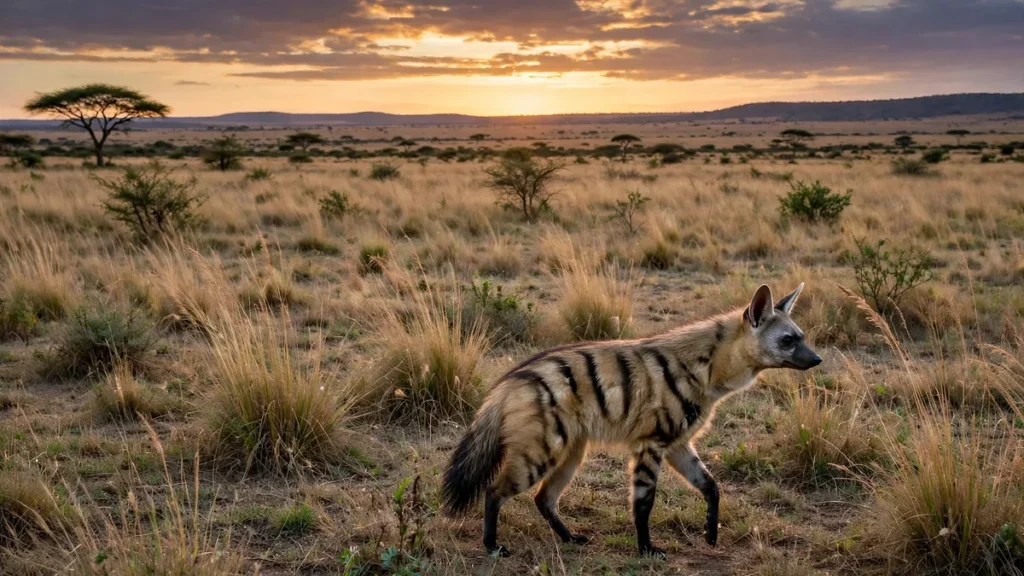
The aardwolf species number one, a single species called Proteles cristata, and it is the smallest member of the hyena family, a shy striped insect-eater that laps up termites on the dry savannas of eastern and southern Africa. If you are asking how many aardwolf species there are, the answer is one: there is one recognised aardwolf species in the world, and every aardwolf alive today belongs to it.
The aardwolf is the hyena that does not hunt. While its cousins chase down antelope and crush bones, this animal spends its nights licking termites off the ground, and a single aardwolf can eat up to 300,000 termites in one night. It is nocturnal and shy, so it is rarely seen, but it is one of the most specialised feeders in Africa, and its yellowish coat, dark stripes and tall mane make it unmistakable.
Key takeaways
- There is one aardwolf species, Proteles cristata, found in eastern and southern Africa.
- Aardwolves measure about 55 to 80 centimetres, plus a bushy tail of 20 to 30 centimetres, and weigh about 7 to 10 kilogrammes.
- Aardwolves eat almost only termites, and one animal can lap up as many as 300,000 termites in a single night.
- Aardwolves are nocturnal and shy, and they raise the mane along their neck and back when threatened.
- Aardwolves are listed as Least Concern, with a stable population across a wide range.
What makes an aardwolf an aardwolf
An aardwolf is a small hyena-like mammal with a yellowish coat marked with dark vertical stripes, a thick mane running from the back of its head to its tail, and large pointed ears, and it measures about 55 to 80 centimetres in body length, plus a bushy tail of 20 to 30 centimetres. It weighs about 7 to 10 kilogrammes, and its hind legs are shorter than its forelegs, giving it a sloping back like other hyenas.
The name tells the story. Aardwolf is Afrikaans for earth wolf, and Proteles cristata means the crested one, complete in front, a nod to the five toes on its forepaws where other hyenas have four, and to the mane it raises when threatened. Like other spotted hyenas, the aardwolf belongs to the hyena family, but it has weak jaws and small peg-like cheek teeth instead of bone-crushing teeth, because its food is soft, and it has five toes on each forepaw where other hyenas have four. When threatened it raises its mane to look bigger, and may bark, growl or spray a foul-smelling fluid from the glands at its rear.
The aardwolf species and their relatives
There is one aardwolf species. It is the only living member of its genus, Proteles, and it sits in its own branch of the hyena family, the Protelinae, apart from the three bone-crushing hyenas. There are two populations, one in East Africa and one in southern Africa, separated by wet woodland, and they are recognised as two subspecies, the northern and the southern aardwolf, which differ slightly in size.
The spotted hyena is the aardwolf’s most famous relative, a large hunter that lives in clans and takes down antelope, while the striped hyena is a scavenger of dry country across Africa and Asia, and the brown hyena is a shaggy scavenger of the deserts of southern Africa. The aardvark is not a hyena at all, but it shares the aardwolf’s name, its burrows and its taste for termites, and it often digs the dens that aardwolves later move into. The bat-eared fox is another small termite-eater of the savanna, and the ground pangolin is a scaly ant-eater that also feeds on termites.

| Type | Animal | Where it lives | Best-known food | Length or Weight |
|---|---|---|---|---|
| Species | Aardwolf (Proteles cristata) | Eastern and southern African savanna | Harvester termites | 55 to 80 cm plus tail, 7 to 10 kg |
| Close relative | Spotted hyena | Savanna of sub-Saharan Africa | Antelopes and large prey | 95 to 165 cm, 40 to 86 kg |
| Close relative | Striped hyena | Dry country, Africa and Asia | Carrion, small animals | 100 to 115 cm, 22 to 55 kg |
| Close relative | Brown hyena | Southern African deserts | Carrion, small animals | 110 to 140 cm, 34 to 72 kg |
| Name twin | Aardvark | Savanna of sub-Saharan Africa | Ants, termites | 105 to 130 cm, 40 to 65 kg |
| Fellow termite-eater | Bat-eared fox | Eastern and southern African savanna | Termites, other insects | 46 to 66 cm, 3 to 5 kg |
| Fellow termite-eater | Ground pangolin | Savanna of sub-Saharan Africa | Ants, termites | 60 to 100 cm, 9 to 18 kg |
How aardwolves live
Aardwolves are creatures of the night. An aardwolf spends the day asleep in a burrow, often one dug by an aardvark or a springhare, and it comes out after dark to hunt termites, foraging alone, though it shares its territory with a mate. It does not tear open termite mounds like an aardvark does. Instead it waits for harvester termites of the genus Trinervitermes to come out and forage on the surface, and it licks them off the ground with its broad sticky tongue. Like other aardvarks, the aardwolf depends entirely on insects, and a single animal can eat as many as 300,000 termites in one night, and tens of millions in a year.
The aardwolf’s tongue is its great tool. It is long, broad and sticky, and tough enough to stand the bites of termites, and the aardwolf’s cheek teeth are small and peg-like, because there is nothing to chew in a diet of soft insects. It listens for termites with its large ears, and it can hear them moving in the soil. It eats almost nothing else, and it does not hunt large prey or scavenge carcasses the way other hyenas do.
Aardwolves live in monogamous pairs that share and defend a territory of about one to four square kilometres, marking the boundaries with a musky paste from the glands at their rear, sometimes hundreds of times in a single night. Breeding is timed to the season when termites are most plentiful, and after a gestation of about two to three months the female gives birth to two to five cubs, most often two or three, in a burrow. The cubs stay underground for their first six to eight weeks, begin to forage with their parents at about three months old, and become independent at about four months, while the father guards the den. An aardwolf lives for about seven to ten years in the wild, and longer in captivity.
Where aardwolves live
The aardwolf lives in the dry savannas, grasslands and scrublands of eastern and southern Africa, in countries including South Africa, Namibia, Botswana, Zimbabwe, Tanzania, Kenya and Somalia. It needs open country with sandy soils and plenty of harvester termites, and it avoids deserts, dense forest and wet woodland, so its range is split into two populations, one in the east and one in the south. It is most common where the rainfall is below about 80 centimetres a year.
Aardwolves are listed as Least Concern by the International Union for Conservation of Nature, and their population is considered stable, because they live across a very large range. They are sometimes killed by farmers who mistake them for livestock killers, and they are hit by vehicles at night, but they do not hunt livestock at all, and they help farmers by eating harvester termites, which can damage crops and pasture.
Best seasons for aardwolf watching
There is no closed season, because aardwolves are active all year, but the best time to look depends on where you go. In southern Africa the best months are often October to March, when termites are most active and aardwolves forage for longer each night, and in East Africa the rainy seasons are often best. The best hours are the first few hours after dark, so a night drive with a guide is the usual way to see one.
Staying safe around aardwolves
An aardwolf is a wild animal with sharp teeth and claws, and it can bite or spray a foul-smelling fluid if it is cornered, though aardwolves almost never attack people. Keep your distance, never touch an aardwolf, and never reach into a burrow, because a burrow may hold cubs. Stay in your vehicle on a night drive, watch with a red-filtered light, and never chase an aardwolf with a torch, because an animal that is chased may run onto a road. If you see an aardwolf, stay calm and still, because a frightened aardwolf may raise its mane and bark, but it will slip away into the dark as soon as it can.
Aardwolf watching checklist
A little preparation turns a savanna night drive into a real chance of seeing an aardwolf.
- Binoculars, because aardwolves are shy.
- A red-filtered torch, for finding eyeshine.
- Warm clothing, for sitting in an open vehicle after dark.
- A camera with a fast lens, for the stripes in low light.
- A booked night drive with a guide who knows the aardwolf dens.
- Patience and silence, because a noisy group will send them away.
- A field guide to African mammals.
Frequently asked questions
How many aardwolf species are there?
There is one aardwolf species, Proteles cristata, the only living member of its genus, and there are two recognised subspecies, northern and southern, but both are the same species.
Why does the aardwolf eat only termites?
The aardwolf eats almost only termites because it is a specialist, with a broad sticky tongue, small peg-like teeth and weak jaws built for licking up insects. Harvester termites are plentiful on the dry savanna, so a specialist that can eat up to 300,000 of them in a night has food few other animals compete for.
Is the aardwolf a hyena?
Yes. The aardwolf is a true member of the hyena family, and it is the smallest of the four living hyenas, but it is very different from the others. It does not hunt large prey or crush bones, and it lives alone at night eating termites, while the other hyenas hunt or scavenge larger food.
What is the aardwolf’s mane for?
The aardwolf’s mane is a display. When the animal feels threatened it raises the long hairs along its neck and back, which makes it look much bigger than it is, and it may bark, growl and spray a foul-smelling fluid at the same time. The display is usually enough to drive a predator away.
How is this guide different from the burrowing owl species guide?
This guide covers the single aardwolf species, a small striped hyena relative of the dry savannas of eastern and southern Africa that eats termites at night, while our burrowing owl species guide covers the single burrowing owl species, a small long-legged owl of the grasslands of the Americas that eats insects and small mammals by day. The aardwolf weighs about 7 to 10 kilogrammes and laps up as many as 300,000 termites in one night, and the burrowing owl weighs only 140 to 240 grammes and decorates its burrow with dung.
Are aardwolves endangered?
No. Aardwolves are listed as Least Concern by the International Union for Conservation of Nature, with a stable population across eastern and southern Africa. They are sometimes killed by farmers who mistake them for livestock killers, but they do not hunt livestock, and they help farmers by eating termites.
Conclusion
The aardwolf species shows how much character one small mammal can hold: a single species of striped hyena, with a sticky tongue, a raised mane, and a nightly appetite for hundreds of thousands of termites.
If you go looking for one, go to dry savanna on a warm night, go quietly, and go with patience. Watch an aardwolf moving through the grass in the dark, mane raised and ears pricked, licking termites from the ground, and you will understand why this gentle hyena is one of the most unusual animals of Africa.