The lanternfish species is the small, glowing fish that lights up the dark middle of the ocean, and if you are asking what a lanternfish is, the short answer is a member of the family Myctophidae, a group of around 250 species that live in the mesopelagic zone, the twilight waters between 200 and 1,000 metres deep. Most lanternfish are between 5 and 15 centimetres long, small enough to fit in your hand, yet together they may form the largest mass of fish in the sea, rising towards the surface every night to feed and sinking back into the dark by day. They carry their own light with them, in rows of tiny organs along their bellies, and that light is what gives them their name.
Almost nobody has seen a lanternfish alive, and that is part of their pull. They live too deep for divers, too far out for most boats, and they only come near the surface on dark nights, when few people are watching. Yet they matter enormously: they feed the tuna, the swordfish, the seals and the penguins, they move vast amounts of food and carbon up and down the water column every night, and they may be the most numerous fish in the ocean. This guide explains how they live in the dark, how they make their light, how they feed, how they breed, and why a fish you will probably never see is one of the most important fish in the sea.
Key takeaways
- The lanternfish species belongs to the family Myctophidae, a group of around 250 small fish that live in the mesopelagic zone, between 200 and 1,000 metres deep.
- Most lanternfish are between 5 and 15 centimetres long, and the largest reach about 30 centimetres, which makes them small fish with an enormous total population.
- They carry rows of light-making organs called photophores along their bellies and sides, and the pattern of those lights is different in every species.
- Every night they rise towards the surface to feed on zooplankton, and every morning they sink back into the dark, in the largest daily migration on Earth.
- They are harmless to people, and many species are listed as Least Concern, but they are eaten by nearly every large ocean predator, and they may be fished for fishmeal in the future.
The lanternfish species and their relatives
Lanternfish belong to the family Myctophidae, a name that comes from the genus Myctophum, from the Greek words for nose and light, a nod to the glowing organs near the snout of the first species described. The family sits within the order Myctophiformes, a small order of deep-water fish, and it holds around 250 species spread across about 33 genera, though the count shifts a little as scientists describe new species from the deep sea. The family is found in every ocean, from the tropics to the poles, and it is most diverse in the warm waters of the tropics, where the mesopelagic zone holds more species than anywhere else.
The largest genus is Diaphus, which holds around 75 species, and it is the genus that most people picture when they think of a lanternfish: a small, silvery fish with a neat row of glowing spots along its belly and a large eye for the dark. Myctophum, the genus that gives the family its name, holds around a dozen species, and it is found in tropical and temperate oceans around the world. Diaphus species feed mainly on copepods and krill, while Myctophum species feed mainly on copepods and small crustaceans, and species in both genera are mostly 5 to 15 centimetres long. The species within these genera look much alike to an untrained eye, and scientists tell them apart by counting the photophores, the glowing organs, and by the exact pattern those lights make on the body, which is as distinctive as a fingerprint.
| Type | Animal | Where it lives | Best-known food | Length or Weight |
|---|---|---|---|---|
| Family | Lanternfishes (Myctophidae) | Oceans worldwide, 200 to 1,000 m deep | Zooplankton | Most 5 to 15 cm long |
| Genus | Diaphus | Tropical and temperate oceans | Copepods and krill | Most 5 to 15 cm long |
| Genus | Myctophum | Tropical and temperate oceans | Copepods and small crustaceans | Most 5 to 15 cm long |
| Species | Glacier lanternfish (Benthosema glaciale) | North Atlantic | Copepods | About 7 to 10 cm long |
| Species | Madeira lanternfish (Ceratoscopelus maderensis) | Atlantic Ocean and Mediterranean Sea | Copepods and krill | About 7 to 8 cm long |
| Species | Horned lanternfish (Ceratoscopelus warmingii) | Tropical oceans worldwide | Copepods and krill | About 7 to 8 cm long |
The lead species of this guide is the glacier lanternfish, Benthosema glaciale, a small fish of the North Atlantic that grows to about 7 to 10 centimetres long and feeds mostly on copepods, the tiny crustaceans that drift in the open sea. It is one of the best-studied lanternfish, because it is common in the North Atlantic, where research ships have sampled it for decades, and it shows the family pattern clearly: a silvery body, a large eye, a row of glowing photophores along the belly, and a life spent rising at night and sinking by day. If you have ever read about the deep scattering layer, the false sea floor that sonar picked up in the Second World War, there is a good chance that the glacier lanternfish was part of it.
The Madeira lanternfish, Ceratoscopelus maderensis, lives in the Atlantic Ocean and the Mediterranean Sea, grows to about 7 to 8 centimetres long, and feeds on copepods and krill. Its close cousin, the horned lanternfish, Ceratoscopelus warmingii, lives in tropical oceans worldwide, grows to about 7 to 8 centimetres long, and feeds on copepods and krill as well. The two are so alike that only the pattern of their lights and the shape of a small horn-like bump on the head tell them apart, and they are a good example of how the family sorts itself: many species, each slightly different, each fitted to its own patch of ocean.
What a lanternfish looks like
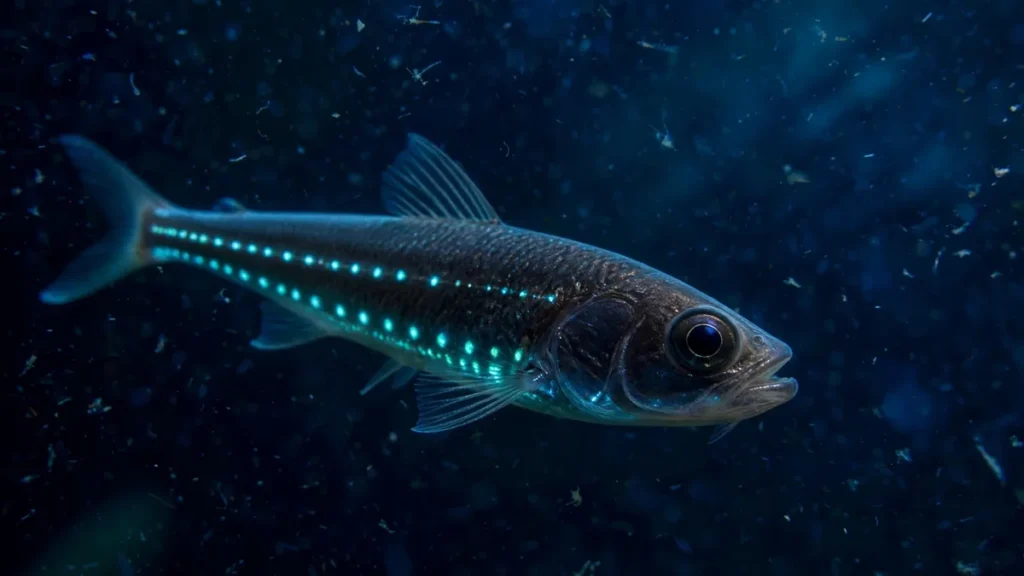
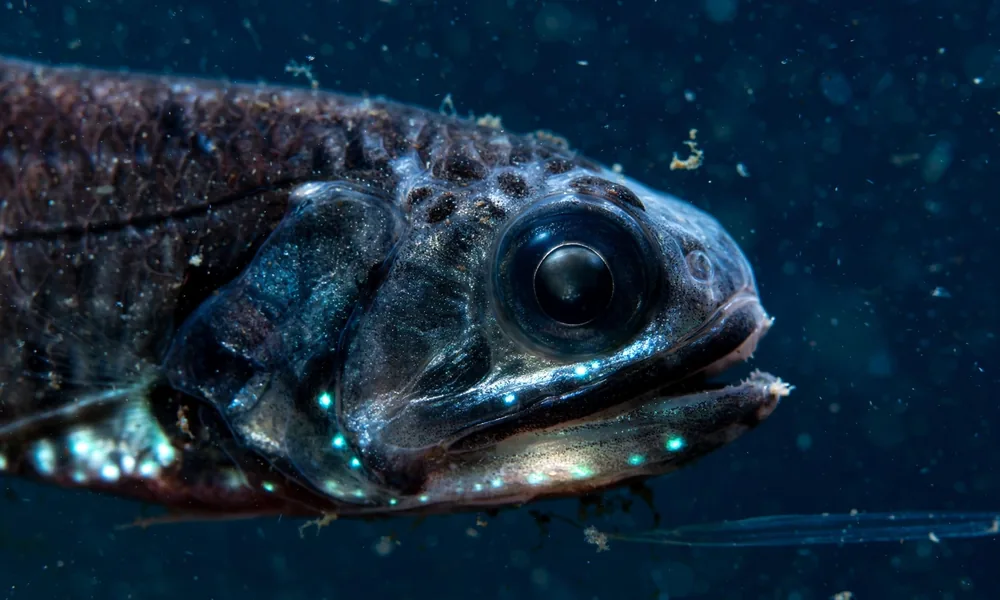
A lanternfish is a small, slender fish, most species between 5 and 15 centimetres long, with a body that is built for the dark. The back is dark, blue-black or brown, the sides are silvery, and the belly is pale, a pattern that helps the fish blend into the water from above and from below. The head is large for the size of the fish, and the eye is very large, round and dark, made to gather the faintest light in water where the sun barely reaches. The mouth is wide and set at an angle, and it is full of small, sharp teeth, which a fish that eats plankton still needs, because its prey can wriggle.
The photophores are the feature that makes a lanternfish unmistakable, and they are worth looking at closely. They are small, round organs set in neat rows along the belly, the sides and sometimes the head, and each one makes its own cold light, usually blue-green, by a chemical reaction inside the organ. The pattern of the lights is different in every species, and it is the pattern that scientists use to tell one lanternfish from another. The lights are not just decoration: the glow along the belly matches the faint light coming down from the surface, so a predator looking up from below sees a glow that blends with the water above, and the fish disappears.
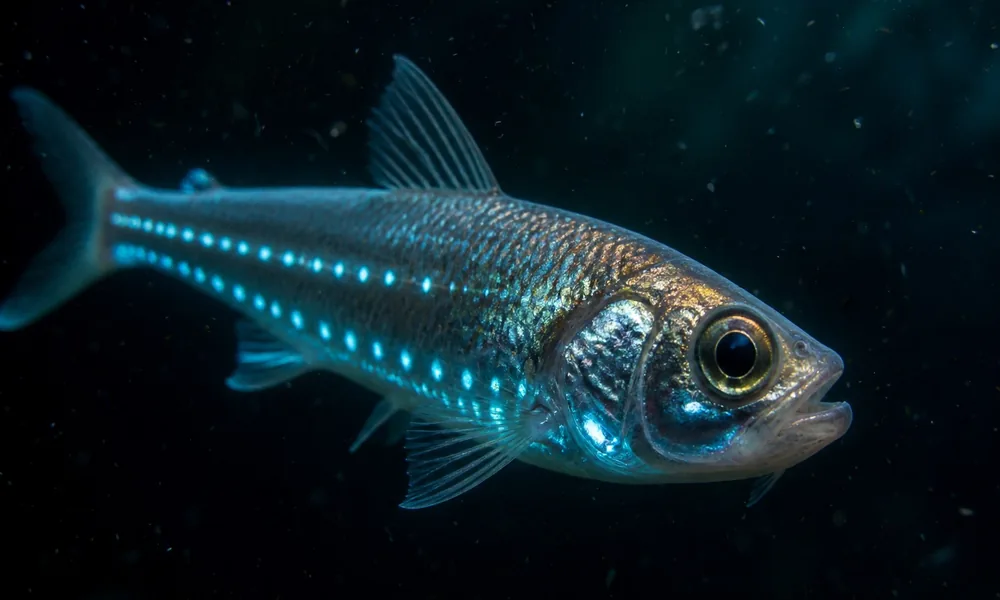
The fins are small and neat, and they are built for steady swimming rather than for speed. The dorsal fin sits about halfway along the back, the tail is forked and gives short bursts of speed, and there is a small fin on the back near the tail, called the adipose fin, which is a feature of the order. The scales are large and thin, and they fall off easily, which is why a lanternfish caught in a net often looks ragged and pale by the time it reaches the deck. A live lanternfish in the water is a bright, silvery fish, and a dead one is a dull, grey thing, and the difference is a reminder of how much of the fish is made for the dark.
Males and females look much alike, and telling them apart by eye is hard even for people who study them. In some species the males carry an extra light organ on the top of the head or on the tail, a glowing patch that may help them find a mate in the dark, and the females are often a little larger and fuller in the body. Juveniles are a different story: young lanternfish are often more transparent than adults, with larger eyes and longer fins, and they live closer to the surface, in the plankton, before they grow up and join the adults in the deep.
Where lanternfish live
Lanternfish live in the mesopelagic zone, the middle waters of the open ocean, between 200 and 1,000 metres deep, in a band of water that runs around the whole world. It is called the twilight zone, because the sunlight that reaches it is faint and blue, and it is a cold, dark place where the pressure is many times greater than at the surface. There are more fish in the mesopelagic zone than in any other part of the sea, and lanternfish are the most numerous of them, so numerous that their bodies form a layer that sonar can see, a false sea floor that rises and falls with the day.
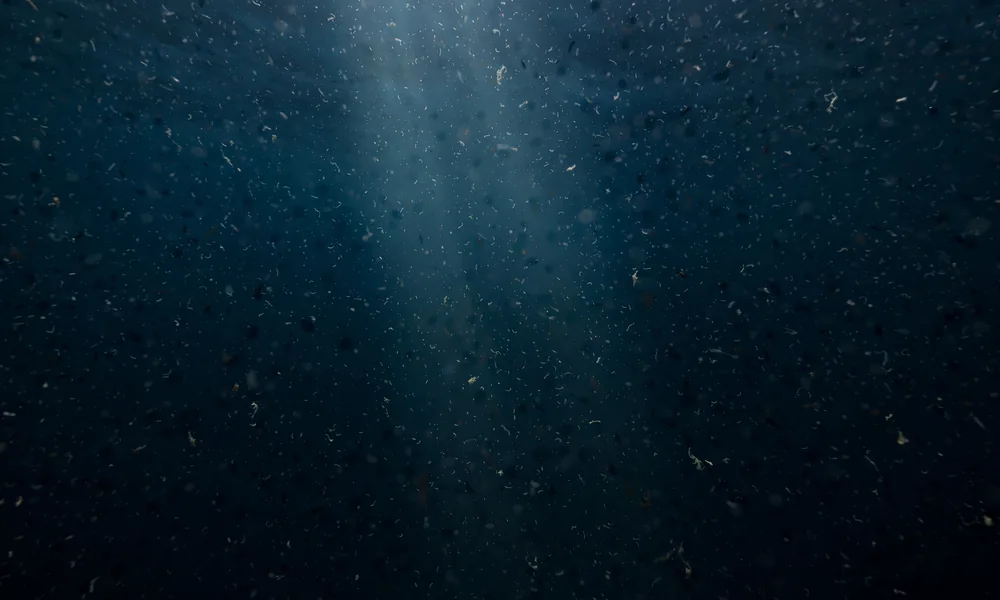
The habitat a lanternfish chooses changes with the hour, and that daily move is the most remarkable thing about the family. By day, the fish sit deep, between 300 and 1,000 metres down, where the light is too faint for most predators to hunt by sight. At dusk they rise, sometimes hundreds of metres in a few hours, to feed in the rich waters near the surface, and they spend the night in the top 100 metres, where the plankton is thickest. At dawn they sink again, and the whole layer moves as one, in the largest daily migration of animals on Earth, a migration that involves billions of fish and happens every night in every ocean.
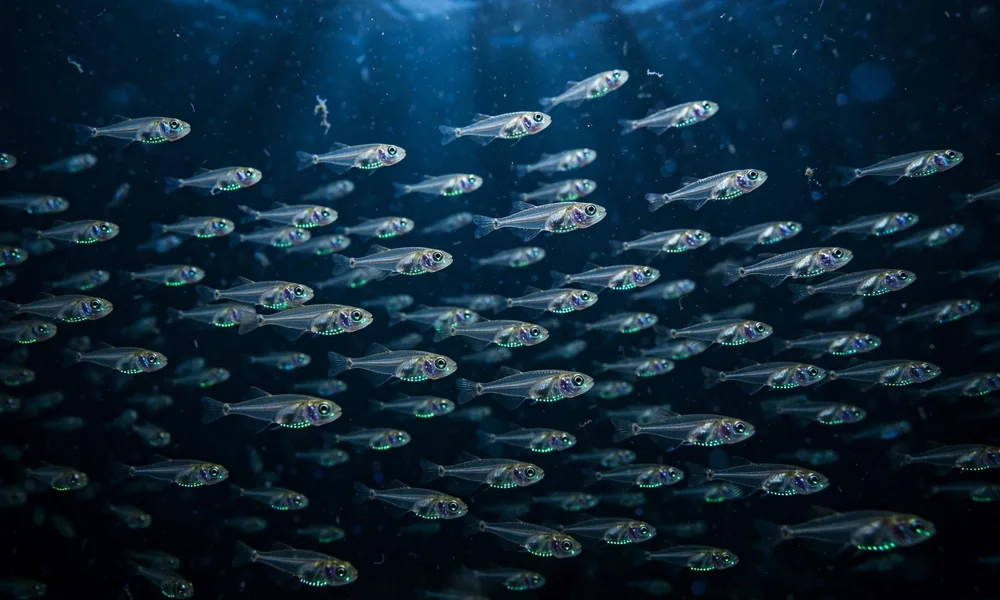
The deep scattering layer, the sonar echo that puzzled sailors in the Second World War, was the first sign of how many lanternfish there are. Sonar operators thought they were seeing the sea floor rise at night and sink by day, but the echo was the swim bladders of millions of lanternfish and other mesopelagic fish, moving up and down together. Scientists now estimate that the total weight of lanternfish runs into the hundreds of millions of tonnes, and some estimates put the whole mesopelagic fish community far higher, which would make these small fish one of the largest masses of vertebrate life on the planet.
What lanternfish eat
Lanternfish eat zooplankton, the tiny animals that drift in the sea, and they eat a great deal of it. Their main food is copepods, the small crustaceans that are the most numerous animals in the ocean, and they also eat krill, amphipods, small shrimps and the larvae of other sea animals. A lanternfish feeds at night, in the surface waters, picking its prey out of the plankton one by one, and it feeds most eagerly in the hours after dark, when the plankton is thickest and the fish are at their shallowest. By dawn, with its stomach full, it sinks back into the deep to digest.
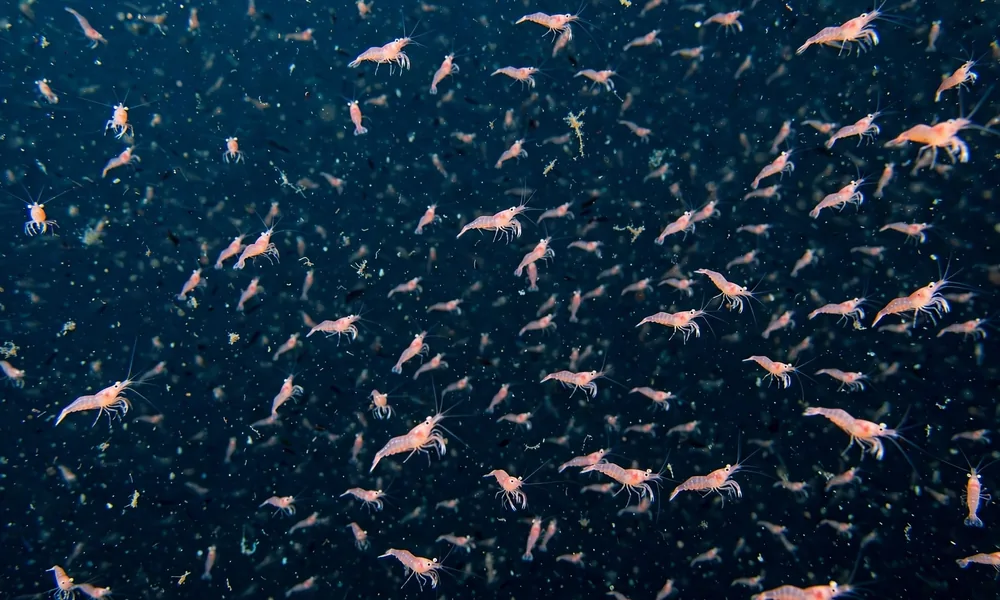
The feeding of lanternfish matters far beyond the fish themselves, because they are the link between the plankton and the big predators. A tuna, a swordfish, a shark or a seal cannot live on copepods, which are too small to chase one by one, but it can live on lanternfish, which gather the copepods into bodies worth eating. The lanternfish eat the plankton at the surface, and the predators eat the lanternfish, and in that way the food of the surface waters is carried down into the deep, and the energy of the plankton reaches animals that never come near the surface themselves.
There is a second gift in the way lanternfish feed, and it is one that the whole planet benefits from. When a lanternfish feeds at the surface and then sinks to the deep, it carries carbon down with it, in its body and in its waste, and that carbon stays in the deep water for a long time. Scientists call this the biological pump, and the daily migration of lanternfish is one of its strongest parts, moving carbon out of the surface waters and into the deep sea, where it is locked away from the air. A small fish, multiplied by billions, becomes a force that shapes the climate.
How lanternfish behave
Lanternfish are schooling fish, and they are at their best in a crowd. By day they gather in vast, loose schools in the deep, sometimes so dense that sonar reads them as a solid layer, and at night they spread out a little as they feed, but they still stay close together. They do not fight over food the way some fish do, and they do not defend territories, and a school of lanternfish is a quiet, orderly place. The school is safety: a single lanternfish is an easy meal, but a school of a thousand is a confusing, flashing mass that is hard for a predator to pick a fish from.
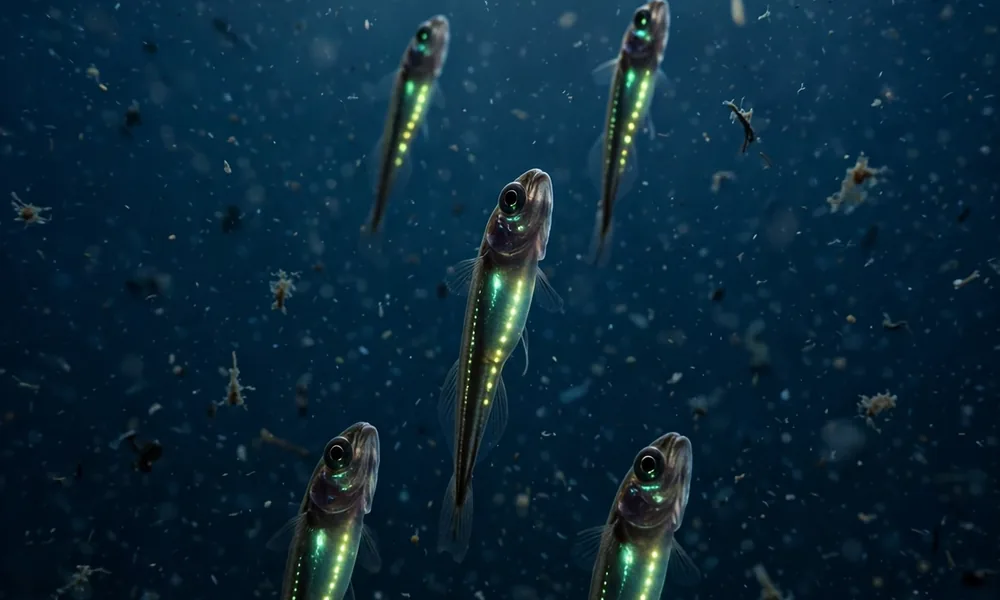
The daily migration is the heart of lanternfish behaviour, and it is a journey that few other animals attempt. Like the salmon, the lanternfish is a great migrant, but it migrates up and down each day rather than between river and sea. The salmon travels thousands of kilometres once in its life, while the lanternfish travels hundreds of metres twice a day, every day of its life, and the total distance it covers in a year is far greater. The migration is driven by hunger and by fear: the food is at the surface, and the safety is in the deep, and the fish must balance the two every night.
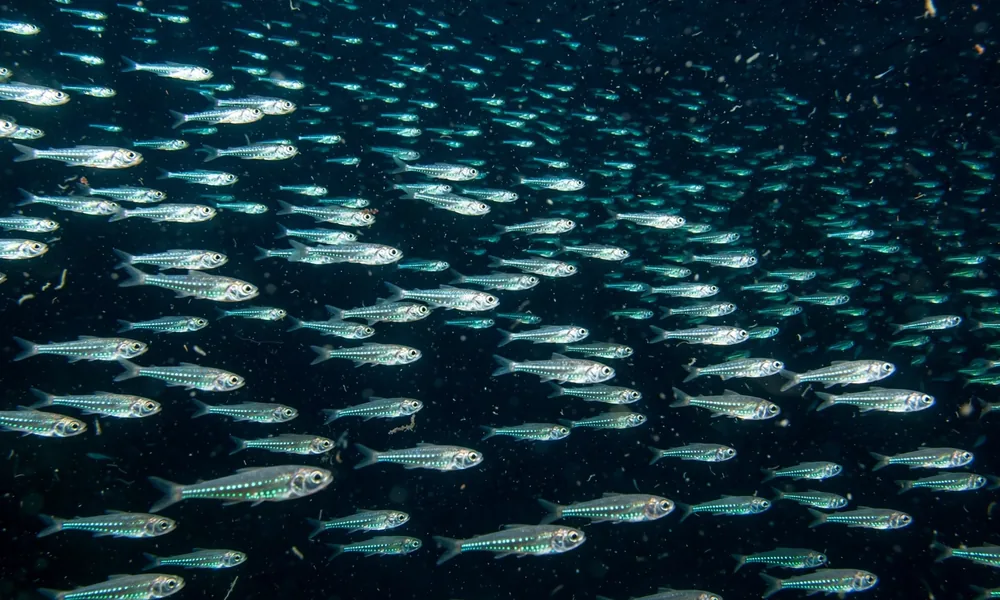
Unlike the angelfish, which lives alone or in pairs on a shallow reef, the lanternfish lives in schools in the open sea, and the difference shapes everything about the two fish. The angelfish guards a small patch of coral and knows every rock in it, while the lanternfish knows no home at all, only the daily rise and fall of the school. One is a reef fish you watch through a mask, and the other is a deep-sea fish you will likely never see alive, and the pleasure of the two could hardly be more different.
The light of a lanternfish is part of its behaviour, not just part of its body. The fish can control their photophores, turning them up and down, and they use the light to hide, to signal and perhaps to find a mate. The glow along the belly hides the fish from predators below, the flashes from the sides may help the school stay together in the dark, and the extra lights that some males carry may help a female find them. In water where no sunlight reaches, light is the only language the fish have, and they speak it all night.
How lanternfish breed
Lanternfish breed in the open sea, and they do it without any of the care that a reef fish or a pond fish gives its young. They are broadcast spawners, which means the female releases her eggs into the water and the male releases his milt over them, and the eggs drift away on the current. A female can release thousands of eggs in a season, and the eggs are small, round and buoyant, and they float up towards the surface, where they hatch in the plankton. There is no nest, no guarding and no parent that stays with the young, and the whole strategy is to make so many eggs that some of them survive.
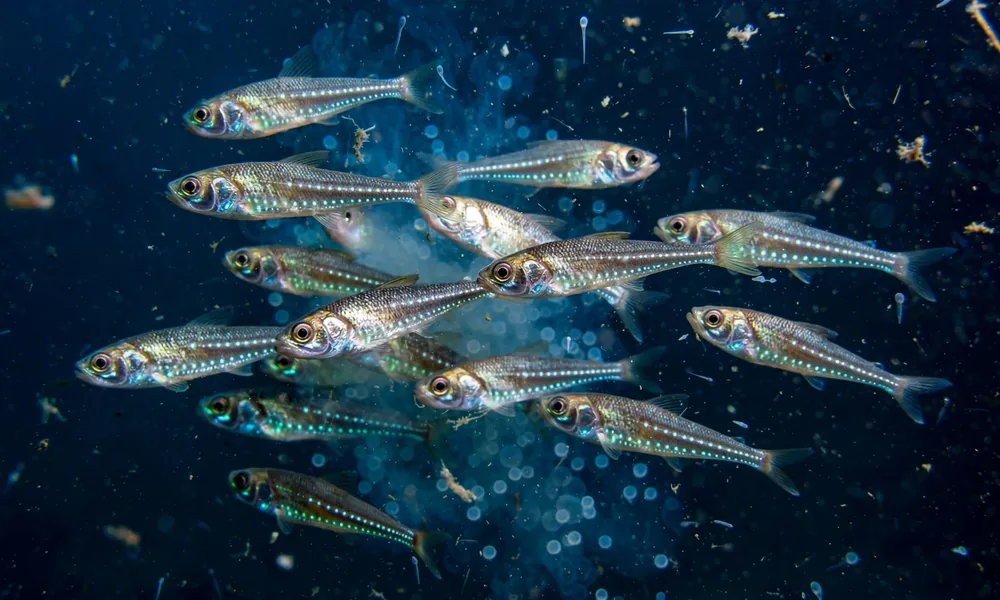
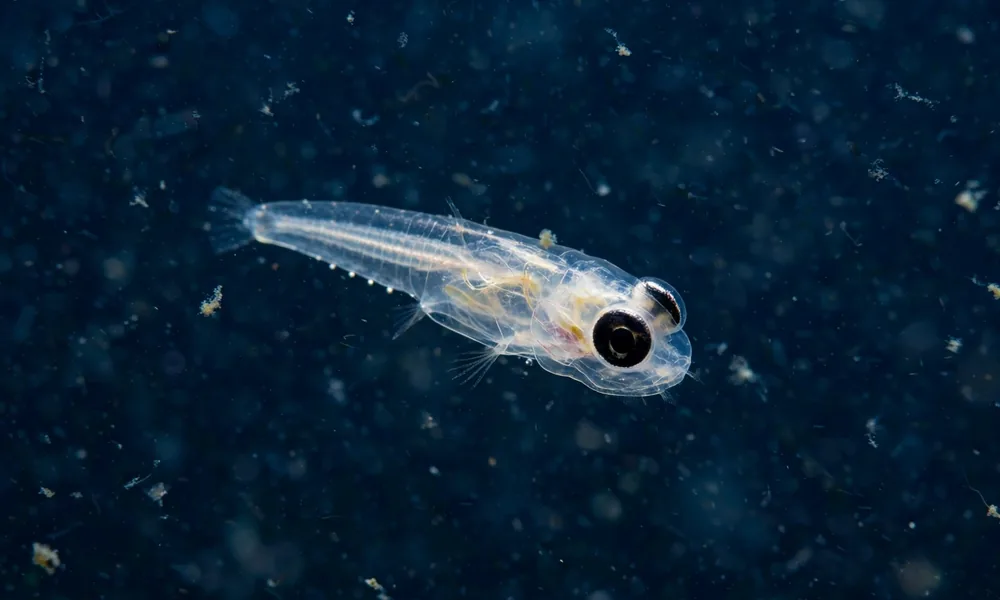
The young fish that hatch are larvae, and they look very different from the adults. A lanternfish larva is small, transparent and delicate, with a large eye and a long, trailing fin, and it drifts in the plankton near the surface, feeding on the smallest life in the sea. As it grows, its body fills out, its photophores appear one by one, and it begins to swim with the adults, rising at night and sinking by day. The change from larva to adult takes weeks or months, depending on the species and the temperature of the water, and most larvae do not survive it.
Unlike the seahorse, where the male carries the young in a pouch until they are born, the lanternfish gives its young nothing but a start in the plankton, and the difference shows in the numbers. A seahorse may produce a few hundred young in a season, while a lanternfish produces thousands of eggs, and most of them are eaten. The lanternfish bets on numbers, and the seahorse bets on care, and both strategies work in the seas they live in.
Most lanternfish live only a few years, and that short life is part of the reason they breed as they do. A fish that lives for a year or two has little time to find a mate, spawn and grow, so it spawns early, spawns often and spawns in large numbers. Some of the larger, colder-water species live longer, but the pattern is the same: a short life, a great many eggs, and a generation that turns over quickly. That fast turnover is why the population can recover quickly when it is disturbed, and why it can also fall quickly if the food fails.
Lanternfish and conservation
Lanternfish are not threatened as a group, and many species are listed as Least Concern, because they are so numerous and so widespread that no single fishery or disaster could easily wipe them out. That is the good news, and it is worth stating plainly, because a fish that lives in the deep sea is easy to worry about and hard to check on. The concern is not that lanternfish will disappear, but that the ocean they live in is changing, and that a fishery could grow faster than the science that watches it.
The main threat on the horizon is fishing. Lanternfish are not widely eaten by people, but they are rich in oil and protein, and there is interest in catching them for fishmeal and fish oil, to feed farmed fish and livestock. A fishery on that scale would take millions of tonnes a year, and it would take food from the tuna, the seals and the penguins that depend on lanternfish. The fishery does not exist at that scale yet, and scientists have warned that it should not grow until the size of the population and the role of the fish are better understood.
The Atlantic cod is one of the larger fish that may take lanternfish when the two meet in deep water, and it is a reminder that the lanternfish does not live alone in the sea. The cod is a cold-water fish of the North Atlantic, and it hunts in the dark depths where lanternfish spend their days, and the two fish are linked by the same food web. Protecting the lanternfish means protecting the whole web, from the copepods at the bottom to the cod, the tuna and the whales at the top.
The other threat is the changing climate. As the sea warms, the plankton that lanternfish eat may shift, the layers of the ocean may change, and the daily migration may grow harder or easier in ways that are not yet clear. A warmer sea holds less oxygen, and the deep water is already short of oxygen in some places, and a fish that lives in the deep feels that change first. The best defence for the lanternfish is the same defence that works for the whole ocean: careful science, slow fisheries and a watch kept on the deep.
The best seasons for lanternfish
Lanternfish are present all year, and they rise every night, so there is no season when they are absent. The best time to look for them is a calm, dark night in summer, when the sea is settled, the plankton is rich and the surface waters are warm, and a boat with lights can draw the fish up from below. The fish come to the light, and on a good night a plankton net towed near the surface can bring up a glittering catch of small, glowing fish. Winter nights are harder, because the sea is rough, the weather is cold and the work is slower, even though the fish are still there.
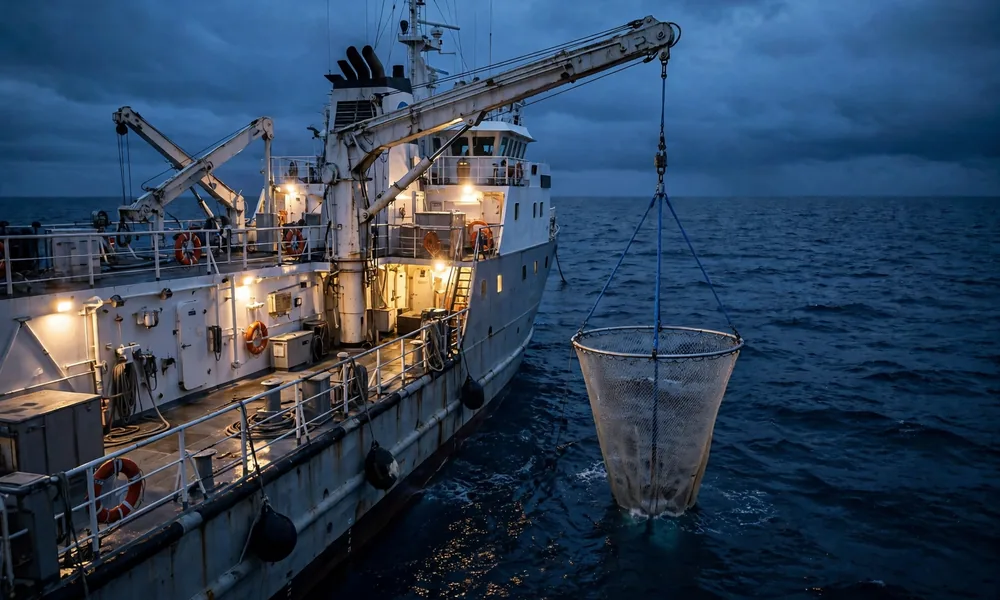
If you want to see a lanternfish, the best chance is not a fishing boat but an aquarium or a research ship. A few large aquariums keep deep-sea fish in cold, dark tanks, and a lanternfish in a tank is a rare and wonderful sight, with its photophores glowing in the dark water. A research cruise is the other way, and it is how most of what we know about lanternfish was learned: a ship, a fine net, a dark night and a team of scientists sorting the catch on deck by torchlight.
The worst time to look for lanternfish is a bright day, when the fish are hundreds of metres down and no net or camera can easily reach them. Even the best submersibles struggle to find a small, silvery fish in the vast dark of the mesopelagic zone, and a diver will never reach them at all. The lanternfish belongs to the night, and the night is when it is closest to us, which is why every study of the family is a study done after dark.
Staying safe around lanternfish
Lanternfish themselves are harmless. They are small, they have no venom, they do not bite, and they will never come near a swimmer, because they live hundreds of metres down. The safety questions around lanternfish are the safety questions of the sea at night, and they are worth taking seriously, because the open ocean after dark is a serious place. A night boat trip needs a sound boat, a sober crew, life jackets for everyone, and a skipper who knows the water, and nobody should go out on a dark sea in a small boat without telling someone ashore where they are going.
There are a few practical points for anyone who handles a lanternfish on a research deck. The fish are delicate, and they die quickly out of water, so they should be handled gently, kept wet and returned to the sea as soon as they have been studied. Wash your hands after handling any sea animal, because the sea carries bacteria, and keep any cuts covered while you work. None of this is hard, and all of it is the ordinary care that working with wild animals at sea asks for.
Lanternfish watching checklist
A little preparation turns a night at sea into a real chance of seeing lanternfish, glowing in a net or a tank under the stars.
- A calm, dark night in summer, when the sea is settled and the fish rise to feed.
- A boat trip with a research team or an aquarium visit, rather than a lone swim in the dark.
- A plankton net or a viewing tank, so the small fish can be seen close up without harm.
- A red torch, which lets you see without blinding the fish or spoiling your night vision.
- Warm clothes and a life jacket, because the sea at night is cold even in summer.
- Patience, because the fish rise slowly and the best catches come after midnight.
- Respect for the sea and its fish, keeping the catch small, handling the fish gently, and returning them to the water.
Frequently asked questions
How big do lanternfish get?
Most lanternfish grow to between 5 and 15 centimetres long, and the largest reach about 30 centimetres. The glacier lanternfish grows to about 7 to 10 centimetres, while the Madeira lanternfish and the horned lanternfish grow to about 7 to 8 centimetres. They are small fish by any measure, and their importance comes from their numbers, not their size.
What do lanternfish eat?
Lanternfish eat zooplankton, mostly copepods, krill, amphipods and small shrimps, and they feed at night in the surface waters, where the plankton is thickest. They pick their prey out of the water one by one, and they feed most eagerly in the hours after dark. By dawn, with their stomachs full, they sink back into the deep to digest.
Why do lanternfish glow?
Lanternfish glow because of rows of light-making organs called photophores, which produce a cold blue-green light. The glow along the belly matches the faint light from the surface, so a predator looking up from below sees a glow that blends with the water, and the fish disappears. The pattern of the lights is different in every species, and it may also help the fish find a mate and stay with its school in the dark.
Are lanternfish dangerous?
No, lanternfish are not dangerous to people. They are small, they have no venom, they do not bite, and they live hundreds of metres down, where no swimmer will ever meet them. The safety rules for lanternfish are the safety rules of the sea at night: a sound boat, a sober crew, life jackets for everyone, and no lone trips in the dark.
Can you keep a lanternfish in an aquarium?
You can, but it is very hard, and almost nobody should try. A lanternfish needs cold, dark, deep water, high pressure and a diet of live plankton, and it needs a tank that mimics the mesopelagic zone, which is beyond the reach of a home aquarium. A few large public aquariums keep deep-sea fish in special cold, dark tanks, and that is the place to see one, not a tank at home.
How is this guide different from the koi guide?
This guide covers the lanternfish, a small wild fish of 5 to 15 centimetres that lives in the dark mesopelagic zone and glows with its own light, while our koi guide covers a tame freshwater pond carp of 60 to 70 centimetres that lives in a garden pond and eats pellets by hand. One is a deep-sea fish you will likely never see alive; the other is a garden fish you can feed from your fingers, and the two could hardly live more different lives.
Conclusion
The lanternfish species is a reminder that the most important fish in the sea is not always the biggest or the best known. A small, glowing fish, most species between 5 and 15 centimetres long, rises every night to feed and sinks every morning to hide, and in doing so it feeds the tuna, the seals and the penguins, and it carries carbon down into the deep.
If you ever get the chance to see one, take it on a calm, dark night in summer, on a research boat or in a cold, dark aquarium tank. Watch the small fish glow in the dark water, and you will have met the lanternfish that lights up the middle of the ocean.