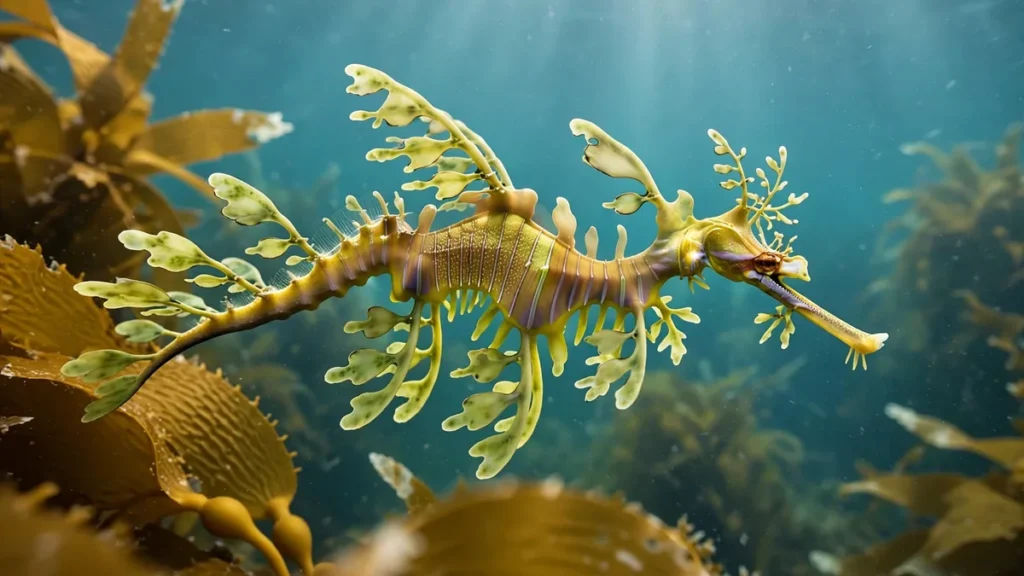
The leafy seadragon species is the Australian fish that looks more like a piece of drifting seaweed than an animal at all. If you are asking what a leafy seadragon is, the short answer is Phycodurus eques, a relative of the seahorse that grows to around 20 to 24 centimetres, lives in the kelp forests of southern Australia, and hides from its enemies by pretending to be a plant. It does not swim fast, it does not fight, and it does not need to. Its body is covered in leaf-like lobes that sway in the current exactly like kelp, and a predator looking straight at it will often see nothing but seaweed.
Most people meet a leafy seadragon on a dive, and the meeting is usually a quiet one. You drift over a kelp forest off South Australia, and your guide points at a patch of weed that seems to have a small eye, and there it is, a yellow-green fish hanging upright in the water, its leafy lobes moving with the kelp around it, its long snout pointing down at the tiny shrimp it feeds on. That is the heart of this guide: how a single species of pipefish became one of the most famous fish in Australia, how it lives, feeds and breeds in the kelp, and why it is protected by law in the only country where it is found.
Key takeaways
- The leafy seadragon species is Phycodurus eques, a member of the pipefish family Syngnathidae, found only in the cool coastal waters of southern Australia.
- It is usually 20 to 24 centimetres long, and its body is covered in leaf-like lobes that let it disappear among the kelp it lives in.
- Leafy seadragons are poor swimmers that drift with the current, feeding on tiny mysid shrimp and other small crustaceans sucked in through a long, tubular snout.
- The male carries the eggs on the underside of his tail, where the female glues them, until they hatch after several weeks.
- They are listed as Least Concern, but they are protected in Australia, and they depend on healthy kelp forests, so reef loss and warming seas hit them hard.
The leafy seadragon species and their relatives
Leafy seadragons belong to the family Syngnathidae, the pipefish family, a group of slender, armour-plated fish that includes the seahorses, the pipefish and the seadragons. The family holds around 300 species, from tiny pipefish of only a few centimetres to seadragons of 45 centimetres, and they share a set of features that set them apart from other fish: a long, tubular snout, a body covered in bony rings rather than scales, and a way of feeding that relies on sucking prey in through the snout rather than biting it. The seadragons sit among them as the most ornate members, with leafy growths that no other fish in the family carries.
The leafy seadragon, Phycodurus eques, is the lead species of this guide, and it is a good ambassador for the whole family. It is a yellow-green fish of 20 to 24 centimetres, covered in leaf-like lobes, and it is found in the kelp forests and seagrass meadows of southern Australia, from Western Australia to New South Wales. It is a poor swimmer, it is active by day, and it is one of the most photographed fish in Australia, with divers travelling from around the world to see it. If you have dived a kelp forest in South Australia, there is a fair chance the fish your guide pointed out was a leafy seadragon, or one of its close cousins in the same family.
| Type | Animal | Where it lives | Best-known food | Length or Weight |
|---|---|---|---|---|
| Family | Pipefishes and seahorses (Syngnathidae) | Seas worldwide | Tiny crustaceans and plankton | About 5 cm to 45 cm long |
| Genus | Leafy seadragons (Phycodurus) | Southern Australia | Mysid shrimp and small crustaceans | About 20 cm to 24 cm long |
| Species | Leafy seadragon (Phycodurus eques) | Kelp forests of southern Australia | Mysid shrimp and small crustaceans | About 20 cm to 24 cm long |
| Species | Weedy seadragon (Phyllopteryx taeniolatus) | Rocky reefs of southern Australia | Mysid shrimp and small crustaceans | About 30 cm to 45 cm long |
| Species | Ruby seadragon (Phyllopteryx dewysea) | Deep reefs off Western Australia | Small crustaceans | About 23 cm long |
| Species | Pot-bellied seahorse (Hippocampus abdominalis) | Seagrass of southern Australia and New Zealand | Small crustaceans and plankton | About 20 cm to 35 cm long |
The closest relative of the leafy seadragon is the weedy seadragon, and the two are often confused by divers who are new to the kelp. Like the leafy seadragon, the weedy seadragon is a member of the pipefish family that lives in the waters of southern Australia, but it is larger, usually 30 to 45 centimetres, and its lobes are fewer and simpler, more like weeds than leaves, and it prefers rocky reefs to the kelp forests that the leafy seadragon loves. The weedy seadragon is also a stronger swimmer, and it ranges more widely, while the leafy seadragon stays close to its patch of kelp. Like the seahorse, the leafy seadragon is a pipefish that swims upright and feeds through a tube, but the seahorse curls its tail around a stem and stays in one place, while the seadragon drifts free in the kelp, trusting its camouflage rather than a grip.
Within the family, the seadragons sort themselves by the water they like and the cover they hide in, and the differences are worth knowing. The leafy seadragon is the kelp-forest fish, its lobes matching the fronds it drifts among. The weedy seadragon is the rocky-reef fish, its simpler lobes matching the weeds on the rock. The ruby seadragon, found only in 2015, is the deep-water fish, living below 50 metres off Western Australia, where the light is dim and the kelp does not grow. The pot-bellied seahorse, another southern cousin, grows to 20 to 35 centimetres and lives in the seagrass meadows of southern Australia and New Zealand. Each species is a small variation on the same theme, and each one fits a slightly different corner of the southern sea.
What a leafy seadragon looks like
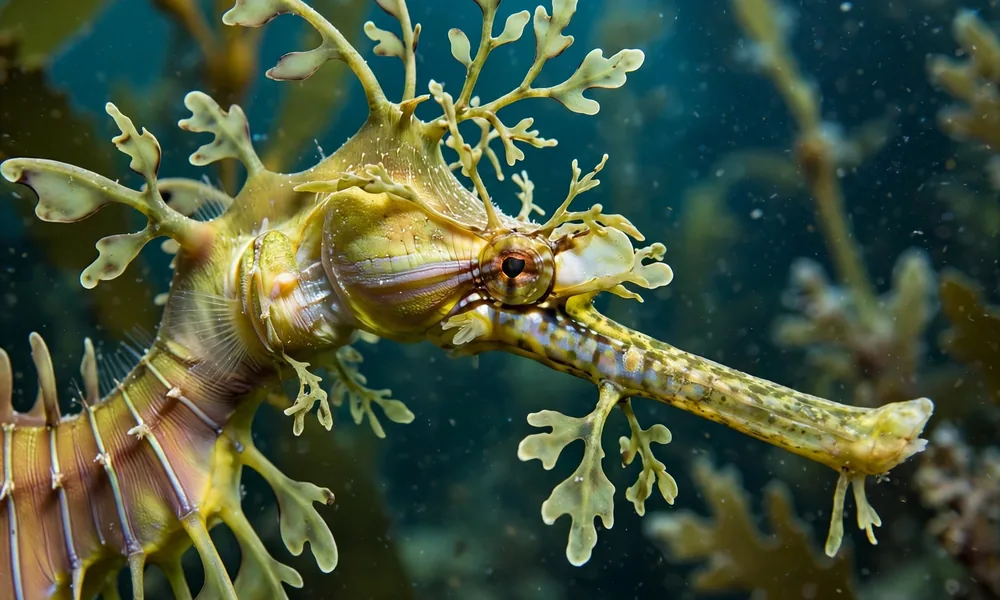
A leafy seadragon is a slender, upright fish, almost as tall as it is long when it hangs in the water, with a body that is hard to pick out from the kelp around it. Most adults measure between 20 and 24 centimetres from snout to tail, and they are light for their length, with a body made of bony rings rather than muscle and flesh. The body is yellow-green to brown, with fine lines across the rings, and it is covered in leaf-like lobes that hang from the head, the back and the tail, each one shaped like a small kelp frond. The lobes are not used for swimming, and they are not fins at all, but outgrowths of the skin, and they sway in the current exactly like the kelp they mimic.
The head is small, and the snout is the feature that gives the fish its way of feeding. The snout is a long, thin tube, and at its end is a tiny mouth that opens like a trapdoor, sucking in a shrimp with a snap of the head. The eye is small and dark, and it can move on its own, watching for food while the rest of the body stays still. The fins are small and nearly transparent, a pair of pectoral fins behind the head and a dorsal fin on the back, and they beat fast and constantly, holding the fish upright in the water. There is no tail fin, and the tail ends in a curl, though it cannot grip like a seahorse’s tail.
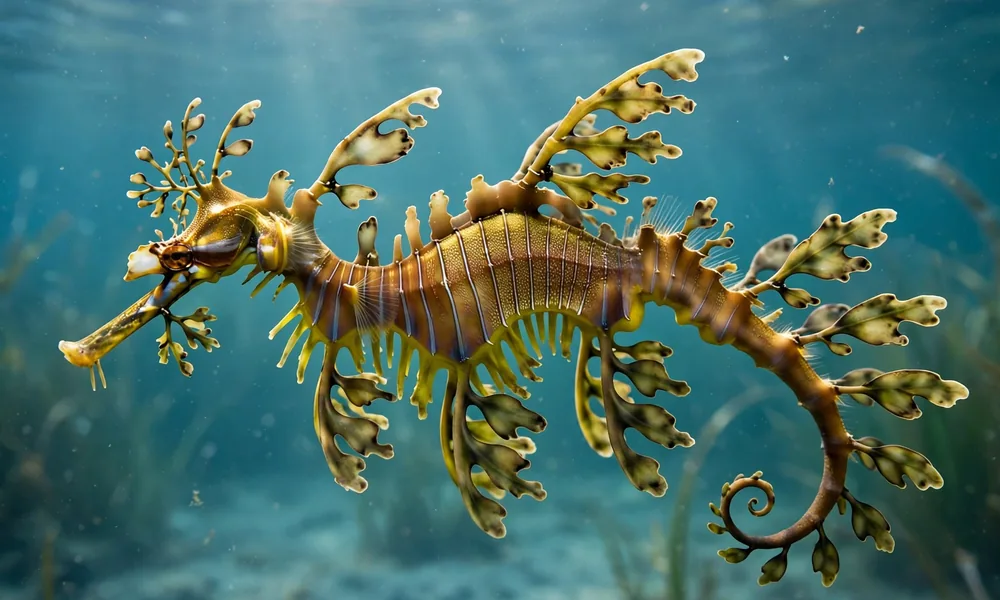
The colours change with the water the fish lives in, and a seadragon from a kelp forest can look quite different from one in a seagrass meadow. Fish in golden kelp are yellow-green, with lobes that match the fronds, while fish in darker weed are browner, with the lobes shading to olive and rust. Young seadragons are paler still, with lobes that are finer than the adult’s, and they grow into their full disguise as they lengthen. Males and females look much alike, and telling them apart by eye is hard, though the male carries the eggs on his tail in the breeding season, which is the one clear sign of the difference.
Compared with its cousins, the leafy seadragon is easy to tell apart once you know what to look for. The weedy seadragon is larger, with fewer and simpler lobes, and the ruby seadragon is red, with no leafy lobes at all, living in deep water where there is no kelp to mimic. Like the clownfish, the leafy seadragon is a small reef fish that depends on its home for shelter, but the clownfish lives in an anemone that stings its enemies, while the seadragon lives in kelp that hides it, and it is the hiding, not the stinging, that keeps it alive.
Where leafy seadragons live
Leafy seadragons live in the cool coastal waters of southern Australia, and they are found nowhere else in the world. Their range runs from Western Australia, around the Great Australian Bight, through South Australia and Victoria, and up the coast of New South Wales, following the kelp forests of the Great Southern Reef. They favour water that is cool, usually between 12 and 20 degrees Celsius, and they are rarely found in warm tropical seas, where the kelp does not grow. Wherever there is cool water, kelp and a rocky reef, there is a good chance a leafy seadragon is nearby.
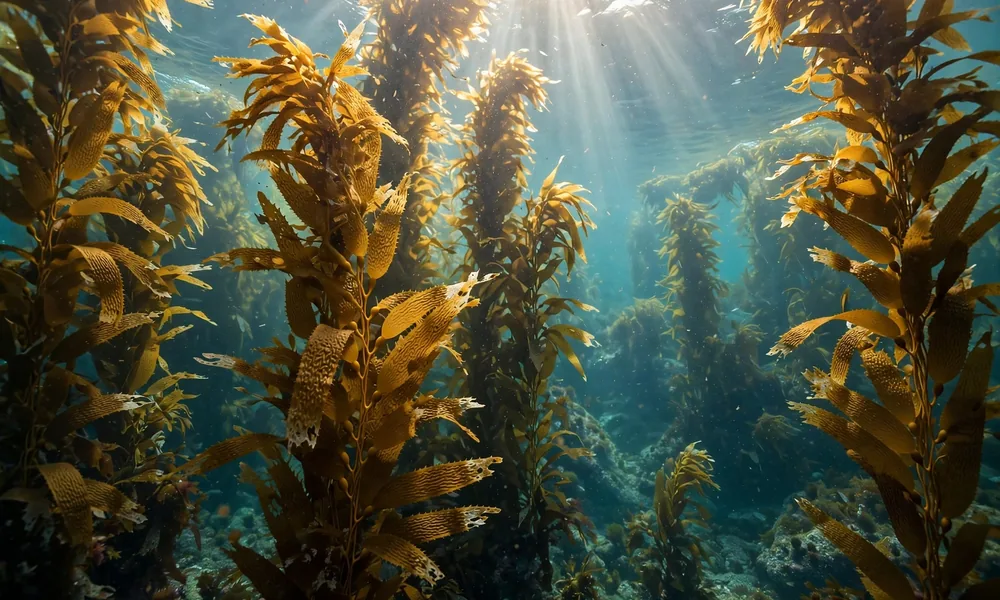
The habitat they choose is the kelp forest itself, and they are rarely found far from it. Most seadragons live in water between 3 and 25 metres deep, among the kelp fronds, the seagrass and the rocky reef, where the food is richest and the shelter is thickest. They favour areas with plenty of kelp, which gives them both hunting cover and a place to hide from the larger fish that hunt them, and they are less common on bare sand or open rock, where there is little to eat and nowhere to hide. A leafy seadragon spends much of its life within a small patch of reef, sometimes no larger than a few dozen square metres, and it knows every kelp frond and every rock in that patch the way you know the rooms of your own house.
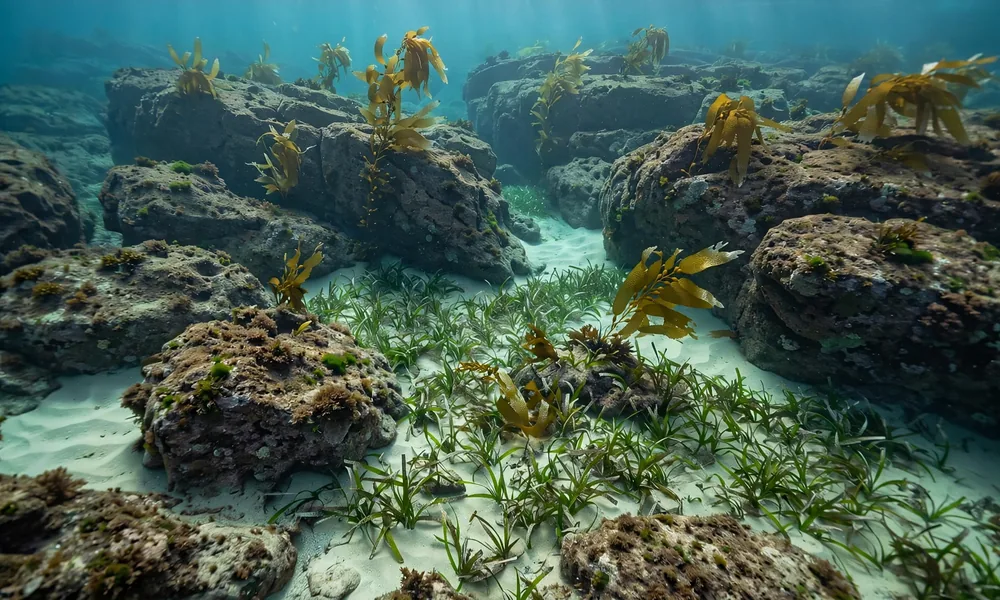
Depth matters, but not in the way it does for a deep-sea fish. Leafy seadragons are shallow-water animals, and most of them stay above 25 metres, where the sunlight reaches the kelp and the mysid shrimp they feed on are thickest. A few are found deeper, to 50 metres or more on the reef edge, and the fish that live deep are often paler and less brightly marked than their shallow cousins. The water temperature matters too: leafy seadragons need cool water, usually below 20 degrees Celsius, and they are absent from warm seas altogether, which is why their range stops where the kelp stops.
The leafy seadragon has never left its home waters, and it is one of the few famous fish that has not been carried around the world by people. It lives only in southern Australia, and it is protected by law in every state where it is found, which means it cannot be collected, exported or kept in an aquarium without a permit. Like the blue tang, the leafy seadragon is a reef fish that depends on the health of its home, but the tang is a tropical fish that ranges across the Indo-Pacific, while the seadragon is a cool-water fish that lives on a single reef system, and it is that narrow range that makes it so vulnerable.
What leafy seadragons eat
Leafy seadragons are pickers, not hunters, and their diet is written on the reef itself. The everyday food is mysid shrimp, tiny translucent crustaceans that drift in the water among the kelp, and a seadragon will hover in the current, watching for a shrimp to come within range of its snout. They also eat small amphipods, tiny crabs and the larvae of other crustaceans, and a single seadragon may take dozens of small animals in a day. They feed all day, in small mouthfuls, and a seadragon that is feeding well is a busy fish, its head snapping from side to side as it picks shrimp from the water.
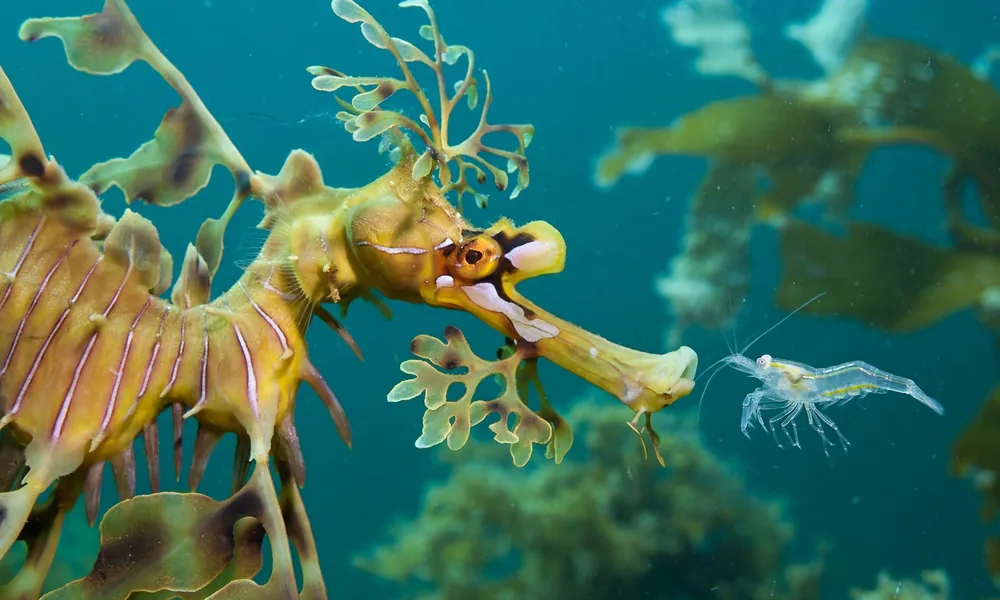
What sets the leafy seadragon apart is how it feeds. It does not chase its prey, and it does not hunt in a pack. It waits, hanging upright in the kelp, and it watches for a shrimp to drift close. When the moment comes, it snaps its head forward and sucks the shrimp straight into its snout, the whole strike taking a fraction of a second. The seadragon has no teeth, and it swallows its food whole, digesting it in a gut that has no stomach, which is why it must feed so often, taking small meals through the day rather than one large one. Like the angelfish, the leafy seadragon is a reef fish that feeds on small animals among the cover, but the angelfish is a strong swimmer that picks at sponges and algae on the reef, while the seadragon is a weak swimmer that takes its food from the water itself, one tiny shrimp at a time.
Feeding is a daytime affair, and it follows the rhythm of the reef. Leafy seadragons feed most actively in the morning and the late afternoon, when the light is good and the shrimp are thickest in the water, and they rest in the heat of midday, hanging in the shade of a kelp frond. A seadragon that is feeding well is a busy fish, moving constantly from frond to frond, and a fish that has stopped feeding is usually a fish in trouble, because a seadragon that cannot find shrimp has nowhere else to turn.
How leafy seadragons behave
Leafy seadragons are daytime fish, and their day is a quiet round of drifting, feeding and staying hidden. They wake at dawn, leave the kelp frond where they slept, and drift out into the current to feed, and they spend the day moving through the kelp in a slow, unhurried way, never rushing, never chasing. They are not strong swimmers, and they do not need to be: their life is lived within a few dozen metres of reef, and speed matters less than knowing every kelp frond and every hiding place. When a larger fish passes, a leafy seadragon will often turn sideways and hold still, letting its lobes sway with the kelp, and if that fails it will drift down into the fronds and wait.
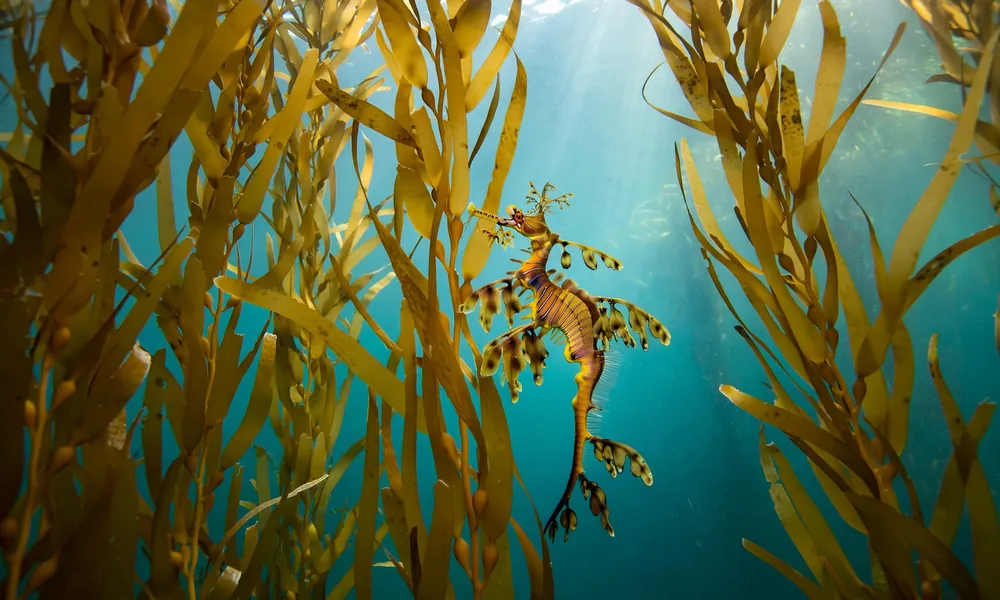
The most famous behaviour in the leafy seadragon is the disguise itself. The lobes that cover its body are not fins, and they are not used for swimming, but they are the reason the fish survives. A leafy seadragon hanging in the kelp is almost impossible to see, even for a diver who knows it is there, and the fish will often stay in the same patch of kelp for weeks, drifting with the current and feeding on the shrimp that pass by. The disguise is so good that a seadragon can be photographed from a metre away and still be hard to pick out in the picture, which is why the best seadragon photographs are taken by divers who have spent years learning to spot them.
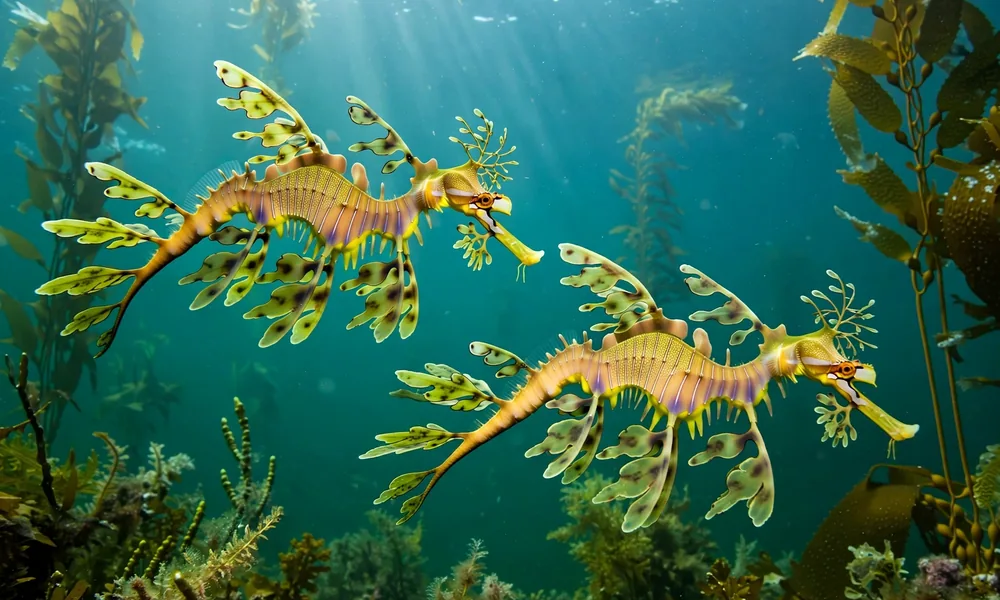
When a leafy seadragon is threatened, it does not behave like a fish that wants to fight. Its first response is to freeze, relying on its lobes and its colour to break up its outline against the kelp, and if that fails it will drift down into the fronds and stay there, fins folded, until the danger passes. Leafy seadragons have no venom, no spines worth fearing and no bite that matters to a person, and their whole defence is built on being hard to see, hard to catch and hard to swallow. A seadragon that is handled roughly will lose the skin that protects it, which is why divers are told never to touch one, and to keep their fins well clear of the kelp it lives in.
Breeding and life cycle
Leafy seadragons breed in the warmer months, when the water is at its warmest and the shrimp are thickest, and the timing is set by the season rather than the calendar. The female produces her eggs in small batches, and she transfers them to the male, who carries them on the underside of his tail. The eggs are glued to a brood patch on the tail, where they sit in neat rows, and a male may carry a few hundred of them at a time. The female does not stay to guard them, and the male does the work of carrying them, fanning them with his fins and keeping them clean until they hatch.
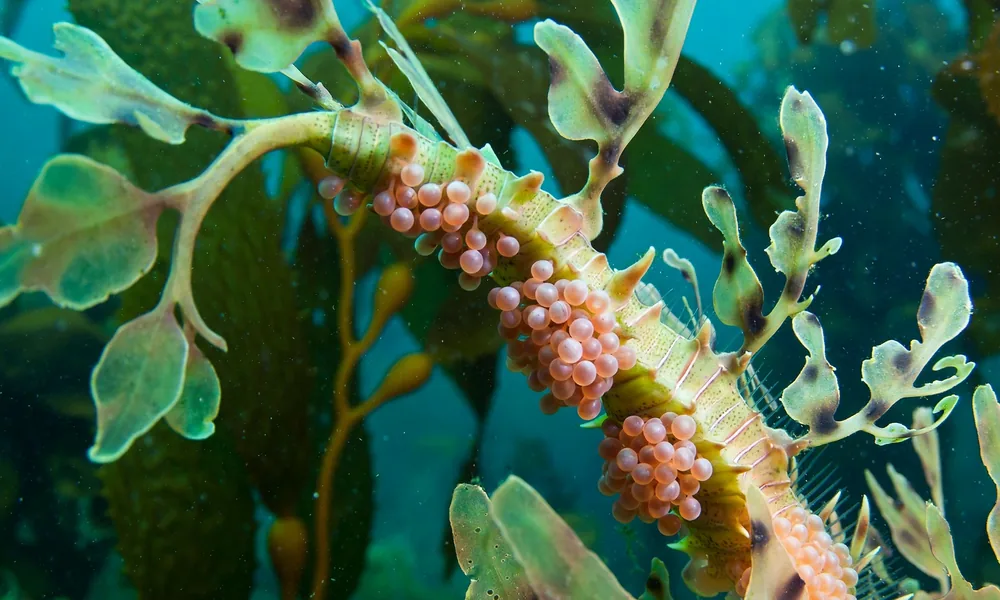
The eggs hatch after several weeks, and the young seadragons emerge as tiny, perfect copies of their parents, only a few centimetres long. They are independent from the moment they hatch, able to feed and hide within hours, and they drift with the current, feeding on the smallest plankton before they turn to mysid shrimp. The young grow fast in their first year, shedding their pale juvenile colours for the adult pattern as they lengthen, and they reach breeding size in their second year, when they are close to full length.
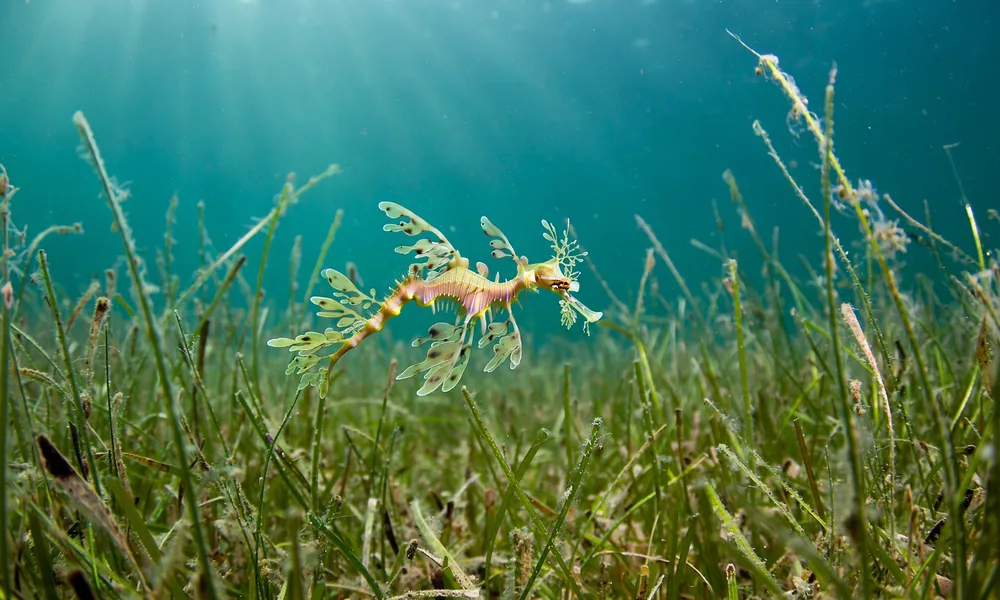
The lifespan in the wild is thought to be only a few years, though animals that survive the dangerous first year, when they are small enough to be eaten by almost anything, can live longer.
Conservation status
The leafy seadragon is listed as Least Concern by the International Union for Conservation of Nature, and the reasoning is straightforward: it has a large range along the southern coast, it is still common on many reefs, and it breeds well enough to replace itself. That broad picture hides a more worrying local one, and it is worth understanding both sides, because the leafy seadragon is one of the reef fish most tied to the fate of the kelp it lives in. A fish that hides in kelp cannot live where the kelp has died, and a reef that loses its kelp loses its seadragons within a season or two.
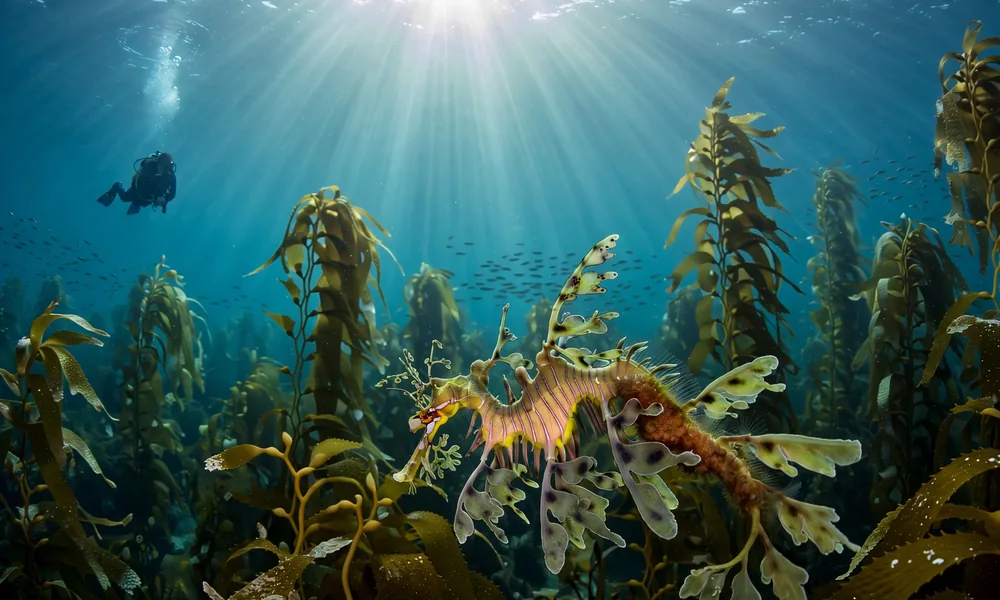
The main pressure is the loss of kelp itself. When the sea warms, the kelp dies back, and the seadragons that hide in it lose their cover overnight. The warming of the southern seas is already thinning the kelp forests in some places, and the seadragons that live there have nowhere else to go. The aquarium trade is a second pressure, as seadragons are taken in small numbers for home tanks, though they are protected by law in Australia, and most of them do not survive the journey, or they starve in captivity because their diet of live mysid shrimp is so hard to provide.
The most useful conservation work is practical, and it is the same work that helps the whole reef. Protecting kelp from warming means cutting the warming that causes it, and protecting reefs from overfishing, pollution and careless anchoring keeps the kelp alive for the fish that depend on it. Marine protected areas, where fishing and collecting are limited, give seadragons a safe patch to feed and breed in, and they give the kelp a chance to recover after a warm summer. The leafy seadragon is the marine emblem of South Australia, and that honour has helped to protect it, but the kelp it lives in needs the same protection.
Best seasons for leafy seadragon watching
The best time to look for a leafy seadragon is the summer, when the seas are calm and the water is clearest, and the fish are out feeding for much of the day. In southern Australia that usually means the months from about November to April, when the weather is warm and the visibility on the reef can reach 20 metres or more. Leafy seadragons are present on the reef all year round, and they do not migrate, so there is no wrong season in the strict sense, but a calm, clear day in summer will show you far more fish than a rough day in winter.
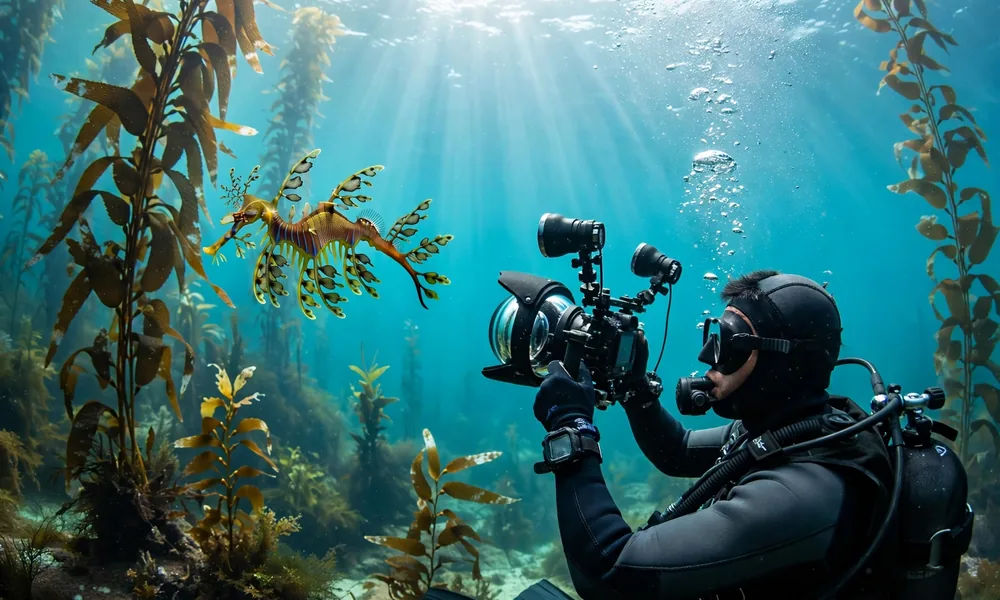
The best hours are the morning and the late afternoon, when the leafy seadragons are feeding actively and the light is good for seeing them. From about eight o’clock until eleven, and again from about three until five, the seadragons are out in the kelp, drifting with the current and snapping at shrimp, and they are at their most approachable then. A slow dive over a kelp forest, with the sun behind you and a guide who knows the reef, is all you need, and the fish will often come close enough to see the lobes and the long snout clearly, if you move gently and keep your distance.
Staying safe around leafy seadragons
A leafy seadragon is not dangerous to people, and there is no safety warning that belongs to the fish itself. It has no venom, it does not bite, and it will not chase or threaten a diver. The safety rules for watching leafy seadragons are the rules of the reef and the sea: watch the water, watch the weather, and respect the kelp that the fish depends on. Never touch a seadragon, never grab at the kelp to steady yourself, and never kick the reef with your fins, because a single careless kick can break kelp that took years to grow, and a broken reef is a reef that hides fewer fish.
There are a few practical points for the water itself. Dive with a buddy, stay within your depth, and keep an eye on the current, which can be stronger on the reef edge than it looks from the surface. Listen to your dive guide about where to enter and exit the water, and keep clear of the boat’s propeller. A leafy seadragon will not hurt you, but the sea can, and the sensible approach is to enjoy the fish and respect the water they live in.
Leafy seadragon watching checklist
A little preparation turns a dive over a kelp forest into a real chance of seeing leafy seadragons at their best, drifting in the kelp in clear, cool water.
- A visit in summer, when the seas are calm and the visibility on the reef is at its best.
- A morning or late-afternoon dive, when the leafy seadragons are out feeding and the light is good.
- A kelp forest or seagrass meadow in southern Australia, where the fish feed and shelter.
- A slow dive that follows the kelp edge, watching for a small, leafy shape drifting upright in the fronds.
- A dive guide who knows the reef, and can point out a seadragon you would swim straight past.
- A camera with a good macro lens, so that you can photograph the seadragon without touching it.
- Respect for the reef and its fish, keeping your distance, never touching the kelp, and leaving the reef as you found it.
Frequently asked questions
How big do leafy seadragons get?
Most leafy seadragons measure between 20 and 24 centimetres from snout to tail, and they are light for their length, with a body made of bony rings rather than muscle and flesh. The weedy seadragon is larger, usually 30 to 45 centimetres, and the ruby seadragon is about 23 centimetres long. They are small fish by reef standards, and their slender, upright body makes them look larger than they are among the kelp.
What do leafy seadragons eat?
A leafy seadragon eats mysid shrimp, small amphipods, tiny crabs and the larvae of other crustaceans, sucking its food in through its long, tubular snout. It feeds all day, in small mouthfuls, taking dozens of small animals in a day, and it must feed so often because it has no stomach, and it digests its food as it passes through its gut. A seadragon that has stopped feeding is usually a fish in trouble, because it has nowhere else to turn.
Do male leafy seadragons carry the eggs?
Yes, the male leafy seadragon carries the eggs on the underside of his tail, where the female glues them in neat rows on a brood patch. He may carry a few hundred of them at a time, and he fans them with his fins and keeps them clean until they hatch after several weeks. The young emerge as tiny, perfect copies of their parents, only a few centimetres long, and they are independent from the moment they hatch.
Are leafy seadragons dangerous?
No, leafy seadragons are not dangerous to people. They have no venom, they do not bite, and they will not chase or threaten a diver. Their whole defence is built on being hard to see, hard to catch and hard to swallow, and their first response to a threat is to freeze or to drift down into the kelp. The safety rules for watching them are the rules of the reef itself: watch the water, watch the current, and never touch the kelp.
Can you keep a leafy seadragon in an aquarium?
You can, but it is hard, and most people should not try. Leafy seadragons are protected by law in Australia, and they cannot be collected or exported without a permit. They need a large tank, clean cool water and a constant supply of live mysid shrimp, which is hard to provide, and many of them starve in captivity. A seadragon belongs in a kelp forest, not in a living room.
How is this guide different from the largemouth bass guide?
This guide covers the leafy seadragon, a small, gentle sea fish of 20 to 24 centimetres that drifts through kelp forests off southern Australia and hides by pretending to be seaweed, while our largemouth bass guide covers a freshwater predator of 40 to 60 centimetres that hunts by ambush in weedy lakes and guards a nest in the shallows each spring. One is a shy drifter you watch on a dive in cool Australian water; the other is a leaping hunter you watch from the bank of a warm North American lake.
Conclusion
The leafy seadragon species is a reminder that a fish does not need to be large to be unforgettable. A slender body, a long snout, a coat of leafy lobes and a male that carries the eggs on his tail have made the leafy seadragon one of the best-known fish in Australia, at home in a kelp forest off South Australia, a seagrass meadow in Victoria and a rocky reef in Western Australia alike.
If you go looking for one, go on a calm, clear day in summer, go in the morning or the late afternoon, and dive slowly over a kelp forest with the sun behind you. Find the kelp edge, watch for a small, leafy shape drifting upright in the fronds, and wait for the fish to turn sideways in the light, and you will have met the leafy seadragon that turns a reef into a garden.