The lungfish species are the oldest fish still swimming, animals that were already old when the first dinosaurs appeared and that have barely changed since. If you are asking what a lungfish is, the short answer is a freshwater fish with lungs as well as gills, a long eel-like body, and paddle-shaped fins, one of only six living species in a lineage about 400 million years old. It lives in the slow rivers and swamps of Africa, South America and Australia, it can breathe air at the surface, and the African kinds can sleep buried in dry mud for months, or even years, waiting for the rain to return.
Most people hear the word lungfish and picture a curiosity, a fish out of time, and in a way that is fair. A lungfish looks like a fish that has not quite decided what it wants to be. It has the scales and the fins of a fish, and the lungs of a land animal, and it uses both, breathing water through its gills when the river is full and gulping air at the surface when the water turns stale and warm. That double life is the reason the lungfish is still here, and it is the reason scientists study it so closely, because the lungfish is the closest living relative we have to the fish that first crawled onto land.
Key takeaways
- The lungfish species number just six in the world: one in Australia, one in South America, and four in Africa.
- Lungfish have true lungs as well as gills, and the African and South American kinds must breathe air at the surface to survive.
- African lungfish can aestivate, sleeping in a mucus cocoon in dry mud for months, and in some cases for years, until the rains return.
- The lineage is about 400 million years old, and the Australian lungfish is the closest living link to the fish that first moved onto land.
- The Australian lungfish is listed as Endangered by the International Union for Conservation of Nature, while most African and South American kinds are listed as Least Concern.
The lungfish species and its relatives
Lungfish belong to the group Dipnoi, the double-breathers, and they sit in a place of their own in the fish family tree, between the ray-finned fishes that fill the seas and the lobe-finned fishes that gave rise to land animals. The six living species fall into three families. The Australian lungfish, Neoceratodus forsteri, is the only member of the Neoceratodontidae, and it lives only in the Mary and Burnett rivers of south-eastern Queensland. The South American lungfish, Lepidosiren paradoxa, is the only member of the Lepidosirenidae, and it lives in the swamps of the Amazon and Parana basins. The four African lungfish, all in the genus Protopterus, make up the Protopteridae, and they live in the rivers, lakes and swamps of West, East, Central and Southern Africa.
The split between the three families is old, and the differences between them are easy to see once you know them. The Australian lungfish is the most fish-like of the six, with a heavy body, large overlapping scales, broad paddle fins and a single lung, and it relies mostly on its gills, gulping air only when the oxygen in the water runs low. The African and South American kinds are more eel-like, with small scales, long thin fins that look like threads, and paired lungs, and they are true air-breathers that must come to the surface to gulp air or they will drown. That difference matters, because it is the African and South American kinds that can aestivate, and the Australian kind that cannot.
| Type | Animal | Where it lives | Best-known food | Length or Weight |
|---|---|---|---|---|
| Family | Lungfishes (Dipnoi) | Fresh waters of Africa, South America and Australia | Fish, molluscs and crustaceans | About 1 m to 2 m long |
| Genus | African lungfishes (Protopterus) | Rivers and swamps of Africa | Fish, frogs and molluscs | About 1 m to 2 m long |
| Species | Australian lungfish (Neoceratodus forsteri) | Mary and Burnett rivers, Queensland | Fish, frogs, molluscs and crustaceans | About 1 m to 1.5 m long, up to about 40 kg |
| Species | Marbled lungfish (Protopterus aethiopicus) | Lakes and rivers of East and Central Africa | Fish, molluscs and crustaceans | Up to about 2 m long |
| Species | West African lungfish (Protopterus annectens) | Swamps and rivers of West and Central Africa | Fish, frogs and molluscs | About 1 m long |
| Species | South American lungfish (Lepidosiren paradoxa) | Swamps of the Amazon and Parana basins | Fish, molluscs and crustaceans | About 1 m to 1.25 m long |
The marbled lungfish is the largest of the six, growing to about 2 metres long in the lakes and rivers of East and Central Africa, and it is the one most often caught for food. The West African lungfish is smaller, about 1 metre long, and it is the one scientists study most, because it is the best at aestivation. The South American lungfish grows to about 1.25 metres, and it lives in the swamps of the Amazon and the Parana, where the water rises and falls with the seasons.
What sets the lungfish apart from every other fish is the lung itself. A lungfish lung is not a swim bladder with a new job. It is a true lung, with the same shape and the same blood supply as the lung of a land animal, and it opens into the throat through a duct that works like a windpipe. The Australian lungfish has one lung, and the African and South American kinds have two. The salmon has a swim bladder and nothing more, and it would drown in air in minutes, while a lungfish can breathe air for hours, and the African kinds can breathe it for years without ever touching water.
What a lungfish looks like
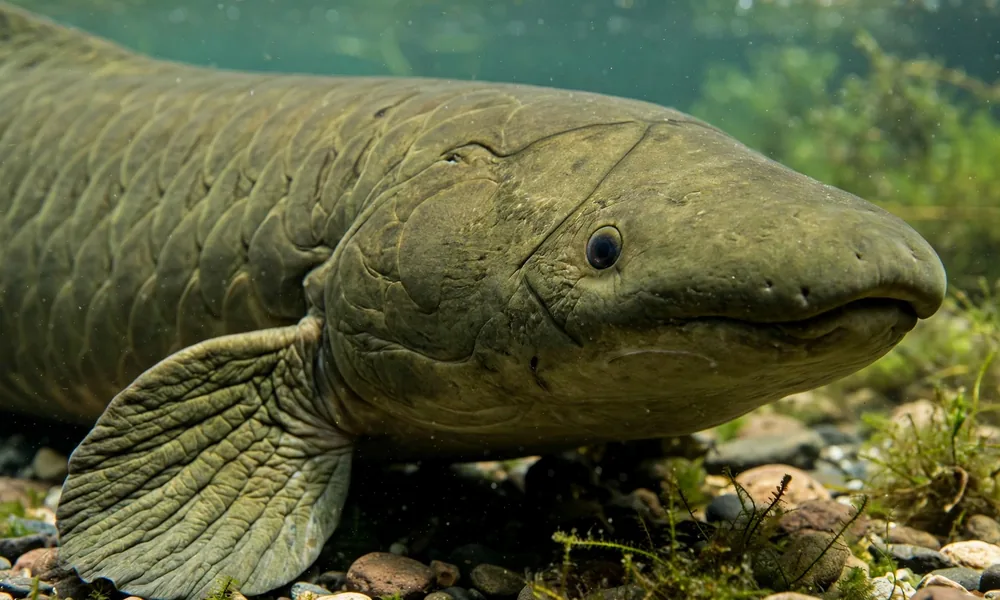
A lungfish looks like a fish that time forgot. The body is long and eel-like, with a heavy head, a blunt snout, and a tail that tapers to a point, and the whole animal moves with a slow, wriggling stroke that suits its life in still water. The Australian lungfish is the stoutest of the six, about 1 to 1.5 metres long and up to about 40 kilograms, with a laterally flattened body, large overlapping scales the size of coins, and a back that is olive-green or brown, fading to a pale yellow belly. The African and South American kinds are slimmer and longer, with small scales that are hard to see, and a back that is dark grey or brown, often with spots and marbling that give the marbled lungfish its name.
The fins are the feature that gives the lungfish away. The Australian lungfish has two pairs of broad, fleshy, paddle-shaped fins, one pair on the chest and one pair on the belly, and the paddles are supported by a single bone down the middle, like the limb of a land animal. The African and South American kinds have fins that are long and thin, like threads or whips, and they use them less for swimming than for feeling their way through murky water and mud. The tail is a single fin that runs around the end of the body, joining the dorsal, the caudal and the anal fins into one long, continuous fringe, and the whole animal looks less like a fish than like a salamander that never left the water.

Young lungfish look different from their parents, and the difference is most striking in the African and South American kinds. A young lungfish has feathery external gills, like the gills of a tadpole, sticking out from the sides of its head, and it breathes through them until its lungs are ready. The gills are lost as the fish grows, and the adult breathes through its internal gills and its lungs, but the young fish is a reminder of how the animal begins. The Australian lungfish is different again: its young have no external gills, and they look like small, pale versions of their parents from the start, with the same large scales and the same paddle fins.
There is one more thing about the lungfish’s looks that matters, and it is the teeth. A lungfish does not have the sharp, pointed teeth of a hunter. It has broad, flat tooth plates on the roof of its mouth and on its lower jaw, like millstones, built for crushing snails, clams and crustaceans. The teeth grow throughout the animal’s life, and they wear down and are replaced as the fish grinds its food. The teeth are the tool of a slow, deliberate eater, and they suit an animal that has never been in a hurry.
Where lungfish live
Lungfish live in slow, warm, fresh water, in a band that runs through the tropics and subtropics of three continents. The Australian lungfish lives only in south-eastern Queensland, in the Mary and Burnett rivers and their tributaries, and its natural home is small, and it is the smallest range of any lungfish. The African lungfish live across the continent, from the swamps of West Africa to the lakes of East Africa and the rivers of the Congo basin, and the South American lungfish lives in the swamps of the Amazon and Parana basins and the Chaco region, where the water rises and falls with the seasons.

The habitat a lungfish chooses is slow, warm and still, and that is what makes it different from most fish. It likes water that is warm, shallow and full of plants, in rivers, lakes, swamps and floodplains, where the water is often low in oxygen and the bottom is soft mud. It is not a fish of the fast river, and it is not a fish of the open lake. It is a fish of the edge, where the water meets the land, and it is happiest where the water is too warm and too still for most other fish to live.

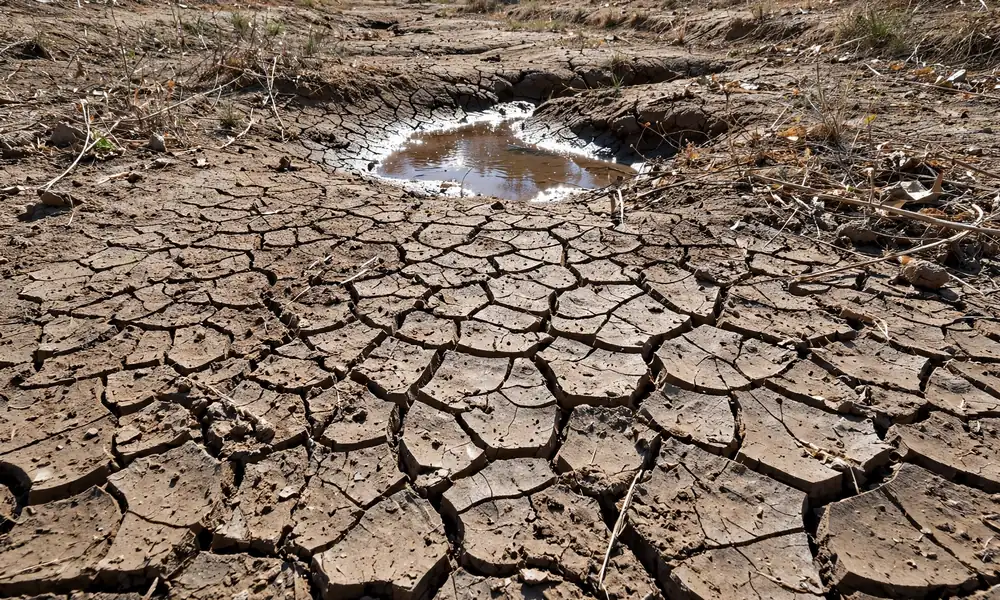
The swamp is the heart of the story for the African and South American kinds. In the wet season the swamp is full of water, and the lungfish feed and breed in the shallows, among the reeds and the water lilies. In the dry season the water shrinks, and the swamp becomes a patch of mud, and the lungfish dig into the mud, make a chamber, and go to sleep. The chamber is lined with mucus, which hardens into a cocoon, and the fish breathes air through a small hole at the top, and it waits. The wait can last for months, and in the West African lungfish it can last for years, and the fish wakes only when the rain returns and the water seeps into the mud.
The range is set by water as much as by temperature. Lungfish stay in fresh water, and they cannot cross the sea, which is why they are found on three continents that were once joined, and nowhere else. The Australian lungfish is the most restricted, because it lives in just two river systems, and a dam or a drought can cut it off from the places it needs. The African kinds are more widespread, and they can survive a drought by sleeping in the mud, but they are still tied to the water, and they still need the swamp to flood every year.
What lungfish eat
Lungfish are slow, deliberate eaters, and they eat the animals of the mud. The everyday diet is molluscs and crustaceans: snails, clams, freshwater prawns and crabs, and any other shelled animal that can be crushed between the tooth plates. They also eat small fish, frogs, tadpoles and worms, and they will take plant matter, seeds and fallen fruit when the water is low and the animals are scarce. The heart of the diet is the shelled animal, and the hunting is done at night, in the dark, on the bottom.

The feeding style is a mix of patience and power, and it is built around the animal’s sense of smell in murky water. A lungfish will cruise slowly along the bottom, nosing through the mud and the plants, and it will seize a snail or a crab in its jaws and crush it. The tooth plates are strong enough to crack a shell, and the fish will grind the food and spit out the fragments, swallowing only the soft flesh inside. The Atlantic cod hunts in open water with its eyes, but the lungfish hunts in the dark with its nose, and it does not need to see its food to find it.
Young lungfish eat smaller food than adults do, because they hunt in the shallows where the prey is small. A young lungfish will eat small worms, insect larvae and tiny crustaceans among the plants. Adults eat bigger prey, and a big lungfish on a riverbed may take a large snail, a crab or a frog in a single meal. Like the alligator gar, a lungfish is an opportunist first and a specialist second, and it takes what the water offers, but it does it slowly, at night, and on the bottom.
Feeding is tied to the seasons and to the water. Lungfish feed most in the wet season, when the water is high and the swamp is full of food, and they feed hard before the dry season comes, building up fat for the long sleep. In the dry season they stop feeding altogether, and a lungfish in aestivation may go for months, or even years, without eating a thing. A lungfish that has fed well can go for weeks without another meal, and it will not waste energy chasing prey it cannot catch.
How lungfish behave
Lungfish are mostly solitary, mostly nocturnal, and mostly slow, and those three habits shape almost everything they do. By day they rest on the bottom, often alone, in the shade of a log or a bank, and at night they become active, moving slowly through the shallows to feed. They are not schooling animals. Two adults in the same swamp will mostly ignore each other, except in the breeding season. The Australian lungfish is the most social of the six, and it will gather in small groups in a deep pool, but even it is a quiet animal, and it does not play.
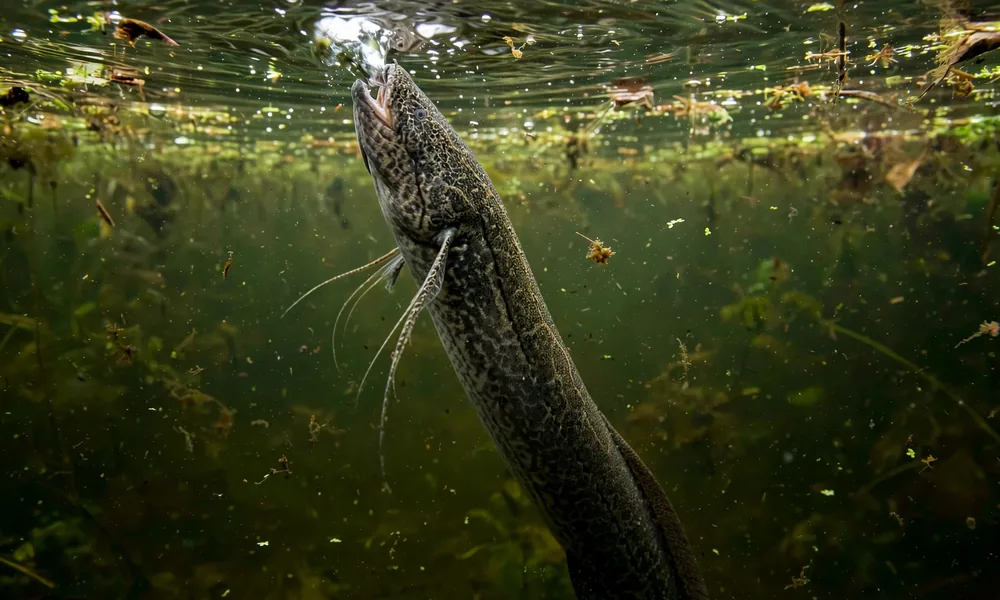
The behaviour that has made the lungfish famous is its breathing. Most fish never leave the water, but a lungfish will rise to the surface every few minutes, poke its snout out, and gulp a mouthful of air, and then sink back down to the bottom. The African and South American kinds must do this to survive, because their gills are small and their lungs do the work, and a fish that is kept underwater will drown, just as a land animal would. The Australian kind breathes air only when the water is low in oxygen, but on a hot, still day it will rise to the surface too, and gulp, and sink again.
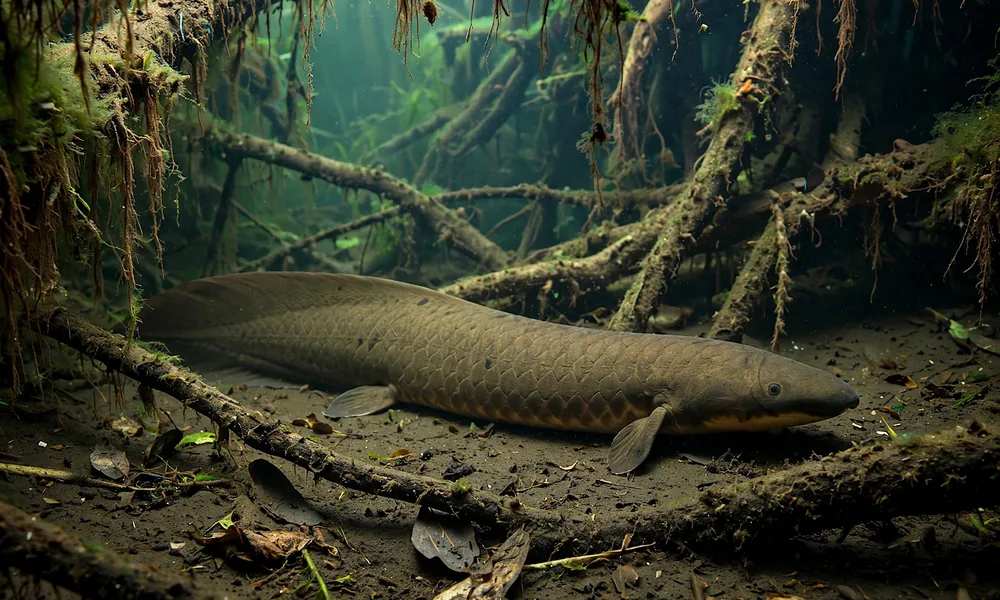
Lungfish are also famous for what they have taught us about the move onto land. The lungfish is the closest living relative we have to the fish that first crawled out of the water, and its fins, its lungs and its skull all carry the marks of that journey. The paddle fins of the Australian lungfish are built like the limbs of a land animal, with a single bone down the middle, and the lungs are built like the lungs of a frog. Studying a lungfish is as close as we can come to watching that journey happen, and it is one of the reasons the animal is protected in Australia.
Breeding and life cycle
Lungfish breed in the wet season, when the water is high and the swamp is full of food, and the timing is set by the rain. The Australian lungfish spawns in spring, from August to November, when the water is warm and the plants are growing, and the female lays her eggs among the water plants in shallow water. The African and South American kinds spawn when the floods come, and the males dig nests in the mud, and the females lay their eggs in the nest, and the males guard them. The eggs are large for a fish, about the size of a pea, and they are laid in small numbers, and they hatch in one to four weeks, depending on the species and the temperature of the water.
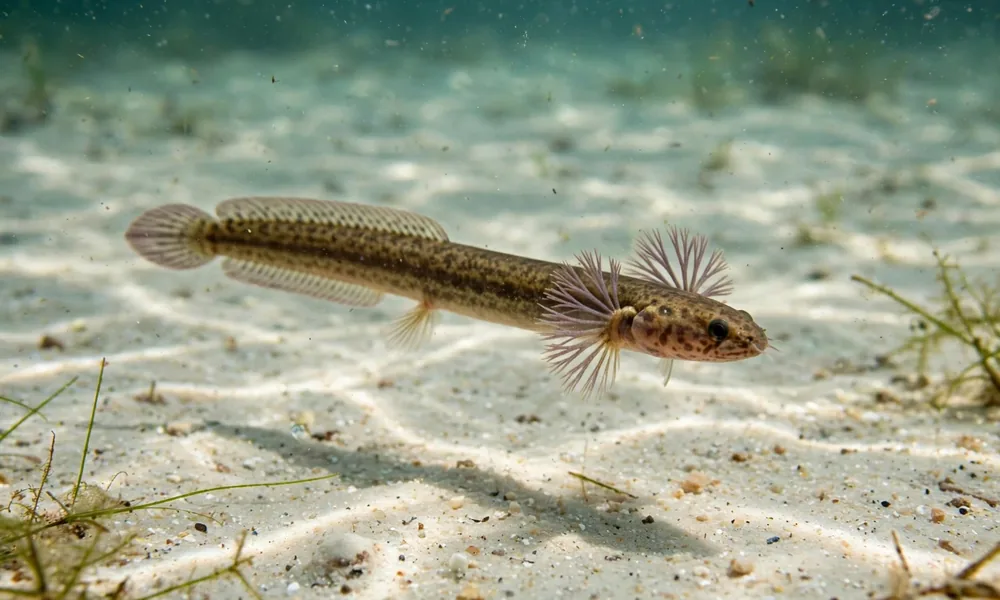
The young are born small and helpless, and they stay in the nest for their first days, feeding on the yolk of the egg and then on tiny animals among the plants. The male South American lungfish guards the nest, and during the breeding season he grows feathery, gill-like structures on his pelvic fins, which carry oxygen from his blood into the nest water for his young, a habit no other fish is known to share. The African males guard their nests too, and they will drive off anything that comes too close. There is no care after the young leave the nest. The parents swim away, and the young are on their own, feeding on small worms and crustaceans in the shallows.
The young grow slowly, and they stay in the shallows for their first years, growing fast on the small animals of the plants, and they move into deeper water only when they are big enough to look after themselves. A lungfish reaches breeding size at about 15 to 20 years old for the Australian kind, and at about 3 to 5 years old for the African and South American kinds, when it is close to full length. The sex of a young lungfish is set by its genes, not by the temperature of the water, and the ratio of males to females is roughly even.
A lungfish that survives its first years can live a very long time. The Australian lungfish is the longest-lived of the six, with wild fish living for 50 to 100 years, and one famous animal, known as Granddad, lived for 84 years in captivity at the Shedd Aquarium in Chicago before his death in 2017, with scientists estimating his true age at about 109 years. The African and South American kinds live shorter lives, with the West African lungfish living for about 18 years in captivity, and unconfirmed reports reaching 30 years in the wild.
Aestivation is the last great event of the cycle, and it is the one that researchers find most remarkable. As the swamp dries, the African lungfish digs into the mud, makes a chamber, and lines it with mucus, which hardens into a cocoon, and the fish curls up inside and goes to sleep. Its heart rate falls from about 25 beats a minute to as low as 2 beats a minute, its metabolism slows to a crawl, and it converts its waste into urea, which is less toxic than the ammonia a fish normally makes. The wait can last for months, and in the West African lungfish it can last for up to five years, and the fish wakes only when the rain returns. The South American kind sleeps too, but for only three or four months, and it makes no cocoon, and the Australian kind does not sleep at all.
Conservation status
The Australian lungfish is listed as Endangered by the International Union for Conservation of Nature, and the reasoning is straightforward: it lives in just two river systems, it takes 15 to 20 years to start breeding, and it lays its eggs in small batches, so it cannot replace lost adults quickly, and a river that is dammed or polluted takes years to recover. The African and South American kinds are listed as Least Concern, because they are widespread and still common in many places, but their numbers are falling in others.

The main pressure is the loss of habitat. Dams block the rivers the Australian lungfish needs to spawn, and they change the flow of the water so the eggs are laid in the wrong places, or not laid at all. Pollution from farming and mining fouls the water, and the weeds that choke the rivers smother the plants the eggs need. In Africa, the swamps are drained for farming and building, and the fish are caught for food. In some places lungfish are killed because they are seen as strange, even when they are harmless.
The most useful conservation work is practical, and much of it is done in the rivers. Protecting the Mary and Burnett rivers, keeping the water clean and the flow natural, and setting aside reserves where the fish can feed and breed without nets all make a real difference. In Australia the lungfish is protected by law, and it cannot be caught without a permit, and the research on its breeding has shown where the fish spawn and where they are most at risk, and that knowledge lets managers set rules that protect the animals without closing the river to everyone.
Best seasons for lungfish watching
The best time to look for a lungfish is the wet season, when the water is high, the swamp is full of food, and the fish are feeding and breeding in the shallows. The Australian lungfish spawns in spring, from August to November, when the water is warm and the plants are growing, and that is the best season of all, because the fish are in the shallows, among the water plants, and they are easier to see from a bank or a boat than they are in the deep river.
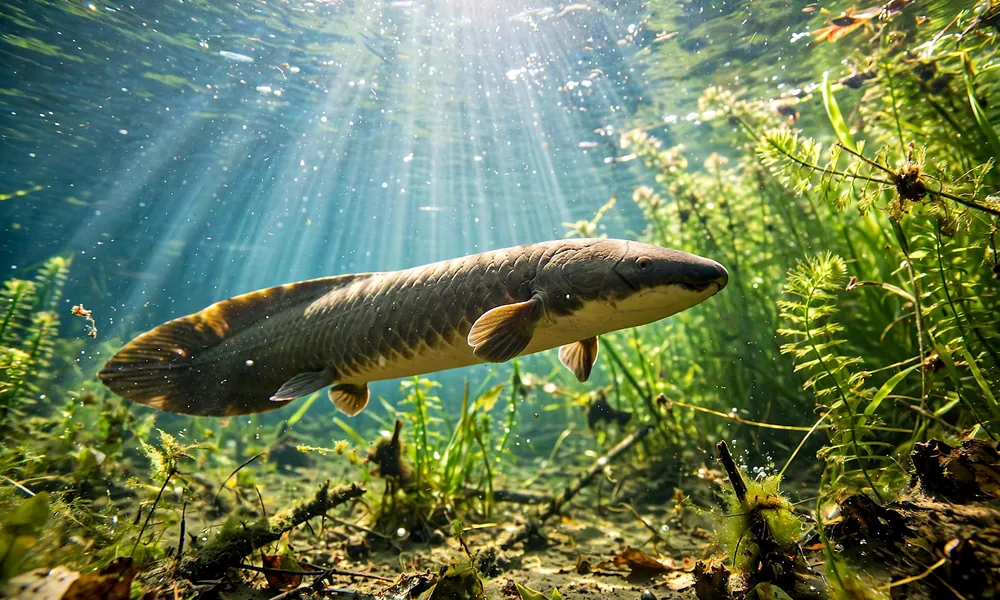
The best hours are the early morning and the late afternoon, when the light is low and the fish come into the shallows to feed. A calm, warm morning after a still night is ideal: the water is flat, the fish are moving, and a long shape under the surface is easier to spot than it is at midday, when the sun is high and the fish slip into deeper water. By the dry season the swamps are empty, and the fish are asleep in the mud until the rain returns.
Staying safe around lungfish
A lungfish is a wild animal that deserves real respect, and the safety rules are mostly about not putting yourself where it lives, and not handling it. The fish does not chase people, and most encounters end with the fish swimming away, but it is large and strong, and it has broad tooth plates that can crush a snail, and a bite would be painful. The rule is simple: do not wade in murky water where you cannot see the bottom, do not put your hands into a nest or a burrow, and do not try to pick up a lungfish.
Do not disturb a lungfish that is aestivating, because the fish is in a deep sleep and it cannot defend itself, and waking it in the dry season may kill it. If you find one in the mud, leave it alone and walk away. If you are fishing in a river where lungfish live, use a barbless hook, and if you catch one, wet your hands, support the fish, and release it quickly. If you are bitten, wash the wound, apply pressure, and seek medical help at once.
Lungfish watching checklist
A little preparation turns a trip to a slow river into a real chance of seeing one of these ancient, air-breathing fish.
- A visit in the wet season, or in spring for the Australian lungfish, when the fish are feeding and breeding in the shallows.
- An early morning or late afternoon start, when the animals are feeding in the shallows in the low light.
- A slow, warm river, lake or swamp, with water plants, submerged logs and plenty of snails and crustaceans for the fish to eat.
- A slow walk along the bank that scans the water surface, watching for a snout breaking the surface to gulp air, or a long shape below.
- Binoculars and polarised sunglasses, which cut the glare and let you see a fish under the surface from a distance.
- A reputable local guide, who knows the water, the seasons and the fish, and who keeps you at a safe distance.
- Respect for the animal and its ground, keeping your distance, never digging up a sleeping fish, and leaving the rivers and swamps as you found them.
Frequently asked questions
How many lungfish species are there?
There are six living lungfish species in the world: one in Australia, the Australian lungfish, one in South America, the South American lungfish, and four in Africa, all in the genus Protopterus. The lineage is about 400 million years old, and the six species are all that is left of a group that was once found all over the world.
Can lungfish really breathe air?
Yes. A lungfish has true lungs as well as gills, and the African and South American kinds must come to the surface to gulp air or they will drown. The Australian kind has a single lung and relies mostly on its gills, gulping air only when the oxygen in the water runs low, but on a hot, still day it will rise to the surface too.
How long can a lungfish sleep in the mud?
An African lungfish can aestivate, sleeping in a mucus cocoon in dry mud, for months at a time, and African lungfish have been recorded sleeping for up to five years. During the sleep its heart rate falls to as low as 2 beats a minute, and it lives off its fat reserves until the rain returns.
What do lungfish eat?
A lungfish eats molluscs and crustaceans such as snails, clams, prawns and crabs, as well as small fish, frogs, tadpoles and worms. It crushes the shells between the broad, flat tooth plates in its mouth, swallowing only the soft flesh inside, and it hunts mostly at night, on the bottom, using its sense of smell.
How long do lungfish live?
The Australian lungfish is the longest-lived of the six, with wild fish living for 50 to 100 years, and one animal, known as Granddad, lived for 84 years in captivity before his death in 2017, with scientists estimating his true age at about 109 years. The African and South American kinds live shorter lives, with the West African lungfish living for about 18 years in captivity.
How is this guide different from the lemon shark guide?
This guide covers the lungfish, a slow, ancient freshwater fish that breathes air, crushes snails between its tooth plates, and can sleep in dry mud for years, while our lemon shark guide covers a large yellow shark of warm coastal waters that hunts fish over sand flats, gathers in social groups, and returns to the mangrove lagoon where it was born to give birth. One is a quiet survivor of the swamp that has barely changed in 400 million years; the other is a fast, live-bearing hunter of the tropics.
Conclusion
The lungfish species are a reminder that survival is not always about being the fastest or the strongest. A long, eel-like body, a pair of lungs, a habit of breathing air at the surface, and a capacity to sleep in dry mud for years have kept the lungfish alive for about 400 million years, through extinctions that wiped out the dinosaurs and most of the animals that lived alongside them. It is the closest living link we have to the fish that first moved onto land.
If you go looking for one, go in the wet season, go in the early morning, and take a walk along a slow river with a good local guide and a pair of polarised sunglasses. Watch the surface for a snout breaking the water to gulp air, keep a respectful distance, and leave the fish exactly as you found it, and you will have met one of the oldest animals on earth.