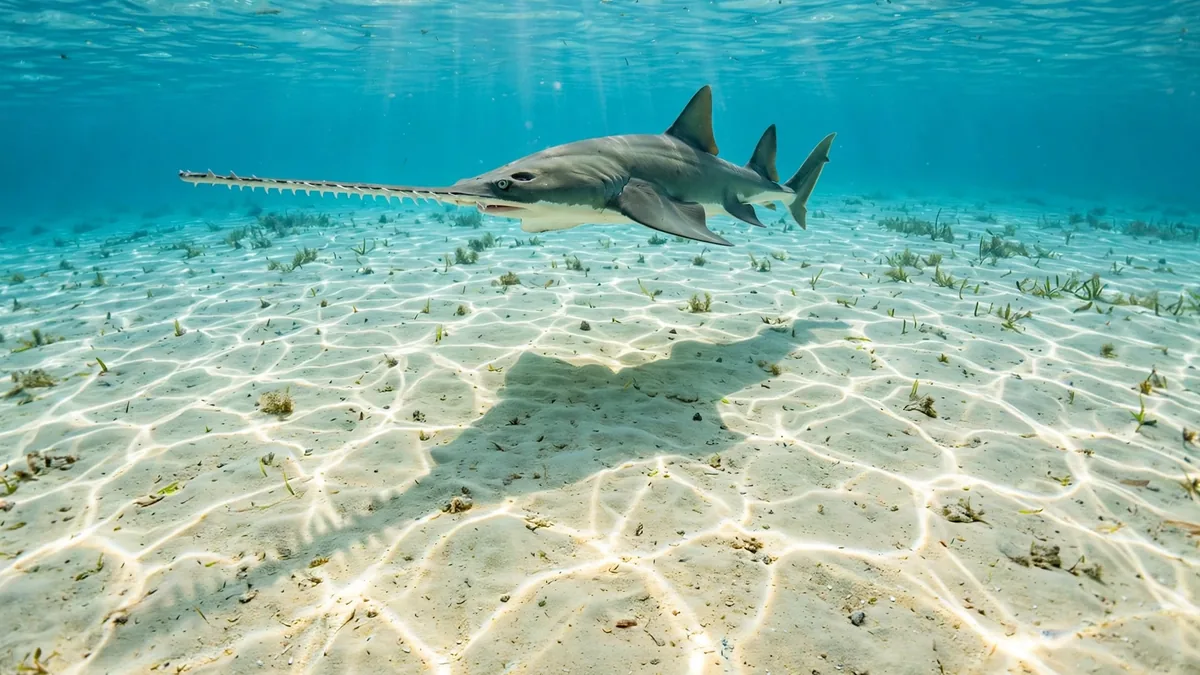
The sawfish species are the strangest-looking large fish in the sea, and the first thing anyone asks about them is always the same: what is that saw for? The short answer is that a sawfish is a giant ray with a long, flat, tooth-lined snout called a rostrum, and it uses that saw as a sensor, a club and a shovel, sweeping it through schools of fish, raking it across the seabed and pinning prey to the sand. There are five living sawfish species in the world, all of them large, all of them rare, and the biggest of them, the largetooth sawfish, can grow to about 7 metres long, which is longer than most family cars.
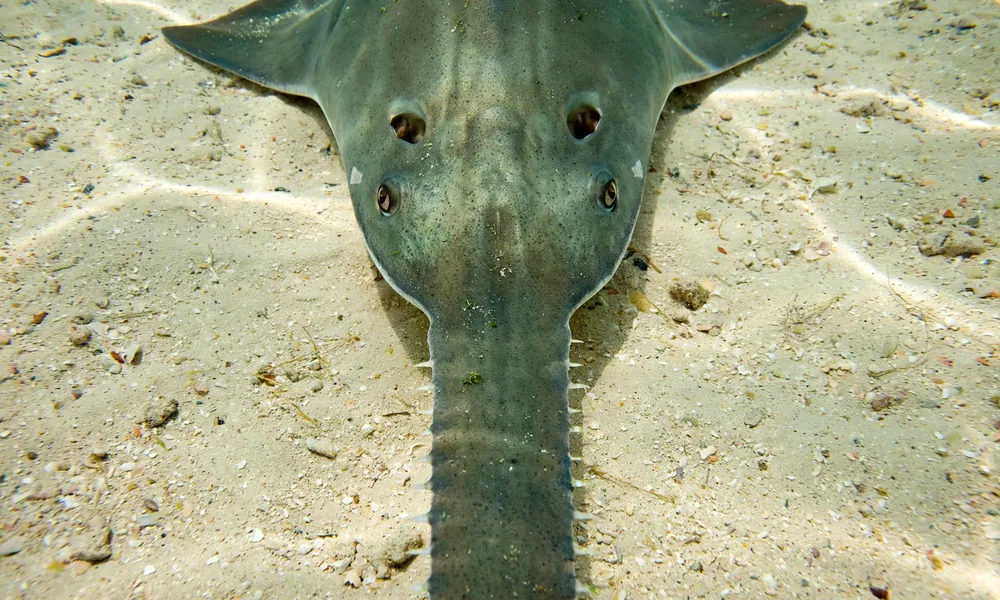
I first understood what a sawfish really is when I stopped thinking of it as a shark with a saw on its face. It looks like a shark from above, long and grey and powerful, but flip it over and the truth is plain: the five pairs of gill slits sit on its underside, and its broad pectoral fins are fused to the sides of its head, which makes it a ray, not a shark at all. That is the heart of this guide: how five species of ray came to carry the most extraordinary tool in the ocean, how they live between the sea and the river, and why they have all but vanished from most of their old range.
Key takeaways
- The sawfish species are five living species of giant ray in the family Pristidae, all of them recognised by the long, flat, tooth-lined rostrum they carry on the front of the head.
- The largetooth sawfish is the largest of the five, reaching about 7 metres long and 500 to 600 kilograms, though most sawfish seen today measure 2 to 2.5 metres.
- A sawfish is a ray, not a shark: its gill slits sit on its underside and its pectoral fins are fused to its head, even though its body looks shark-like from above.
- The rostrum is both a sensor and a weapon, packed with electroreceptors that detect the faint electric fields of hidden prey, and it is used to slash, rake and pin food.
- All five sawfish species are endangered or critically endangered, threatened by fishing, bycatch and the loss of the shallow coastal waters they depend on.
The sawfish species and their relatives
Sawfish belong to the family Pristidae, a small family of rays that has just five living species in two genera, and it took scientists until 2013 to settle that number for certain. For decades the family was a muddle of names, with the same fish described under several different names in different oceans, until careful work on their shape and their genes showed that there are only five: the largetooth, the smalltooth, the green and the dwarf sawfish in the genus Pristis, and the narrow sawfish, the only member of the genus Anoxypristis. Across the family the five species run from about 3.2 to 7 metres in length, which makes sawfish among the largest of all rays, and every one of them carries the same unmistakable saw. If you go looking for a single-species profile of the animal, National Geographic files its account under the name largetooth sawfish, which is the species this guide leads with.
The largetooth sawfish, Pristis pristis, is the lead species of this guide, and it is the most widespread of the five, or at least it was. It once ranged through the tropical and subtropical waters of the Atlantic, the eastern Pacific and the Indo-West Pacific, and it is the only sawfish that regularly swims far up rivers, having been recorded 1,340 kilometres from the sea. It grows to about 7 metres long, it is most at home in shallow estuaries and river mouths, and it is the species that most people picture when they hear the word sawfish. A largetooth sawfish is a grey-green giant with a saw that can be a quarter of its whole body, and when you see one resting on the sand in a clear estuary, it looks less like a fish and more like something left over from an older world.
| Type | Animal | Where it lives | Best-known food | Length or Weight |
|---|---|---|---|---|
| Family | Sawfishes (Pristidae) | Tropical and subtropical coastal waters worldwide | Fish, crustaceans and molluscs | About 3.2 m to 7 m long |
| Genus | Sawfishes (Pristis) | Tropical and subtropical coastal waters worldwide | Fish, crustaceans and molluscs | About 3.2 m to 7 m long |
| Species | Largetooth sawfish (Pristis pristis) | Tropical Atlantic, eastern Pacific and Indo-West Pacific, including rivers | Fish, crustaceans and molluscs | About 2 m to 7 m long |
| Species | Smalltooth sawfish (Pristis pectinata) | Western Atlantic, now mainly Florida | Fish, crabs and shrimp | Up to about 5.5 m long |
| Species | Green sawfish (Pristis zijsron) | Indo-West Pacific and northern Australia | Fish, crabs and shrimp | Up to about 7 m long |
| Species | Dwarf sawfish (Pristis clavata) | Coastal waters of northern Australia | Fish and small crustaceans | Up to about 3.2 m long |
The closest relatives of the sawfish are not sharks at all, but the other rays of the order Rhinopristiformes, which includes the guitarfish, the wedgefish and the banjo rays, all of them flat-bodied fish with shark-like tails. Like the shark, a sawfish is a cartilaginous fish with a skeleton of cartilage rather than bone, but the shark carries its gill slits on the sides of its head and swims in open water, while the sawfish carries its gills underneath and spends its life close to the seabed, which is the ray way of doing things.
Within the family, the species sort themselves by their saws. The largetooth has 14 to 21 rostral teeth on each edge of its saw, and its first dorsal fin starts clearly in front of its pelvic fins, which is the quickest way to tell it from the smalltooth. The smalltooth has 23 to 34 teeth on each edge, a narrower saw and a dorsal fin that starts above the pelvic fins. The green sawfish has the longest rostrum of any living species, the dwarf is the smallest of the five, and the narrow sawfish is the odd one out, with flat, triangular rostral teeth instead of the peg-like teeth of the other four, and a saw that looks more like a knife blade than a carpenter’s tool.
What a sawfish looks like
A sawfish is a large, heavy-bodied fish, built like a shark in the back half and like a ray in the front. A largetooth sawfish can measure from about 2 to 7 metres in length, though most seen today are 2 to 2.5 metres, and the largest confirmed specimen, a West African fish, measured 7 metres, with large adults weighing 500 to 600 kilograms. The body is long and muscular, deepest just behind the head, and it tapers to a broad tail with a small lower lobe that helps the fish steer close to the bottom. The back is grey, greenish-grey or brownish, fading to a pale, almost white belly, and the skin is rough to the touch, covered in tiny denticles like the skin of a shark.
The head is broad and flat, and the rostrum is the feature that gives the fish its name. The saw is an extension of the skull, made of cartilage and covered in skin, and it can make up around a quarter of the animal’s total length, so a 7-metre sawfish can carry a saw nearly 1.8 metres long. Each edge of the saw is lined with sharp rostral teeth, and these are not true teeth at all but modified scales called denticles, which grow through the animal’s life and are not replaced if they are lost. The mouth sits underneath the head and holds small, crushing teeth for gripping prey, and the eyes sit on top of the head, set well back from the saw, with two spiracles behind them that draw water over the gills when the fish is resting on the bottom.
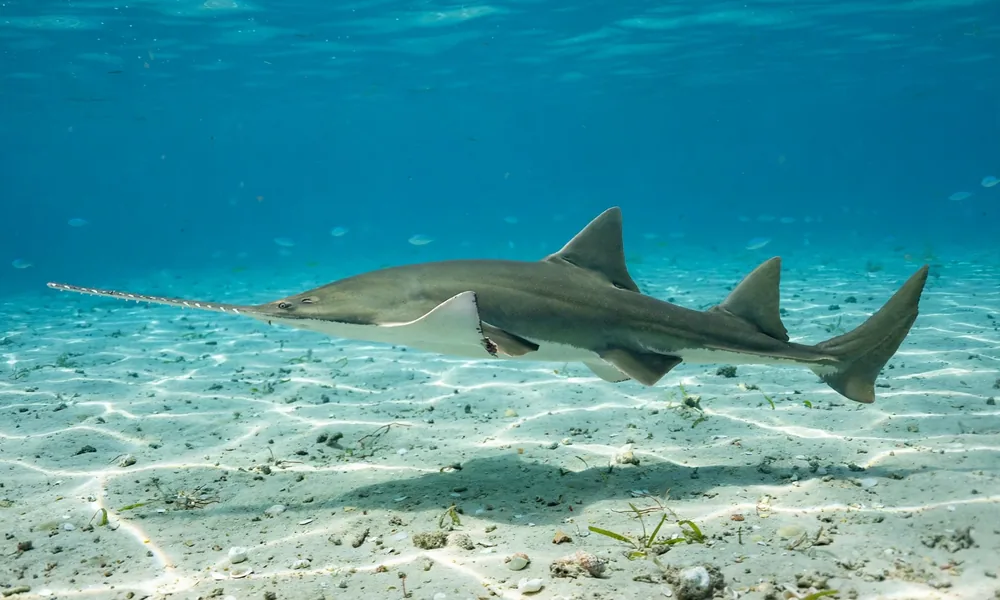
The colours change with the water the fish lives in. Sawfish in clear coastal water are greyer and paler, while fish in muddy estuaries and rivers are darker, sometimes almost brown, with a greenish tinge that helps them blend into the riverbed. Young sawfish are paler still, and their saws are soft and flexible at birth, with the teeth covered by a sheath that falls away soon after they are born, so the pup does not injure its mother on the way out.
Compared with its cousins, the largetooth is easy to tell apart once you know what to look for. The smalltooth sawfish is smaller, usually up to about 5.5 metres, with more rostral teeth and a narrower saw, and the green sawfish is a similar size to the largetooth but carries the longest rostrum of the five. Like the stingray, the sawfish is a ray that spends its life on the seabed, but the stingray is a flat disc with a whip-like tail and a venomous spine, while the sawfish is long and shark-shaped, with a saw on its face and no sting in its tail, a difference you can see at a glance.
Where sawfish live
Sawfish live in the warm, shallow waters of the tropics and subtropics, and they are at home in the sea, the estuary and the river alike. Their range runs through the coastal waters of the Atlantic, the eastern Pacific and the Indo-West Pacific, from the river mouths of West Africa to the mangrove coasts of northern Australia, and they favour water that is warm, shallow and rich in food. They are rarely found far from the coast, and most of them live in water less than 10 metres deep, though adults have been recorded down to about 25 metres. Wherever there is a warm estuary, a mangrove creek or a muddy river mouth, there is, or once was, a good chance a sawfish lived nearby.
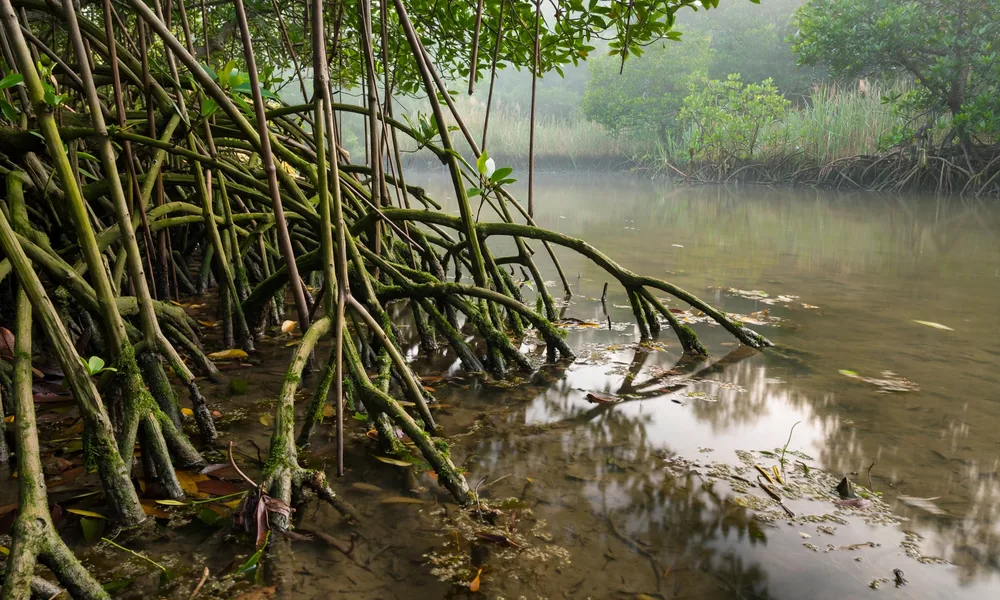
The habitat they choose is the edge of the water, and they are rarely found far from cover. Most sawfish live in water between 1 and 10 metres deep, along the mangrove edge, the mudflat and the river mouth, where the food is richest and the shelter is thickest. They favour soft, muddy or sandy bottoms, which they can rake with their saws, and they are less common on rocky reefs or in open water, where there is little to eat and nowhere to hide.
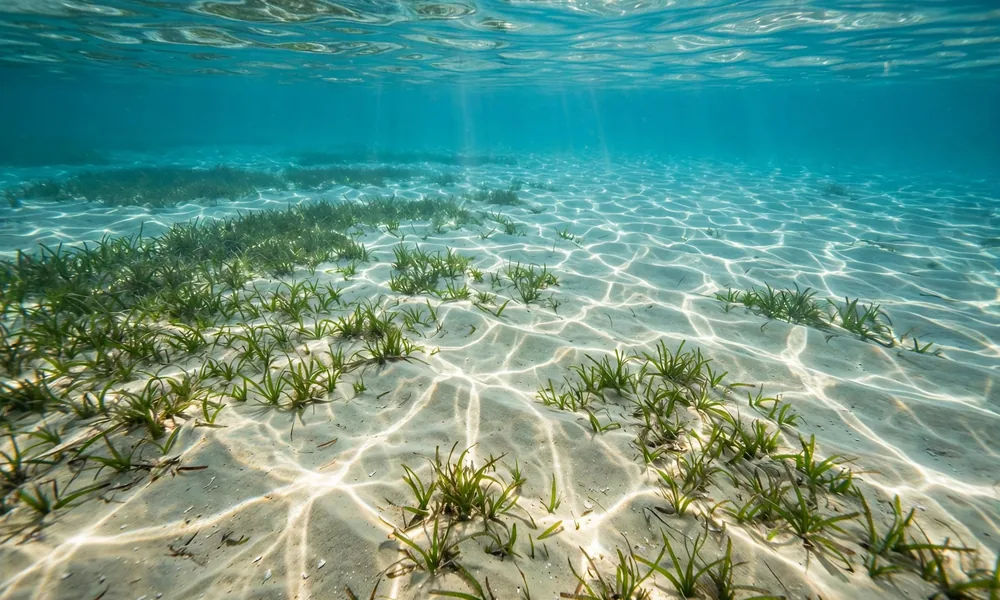
Depth matters, but not in the way it does for a deep-water fish. Sawfish are shallow-water animals, and most of them stay above 10 metres, where the sunlight reaches the seagrass and the water is warmest. Young sawfish spend their first years in the very shallowest water, in mangrove creeks and river mouths only a metre or two deep, where the big sharks that hunt them cannot easily follow. Adults move a little deeper, into estuaries and coastal bays, and they are also among the few large rays that swim far up rivers: largetooth sawfish have been recorded 1,340 kilometres from the sea, and the population in Lake Nicaragua appears to spend most, if not all, of its life in fresh water.
The sawfish has lost ground across its whole range, and it now survives in only two reliable strongholds: Florida in the United States and northern Australia. In Florida the smalltooth sawfish still breeds in the mangrove estuaries of the south-west coast, and in northern Australia the largetooth, green, dwarf and narrow sawfish all still swim in rivers and coastal waters that are among the least disturbed in the world. Like the tiger shark, the sawfish is a large cartilaginous fish of warm coastal waters, but the tiger shark roams the open ocean, while the sawfish stays close to the shore and the river.
What sawfish eat
Sawfish are hunters of the seabed, and their diet is written on the mud itself. The everyday food is small fish, and a sawfish will eat almost any fish it can find on the bottom, from mullet and herring to catfish and small rays, and it also takes crustaceans such as crabs and shrimp and molluscs such as squid and shellfish. A single sawfish may eat several small fish in a day, and a stretch of estuary full of sawfish can keep the numbers of smaller fish in check, which is one reason their loss is felt across the whole food web of the coast.
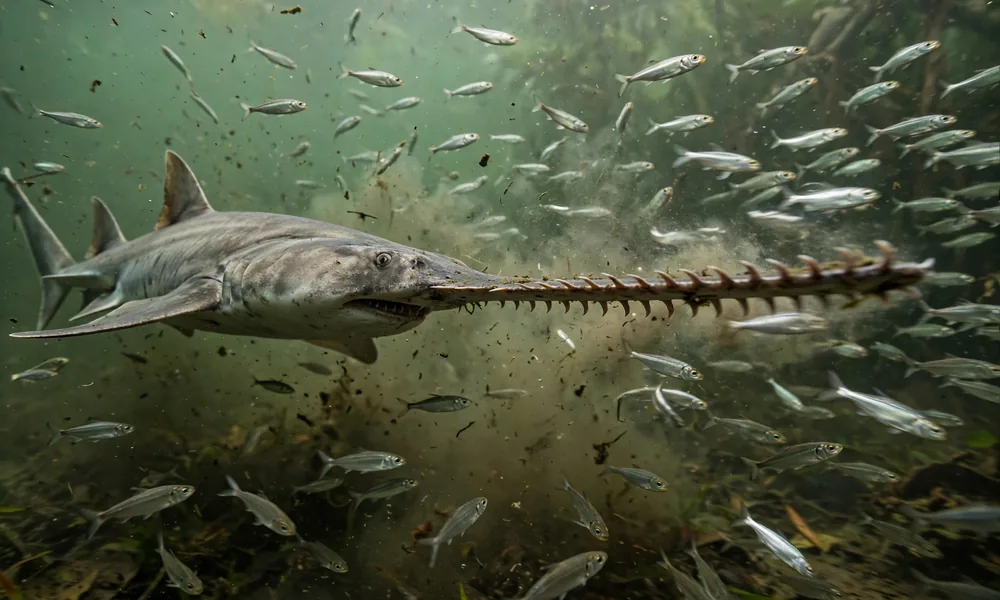
What sets the sawfish apart is how it hunts, and researchers have watched three distinct uses of the saw. First, the sawfish sweeps its rostrum sideways through a school of fish, stunning or injuring them with the blow, and then it turns back to swallow the wounded fish whole. Second, it rakes the saw across the seabed, flushing out crabs, shrimp and flatfish that are buried in the mud. Third, it pins a fish to the bottom with the saw and then swings its head around to take the prey in its underside mouth. The rostrum is covered in thousands of tiny sensory pores called ampullae of Lorenzini, which detect the faint electric fields made by the muscles of hidden prey from about 40 centimetres away, so a sawfish can hunt in murky water or in the dark, finding food it cannot see at all.
Feeding follows the rhythm of the tide and the day, and it is busiest when the water is moving. Sawfish feed most actively as the tide rises and falls, when small fish are pushed into the creeks and across the mudflats, and they do much of their hunting at night, when their electric sense gives them an edge over prey that relies on sight. In the heat of midday they often rest on the bottom, half-buried in the sand, saving their energy for the next tide. Like the manta ray, the sawfish is a ray that feeds in the open water column, but the manta is a gentle filter feeder that sieves plankton from the sea, while the sawfish is a predator that hunts with a weapon.
How sawfish behave
Sawfish are slow, deliberate fish, and their day is a quiet round of resting, drifting and hunting along the bottom. They spend much of the daylight hours lying on the seabed, sometimes half-buried in the sand with only their eyes and their saw showing, and they move in a slow, unhurried way, never rushing, never chasing far. They are not strong swimmers over distance, and they do not need to be: their life is lived within a few kilometres of coastline, and their electric sense matters more than speed, because it lets them find food in water too murky to see through. When a larger shark passes, a sawfish will often thrash its saw from side to side, and the saw is a real weapon, capable of cutting a person badly, which is why fishermen handle a caught sawfish with great care.

The most remarkable behaviour in the sawfish is the leap. A sawfish can throw itself clear of the water, and a 1.8-metre individual was once seen jumping to a height of about 5 metres, which is a startling sight from an animal that spends its life on the bottom. Nobody is quite sure why they do it, though it may help them shake off parasites, and young sawfish leap more often than adults.
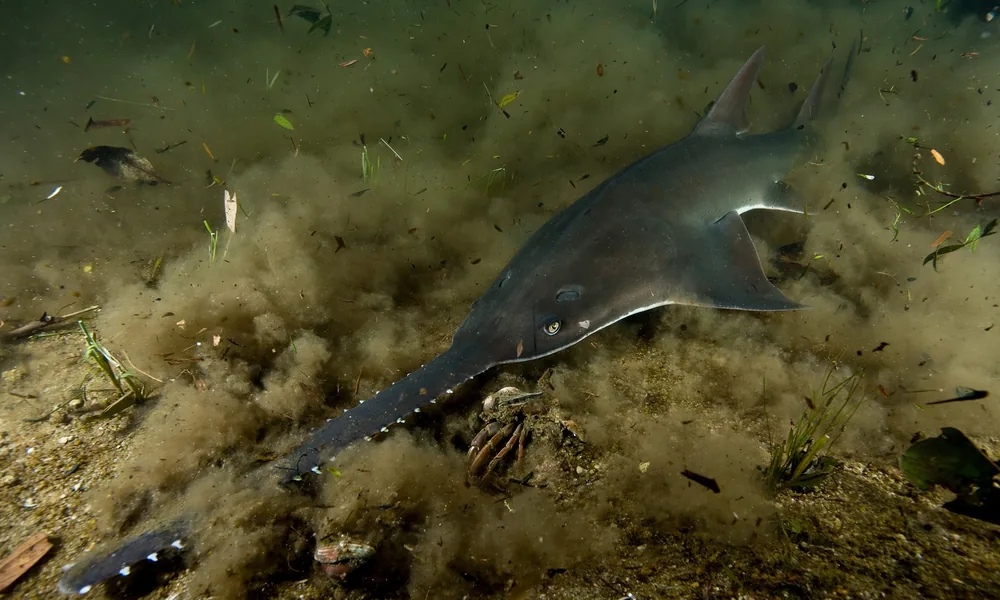
When a sawfish is threatened, its first response is to freeze, relying on its grey back and its flat body to break up its outline against the sand, and if that fails it will thrash its saw and swim for deeper water. Sawfish are not aggressive towards people, and there is no record of a sawfish deliberately attacking a swimmer, but a cornered or tangled sawfish can injure a person badly with a wild sweep of its saw, and divers are told to give them a wide berth. The saw is a tool for hunting, not for fighting, and a sawfish that is left alone will almost always choose to swim away.
Breeding and life cycle
Sawfish breed slowly, and that slow breeding is at the heart of their trouble. Females give birth to live young, a way of breeding called ovoviviparity, in which the eggs hatch inside the mother and the pups are born fully formed. A largetooth female carries her young for about five months, and she gives birth to between 1 and 13 pups, with an average litter of about seven. The pups are born in shallow, sheltered water, in mangrove creeks and river mouths, and they are about 60 to 90 centimetres long at birth, already carrying a small saw of their own, with its teeth covered by a sheath that falls away soon after they are born.

The young stay in the nursery shallows for their first years, growing slowly and staying where the big sharks cannot easily reach them. They feed on small fish and crustaceans in the mangrove creeks, and they grow steadily, reaching maturity at about 2.8 to 3 metres long, when they are 7 to 10 years old. A female largetooth breeds only once every one to two years, and there are signs that mothers return to the place where they themselves were born to give birth to their own young, which makes the nursery creeks doubly important. In a strange twist, female smalltooth sawfish have been found to reproduce without a male at all, a rare trick called parthenogenesis, giving birth to male pups that are clones of their mother when males are scarce.
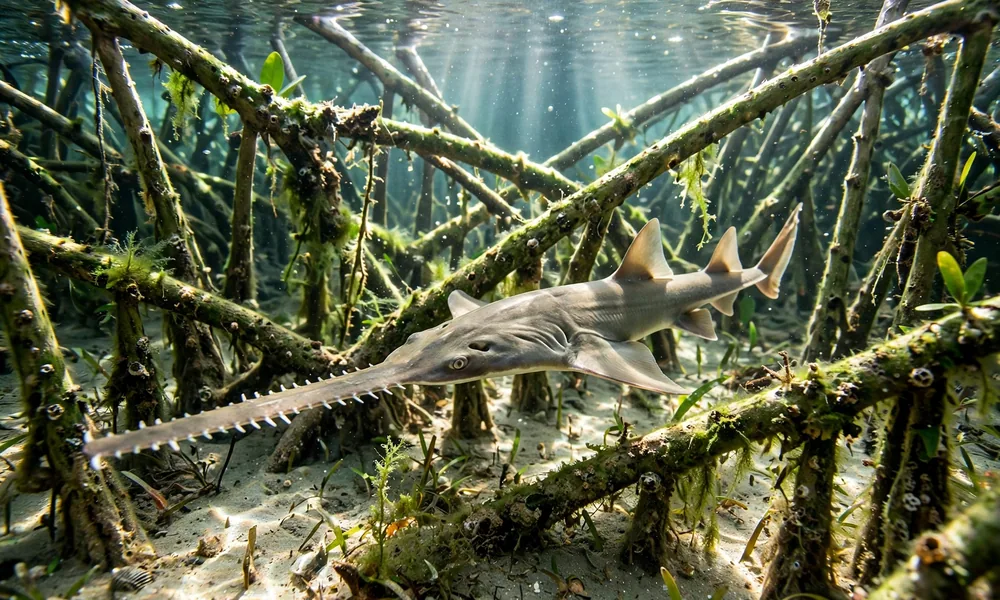
Growth is slow through life, and a sawfish may live for decades. The potential lifespan is not known for certain, and estimates for the largetooth range from 30 years to 80 years, which is a wide spread, but it is clear that sawfish are long-lived animals that take many years to replace themselves. The young are independent from the day they are born, but so few survive to breeding age, and so slowly do the survivors breed, that a population that is fished hard can take decades to recover, if it recovers at all.
Conservation status
The sawfish is in deep trouble, and the numbers are stark. Three of the five species, the largetooth, the smalltooth and the green sawfish, are listed as Critically Endangered by the International Union for Conservation of Nature, and the other two, the dwarf and the narrow sawfish, are listed as Endangered, which means that every living sawfish species is at risk of extinction. That broad picture hides a more worrying local one, and it is worth understanding both sides, because the sawfish is one of the marine animals most tied to the fate of the shallow coast it lives on. A fish that hunts in mangrove creeks cannot live where the mangroves have been cleared, and an estuary that loses its shallow nurseries loses its sawfish within a season or two.

The main pressure is fishing. Sawfish are caught for their fins, which are used in shark fin soup, and for their saws and teeth, which are sold as curios and used in traditional medicine, and their saws tangle easily in fishing nets, so many are caught by accident and killed before they can be released. Habitat loss is a second pressure, as mangroves are cleared for building and aquaculture, and rivers are dammed, cutting off the nursery creeks and the upstream journeys that the largetooth depends on. All sawfish species were added to Appendix I of the Convention on International Trade in Endangered Species of Wild Fauna and Flora in 2007, which bans international trade in them and their parts.
The most useful conservation work is practical, and it is the same work that helps the whole coast. Protecting the mangrove creeks and the river mouths keeps the hunting grounds and the nursery shallows in place, and protecting the shoreline from development keeps the water clean for the fish that live in it. Fishermen are now taught to cut the net and release a tangled sawfish alive rather than killing it for its saw, and tagging programmes in Florida and northern Australia track the survivors, showing scientists where the fish go and where they need protection. A sawfish returned to the water can go on breeding for decades, and it is the long life of a single female that makes the difference between a population that recovers and one that does not.
Best seasons for sawfish watching
The best time to look for a sawfish is the dry season in the tropics, when the rivers run low and clear and the fish gather in the estuaries and creek mouths. In northern Australia that usually means the months from about May to October, when the water is clear enough to see a sawfish resting on the sand from a boat, and the mangrove creeks are at their most accessible. In Florida the best months are the spring and early summer, from about March to June, when the smalltooth sawfish are active in the mangrove estuaries of the south-west coast and the water is warm and clear. Sawfish are present in their home waters all year round, and they do not migrate far, so there is no wrong season in the strict sense, but a calm, clear day in the dry season will show you far more fish than a muddy day in the wet season, when the rivers run brown with rain.
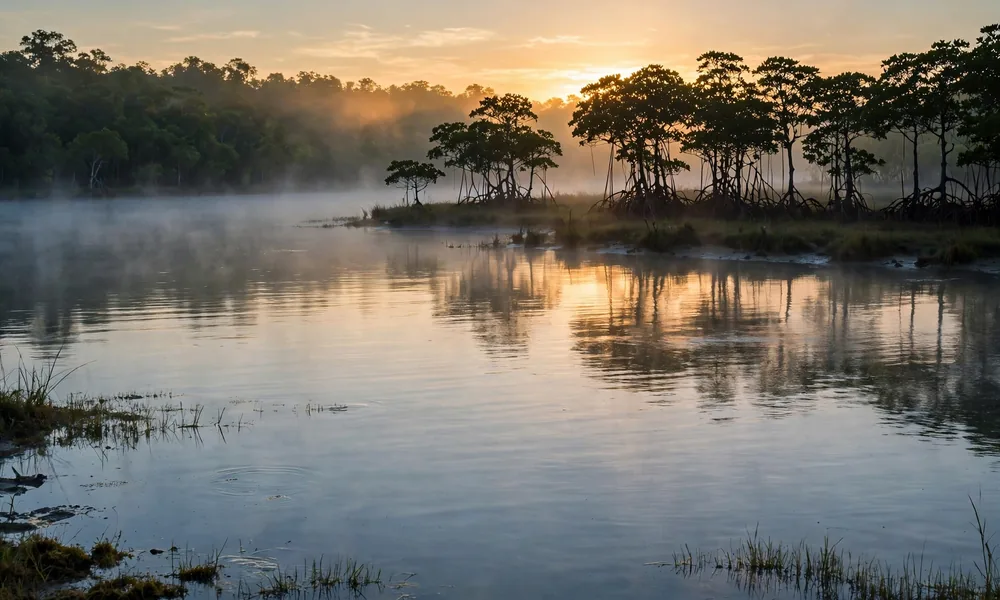
The best hours are the dawn and the dusk, when the sawfish are feeding actively and the light is good for seeing them. From about six o’clock until nine in the morning, and again from about five until eight in the evening, the sawfish are out on the mudflats and the creek mouths, sweeping their saws through the shallows. A slow drift along the mangrove edge in a small boat, with the sun behind you and a pair of polarised sunglasses to cut the glare, is all you need.
Staying safe around sawfish
A sawfish is not dangerous to people in the way a shark is, and there is no safety warning that belongs to the fish itself, but the saw deserves real respect. It has no venom, it does not bite, and it will not chase or threaten a swimmer, and there is no record of a sawfish deliberately attacking a person. The safety rules for watching sawfish are the rules of the saw itself: a cornered or tangled sawfish can thrash its rostrum from side to side, and the teeth on the saw can cut deeply, so never approach a sawfish in the water, never try to touch one, and never handle a caught sawfish without help from someone who knows how.
There are a few practical points for the water itself. Watch sawfish from a boat, not from the water, and keep your hands and feet inside the boat when a sawfish is near, because a leaping sawfish can clear the surface without warning. If you are fishing and you catch a sawfish by accident, do not lift it into the boat, cut the line or the net as close to the fish as you safely can, and let it go.
Sawfish watching checklist
A little preparation turns a morning on the estuary into a real chance of seeing a sawfish at its best, resting on the sand in clear, warm water.
- A visit in the dry season, when the rivers run low and clear and the sawfish gather in the estuaries and creek mouths.
- A dawn or dusk trip, when the sawfish are out feeding and the light is good.
- A mangrove estuary with shallow creek mouths, mudflats and seagrass beds, where the fish hunt and shelter.
- A slow drift in a small boat along the mangrove edge, watching for a grey shape resting on the sand or a saw sweeping the shallows.
- Polarised sunglasses that cut the glare, so you can see into the water and spot the fish.
- A life jacket and a buddy, so that a day on the water stays safe from start to finish.
- Respect for the fish and the estuary, keeping your distance, never touching a sawfish, and leaving the shore as you found it.
Frequently asked questions
How big do sawfish get?
Most sawfish seen today measure 2 to 2.5 metres long, but the largetooth sawfish can grow much larger, and the biggest confirmed specimen, a West African fish, measured 7 metres, with large adults weighing 500 to 600 kilograms. The green sawfish can also reach about 7 metres, the smalltooth grows to about 5.5 metres, and the dwarf sawfish, the smallest of the five, grows to about 3.2 metres. Females grow larger than males, and the biggest sawfish in any population are almost always female.
What is the sawfish’s saw for?
The saw, or rostrum, is a tool with three jobs: it is a sensor, a club and a shovel. It is packed with electroreceptors called ampullae of Lorenzini that detect the faint electric fields of hidden prey from about 40 centimetres away, it is swept sideways through schools of fish to stun them, and it is raked across the seabed to flush out crabs, shrimp and flatfish. The rostral teeth are modified scales, not true teeth, and they grow through the animal’s life but are not replaced if they are lost.
Are sawfish sharks or rays?
Sawfish are rays, even though they look like sharks. Their gill slits sit on the underside of the body, their broad pectoral fins are fused to the sides of the head, and they spend their lives close to the seabed, all of which are the marks of a ray. They belong to the order Rhinopristiformes, alongside the guitarfish and the wedgefish, and they are more closely related to skates and rays than to any shark.
Do sawfish live in fresh water?
Yes, and the largetooth sawfish is the best traveller of the five. It swims between the sea, the estuary and the river, and it has been recorded 1,340 kilometres upriver from the sea, while the population in Lake Nicaragua appears to spend most, if not all, of its life in fresh water. Young sawfish grow up in river mouths and mangrove creeks, and adults move between fresh and salt water as the seasons and the tides change.
Are sawfish dangerous?
Sawfish are not aggressive towards people, and there is no record of a sawfish deliberately attacking a swimmer, but the saw is a real weapon and it deserves respect. A cornered or tangled sawfish can thrash its rostrum from side to side and cut a person badly, so divers and fishermen are told to give them a wide berth, to watch them from a boat, and never to handle a caught sawfish without help. The danger is in the saw, not in the fish’s temper.
How is this guide different from the rainbow trout guide?
This guide covers the sawfish, a giant tropical ray of 2 to 7 metres that hunts with a toothed saw in mangrove estuaries and river mouths and gives birth to live young, while our rainbow trout guide covers a cold-water freshwater fish of rivers and lakes that is famous with anglers, spawns in gravel redds and is stocked in waters around the world. One is a rare, endangered ray you watch from a boat at dawn; the other is a familiar sport fish you meet on the end of a fly rod.
Conclusion
The sawfish species are a reminder that the strangest animals are often the ones most worth saving. A ray with a saw for a snout, a sense that reads the electricity of hidden fish, a life spent between the river and the sea and a breeding pace so slow that a fished-out population may need decades to recover: the sawfish is an animal that asks for patience, and it is an animal that has nearly run out of time.