The manta ray species number two, giant and reef mantas, winged giants of the tropical seas, and they are the largest rays in the world, with wingspans wider than a small car. If you are asking how many manta ray species there are, the answer is two: there are two recognised manta ray species in the world, the giant manta ray and the reef manta ray, and every manta ray alive today belongs to one of them.
The manta ray belongs to the family Mobulidae, the devil rays, and it lives in the warm tropical and subtropical seas around the world, from the coral reefs of Indonesia to the open ocean off Mexico. Its huge wings, its horn-like head fins, its gentle nature and its habit of leaping clear of the water make it one of the most loved animals in the sea.
Key takeaways
- There are two manta ray species, the giant manta ray and the reef manta ray, both in the genus Mobula.
- Giant mantas are the largest rays in the world, with wingspans of up to 7 metres and weights of up to 2,000 kilogrammes.
- Manta rays are filter feeders that eat plankton, krill and small fish, funnelling food into their mouths with their cephalic fins.
- Manta rays visit cleaning stations where small fish pick parasites from their skin, and they often leap clear of the water.
- Both manta ray species are listed as Vulnerable, and their gill plates are sold for traditional medicine.
What makes a manta ray a manta ray
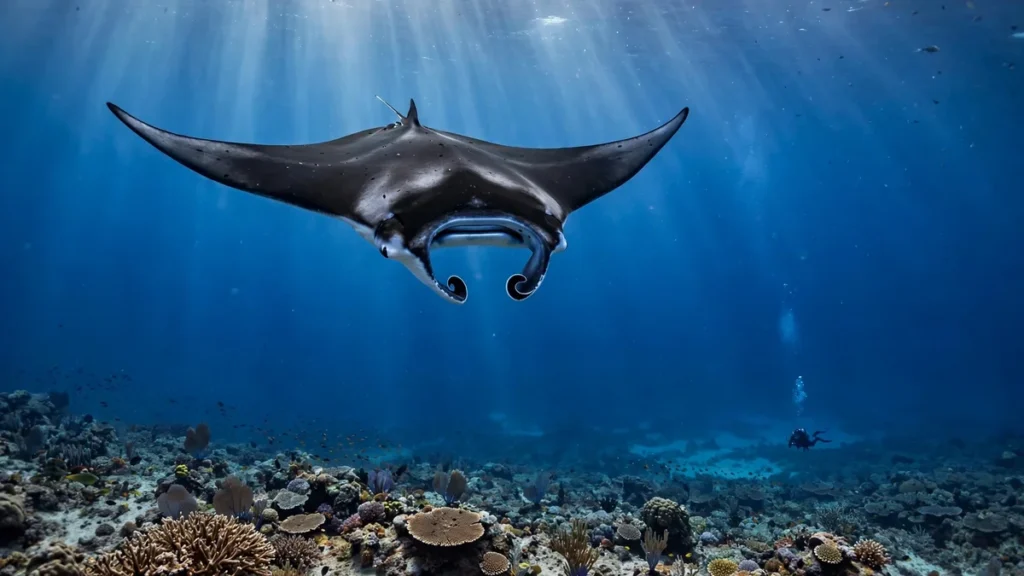
A manta ray is a huge flat ray with wide triangular wings, a broad head, two horn-like fins called cephalic fins, and a long thin tail with no stinging spine, and it measures roughly 3 to 7 metres across the wings and usually weighs between 500 and 2,000 kilogrammes, depending on the species. The giant manta ray is the larger of the two, at up to 7 metres across and up to 2,000 kilogrammes, while the reef manta ray is smaller, at up to 5 metres across and up to 1,400 kilogrammes.
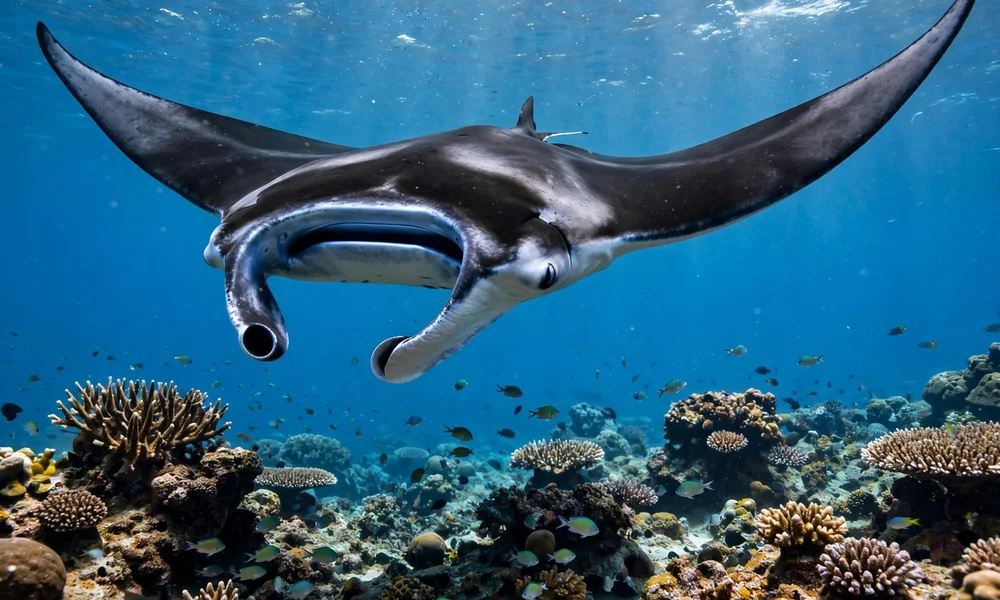
The wings define the manta ray: huge triangular fins that flap slowly, like a bird flying through the water, and a manta ray can glide for hours without a single beat, riding the currents of the open sea. The cephalic fins curl forward to funnel plankton into the mouth, and they uncurl when the manta is feeding. Like other whale sharks, the manta ray is a filter feeder, but it is a ray, not a shark, and it has no teeth for biting, only tiny tooth-like plates for filtering food.
The manta ray species and their relatives
There are two manta ray species. The giant manta ray lives in the open ocean, roaming the tropical and subtropical seas of the Atlantic, Pacific and Indian oceans, and it is the largest ray in the world. The reef manta ray lives closer to shore, around coral reefs and island coasts, and it is smaller and more often seen by divers, though it can still grow to 5 metres across.
The devil ray is the manta ray’s closest relative, a smaller ray of the Mediterranean and Atlantic with a similar shape, while the spotted eagle ray is a ray with white spots and a long tail that swims in tropical seas. The cownose ray is a small ray that migrates in huge schools, the southern stingray is a ray of the Caribbean with a stinging spine, and the blue-spotted ribbontail ray is a reef ray with bright blue spots and a striped tail.
| Type | Animal | Where it lives | Best-known food | Length or Weight |
|---|---|---|---|---|
| Species | Giant manta ray (Mobula birostris) | Open tropical and subtropical oceans | Plankton, krill and small fish | Up to 7 m wingspan, up to 2,000 kg |
| Close relative | Reef manta ray | Coral reefs and island coasts | Plankton, krill and small fish | Up to 5 m wingspan, up to 1,400 kg |
| Close relative | Devil ray | Mediterranean and Atlantic oceans | Plankton and small fish | Up to 5.2 m wingspan, up to 1,000 kg |
| Close relative | Spotted eagle ray | Tropical seas worldwide | Clams, shrimp and crabs | Up to 3.5 m wingspan, up to 230 kg |
| Close relative | Cownose ray | Western Atlantic and Gulf of Mexico | Clams, oysters and crabs | Up to 2.1 m wingspan, up to 20 kg |
| Close relative | Southern stingray | Caribbean and western Atlantic | Clams, shrimp and crabs | Up to 2 m disc width, up to 97 kg |
| Close relative | Blue-spotted ribbontail ray | Coral reefs of the Indo-Pacific | Clams, shrimp and worms | Up to 1.8 m long, up to 30 kg |
How manta rays live
Manta rays are creatures of the warm sea. A manta ray lives alone or in small groups, gliding through the water by day and night and following the plankton where it gathers, and it can roam over thousands of kilometres in a single year. Like other great white sharks, the manta ray is a giant of the ocean, but it is gentle and harmless, and it has no teeth, no sting and no interest in people.
Plankton, krill and small fish make up most of the diet, along with tiny shrimp and fish eggs, and a manta ray eats by swimming with its mouth open, funnelling water through its gills and trapping the food on its gill plates. It feeds mostly near the surface, where plankton gathers in the light, and it somersaults slowly through a cloud of food, turning in tight loops to stay in the richest water.
Breeding is slow, and the female gives birth to a single live pup after a pregnancy of about a year, and the pup is born with a wingspan of about 1.4 metres, already able to swim and feed on its own. The mother gives birth every two to five years, and the pup grows slowly, taking about ten years to reach adulthood. Manta rays live for around 40 to 50 years, and some may live longer.
Where manta rays live
The manta ray lives in the tropical and subtropical seas around the world, from the coral reefs of Indonesia and the Maldives to the open ocean off Mexico, Ecuador and Mozambique, and it is most common in the warm waters of the Indo-Pacific, where plankton is plentiful. The giant manta ray lives in the open ocean, while the reef manta ray lives around reefs and island coasts, and the two species often meet at the same feeding grounds.
Warm plankton-rich water is the key requirement. A manta ray needs warm water above 20 degrees, with plenty of plankton to eat, and cleaning stations where small fish pick parasites from its skin, so it follows the plankton as it blooms with the seasons, and when the food moves the mantas move with it. It depends on the reefs staying healthy, and it returns to the same cleaning stations year after year, generation after generation.
Both manta ray species are listed as Vulnerable, and their numbers have fallen sharply in many places. The main pressures are the trade in gill plates for traditional medicine, being caught in fishing nets, and boat strikes, though manta rays breed slowly and their numbers recover slowly even when fishing stops. Manta rays are protected in many countries, and dive tourism has made a live manta worth far more than a dead one.
Best seasons for manta ray watching
There is no closed season, because manta rays are active all year, but the best time to look for them depends on where you go. In the Maldives the best months are often November to April, when the plankton blooms bring the mantas to the atolls. In Indonesia the best months are often July to September, when the mantas gather at the cleaning stations of Komodo and Raja Ampat.
Staying safe around manta rays
A manta ray is a wild animal with huge wings and great strength, and it can injure a person with a blow from its wing, though manta rays almost never attack people. Keep your distance, never touch a manta ray, and never try to ride one, because a manta ray that is touched may dive away and never return to that cleaning station. If you see manta rays while diving, stay calm, stay still, and let them come to you, because mantas that are chased may leave their feeding grounds for good.
Manta ray watching checklist
A little preparation turns a reef visit into a real chance of seeing a manta ray, so pack for sun, salt water and long quiet hours.
- A mask, snorkel and fins, for watching mantas from the surface without disturbing them.
- A camera with a wide-angle lens, because mantas are huge and should always be watched from a distance.
- Sun cream that is safe for reefs, because the best watching is in the bright midday sun.
- A booked boat tour with a guide who knows the manta cleaning stations and the safe routes.
- A plan to be out in the morning, when the mantas are most active and feeding.
- Patience and silence, because mantas are shy animals and a noisy group will send them away.
- A field guide to rays and sharks, for telling a giant manta from a reef manta at a glance.
Frequently asked questions
How many manta ray species are there?
There are two manta ray species, the giant manta ray and the reef manta ray. They were once thought to be one species, but scientists split them in 2009, and a possible third species is still being studied in the Atlantic, though it is not yet formally recognised.
Do manta rays sting?
No. Manta rays have no stinging spine on their tails, unlike stingrays, and they are harmless to people. Their tails are long and thin, and they use them only for steering, not for defence.
Why do manta rays leap out of the water?
Manta rays leap out of the water to shake off parasites, to communicate with other mantas, and possibly to show off during courtship. A giant manta can clear the water completely, and the splash can be heard from a long way off.
Can you keep a manta ray as a pet?
No. A manta ray is a wild animal that needs the open ocean, swims thousands of kilometres, and is protected by law in most of the places where it lives. Manta rays in aquariums are extremely rare, and they are not pets.
How is this guide different from the swordfish species guide?
This guide covers two manta ray species, gentle filter feeders that glide through warm tropical seas eating plankton, while our swordfish species guide covers the single swordfish species, a flat-sworded hunter that warms its eyes to hunt in the cold deep sea. The giant manta is up to 7 metres across and eats plankton, and the swordfish is up to 4.5 metres long and hunts squid and tuna.
Are manta rays endangered?
Both manta ray species are listed as Vulnerable, so they are not classed as endangered, but their numbers have fallen sharply in many places. The trade in gill plates for traditional medicine is the main threat, along with being caught in fishing nets.
Conclusion
The manta ray species show how much grace one fish can hold: two species of winged giant, with wings like a bird, horns that funnel food, and lives spent gliding through the warm tropical seas of the world.
If you go looking for one, go in the dry season to the Maldives or Indonesia, go quietly, and go with patience. Watch a giant manta glide over the reef and you will understand why it has earned its place as the most loved ray in the sea, and why keeping its oceans clean matters most.