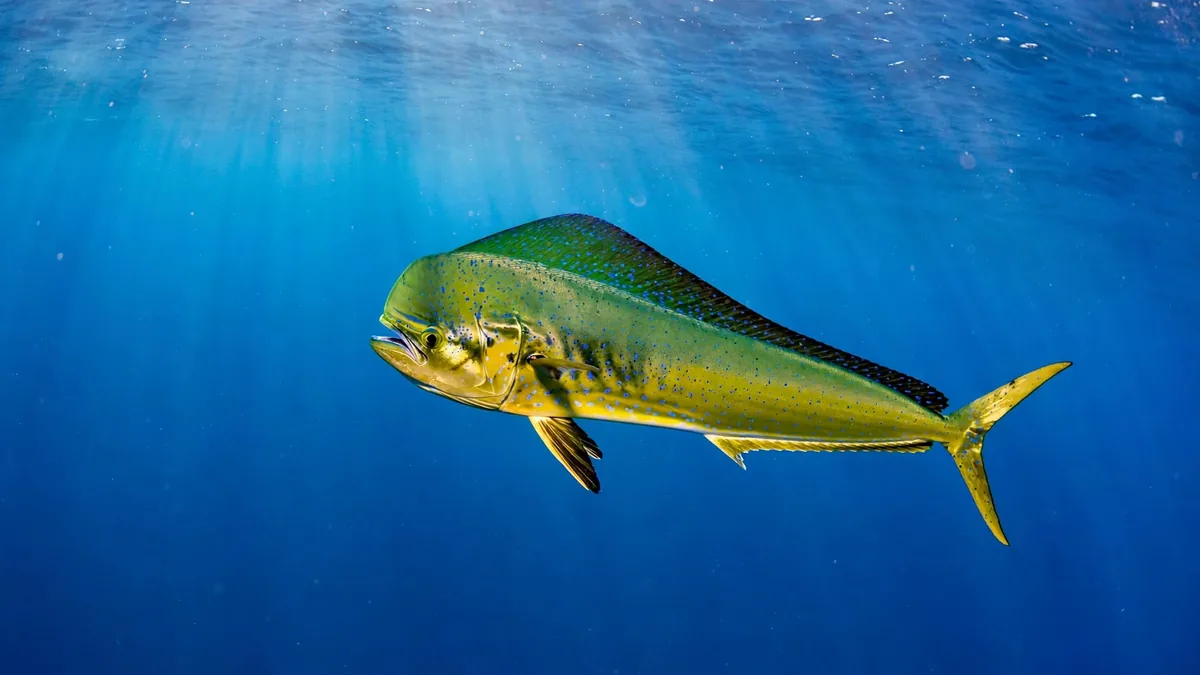
The mahi-mahi species is the dazzling green-and-gold fish of the open ocean, a fast, brightly coloured hunter that most people meet on a plate long before they ever see one alive. If you are asking what a mahi-mahi is, the short answer is Coryphaena hippurus, a fish also called the dolphinfish, which is not a dolphin at all but a true fish, and one of the fastest-growing fish in the sea. Most adults measure 70 centimetres to 1 metre long, the biggest reach about 1.5 metres and close to 40 kilograms, and the whole animal, from its steep blunt forehead to its deeply forked tail, is built for speed in the warm surface waters of the tropical and subtropical oceans.
You will usually meet a mahi-mahi the way anglers and divers do: as a flash of green and gold under a floating patch of weed, or as a fish leaping clean out of the water after flying fish, shining in the sun for a second before it crashes back down. The colours are the first thing anyone notices, and they are also the first thing to go, fading to a dull grey within minutes of the fish leaving the water, which is why a mahi-mahi on a market stall looks like a different animal from the one that was swimming an hour before. This guide covers the whole fish, from its family tree and its remarkable growth to where it lives, what it eats, how it breeds, and why it is one of the most popular fish on menus around the world.
Key takeaways
- The mahi-mahi species is Coryphaena hippurus, also called the dolphinfish, a true fish and not a dolphin, with vivid green, gold and blue colouring that fades quickly after death.
- It is one of the fastest-growing fish in the sea, reaching nearly a metre long in its first year and living only about four to five years.
- Mahi-mahi live in the warm surface waters of tropical and subtropical oceans worldwide, often gathering under floating weed, logs and other drifting objects.
- They eat flying fish, squid, small fish and crustaceans, hunting in fast chases and leaping clear of the water after their prey.
- The species is listed as Least Concern, and it is a popular food fish, though large fish should be eaten in moderation because of mercury.
The mahi-mahi species and its relatives
Mahi-mahi belong to the family Coryphaenidae, the dolphinfishes, and to the genus Coryphaena, a small group of just two species of fast, brightly coloured open-ocean fish. The scientific name, Coryphaena hippurus, is an old one: Coryphaena comes from a Greek word meaning the top of the head, a nod to the steep forehead of the male, and hippurus means horse tail, after the shape of the tail. The fish was described by the Swedish naturalist Carl Linnaeus in 1758, and it has kept its name ever since, even as its common names have multiplied. Mahi-mahi is the Hawaiian name, and it means strong, which suits a fish that fights hard on a line, while dolphinfish is the older English name, given because the fish was once thought to follow ships the way dolphins do.
The dolphinfish family is a small one, and that is part of what makes the mahi-mahi easy to place. There are only two species in the genus Coryphaena, the common dolphinfish and the smaller pompano dolphinfish, and both share the same basic design: a long, deep, flattened body, a single dorsal fin that runs almost the whole length of the back, a steep forehead, and a deeply forked tail. The family sits among the fast open-ocean hunters, and its closest cousins are the other swift surface fish of the warm seas, though the dolphinfishes are set apart by their colours and by a growth rate that few fish can match.
| Type | Animal | Where it lives | Best-known food | Length or Weight |
|---|---|---|---|---|
| Family | Dolphinfishes (Coryphaenidae) | Tropical and subtropical oceans worldwide | Flying fish, squid and small fish | About 30 cm to 1.5 m long |
| Genus | Dolphinfishes (Coryphaena) | Tropical and subtropical oceans worldwide | Flying fish, squid and small fish | About 30 cm to 1.5 m long |
| Species | Common dolphinfish (Coryphaena hippurus) | Tropical and subtropical oceans worldwide | Flying fish, squid and crustaceans | About 70 cm to 1 m long, up to 1.5 m |
| Species | Pompano dolphinfish (Coryphaena equiselis) | Tropical and subtropical oceans worldwide | Small fish, squid and crustaceans | About 30 cm to 70 cm long |
The two species are easy to tell apart once you know what to look for, and size is the simplest clue. The common dolphinfish is the big one, with most adults measuring 70 centimetres to 1 metre and the largest reaching about 1.5 metres, while the pompano dolphinfish rarely grows past about 70 centimetres and is usually much smaller. The pompano dolphinfish also has a more rounded forehead and a squarer tail, where the common dolphinfish has the steep, blunt forehead and the deeply forked tail that give it away at a glance. In practice, any dolphinfish over about 70 centimetres is almost certainly a common dolphinfish, and that is the fish this guide is about.
There is one more relationship worth knowing, and it is the one that explains the confusion in the name. A mahi-mahi is not a dolphin, and it is not related to dolphins at all: dolphins are mammals that breathe air and feed their young on milk, while a mahi-mahi is a fish that breathes through gills and lays eggs. The name dolphinfish comes from the days when sailors saw the fish leaping and chasing flying fish around their ships, and it has stuck, even though it misleads almost everyone who hears it for the first time. Like the bluefin tuna, a mahi-mahi is a fast, warm-water predator of the open ocean, but the tuna is built for long-distance cruising at speed, while the mahi-mahi is built for short, explosive chases near the surface, and that difference is written all over its body.
What a mahi-mahi looks like
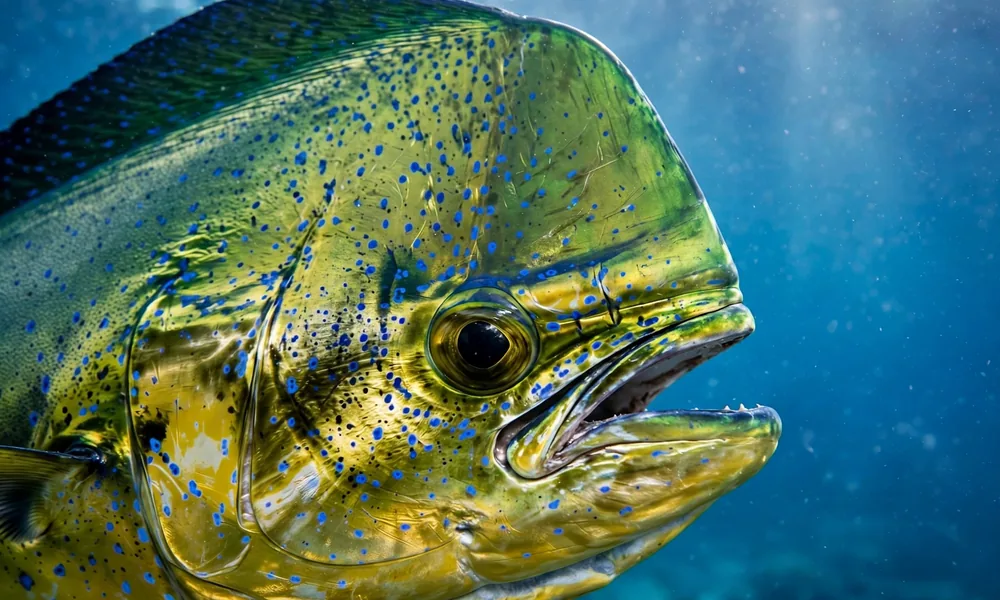
A mahi-mahi is one of the most colourful fish in the open ocean, and its colours are the reason it stops people in their tracks. The back is a vivid metallic green, the sides are bright gold scattered with blue spots, and the belly is a pale yellow-white, and the whole fish seems to shimmer as it turns in the sunlight. Most adults measure 70 centimetres to 1 metre from snout to tail, and a good fish weighs 7 to 15 kilograms, with the largest on record reaching about 1.5 metres and close to 40 kilograms. The colours are not fixed, though: a mahi-mahi can change its shade in seconds, flashing brighter when it is excited or hunting, and the colour fades fast once the fish is out of the water, so the brilliant green and gold of a live fish is a sight that does not last.
The head is the part that sets a mahi-mahi apart from every other fish in the sea. In a mature male, the forehead rises steeply from the snout in an almost vertical blunt face, like the front of a bull, and the older and larger the male, the steeper that forehead becomes. Females have a more rounded, sloping forehead, and young fish of both sexes have a gently sloping head that steepens as they grow. The mouth is wide and set low, with small sharp teeth, and the eye is large and set high, which suits a hunter that watches for prey above and around it. The single dorsal fin runs from just behind the head almost all the way to the tail, and when the fin is raised it stands up like a bright blue-green sail along the back.
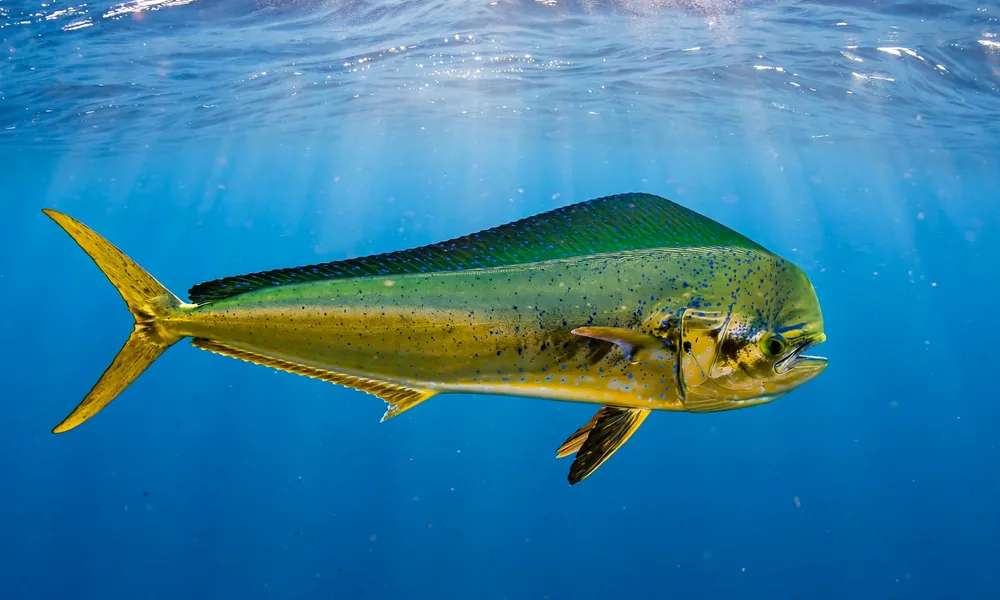
The body is long, deep and flattened from side to side, like a blade, and that shape is the key to how a mahi-mahi swims. It is not a fish built for steady cruising over long distances, but for sudden bursts of speed, turning sharply and leaping clear of the water when it chases flying fish. The tail is deeply forked and narrow at the base, and it drives the fish forward in powerful beats, while the long dorsal fin and the anal fin underneath work like keels, keeping the fish steady when it turns. A mahi-mahi can reach speeds of around 50 kilometres an hour in a chase, which is fast enough to run down a flying fish before it can get airborne.
Males and females look different enough that an experienced eye can usually tell them apart in the water. The male, often called a bull, has the steep, squared forehead and grows larger than the female, while the female, often called a cow, has a rounded forehead and a slimmer body. Young mahi-mahi look different again: they are smaller, slimmer and more strongly marked, with bold vertical bars of blue and gold along their sides, and the bars fade as the fish grows. A fish under about 30 centimetres is still in its striped youngster phase, and by the time it reaches half a metre the adult green and gold has taken over.
Where mahi-mahi live
Mahi-mahi live in the warm surface waters of the tropical and subtropical oceans, in a range that covers the Atlantic, the Pacific and the Indian Oceans, roughly between 40 degrees north and 40 degrees south. They are a fish of the open sea, and they follow the warm currents, which is why they turn up off Florida and the Caribbean, around Hawaii, off the coast of West Africa, and across the warm waters of South-East Asia and Australia. They stay near the surface, usually in the top 10 metres, and they need warm water, generally above about 20 degrees, so they move with the seasons, pushing further from the equator in summer and retreating towards it in winter.
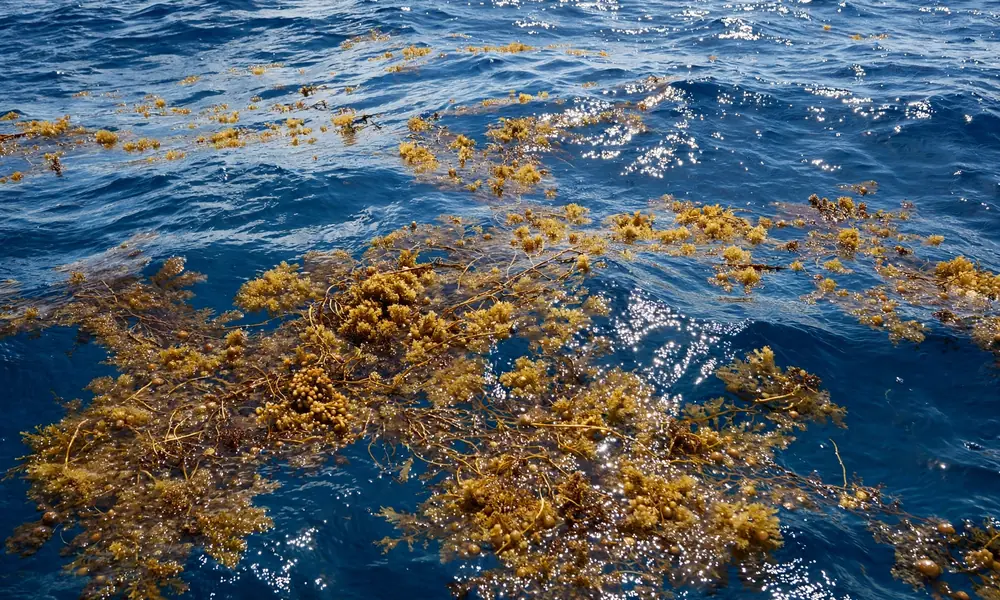
The habitat a mahi-mahi chooses is not a place on a map but a thing floating on the water. Mahi-mahi gather under floating objects of almost any kind: mats of sargassum weed, drifting logs, buoys, wreckage, and even the shadow of a boat, and a single floating log can hold a whole school. The floating object gives them shade, and it gathers a community of small fish, crabs and shrimps underneath it, so the mahi-mahi get a hunting ground and a roof at the same time. Anglers know this well, and the first thing a mahi-mahi boat does in the morning is look for weed lines and floating debris, because where there is something floating, there are usually mahi-mahi underneath it.
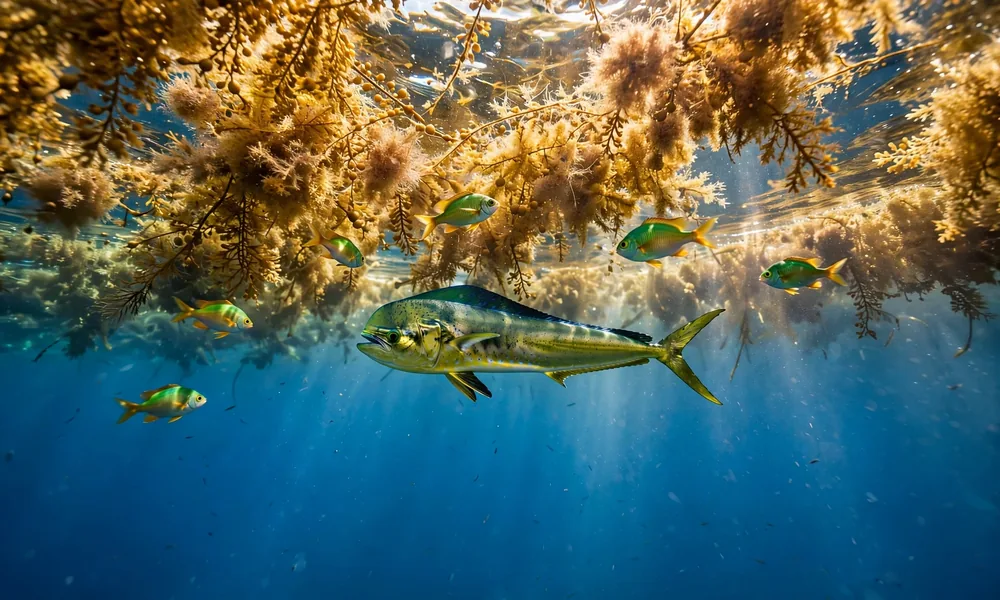
Young mahi-mahi live in the same floating world, and they depend on it even more than the adults do. The juveniles shelter in the thickest sargassum, where the weed hides them from bigger hunters and the small creatures living in it give them their first meals, and they stay close to the floating shelter until they are big and fast enough to look after themselves. As they grow, they range further from the weed and spend more time in open water, but they never really leave the floating world behind: even a large adult mahi-mahi will return to a weed line or a log to hunt, rest and find a mate. Protecting the open ocean matters to this fish in a different way from a reef fish, because its nursery is not a place that can be fenced off, but a drifting mat of weed that moves with the currents.
What mahi-mahi eat
Mahi-mahi eat almost anything they can catch near the surface, and they are not fussy about it. The everyday diet is made up of flying fish, small fish such as sardines and anchovies, squid, shrimps and small crabs, and the fish takes whatever is commonest in its own patch of ocean. A mahi-mahi will eat a fish half its own length if it can get its jaws around it, and it will snap up a flying fish in mid-air as the fish leaves the water, which is one of the most spectacular sights in the open ocean. Stomach studies have found dozens of different prey species in a single fish, which tells you how opportunistic a hunter this is.

The hunting style is a mix of patience and explosion, and it changes with the prey. A mahi-mahi will often cruise slowly under a weed line, watching the small fish sheltering there, and then it will strike: a burst of speed, a snap of the jaws, and the prey is gone. When it hunts flying fish, the chase can leave the water entirely, with the mahi-mahi leaping after its prey in a glittering arc and crashing back down in a burst of spray. The fish also hunts at night, when squid rise towards the surface, and a mahi-mahi feeding under a boat’s lights will take squid after squid, barely pausing between strikes.
Feeding is closely tied to the light and to the floating world the fish lives in. Mahi-mahi hunt most actively in the early morning and the late afternoon, when the small fish are moving and the low sun makes them easier to see against the surface, and they will feed through the day whenever prey is thick under the weed. Like the swordfish, a mahi-mahi is a fast, warm-water predator of the open ocean, but the swordfish is a deep-water hunter that uses its bill to slash at its prey in the dark, while the mahi-mahi is a surface hunter that chases in bright daylight, and that difference shapes everything from its eyes to its daily rhythm.
How mahi-mahi behave
Mahi-mahi are social for an open-ocean fish, and they are most often found in pairs or small schools rather than alone. A pair is usually a male and a female swimming together, and the two stay close, hunting side by side and turning together as if they were tied by a string, and a small school will often be a group of similar-sized fish working the same weed line. They are not shy, and they are curious about boats, drifting up to look at a hull or a propeller, and a diver who stays still in the water will often find a mahi-mahi circling to look at them.
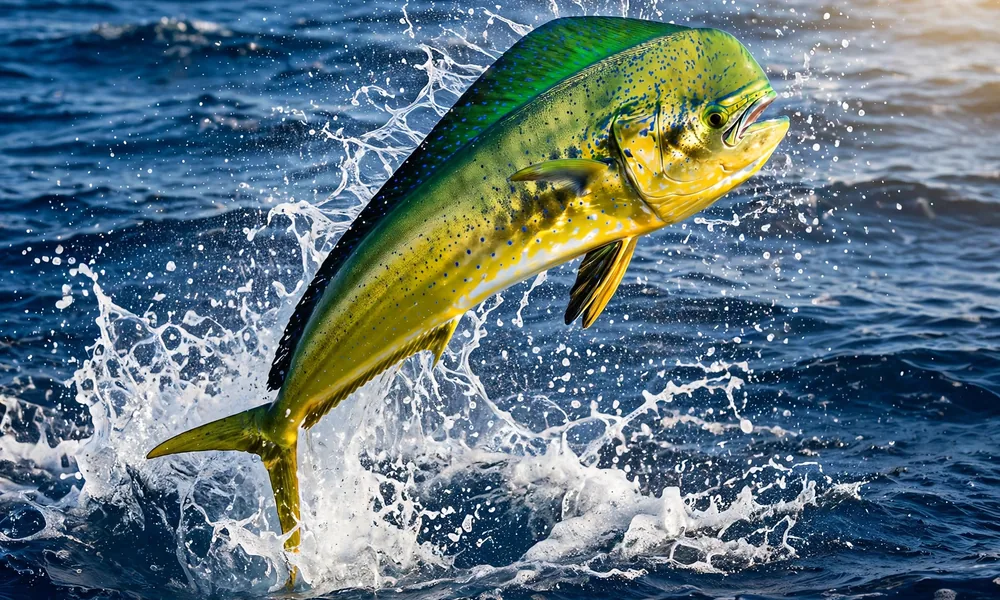
The leap is the behaviour people ask about most, and it is worth describing properly. A mahi-mahi chasing a flying fish will follow its prey right out of the water, leaving the sea in a shining green-and-gold arc and landing with a crash a few metres away, and it will do it again and again until the prey is caught or escapes. The fish also leaps when it is hooked, which is why anglers prize it so highly: a hooked mahi-mahi will jump, run and shake its head in a fight that can last for minutes, and it is that fight, as much as the taste, that has made the fish famous. A leaping mahi-mahi is not showing off and it is not in trouble: it is hunting, or it is trying to throw a hook, and either way it is using the whole of its speed and strength.

Young mahi-mahi behave differently from adults, and they are far more dependent on shelter. Juveniles stay tight to the sargassum, hiding among the weed and darting out only to snatch a small shrimp or a tiny fish, and they grow so fast that the shelter that suited them last month is too small for them this month. As they grow, they range further from the weed and spend more time in open water, and by the time a fish reaches about half a metre it is hunting in the open like an adult. That shift from a weed-hiding youngster to an open-water hunter is one of the clearest signs that a mahi-mahi has grown up, and it is also why the biggest fish are the ones found furthest from the floating shelter.
Breeding and life cycle
Mahi-mahi breed in the warm months, when the surface water is at its warmest and food is plentiful for the young. Spawning takes place in open water, where a female releases her eggs into the current and the male fertilises them as they drift, and a large female can release tens of thousands of eggs at a time, spawning several times over the course of a season. The eggs are tiny, buoyant and transparent, and they drift with the plankton in the surface waters, hatching within a day or two of being laid.

The larvae are tiny and defenceless, and most of them are eaten within days, which is why the numbers are so large. Those that survive drift with the sargassum and settle into the floating weed, where they grow fast on small shrimps and tiny fish, and the growth rate is extraordinary: a young mahi-mahi can reach about 40 centimetres in a few months, and it can grow to nearly a metre in its first year. It reaches breeding size at about four to five months old, when it is roughly 50 centimetres long, which is one of the youngest breeding ages of any large ocean fish, and from then on it lives as a fast, open-water hunter.

Growth slows once a mahi-mahi reaches adult size, and the fish keeps growing slowly for the rest of its life, which is thought to last about four to five years in the wild. There is no parental care at all: once the eggs are released, the adults swim away, and the young are on their own from the moment they hatch. It is a hard start, and the survival rate is low, but the fish that make it through the first months in the sargassum have a good chance of a fast, bright life in the open ocean, and the short life and early breeding are the reason the species can stand heavy fishing without collapsing.
Conservation status
The mahi-mahi is listed as Least Concern by the International Union for Conservation of Nature, and the reasoning is straightforward: it has a very large range, it is still common across much of that range, and it grows so fast and breeds so young that its numbers can recover quickly. It is one of the most heavily fished species in the tropical oceans, taken by longlines, purse seines and sport anglers, but the catch has stayed broadly steady, and the species is found in warm surface waters from the Atlantic to the Pacific.
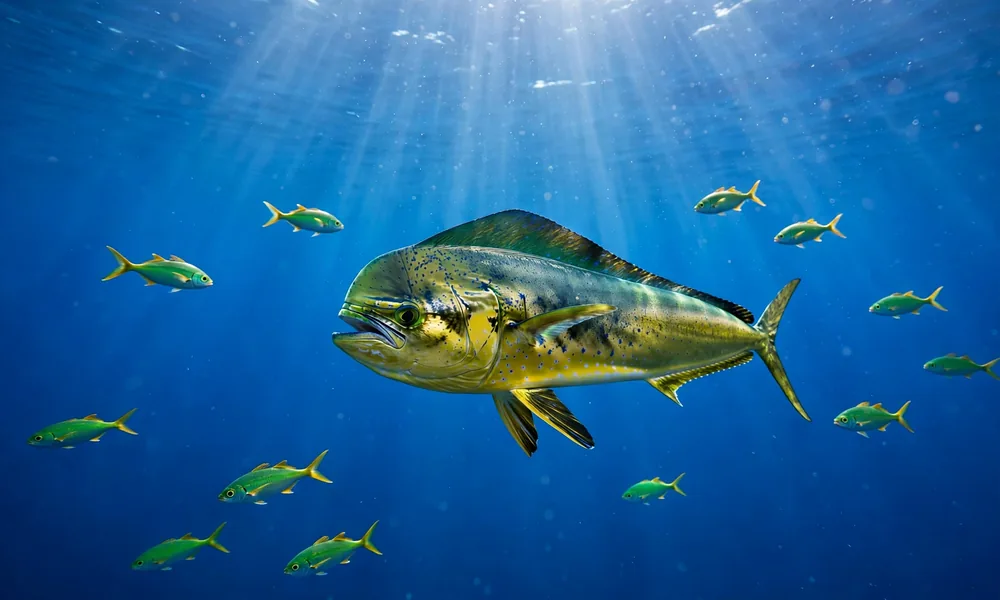
The real pressure on the mahi-mahi is not the number of fish taken but the health of the open ocean it lives in. Floating sargassum is its nursery, and anything that damages the weed or pollutes the surface waters hits the young fish first, while the warming of the seas is already shifting where the fish are found, pushing them further from the equator as the water warms. Plastic is a growing problem too, because mahi-mahi gather under floating debris, and a fish that shelters under a drifting bottle or a piece of net can swallow plastic or be caught in it. The most useful conservation work is practical: keeping the surface waters clean, managing the fisheries so that the breeding fish are not all taken, and making sure that the sargassum beds that shelter the young are left to drift in peace.
There is one more issue that matters to people who eat mahi-mahi, and it is worth stating plainly. Like many large ocean fish, mahi-mahi can carry mercury, which builds up in the fish over its life, and the levels are moderate, higher than in small fish such as sardines but lower than in the biggest predators. Most adults can eat mahi-mahi regularly without worry, but pregnant women and young children are usually advised to eat it in moderation and to follow local advice, and that caution is well founded.
Best seasons for mahi-mahi watching
The best time to look for a mahi-mahi depends on where you are, because the fish lives in warm water all year round and there is no single season for the whole range. In Florida and the Caribbean, the peak months run from about April to September, when the fish push north with the warming water and the weed lines are thickest, and a summer morning off the Florida coast is one of the best places in the world to find one. In Hawaii, the fish are there all year, with the best catches in spring and autumn, and in the eastern Pacific off Mexico and Central America, the warm season from late spring to early autumn is the time to go.

The best hours are the early morning and the late afternoon, when the mahi-mahi are hunting and the flying fish are on the move. At midday, a mahi-mahi will often be holding under a weed line or in the shade of a floating log, resting in the deeper water, and it is still worth looking for, but it is less likely to be leaping. A boater who follows a weed line slowly, watches for birds diving on small fish, and keeps an eye on the water under any floating debris has a good chance of meeting one, and a diver who hangs still near the surface will often find that the mahi-mahi come to look at them.
Staying safe around mahi-mahi
A mahi-mahi is not a fish that threatens people, and it is a safe fish to meet in the water. It has no interest in swimmers, it has no venom, and its teeth are small, made for gripping small fish rather than for biting anything large. The only real risk comes from a hooked fish on a boat, because a mahi-mahi fights hard, leaps wildly and shakes its head, and a fish thrashing on a deck can injure a careless angler with its tail or its gill covers. Keep your hands clear of a green fish on the deck, use a gaff or a net to bring it aboard, and never lean over a fish that is still jumping.
There are a few practical points for the water itself. Never spearfish with dead fish on a belt or a stringer near your body, because any large predator will come for the catch, and never feed a mahi-mahi or wave food at one, because a fish that learns to associate boats with food loses its caution. If a mahi-mahi follows you, stay calm and keep swimming slowly: it is almost certainly curious, not aggressive, and it will lose interest. Like the marlin, a mahi-mahi is a powerful fish that deserves respect rather than fear, but the marlin is an open-ocean giant that can weigh more than a person, while the mahi-mahi is a bright, fast hunter that will come close enough to show you its colours and then be gone.
Mahi-mahi watching checklist
A little preparation turns a morning on the open sea into a real chance of meeting one of these bright hunters face to face.
- A visit in the warm season, from about April to September in Florida and the Caribbean, when the fish push north and the weed lines are thickest.
- An early morning or late afternoon trip, when the mahi-mahi are hunting and the flying fish are on the move.
- A weed line, a floating log or a buoy to follow, where a mahi-mahi can hunt in the shade and find shelter.
- A slow approach that keeps you still in the water, because a mahi-mahi that is not startled will often drift closer to look at you.
- A pair of polarised sunglasses, so you can see the green and gold flash of a fish under the surface glare.
- A mask, snorkel and fins in good order, and a buddy beside you, because the open ocean is deep water and the current can pick up fast.
- Respect for the animal and its ocean, keeping your distance, never feeding it, and leaving the weed lines and the water as you found them.
Frequently asked questions
How big do mahi-mahi get?
Most adult mahi-mahi measure 70 centimetres to 1 metre long, and a good fish weighs 7 to 15 kilograms. The largest on record reach about 1.5 metres and close to 40 kilograms, which makes the mahi-mahi one of the biggest fast-growing fish of the tropical surface waters.
Is a mahi-mahi a dolphin?
No, a mahi-mahi is not a dolphin. It is a true fish, Coryphaena hippurus, also called the dolphinfish, and it breathes through gills and lays eggs. Dolphins are mammals that breathe air and feed their young on milk, and the two are not related at all, even though the English name has confused people for centuries.
What do mahi-mahi eat?
A mahi-mahi eats flying fish, small fish such as sardines and anchovies, squid, shrimps and small crabs, taking whatever is commonest near the surface. It hunts by cruising under floating weed and then striking in a fast burst, and it will leap clear of the water after flying fish.
How fast do mahi-mahi grow?
Mahi-mahi are one of the fastest-growing fish in the sea. A young fish can reach about 40 centimetres in a few months and nearly a metre in its first year, and it can start breeding at about four to five months old. That fast growth and early breeding are the reasons the species can recover quickly from heavy fishing.
Why do mahi-mahi change colour?
A mahi-mahi can change its shade in seconds, flashing brighter when it is excited or hunting, and the colour fades fast once the fish is out of the water. The change is made by special cells in the skin that open and close to show different pigments, and it helps the fish blend into the changing light of the open ocean.
How is this guide different from the lungfish guide?
This guide covers the mahi-mahi, a bright, fast hunter of the warm open ocean that chases flying fish near the surface, leaps clear of the water and grows to nearly a metre in its first year, while our lungfish guide covers a slow, ancient freshwater fish that lives in rivers and swamps, breathes air through a lung and can survive the dry season buried in the mud. One is a sprinter of the open sea; the other is a survivor of the drying river.
Conclusion
The mahi-mahi species is a reminder that a fish does not need to be the biggest in the ocean to be the one everyone remembers. A body built for bursts of speed, colours that seem to glow from inside, a growth rate that few fish can match and a leap that takes it clean out of the water have made Coryphaena hippurus the most recognisable fish of the tropical surface, at home under a weed line, under a log and in the open blue alike.
If you go looking for one, go on a calm morning, follow the weed line, and keep your eyes on the water under anything floating. Find the flash of green and gold, watch it watch you, and you will have met the fish that the whole open ocean keeps an eye on.