The swordfish species is a single species, Xiphias gladius, a flat-sworded hunter of the deep oceans, and one of the fastest fish in the sea. If you are asking how many swordfish species there are, the answer is one: there is only one swordfish species in the world, and every swordfish alive today belongs to it.
The swordfish belongs to the family Xiphiidae, and it is the only living member of its family. It lives in the tropical and temperate oceans around the world, from the surface to the deep sea, and its flat sword, its huge eyes and its warm brain make it one of the most remarkable fish on Earth.
Key takeaways
- There is only one swordfish species, Xiphias gladius, and it is the only living member of its family.
- Swordfish have a flat sword, not a round bill, and they use it to slash at schools of fish and squid.
- Swordfish can warm their eyes and brains, letting them hunt in cold deep water where other fish go blind.
- Swordfish are among the fastest fish in the sea, reaching speeds of up to 100 kilometres per hour in short bursts.
- Swordfish are listed as Least Concern, and Atlantic stocks have recovered after catch limits were set.
What makes a swordfish a swordfish
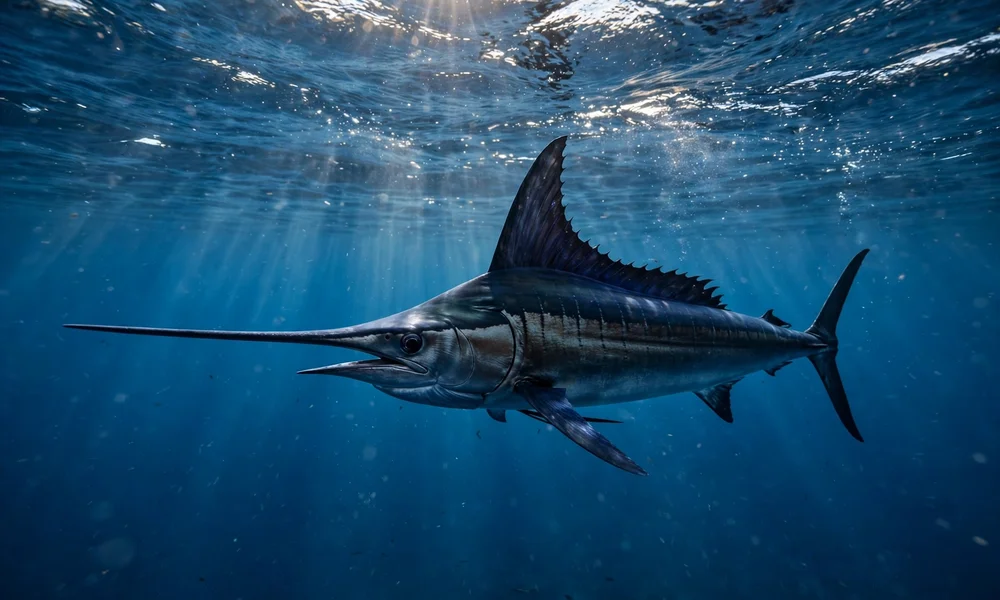
A swordfish is a huge ocean fish with a long flat sword, a tall dorsal fin, a deeply forked tail and a dark back with a silver belly, and it measures roughly 2 to 4.5 metres long and usually weighs between 100 and 650 kilogrammes, with females far larger than males. The sword is about a third of the fish’s whole length, and it is flat, not round like a marlin’s bill.
The eyes define the swordfish: huge eyes that the fish can warm with a special heater organ, letting it see in the cold dark deep sea where other fish go blind. The swordfish is one of the few fish that can warm its own brain and eyes, and it uses this trick to hunt squid in water colder than 10 degrees. Like other tuna, the swordfish is a fast powerful swimmer of the open ocean, but it is a billfish, not a tuna, and it hunts alone instead of in schools.
The swordfish species and their relatives
There is one swordfish species, Xiphias gladius, and it is the only living member of its family. Swordfish in different oceans form separate populations, in the Atlantic, Pacific and Indian oceans, but they are all the same species, and the fish migrate thousands of kilometres between their feeding and breeding grounds.
The blue marlin is the swordfish’s most famous relative, a giant billfish of the tropical oceans with a round bill, while the black marlin is a billfish of the Indo-Pacific with a short bill. The striped marlin is a billfish of the Pacific with bold stripes, the white marlin is a small billfish of the Atlantic, and the Atlantic sailfish is a billfish with a huge sail-like dorsal fin. The shortbill spearfish is a small billfish of the tropical oceans.
| Type | Animal | Where it lives | Best-known food | Length or Weight |
|---|---|---|---|---|
| Species | Swordfish (Xiphias gladius) | Tropical and temperate oceans worldwide | Squid, tuna and mackerel | Up to 4.5 m, up to 650 kg |
| Close relative | Blue marlin | Tropical and temperate oceans worldwide | Tuna, mackerel and squid | Up to 5 m, up to 900 kg |
| Close relative | Black marlin | Tropical Indo-Pacific | Tuna, mackerel and squid | Up to 4.6 m, up to 750 kg |
| Close relative | Striped marlin | Tropical Pacific and Indian oceans | Tuna, sardines and squid | Up to 4.2 m, up to 220 kg |
| Close relative | White marlin | Tropical Atlantic | Small fish and squid | Up to 2.8 m, up to 82 kg |
| Close relative | Atlantic sailfish | Tropical Atlantic | Small fish and squid | Up to 3.4 m, up to 100 kg |
| Close relative | Shortbill spearfish | Tropical Pacific and Indian oceans | Small fish and squid | Up to 2.5 m, up to 50 kg |
How swordfish live
Swordfish are creatures of the open ocean. A swordfish lives alone, roaming the deep blue water by day and night and following the squid and tuna where they gather, and it can roam over thousands of kilometres in a single year. Like other marlins, the swordfish is a billfish, but it is a deep diver, and it hunts in cold dark water where marlins rarely go.
Squid, tuna and mackerel make up most of the diet, along with herring, lanternfish and crustaceans, and a swordfish eats by slashing sideways with its flat sword through a school of fish, stunning them, and then turning back to eat them one by one. It hunts mostly at night, when squid rise to the surface, and it can dive to depths of more than 500 metres in search of food, using its heated eyes to see in the dark.
Breeding happens in the warm tropical seas, and the female releases millions of tiny eggs into the water, where the male fertilises them. The eggs drift in the plankton, and the larvae hatch in a few days, and the tiny swordfish grow fast, reaching a metre long in their first year. The young have scales and teeth and a short snout, and they lose their scales and teeth as they grow, and their snout grows into a sword. Swordfish live for around 9 to 15 years, with females living longer than males.
Where swordfish live
The swordfish lives in the tropical and temperate oceans around the world, from the Atlantic to the Pacific and Indian oceans, and it is most common in the warm waters off Florida, Hawaii, Mexico and Australia, where squid and tuna are plentiful. It is seen regularly in the Gulf Stream off Florida, where the swordfish hunt squid at night.
Warm open water is the key requirement. A swordfish needs warm water at the surface, with plenty of squid and tuna to eat, and deep water to dive in, so it follows the warm currents as they move with the seasons, and when the water cools the swordfish move towards the equator. It depends on the squid staying plentiful, and it hunts the same waters year after year, returning to the same seamounts and currents.
The species is listed as Least Concern, and its numbers have recovered strongly since catch limits were set. The main pressures are overfishing by longlines, and the loss of tuna and squid to the same fleets. Atlantic swordfish stocks were once badly overfished, but catch limits and minimum sizes have let them recover, and the fishery is now one of the best-managed in the world.
Best seasons for swordfish watching
There is no closed season, because swordfish are active all year, but the best time to look for them depends on where you go. In Florida the best months are often May to September, when the swordfish gather in the Gulf Stream. In Hawaii the best months are often June to October, when the swordfish follow the squid into the warm water.
Staying safe around swordfish
A swordfish is a wild animal with a sharp sword and a powerful tail, and it can injure a person with a slash of its sword, though swordfish almost never attack people. Keep your distance, never swim near a hooked swordfish, and never try to touch or feed a swordfish, because a swordfish that is fighting on a line may leap out of the water and land on a boat. If you see swordfish from a boat, stay in the boat, and watch with binoculars, because swordfish that are disturbed may leave their feeding grounds for good.
Swordfish watching checklist
A little preparation turns an ocean visit into a real chance of seeing a swordfish, so pack for sun, salt spray and long quiet hours.
- Binoculars with good low-light performance, for picking a leaping swordfish out of the blue water.
- A camera with a zoom lens, because swordfish should always be watched from a distance.
- Sun cream and a hat, because the best watching is in the bright midday sun.
- A booked boat tour with a guide who knows the swordfish grounds and the safe routes.
- A plan to be out at night, when the swordfish rise to the surface to hunt squid.
- Patience and silence, because swordfish are shy animals and a noisy group will send them away.
- A field guide to ocean fish, for telling a swordfish from a marlin at a glance.
Frequently asked questions
How many swordfish species are there?
There is one swordfish species, Xiphias gladius. It is the only living member of its family, and its closest relatives are the marlins, the sailfish and the spearfish, but they are all separate species.
How is a swordfish different from a marlin?
A swordfish has a flat sword, no scales and no teeth as an adult, and it is the only member of its family, while a marlin has a round bill, keeps its scales and teeth, and belongs to the billfish family with the sailfish. The swordfish can also warm its eyes and brain, which marlins cannot do.
How fast can a swordfish swim?
Swordfish are among the fastest fish in the sea, reaching speeds of up to 100 kilometres per hour in short bursts. They use their speed to chase tuna and squid, and to escape from sharks and killer whales, their main predators.
Can you keep a swordfish as a pet?
No. A swordfish is a wild animal that needs the open ocean, swims thousands of kilometres, and is protected by fishing law in most of the places where it lives. Swordfish in aquariums do not exist, and they are not pets.
How is this guide different from the marlin species guide?
This guide covers the single swordfish species, a flat-sworded hunter that warms its eyes to hunt in the cold deep sea, while our marlin species guide covers four marlin species, giant billfish that slash at schools of fish in the tropical open oceans. The swordfish is up to 4.5 metres long and dives deeper than 500 metres, and the blue marlin is up to 5 metres long and hunts near the surface.
Are swordfish endangered?
Swordfish are listed as Least Concern, so they are not classed as endangered. Atlantic stocks were once badly overfished, but catch limits and minimum sizes have let them recover, and the fishery is now one of the best-managed in the world.
Conclusion
The swordfish species shows how much power one fish can hold: a single species of flat-sworded hunter, with heated eyes, speed like an arrow, and a life spent roaming the deep oceans of the world.
If you go looking for one, go in the summer to Florida or Hawaii, go quietly, and go with patience. Watch a swordfish leap clear of the water at night and you will understand why it has earned its place as the swordsman of the sea, and why keeping its oceans clean matters most.