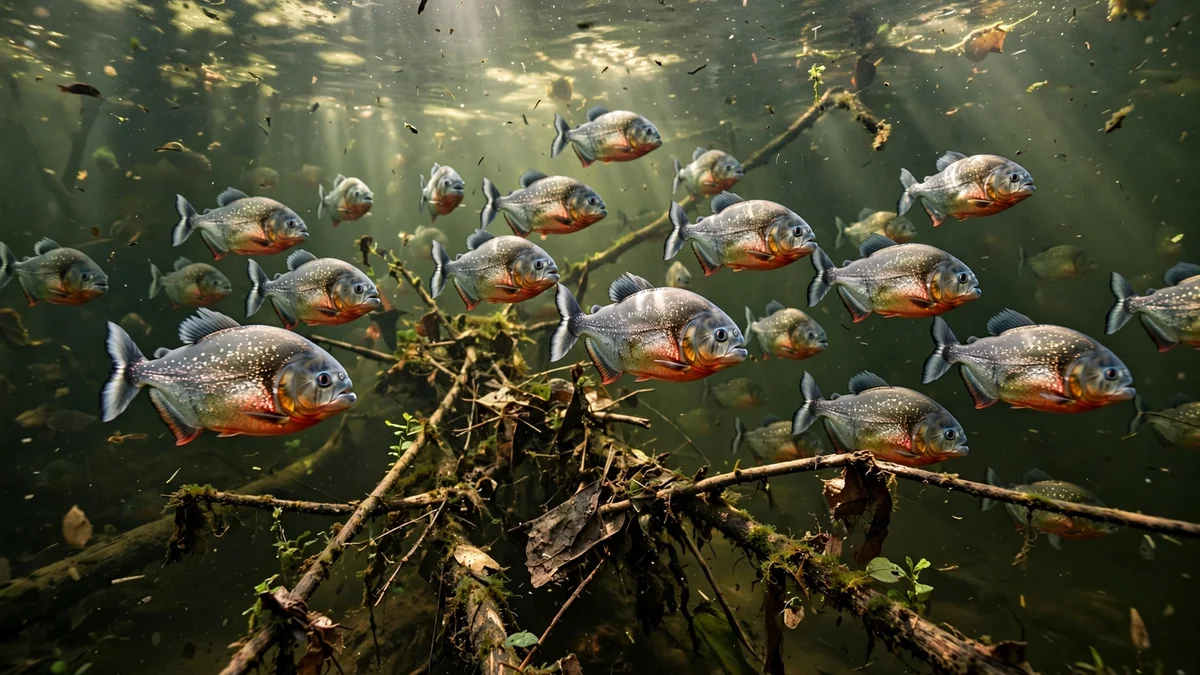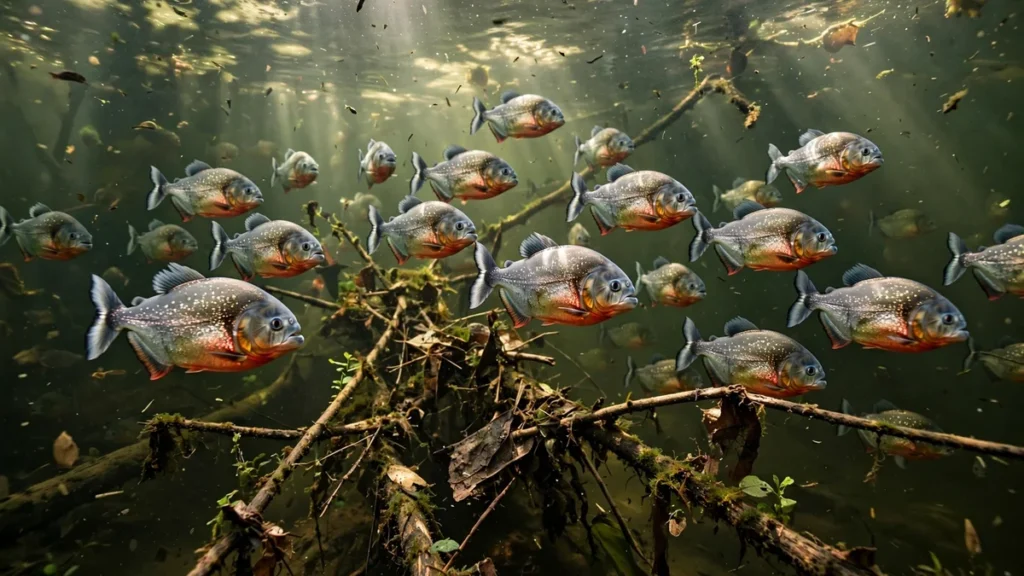
The piranha species number more than thirty, sharp-toothed fish of the Amazon, and they are among the most feared fish in the world, with teeth so sharp they can strip a carcass to bone. If you are asking how many piranha species there are, the answer is more than thirty: there are more than thirty recognised piranha species in the world, in the family Serrasalmidae, and every piranha alive today belongs to one of them.
The piranha belongs to the family Serrasalmidae, along with its vegetarian relatives the pacus, and it lives in the slow rivers and floodplains of South America, from the Amazon to the Orinoco. Its silver body, its red belly, its razor teeth and its shoaling habit make it one of the most recognisable fish on Earth.
Key takeaways
- There are more than thirty piranha species, in the family Serrasalmidae, from the red-bellied piranha to the black piranha.
- Piranhas have triangular razor-sharp teeth that interlock, and the black piranha has one of the strongest bites of any fish for its size.
- Piranhas mostly scavenge and hunt small fish, and the Hollywood image of piranhas stripping a cow in seconds is a myth.
- Piranhas live in shoals of dozens of fish, which protects them from predators like caimans and dolphins.
- Most piranha species are listed as Least Concern, and they are an important part of the Amazon food web.
What makes a piranha a piranha
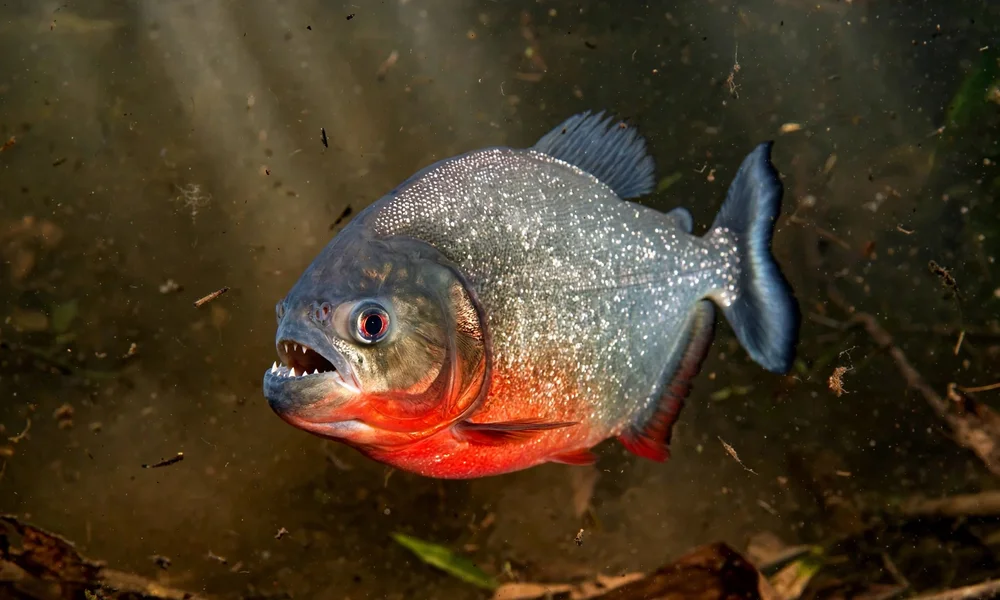
A piranha is a deep-bodied freshwater fish with a blunt head, a powerful jaw, triangular razor-sharp teeth and a silver or grey body, and it measures roughly 15 to 50 centimetres long and usually weighs between 0.5 and 4 kilogrammes, depending on the species. The red-bellied piranha is the best known, at about 30 centimetres, while the black piranha is the largest, at up to 50 centimetres.
The teeth define the piranha: triangular teeth with razor edges that interlock like scissors, and a jaw that can snap shut with enormous force. The black piranha has one of the strongest bites of any fish for its size, and its bite has been measured at around 320 newtons, more than thirty times its own body weight. Like other tuna, the piranha is a fast powerful swimmer, but it is a river fish, not an ocean fish, and it lives in warm slow water instead of the open sea.
The piranha species and their relatives
There are more than thirty piranha species, in several genera. The genus Pygocentrus holds the true piranhas, with five species including the red-bellied, black and piraya piranhas. The genus Serrasalmus holds the smaller piranhas, with more than twenty species, and the wimple piranha is a long-snouted piranha that eats the scales off other fish.
The red-bellied piranha is the best-known piranha, with a silver body and a red belly, and it lives across the Amazon basin. The black piranha is the largest, with a dark body and a powerful bite, and it lives in the Amazon and Orinoco. The white piranha is a pale piranha of the Amazon, the red-eye piranha has a red eye and a silver body, and the wimple piranha has a long snout for picking scales. The pacu is a vegetarian cousin with blunt teeth, and the silver dollar is a round silvery cousin that eats plants.
| Type | Animal | Where it lives | Best-known food | Length or Weight |
|---|---|---|---|---|
| Species | Red-bellied piranha (Pygocentrus nattereri) | Amazon, Paraguay and Parana rivers | Fish, insects and carrion | Up to 33 cm, up to 3.9 kg |
| Close relative | Black piranha | Amazon and Orinoco basins | Fish and carrion | Up to 50 cm, up to 3 kg |
| Close relative | White piranha | Amazon basin | Fish, insects and carrion | Up to 40 cm, up to 2 kg |
| Close relative | Red-eye piranha | Amazon and Orinoco basins | Fish and crustaceans | Up to 30 cm, up to 1 kg |
| Close relative | Wimple piranha | Amazon and Orinoco basins | Fish scales and fins | Up to 25 cm, up to 0.5 kg |
| Close relative | Pacu | Amazon and Orinoco basins | Fruit, nuts and plants | Up to 90 cm, up to 25 kg |
| Close relative | Silver dollar | Amazon basin | Plants and small animals | Up to 15 cm, up to 0.2 kg |
How piranhas live
Piranhas are creatures of the slow river. A piranha lives in a shoal, a group of dozens of fish that swim, feed and rest together, and the shoal protects each fish from caimans, dolphins and herons. Like other goldfish, the piranha is a freshwater fish, but it is a hunter and a scavenger, and it feeds in bursts, tearing at prey and then backing off.
Fish, insects, crustaceans and carrion make up most of the diet, along with fruit and seeds that fall into the water, and a piranha eats by tearing chunks from its prey with its sharp teeth, swallowing the flesh and spitting out the bones. It feeds mostly at dawn and dusk, when the light is low, and it scavenges dead animals from the riverbed, cleaning the river of carrion.
Breeding happens in the rainy season, when the rivers flood the forest, and the pair digs a shallow nest in the riverbed, where the female lays thousands of eggs. The male guards the nest, fanning the eggs with his fins and chasing away intruders, and the eggs hatch in a few days, and the tiny fry hide among the flooded plants, eating microscopic animals until they are big enough to hunt. Piranhas live for around 10 years in the wild, and up to 25 years in captivity.
Where piranhas live
The piranha lives in the slow rivers and floodplains of South America, from the Amazon and Orinoco basins to the Paraguay and Parana rivers, and it is most common in the whitewater rivers of the Amazon, where the water is murky and the food is thick. The red-bellied piranha lives across the Amazon basin, while the black piranha lives in the Amazon and Orinoco, and the piraya piranha lives only in the Sao Francisco river of Brazil.
Slow warm water is the key requirement. A piranha needs warm water above 20 degrees, with plenty of fish and carrion to eat, and flooded forest to spawn in, so it follows the flood as the rivers rise and fall with the seasons, and when the dry season comes the piranhas gather in the remaining pools. It depends on the flood staying regular, and it spawns in the flooded forest year after year, returning to the same waters.
Most species are listed as Least Concern, and piranhas are still common across the Amazon. The main pressures are the loss of floodplain to farming, the damming of rivers, and overfishing, though piranhas breed fast and their numbers recover quickly. Piranhas are an important part of the Amazon food web, cleaning the rivers of dead animals and feeding caimans, dolphins and herons.
Best seasons for piranha watching
There is no closed season, because piranhas are active all year, but the best time to look for them depends on where you go. In the Amazon the best months are often June to November, the dry season, when the rivers fall and the piranhas gather in the remaining pools. In the Pantanal the best months are often May to September, when the water is low and clear.
Staying safe around piranhas
A piranha is a wild animal with razor-sharp teeth and a powerful bite, and it can bite hard enough to take a finger, though piranhas almost never attack people. Keep your distance, never wade in murky water with an open wound, and never try to touch or feed a piranha, because a piranha that is handled may bite, and its teeth can cut deep. If you see piranhas while swimming, stay calm, move slowly, and leave the water, because piranhas that are feeding in a shoal may nip at anything in the water.
Piranha watching checklist
A little preparation turns a river visit into a real chance of seeing a piranha, so pack for heat, humidity and long quiet hours.
- Polarised sunglasses, for cutting the glare and seeing into the water.
- A camera with a zoom lens, because piranhas should always be watched from a distance.
- Sun cream and a hat, because the best watching is in the bright midday sun.
- A booked boat tour with a guide who knows the piranha pools and the safe routes.
- A plan to be out in the morning, when the piranhas are most active and feeding.
- Patience and silence, because piranhas are shy animals and a noisy group will send them away.
- A field guide to Amazon fish, for telling a red-bellied piranha from a black piranha at a glance.
Frequently asked questions
How many piranha species are there?
There are more than thirty piranha species, in the family Serrasalmidae. The red-bellied piranha is the best known, and the black piranha is the largest, but new species are still being found, and the count changes as scientists study them.
Do piranhas really strip animals to bone in seconds?
No. The Hollywood image of piranhas stripping a cow to bone in seconds is a myth, and it comes from a famous story in which Theodore Roosevelt watched piranhas eat a cow that had already been killed and cut open. Wild piranhas mostly scavenge and hunt small fish, and they feed in short bursts, not in frenzies.
Why do piranhas live in shoals?
Piranhas live in shoals because a shoal protects each fish from predators. Caimans, dolphins and herons hunt piranhas, and a lone piranha is easy prey, while a shoal of dozens of fish is hard to attack, and the fish in the middle of the shoal are safest of all.
Can you keep a piranha as a pet?
Yes, in some countries. Piranhas are kept in aquariums, and they need a large tank, clean water and a diet of fish and meat, but they are banned as pets in many places, and they should never be released into a river, where they could become invasive.
How is this guide different from the goldfish species guide?
This guide covers more than thirty piranha species, sharp-toothed hunters and scavengers of the Amazon rivers, while our goldfish species guide covers the single goldfish species, an orange pond fish bred in China into more than a hundred breeds. The piranha is up to 50 centimetres long and eats fish with razor teeth, and the goldfish is up to 30 centimetres long and eats plants and insects.
Are piranhas endangered?
Most piranha species are listed as Least Concern, so they are not classed as endangered. Piranhas are still common across the Amazon, though the damming of rivers and the loss of floodplain are the main threats.
Conclusion
The piranha species show how much power one fish can hold: more than thirty species of sharp-toothed hunter, with teeth like scissors, shoals of dozens, and a life spent in the slow rivers of the Amazon.
If you go looking for one, go in the dry season to the Amazon or the Pantanal, go quietly, and go with patience. Watch a shoal of piranhas move through the murky water and you will understand why it has earned its place as the most feared fish of the Amazon, and why keeping its rivers matters most.