
The nurse shark species is the slow, bottom-living shark that spends its days asleep in a pile on a coral reef and its nights hoovering lobsters out of crevices in the warm Atlantic. If you are asking what a nurse shark is, the short answer is Ginglymostoma cirratum, a broad-headed carpet shark with two fleshy barbels under its snout, a small mouth built for suction, and a habit of resting in groups on the sand while other sharks keep swimming. Adults commonly measure 2.3 to 2.7 metres, the longest reliably documented reached about 3.1 metres, and a big animal weighs up to about 110 kilograms, which makes it one of the largest sharks you are likely to meet on a shallow reef.
Most people meet a nurse shark the same way I did, on a dive over a sand flat in the Caribbean, when the guide pointed down at what looked like a log lying in the shade of a coral head and the log turned out to be a shark, asleep in the middle of the day with two more sharks piled on top of it. There is no menace in the meeting at all. The shark opened one small eye, looked at us with the mild interest of an animal that has decided we are not food, and went back to sleep. That is the heart of this guide: how a single species of shark became the gentle giant of the shallow reef, how it lives, hunts and breeds in the warm, clear water it calls home, and why divers love it while fishermen have pushed it towards trouble.
Key takeaways
- The nurse shark species is Ginglymostoma cirratum, a member of the nurse shark family Ginglymostomatidae, native to the warm, shallow waters of the Atlantic.
- It is named for its sluggish, bottom-living habits, and adults commonly measure 2.3 to 2.7 metres, with the longest reliably documented reaching about 3.1 metres.
- Nurse sharks are nocturnal suction feeders that pull lobsters, crabs, snails and small fish out of reef crevices with a powerful gulp.
- By day they rest in groups of up to 40 animals, piled together in caves and under ledges on the reef.
- They are listed as Vulnerable, are slow to breed, and are mostly seen by divers and snorkellers on Caribbean reefs.
The nurse shark species and their relatives
Nurse sharks belong to the family Ginglymostomatidae, a small family of carpet sharks found in the shallow, tropical and subtropical waters of the world. The family holds four living species in three genera, and every one of them shares the same broad head, the same pair of fleshy barbels, the same small mouth set under the snout and the same slow, bottom-living way of life. They range in size from the short-tail nurse shark of about 75 centimetres to the tawny nurse shark of about 3.2 metres, so the family as a whole spans about 75 cm to 3.2 m long, and the nurse shark sits near the top of that range as the largest and best known of them all. National Geographic’s profile of the nurse shark gives the same broad picture, a big, slow, bottom-living shark of warm shallow water, and this guide builds on that picture with the detail of how the animal actually lives.
The nurse shark, Ginglymostoma cirratum, is the lead species of this guide, and it is a good ambassador for the whole family. It is a long, thickset shark with a yellowish-tan to dark brown back, a pale belly and a broad, flat head, and it is found on reefs, sand flats, seagrass beds and mangrove channels from Rhode Island and Florida through the Gulf of Mexico and the Caribbean to southern Brazil, and along West Africa from Senegal to Gabon. It grows to about 3.1 metres at the very largest, it is most active at night, and it is the shark that divers mean when they talk about the sleepy shark of the reef, an animal with a reputation for gentleness that has followed it from the Florida Keys to the barrier reef of Belize. If you have dived a shallow Caribbean reef, there is a fair chance the broad brown shape lying on the sand was a nurse shark, or one of its close cousins in the same family.
| Type | Animal | Where it lives | Best-known food | Length or Weight |
|---|---|---|---|---|
| Family | Nurse sharks (Ginglymostomatidae) | Shallow tropical waters of the Atlantic and Indo-Pacific | Crustaceans, molluscs and small fish | About 75 cm to 3.2 m long |
| Genus | Nurse sharks (Ginglymostoma) | Tropical Atlantic and eastern Pacific | Crustaceans, molluscs and small fish | About 2.0 m to 3.1 m long |
| Species | Nurse shark (Ginglymostoma cirratum) | Warm, shallow waters of the Atlantic | Spiny lobsters, crabs and small fish | About 2.3 m to 3.1 m long |
| Species | Pacific nurse shark (Ginglymostoma unami) | Eastern Pacific, from Mexico to Peru | Crustaceans, molluscs and small fish | About 2.0 m to 2.8 m long |
| Species | Tawny nurse shark (Nebrius ferrugineus) | Reefs of the tropical Indo-West Pacific | Crustaceans, molluscs and small fish | About 2.3 m to 3.2 m long |
| Species | Short-tail nurse shark (Pseudoginglymostoma brevicaudatum) | East Africa and Madagascar | Small crustaceans and molluscs | About 75 cm long |
The closest relative of the nurse shark, and the one it was confused with until very recently, is the Pacific nurse shark, Ginglymostoma unami, the nurse shark of the eastern Pacific. Like the nurse shark, the Pacific nurse shark is a member of the genus Ginglymostoma, but it lives on the other side of the Americas, from the Gulf of California to Peru, and it was only recognised as a separate species in 2015, after scientists realised the Pacific animals were not the same as the Atlantic ones. The genus as a whole spans about 2.0 m to 3.1 m long, and the Pacific species sits at the smaller end of it, with adults around 2 metres, the largest measured at about 2.1 metres and some accounts citing up to 2.8 metres. Like the shark in our general guide, the nurse shark is a hunter that sits near the top of its food chain, but most sharks are fast, open-water hunters that never stop swimming, while the nurse shark is a slow, bottom-living animal that spends half its life asleep on the sand.
Within the family, the species sort themselves by the ocean they live in. The nurse shark is the Atlantic species, at home from Florida to Brazil and West Africa. The tawny nurse shark, Nebrius ferrugineus, is the Indo-Pacific species, a fish of about 2.3 m to 3.2 m long that lives on the reefs of the Maldives, Thailand and northern Australia. The short-tail nurse shark, Pseudoginglymostoma brevicaudatum, is the dwarf of the family, a fish of about 75 cm long that lives off East Africa and Madagascar. The four of them share the same shape and the same habits, and they are separated mostly by the water they swim in.
What a nurse shark looks like
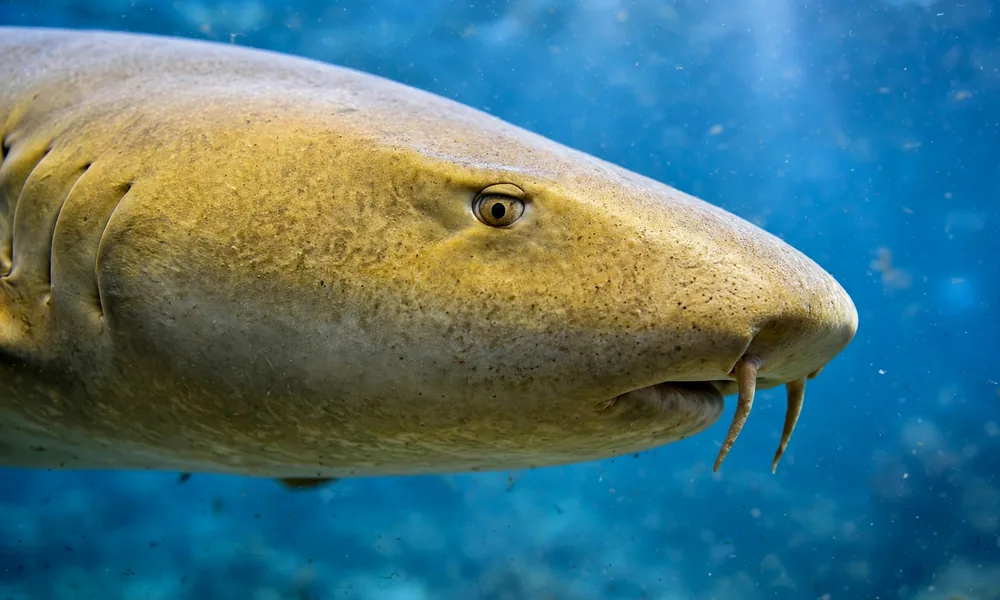
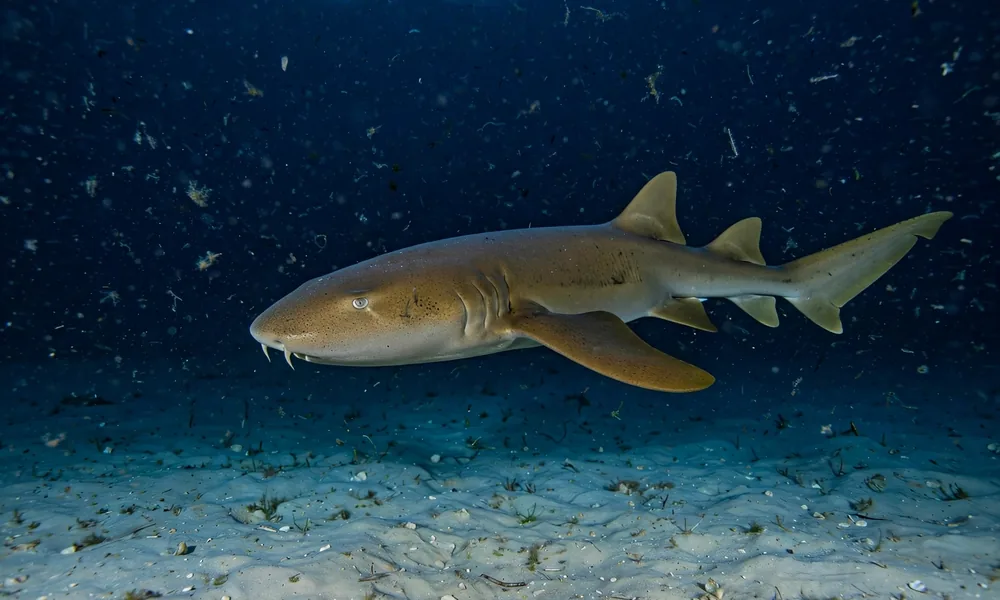
A nurse shark is a long, thickset fish, built low and broad like a shark that has decided to live on the bottom and stay there. Adults commonly measure between 2.3 and 2.7 metres from snout to tail, and a big animal weighs up to about 110 kilograms, though a shark of 90 or 100 kilograms is a fine sight, and the longest reliably documented reached about 3.1 metres. The body is round in cross-section and thickest just behind the head, and it tapers to a very long tail that makes up more than a quarter of the whole length of the animal. The back is yellowish-tan to dark brown, fading to a pale, almost cream belly, and the skin looks smooth and plain, with no spots or stripes on an adult, though the young carry small dark spots that fade as they grow.
The head is broad and flat, and the snout is the feature that gives the fish its look. It is short and blunt, with the mouth set well underneath it, and between the nostrils sit two fleshy barbels, like short whiskers, that the shark uses to feel its way along the seabed and to taste the water for food. The eyes are small and set high on the head, and behind them sit the spiracles, the small openings that let the shark draw water over its gills while it lies still on the bottom. The two dorsal fins are rounded and set far back on the body, the first much larger than the second, and the pectoral fins are broad and muscular, strong enough for the shark to push itself along the seabed almost as if it were walking. The tail has no lower lobe to speak of, which is unusual for a shark, and it gives the animal a long, tapering look from behind.
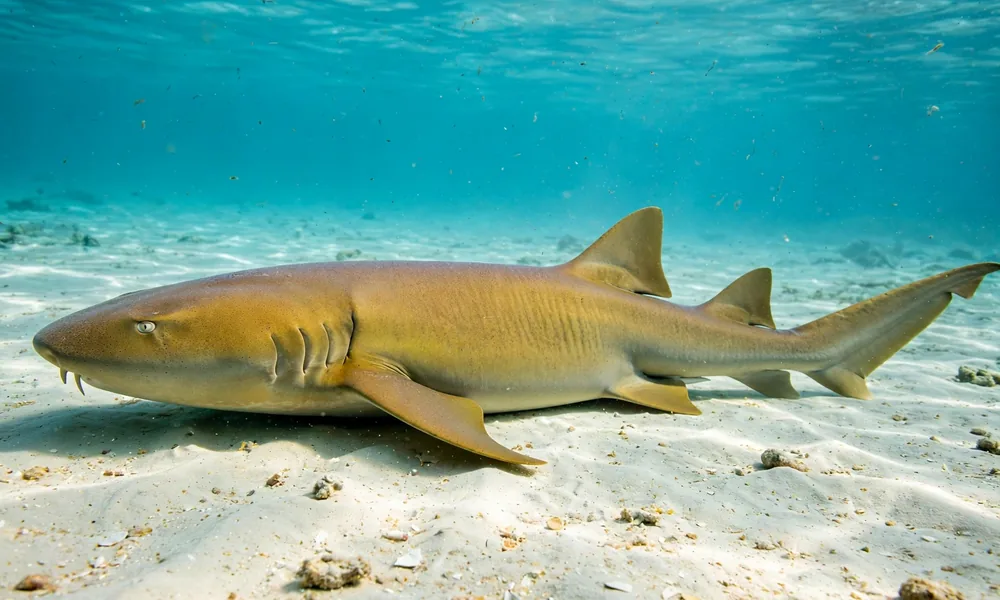
Compared with its cousins, the nurse shark is easy to tell apart once you know what to look for. The tawny nurse shark has more pointed, angular fins and a slightly longer snout, while the short-tail nurse shark is a dwarf that barely reaches your knee. Like the tiger shark, the nurse shark is a big shark of warm water, but the tiger shark is a fast, open-water hunter with stripes and a mouth full of cutting teeth, while the nurse shark is a slow, bottom-living animal with a small mouth and flat teeth for crushing shells, a difference that shapes everything about how the two animals live.
Where nurse sharks live
Nurse sharks live in the warm, shallow waters of the Atlantic, and they are at home on coral reefs, sand flats, seagrass beds and mangrove channels. Their range runs from Rhode Island in the north, as a rare summer visitor, south through Florida and the Gulf of Mexico and the whole Caribbean to southern Brazil, and on the other side of the Atlantic from Senegal to Gabon, with the centre of abundance in the Florida Keys, the Bahamas, the Yucatan coast of Mexico and the barrier reef of Belize. They favour water that is warm, usually 22 degrees Celsius and above, and they are rarely found in cold water, where other sharks take their place. Wherever there is warm water, a reef and something to hide under, there is a good chance a nurse shark is nearby.
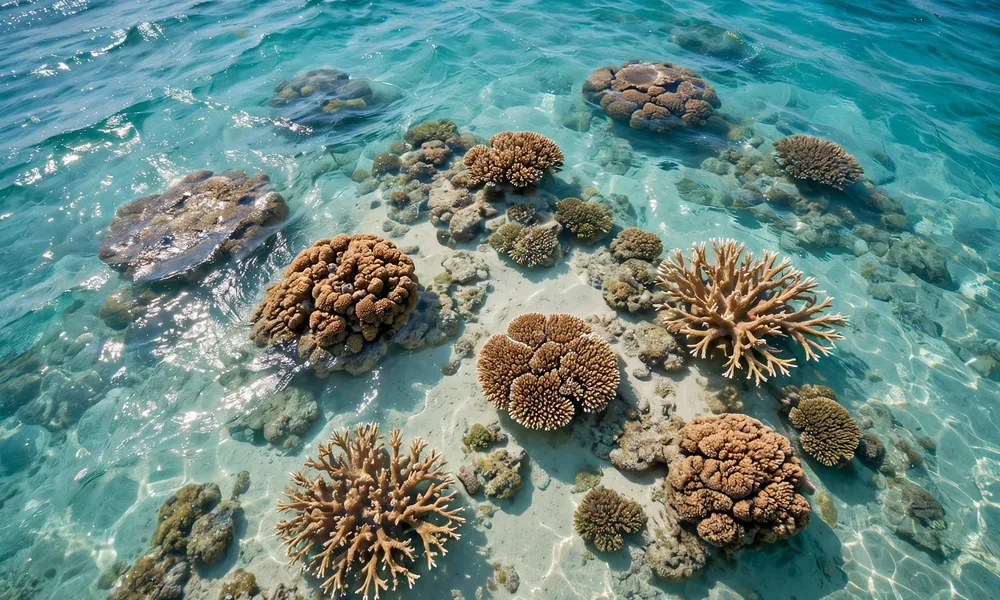
The habitat they choose is the bottom of the sea, and they are rarely found far from shelter. Most nurse sharks live in water between 1 and 35 metres deep, on the sand flats, in the channels and around the coral heads, where the food is richest and the shelter is thickest. They favour places with plenty of caves and ledges, which give them both a resting place by day and a hunting ground by night, and they are less common in open water, where there is little to eat and nowhere to hide. A nurse shark spends much of its life within a small patch of reef, sometimes no larger than a few hundred metres, and tagged animals in Florida have returned to the same ledge year after year, knowing every cave and every crevice in that patch the way you know the rooms of your own house.
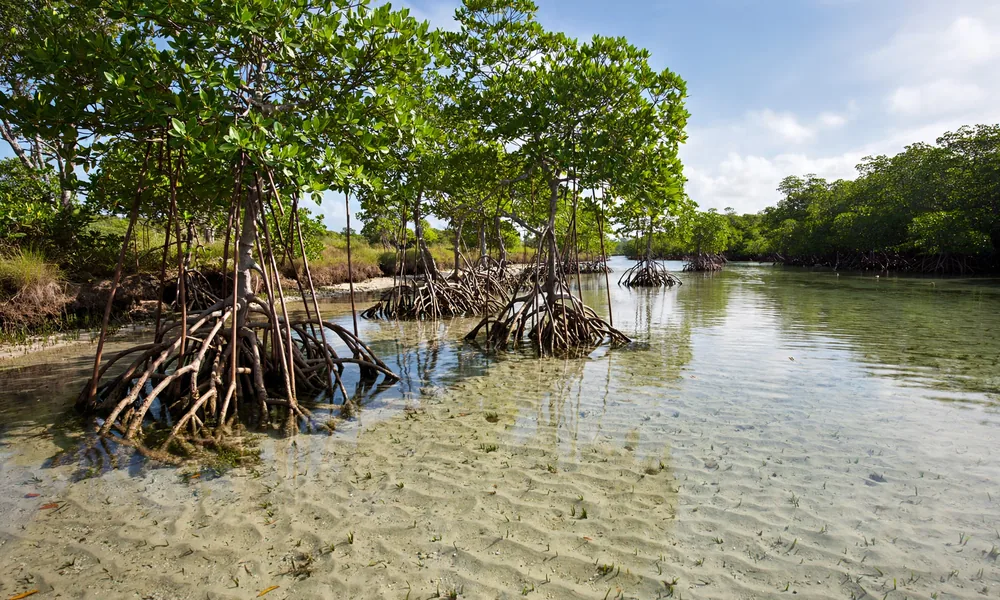
The nurse shark has stayed close to its home waters, and it has not spread the way some sharks have, because it needs warm, shallow water and it does not cross deep ocean easily. It is common on the reefs of the Caribbean and the Bahamas, and it is a regular sight for divers in Florida and Belize. Like the lemon shark, the nurse shark is a shark of shallow tropical water that uses mangroves as a nursery, but the lemon shark is a faster, more active swimmer that patrols the flats by day, while the nurse shark sleeps by day and hunts by night, and it is the night hunter that divers find asleep on the sand.
What nurse sharks eat
Nurse sharks are hunters, not grazers, and their diet is written on the reef itself. The everyday food is slow-moving animals of the seabed, and a nurse shark will eat almost any creature it can suck out of a crevice, from spiny lobsters and crabs to shrimps, snails, clams, sea urchins, squid and octopus. They also eat small fish, from grunts and catfish to stingrays and puffers, and a big nurse shark will take a stingray without a second thought. A single nurse shark may eat several lobsters in a night, and a reef full of nurse sharks can keep the numbers of shellfish in check, which is one reason they sit near the top of the food chain on so many shallow reefs.
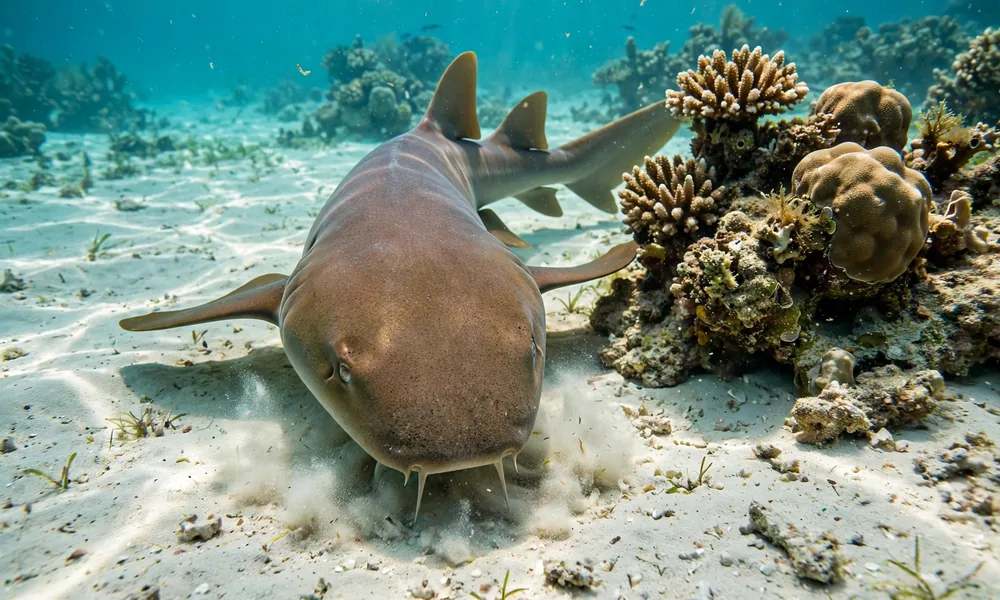
What sets the nurse shark apart is how it hunts. It does not chase its prey across open water, and it does not hunt in a pack. It works slowly along the bottom, using its barbels to feel for food hidden in the sand and in the crevices of the reef, and when it finds something it opens its mouth and sucks with a force that is among the strongest of any fish in the sea. The rush of water pulls the prey straight out of its hiding place, and the flat teeth at the back of the mouth crush the shell before the shark swallows. The whole strike takes a fraction of a second, and the shark then moves on to the next crevice, working the reef in a slow, unhurried way until it has eaten its fill. A nurse shark can even suck a snail out of a heavy conch shell, which is a trick few other fish can manage.
How nurse sharks behave
Nurse sharks are night animals, and their day is a quiet round of sleeping, waking and hunting along the bottom. They wake at dusk, leave the cave or the ledge where they spent the day, and move out onto the sand flats and the reef to feed, and they spend the night working the bottom in a slow, unhurried way, never rushing, never chasing far. They are not strong swimmers over distance, and they do not need to be: their life is lived within a few hundred metres of reef, and speed matters less than knowing every cave and every crevice. When a larger shark passes, a nurse shark will often lie flat on the bottom and stay still, relying on its dark back to blend into the reef, and if that fails it will push itself into the nearest cave and wait.

The most famous behaviour in the nurse shark is the resting pile. By day, nurse sharks gather in caves and under ledges, lying close together and sometimes piled on top of one another, in groups that can reach 40 animals. The pile is not a trick, but a way of life, and a nurse shark that has found a good cave will return to it day after day, sharing the space with the same animals, which is why divers who know a reef can find the same sharks in the same cave on every visit. The sharks in the pile are not asleep in the way we are, but they are resting, breathing slowly through their spiracles, and they will stay there until dusk calls them out to hunt.
Breeding and life cycle
Nurse sharks breed slowly, and the timing is set by the warm water rather than the calendar. The sharks mate in late spring and summer off Florida, when the water is at its warmest, and the courtship is a slow affair, with males swimming alongside the females and biting gently at their fins to hold on. A female may mate with more than one male, and she carries the bite marks of the courtship for weeks afterwards. The female gives birth to live young, and she does so only every second year, which is slow for a shark and is one reason the species is slow to recover when its numbers fall.
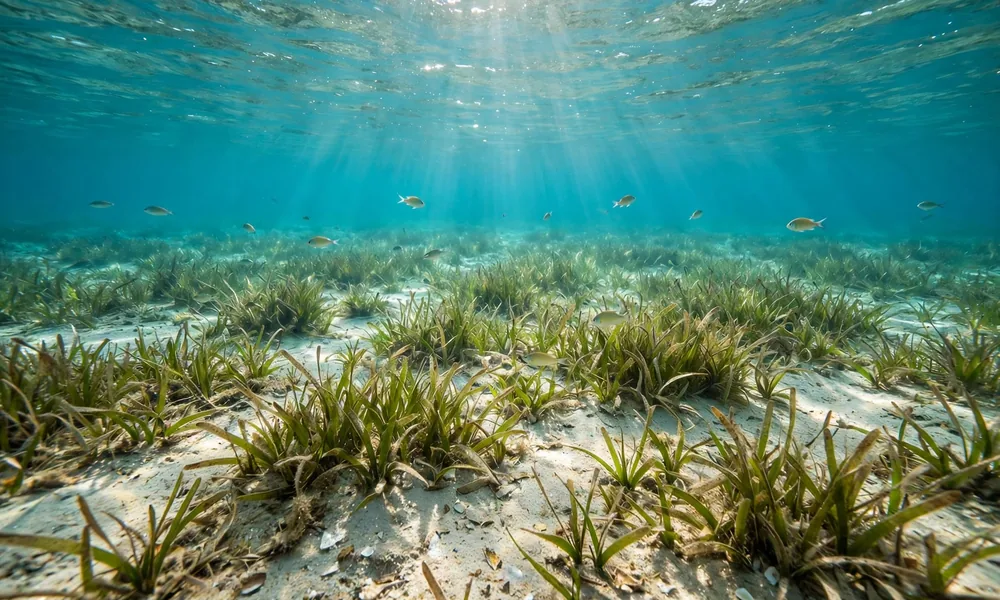
The female carries her young for five to six months, and she gives birth to a litter of 20 to 30 pups, each about 30 centimetres long when it is born. The pups are born in late spring and summer, in the shallow water of the reef flats and the mangrove channels, where the water is warm and the big predators cannot follow. The young are on their own from the day they are born, able to feed and hide within hours, and they must hide well, because a bigger shark will eat a smaller one without a second thought. They spend their first years in water of only 1 to 4 metres, among the mangrove roots and on the seagrass flats, and they move into deeper water as they grow.
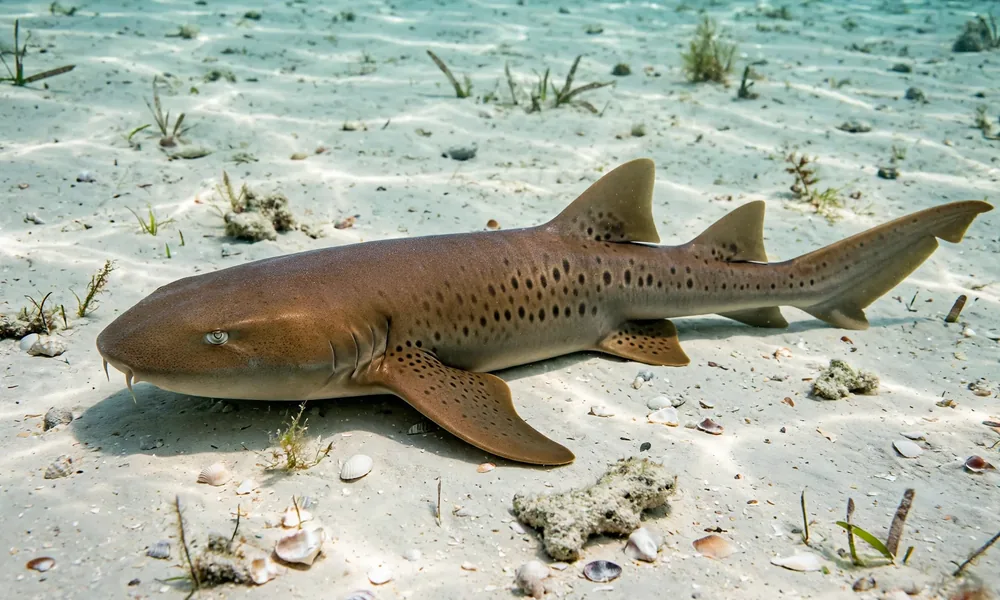
Growth is slow, and a young nurse shark takes many years to reach breeding size. Males mature at 10 to 15 years, when they are close to 2.3 metres long, and females mature later, at 15 to 20 years, when they are about 2.3 to 2.4 metres long. The lifespan in the wild is about 25 years, with some animals living to 35 years in aquaria, where the food is regular and the dangers are few. The slow growth and the late breeding mean that a nurse shark population that loses its big females takes a long time to replace them, which is why the species is watched so closely by the people who study sharks.
Conservation status
The nurse shark is listed as Vulnerable by the International Union for Conservation of Nature, and the reasoning is straightforward: its numbers have fallen in many places, it breeds slowly, and it lives in shallow water where people fish. The assessment was made in 2019 and published in 2021, and it raised the species from an earlier listing of Data Deficient, on evidence of population declines in the Caribbean and South America. That broad picture hides a more hopeful local one, and it is worth understanding both sides, because the nurse shark is doing well in Florida and the Bahamas, where it is protected, and badly in places where it is still caught for its meat and fins.
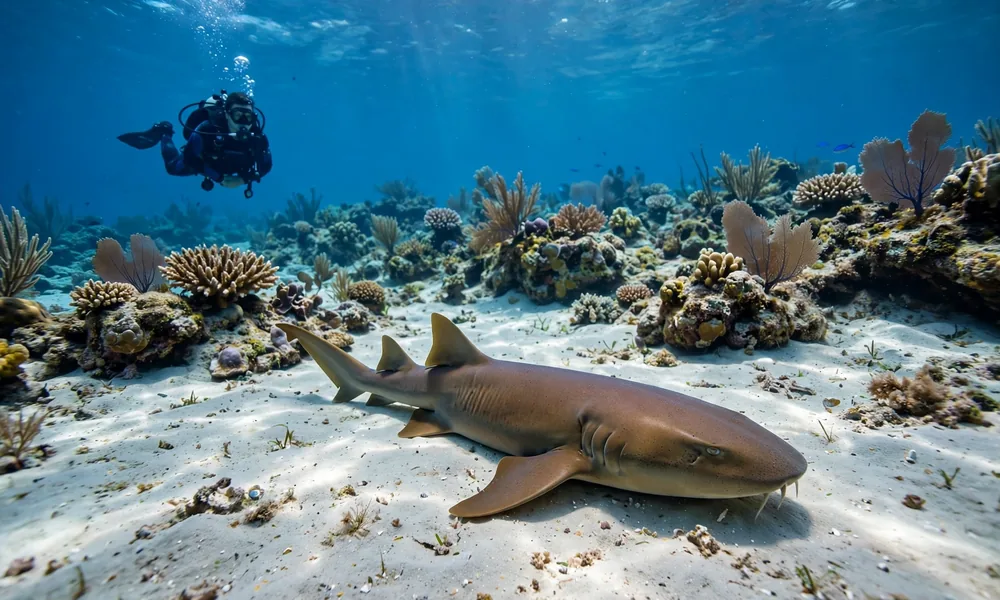
The main pressure is fishing. Nurse sharks are caught directly in some places for their meat, their fins and their skin, which makes a tough leather, and they are caught by accident in others, in nets and on lines set for other fish. A shark that lives in shallow water and returns to the same ledge year after year is an easy shark to catch, and a population that loses its big females loses its best breeders. Habitat loss is a second pressure, as the mangroves and seagrass beds where the young live are cleared for building, and a reef that loses its nursery loses its sharks within a generation or two.
Best seasons for nurse shark watching
The best time to look for a nurse shark is the dry season, when the seas are calm and the water is clear, and the fish are easy to see on the reef. In Florida and the Bahamas that usually means the months from about November to May, when the water is warm and the visibility is at its best, and in Belize the season runs longer, with good diving through most of the year. Nurse sharks are present on the reef all year round, and they do not migrate, so there is no wrong season in the strict sense, but a calm, clear day in the dry season will show you far more sharks than a rough day in the storm season, when the water is cloudy and the sharks stay deep in their caves.
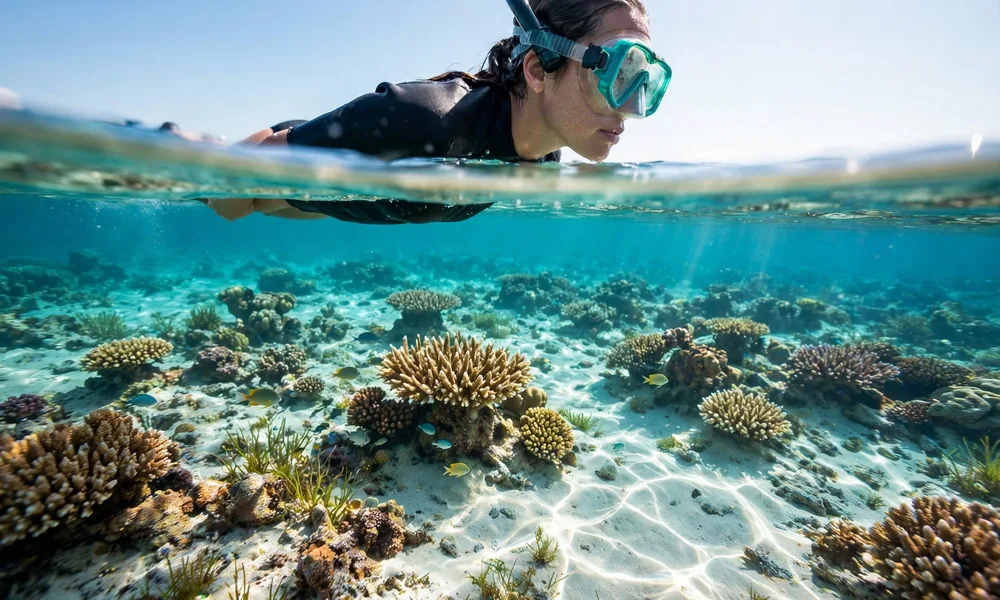
The best hours are the middle of the day, when the nurse sharks are resting in their caves and under their ledges, and the light is good for seeing them. From about ten o’clock in the morning until three in the afternoon, the sharks are lying in their piles, and they are at their most approachable then, though approachable means watching from a few metres away, not touching. A slow swim over the reef, with the sun behind you and a mask that fits well, is all you need, and the sharks will often lie close enough to see the barbels and the small eyes clearly, if you move gently and keep your distance.
Staying safe around nurse sharks
A nurse shark is not dangerous to people who leave it alone, and there is no safety warning that belongs to the shark itself when you are swimming or diving on a reef. It is not aggressive, it does not chase swimmers, and no bite on record has been fatal. The bites that do happen are almost always provoked, by a diver who grabs the shark, or a swimmer who steps on one lying on the sand, and the safety rules are simple: watch the shark, watch the water, and respect the animal that you came to see. Never touch a nurse shark, never pull its tail, never try to feed it, and never step on the sand without looking where your feet are going.
There are a few practical points for the water itself. Dive or snorkel with a buddy, stay within your depth, and keep an eye on the weather, which can change fast on a reef, with wind and waves rising in minutes. Wear fins that fit, and keep clear of the reef itself, because the coral can cut you far more easily than a nurse shark can. If a nurse shark swims towards you, stay still and let it pass, and if one is lying on the sand, give it a wide berth and swim around it. A nurse shark will not hurt you if you treat it with care, but the sea can, and the sensible approach is to enjoy the shark and respect the reef it lives on.
Nurse shark watching checklist
A little preparation turns a day on the reef into a real chance of seeing nurse sharks at their best, resting in their caves in clear, warm water.
- A visit in the dry season, when the seas are calm, the water is clear and the sharks are easy to see on the reef.
- A midday dive or snorkel, when the nurse sharks are resting in their caves and under their ledges.
- A shallow reef with sand flats, coral heads and ledges, where the sharks rest by day and hunt by night.
- A slow swim over the reef, watching for a broad brown shape lying on the sand or tucked under a ledge.
- A mask that fits well and fins that fit, so you can watch the reef without kicking up the sand.
- A buddy and a boat that knows the reef, so that a day on the water stays safe from start to finish.
- Respect for the shark and the reef, keeping your distance, never touching a resting shark, and leaving the reef as you found it.
Frequently asked questions
How big do nurse sharks get?
Most nurse sharks measure between 2.3 and 2.7 metres from snout to tail, and a big animal weighs up to about 110 kilograms. A shark of 2.5 metres is a fine sight, and the longest reliably documented reached about 3.1 metres. Older reports of nurse sharks of 4.3 metres and more are not backed by a measured animal, and the honest maximum is about 3.1 metres. Females grow larger than males, and the biggest nurse sharks on any reef are almost always female.
What do nurse sharks eat?
A nurse shark eats spiny lobsters, crabs, shrimps, snails, clams, sea urchins, squid and octopus, and small fish such as grunts, catfish and stingrays. It is a suction feeder that works slowly along the bottom, using its barbels to feel for food hidden in the sand and in the crevices of the reef, then opening its mouth and sucking the prey out with a force that is among the strongest of any fish in the sea. The flat teeth at the back of the mouth crush the shell before the shark swallows.
Do nurse sharks sleep in piles?
Yes, nurse sharks rest together in groups by day, lying close together and sometimes piled on top of one another in caves and under ledges, in groups that can reach 40 animals. The pile is a resting place, not a hunting pack, and a nurse shark that has found a good cave will return to it day after day, sharing the space with the same animals. At dusk the sharks leave the pile one by one and swim out onto the reef to hunt alone through the night.
Are nurse sharks dangerous?
No, nurse sharks are not dangerous to people who leave them alone. They are not aggressive, they do not chase swimmers, and no bite on record has been fatal. Their whole defence is built on being hard to see, hard to catch and hard to hold, and their first response to a threat is to lie still or to dart into the nearest cave. The bites that do happen are almost always provoked, by a diver who grabs the shark or a swimmer who steps on one, so the safety rule is simple: look, do not touch.
Can you keep a nurse shark in an aquarium?
You can, but it is hard, and most people should not try. A nurse shark grows to 2.3 to 2.7 metres, it needs a very large tank with clean, warm, well-oxygenated water, and it eats lobsters, crabs and fish, which makes it expensive and demanding to keep. It is also illegal to keep one in some places without a permit, and a shark that outgrows its tank must never be released into the sea where it does not belong. A nurse shark belongs on a reef, not in a living room.
How is this guide different from the northern pike guide?
This guide covers the nurse shark, a saltwater shark of 2.3 to 2.7 metres that hunts by suction on warm Atlantic reefs and sleeps in piles in caves by day, while our northern pike guide covers a freshwater fish of 40 to 55 centimetres that hunts by ambush in cold, weedy lakes and scatters its eggs in flooded shallows each spring. One is a shark you watch from a dive boat on a coral reef; the other is a fish you watch from the bank of a northern lake at dawn.
This guide also goes further than our general shark guide, which covers sharks as a whole, from the great white to the whale shark, in broad strokes. That guide tells you what a shark is; this one tells you what one shark does, hour by hour, from the resting pile at midday to the suction feeding at midnight, with the exact sizes, the exact litter of 20 to 30 pups, the Vulnerable listing and the reefs where you can actually find the animal. If you want the whole family of sharks, read the general guide first, and if you want the nurse shark itself, this is the guide to read.
Conclusion
The nurse shark species is a reminder that a shark does not need to be fast or frightening to be unforgettable. A broad flat head, two fleshy barbels, a suction feeding trick that is among the strongest in the sea and a habit of sleeping in piles in caves have made the nurse shark the gentle giant of the shallow reef, at home on a sand flat in the Bahamas, a coral head in Belize and a mangrove channel in Florida alike.
If you go looking for one, go on a calm, clear day in the dry season, go at midday, and swim slowly over a shallow reef with the sun behind you. Find the ledge, look into the shade of the cave, and watch for a broad brown shape lying on the sand, and you will have met the nurse shark that turns a quiet reef into a place of slow, brown wonder.













