The pufferfish species is the round, slow-swimming fish that can turn itself into a spiky balloon in a matter of seconds. If you are asking what a pufferfish is, the short answer is a member of the family Tetraodontidae, a group of about 193 species that live mostly on tropical coral reefs, carry four fused teeth in a beak, and hold one of the strongest natural poisons known, tetrodotoxin, in their skin and organs. The most famous of them is the tiger puffer of Japan, eaten as fugu by people who trust a licensed chef with their lives, and the strangest is the white-spotted puffer, a fish barely 12 centimetres long whose males build giant sand mandalas on the sea floor to win a mate.
Most people meet a pufferfish in an aquarium or on a dive, and the meeting usually starts with a smile. The big eyes, the tiny pursed mouth and the round body make it look permanently surprised, and then somebody tells you the fish can kill you, and the smile turns into respect. That is the heart of this guide: how a slow, defenceless-looking fish became one of the best-defended animals in the sea, and why the same fish is a delicacy, a danger and a marvel of engineering all at once.
Key takeaways
- The pufferfish species belong to the family Tetraodontidae, a group of about 193 species found mostly in tropical and subtropical seas, with some in fresh water.
- They have no ribs and no pelvic fins, four fused teeth that form a beak, and an elastic stomach that lets them inflate to two or three times their normal size.
- Many pufferfish carry tetrodotoxin, a poison about 1,200 times stronger than cyanide, stored in the liver, ovaries and skin, with no known antidote.
- They eat hard-shelled food such as molluscs, crustaceans and sea urchins, crunching the shells with a beak that grows all through their lives.
- Most pufferfish are listed as Least Concern, but the Chinese puffer is Critically Endangered and at least seven other species are Endangered.
The pufferfish species and their relatives
Pufferfish belong to the family Tetraodontidae, a name that comes from the Greek words for four and teeth, and it fits them exactly, because every pufferfish carries four fused teeth that form a hard, parrot-like beak. The family holds about 193 species in around 27 genera, from the dwarf puffer of India, which grows to only about 2.5 centimetres, to the stellate pufferfish, which reaches about 120 centimetres, so the family spans a range of about 2.5 centimetres to 120 centimetres from its smallest member to its largest. National Geographic keeps a short profile of the pufferfish, and it covers the broad strokes well, but it leaves the detail to the imagination, and this guide fills the gaps it leaves behind, from the sand mandalas to the poison and the fugu chefs.
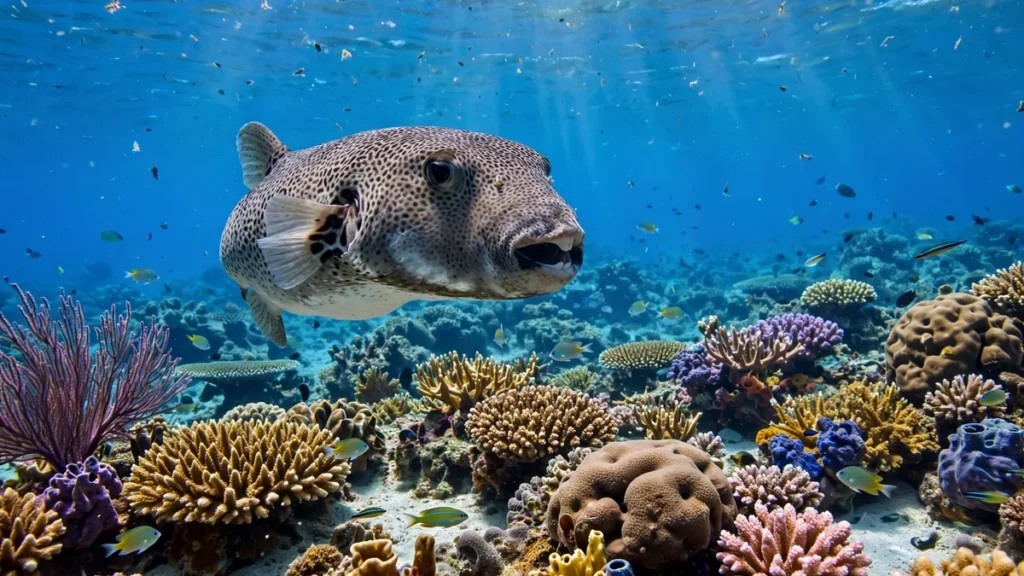
The stellate pufferfish, Arothron stellatus, is the lead species of this guide, and it is a good ambassador for the whole family. It is a big, bold reef fish of the Indo-Pacific, growing to about 120 centimetres, with a body patterned in dark spots and blotches that look like a map drawn on its skin. It swims slowly over coral reefs and lagoons, crunching sea urchins and shellfish with its beak, and when it is threatened it swallows water and turns into a spiky ball that no predator can swallow. Divers often drift past one hovering in the open water, unbothered, because almost nothing on the reef wants to eat it.
| Type | Animal | Where it lives | Best-known food | Length or Weight |
|---|---|---|---|---|
| Family | Pufferfishes (Tetraodontidae) | Tropical seas and fresh waters worldwide | Molluscs, crustaceans and algae | About 2.5 cm to 120 cm long |
| Genus | Reef puffers (Arothron) | Coral reefs of the Indo-Pacific | Molluscs, crustaceans and sea urchins | About 30 cm to 120 cm long |
| Species | Stellate pufferfish (Arothron stellatus) | Coral reefs and lagoons of the Indo-Pacific | Molluscs, crustaceans and sea urchins | Up to about 120 cm long |
| Species | Mbu puffer (Tetraodon mbu) | Rivers and lakes of central Africa | Molluscs, crustaceans and snails | Over 50 cm long, over 5 kg |
| Species | Tiger puffer (Takifugu rubripes) | Coastal seas of the north-west Pacific | Molluscs, crustaceans and crabs | Up to about 80 cm long |
| Species | Dwarf puffer (Carinotetraodon travancoricus) | Fresh waters of south-west India | Small snails and insect larvae | About 2.5 cm long |
The closest relatives of the stellate pufferfish are the other members of its genus, Arothron, the big reef puffers, and they are the largest of all the puffers, ranging from about 30 centimetres to 120 centimetres. The genus holds the guinea fowl puffer, a fish of the Indo-Pacific that can be golden yellow or dark brown with white spots, and the blackspotted puffer, a reef fish of about 80 centimetres common on coral slopes. Like the clownfish, the stellate pufferfish is a reef fish that lives its whole life among the corals, but the clownfish is a small fish that hides in a stinging anemone for safety, while the pufferfish carries its own protection in its skin and its stomach, and needs no anemone at all.
Within the family, the species sort themselves by the water they like. The Arothron puffers are the big reef fish of the open coral, slow and bold and hard to miss. The Mbu puffer is the giant of fresh water, a river fish of central Africa that grows to over 50 centimetres and weighs over 5 kilograms, and it is the largest freshwater pufferfish of all. The tiger puffer is the famous one, a coastal fish of the north-west Pacific that grows to up to about 80 centimetres and is eaten as fugu in Japan, and the dwarf puffer is the tiny one, a freshwater fish of south-west India that grows to only about 2.5 centimetres.
What a pufferfish looks like
A pufferfish is a round, thick-bodied fish, built like a balloon with fins, and it looks quite unlike any other fish on the reef. Most species measure between about 10 and 40 centimetres, and a good-sized stellate pufferfish reaches about 120 centimetres, though most of the ones you meet on a dive are closer to 50 or 60 centimetres. The body is short and deep, with a blunt head, a small mouth and large eyes set high on the sides, and the skin is thick and rough, covered in small spines that lie flat when the fish is relaxed and stand upright when it inflates. There are no scales, no pelvic fins and no ribs, and the tail is small, with the dorsal and anal fins set far back near it.
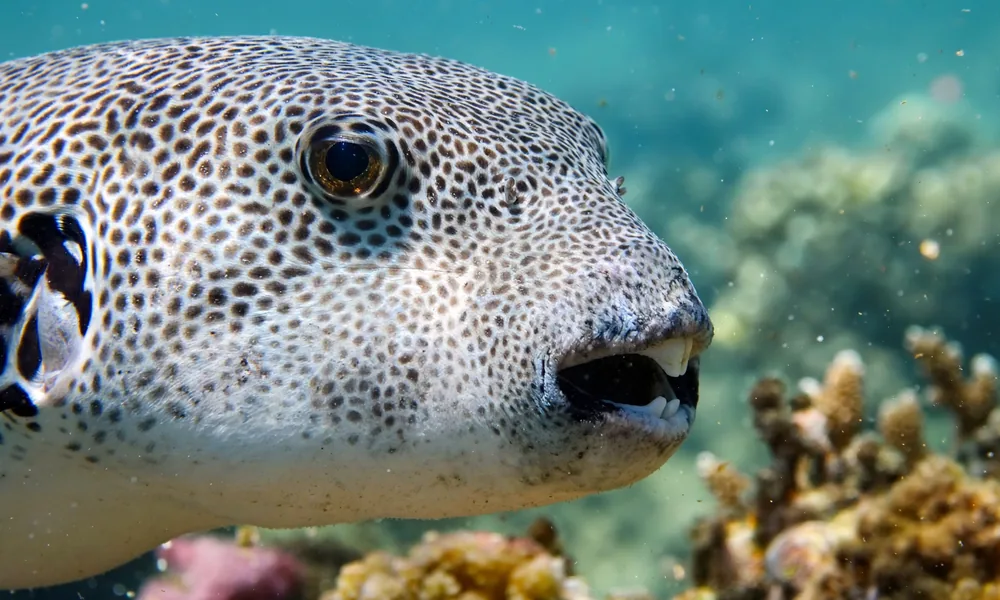
The head is large and round, and the mouth is the feature that gives the family its name, in a roundabout way. The four fused teeth form a beak that never stops growing, and the fish wears it down by crunching hard shells. The teeth are strong enough to crack a clam shell or a sea urchin, and they are the reason a pufferfish can eat food that other reef fish cannot touch. The eyes are large, and they move independently, so the fish can watch for food on one side and danger on the other.
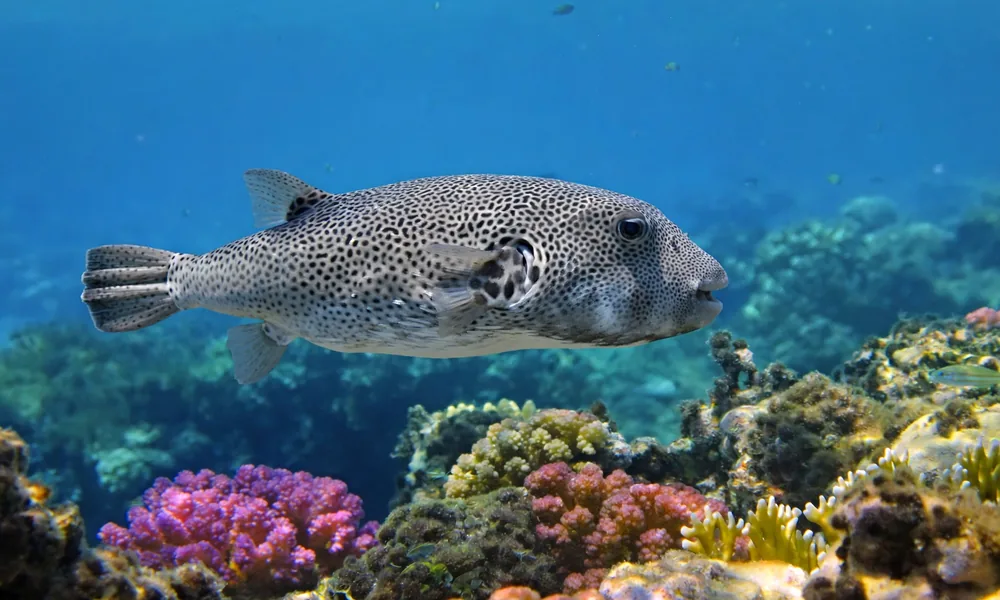
The colours change with the species, and sometimes with the mood of the fish. Stellate pufferfish are pale grey or brown with dark spots and blotches, and the pattern is different on every fish. Guinea fowl puffers can be bright golden yellow with black spots, or dark brown with white spots, and the same fish can change from one to the other over the course of its life. Some puffers are boldly patterned as a warning, telling predators that the fish is poisonous, and some are plain and mottled, blending into the sand and the rubble where they feed. Young fish are often brighter than adults, and a frightened pufferfish can darken or pale in seconds.
Compared with its cousins, the stellate pufferfish is easy to tell apart once you know what to look for. The guinea fowl puffer is smaller, usually 20 to 30 centimetres, and its spots are rounder and more regular, while the blackspotted puffer has a darker body with larger, blacker spots and a paler belly. Like the angelfish, the pufferfish is a reef fish that comes in bright colours and bold patterns, but the angelfish is a flat, disc-shaped fish that glides on long fins, while the pufferfish is round and slow, and it is the shape that gives it away.
Where pufferfish live
Pufferfish live in the warm waters of the world, and they are at home in tropical and subtropical seas from the Atlantic to the Pacific and the Indian Ocean. Most species live on coral reefs, where the water is clear and warm, usually between about 24 and 29 degrees Celsius, and they are rarely found far from the reef itself, because the reef is where their food lives. They favour shallow water, mostly between 5 and 25 metres deep, where the sunlight reaches the coral and the reef is at its richest. Wherever there is warm water, coral and something hard to crunch, there is a good chance a pufferfish is nearby.
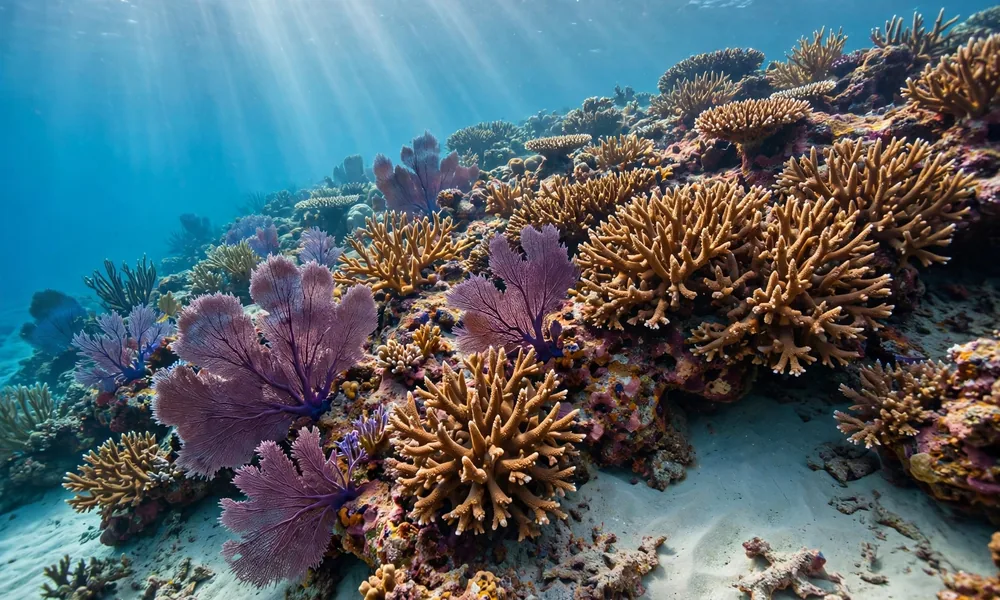
The habitat they choose is the reef itself, and they are rarely found far from cover. Most pufferfish live on the reef slope or the reef flat, hovering over coral heads, sandy patches and rubble, where the molluscs and crustaceans they eat are easiest to find. They favour places with plenty of coral and rock, which give them both hunting ground and a place to hide from the sharks and groupers that hunt them, and they are less common in open water, where there is little to eat and nowhere to hide. A pufferfish spends much of its life within a small stretch of reef, sometimes no larger than a few dozen metres, and it knows every coral head and sandy patch in that stretch.
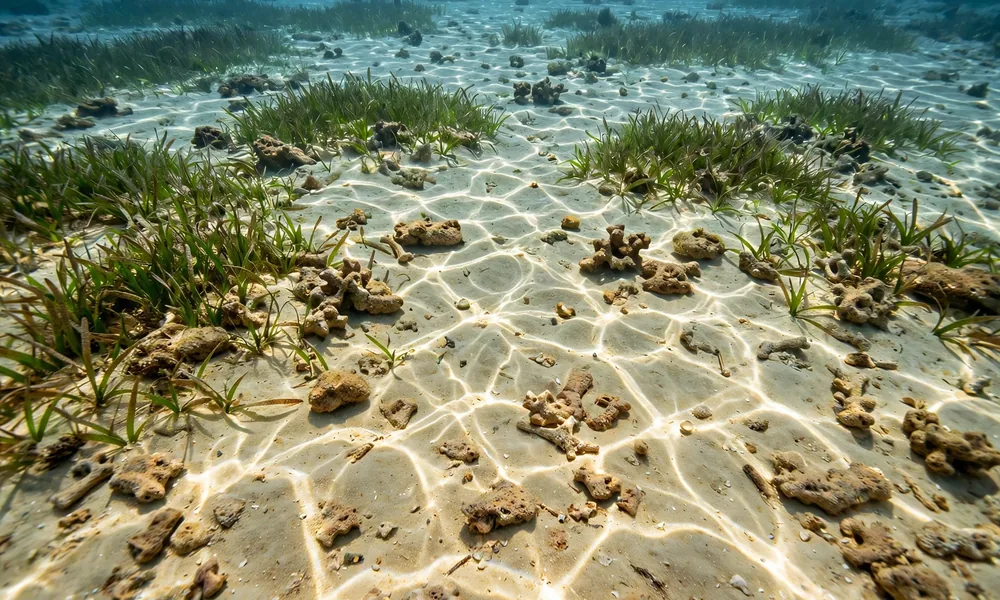
Depth matters, but not in the way it does for a deep-water fish. Pufferfish are shallow-water animals, and most of them stay above 50 metres, where the sunlight reaches the reef and the water is warmest. Some species live in estuaries and brackish water, where the river meets the sea, and about 35 species live in fresh water altogether, in rivers and lakes in South America, Africa and South-East Asia. The Mbu puffer is one of those, a river fish of the Congo and Lake Tanganyika, and the dwarf puffer is another, a fish of the slow rivers and rice paddies of Kerala in south-west India. Pufferfish need warm water, and they are absent from cold northern seas altogether.
The pufferfish has travelled far beyond its native range in one quiet way, and it now turns up in waters where it never lived before, carried there by people. The silver-cheeked toadfish has spread through the Suez Canal into the Mediterranean Sea, where it is now common and unwelcome, because it eats shellfish, damages fishing nets and carries the same tetrodotoxin as its cousins. Like the blue tang, the pufferfish is a tropical reef fish that has been carried around the world by people, but the blue tang is a fast, schooling fish moved by the aquarium trade, while the pufferfish is a slow, solitary fish that swam through a canal of its own accord.
What pufferfish eat
Pufferfish are hunters of hard-shelled food, not grazers, and their diet is written on the reef itself. The everyday food is molluscs and crustaceans, and a pufferfish will eat almost any shellfish it can crack, from clams and snails to crabs and shrimps. They also eat sea urchins, starfish, worms and algae, and a big stellate pufferfish will crunch a whole sea urchin, spines and all. A reef full of puffers keeps the numbers of urchins in check, which matters, because too many urchins will eat the coral itself.
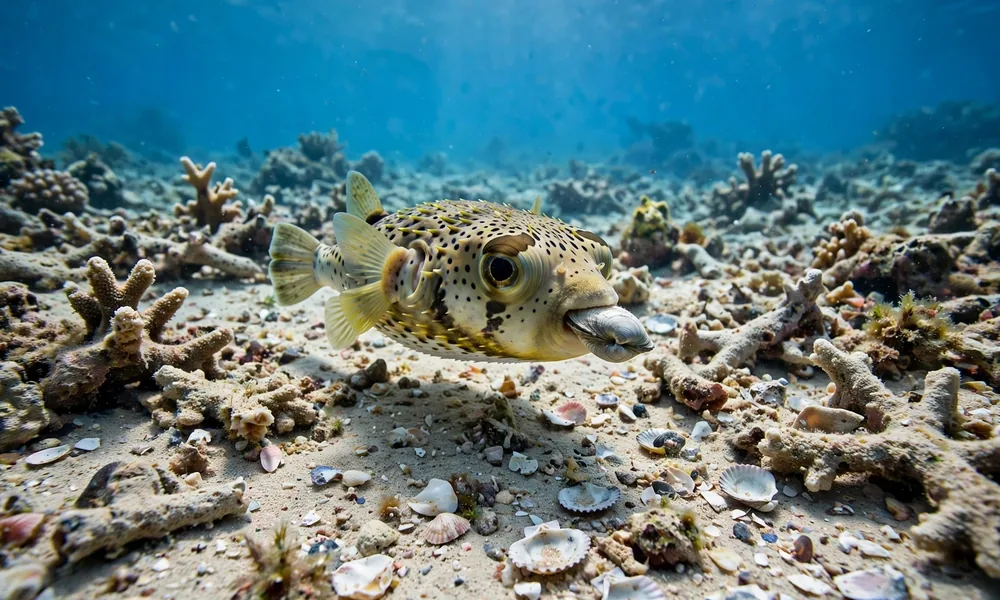
What sets the pufferfish apart is how it eats. It does not chase its prey across open water, and it does not hunt in a pack. It hovers over the sand or the rubble, picks up a clam or a snail in its beak, and crushes it, spitting out the shell fragments and swallowing the soft flesh inside. The beak never stops growing, and the crunching wears it down, so a pufferfish fed only soft food can grow a beak so long it cannot close its mouth. Like the seahorse, the pufferfish is a slow, deliberate feeder that takes its food one mouthful at a time, but the seahorse is a tiny fish that sucks up shrimps through a tube-like snout, while the pufferfish wins its meals by crushing shells.
Feeding follows the rhythm of the day, and it is busiest in the morning and the late afternoon. Pufferfish feed most actively when the light is good and the shellfish are out on the sand, and they rest at night, tucking themselves into a coral crevice or a hole in the reef. In the warm months they feed hard, and in the cooler months they feed less, holding in the shelter of the reef until the warmth returns.
How pufferfish behave
Pufferfish are daytime fish, and their day is a quiet round of hovering, crunching and moving to a new patch of reef. They wake at dawn, leave the crevice where they spent the night, and move out onto the reef to feed, and they spend the day working the coral heads and the sandy patches in a slow, unhurried way, never rushing, never chasing far. They are not strong swimmers over distance, and they do not need to be: their life is lived within a few dozen metres of reef, and speed matters less than knowing every coral head and every hiding place. When a larger fish passes, a pufferfish will often puff itself up a little, and if that fails it will inflate fully and drift, a spiky ball no predator can bite.
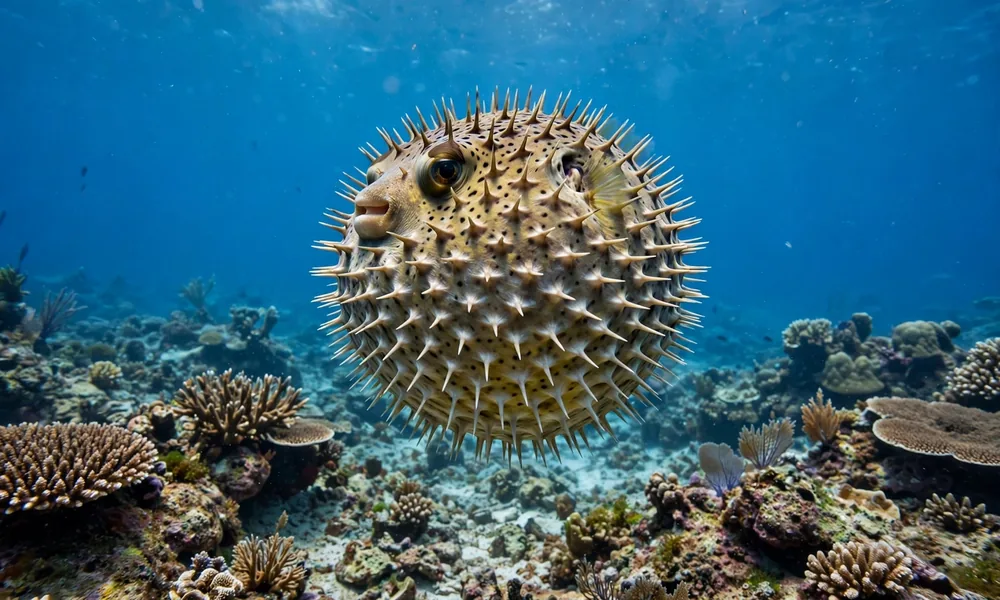
The most famous behaviour in the pufferfish is the inflation itself, and it is worth understanding properly, because it is not a party trick but a piece of engineering. When a pufferfish is threatened, it swallows water into a highly elastic stomach, gulping again and again until its body is two or three times its normal size, and the whole change takes only a few seconds. There are no ribs to get in the way, and the skin is reinforced with collagen, so it stretches without tearing, and the small spines hidden in the skin stand upright as the body swells. Once inflated, the fish cannot swim properly, and it drifts until it lets the water out again, which is why inflation is a last resort, and why a pufferfish made to inflate again and again can die of exhaustion.
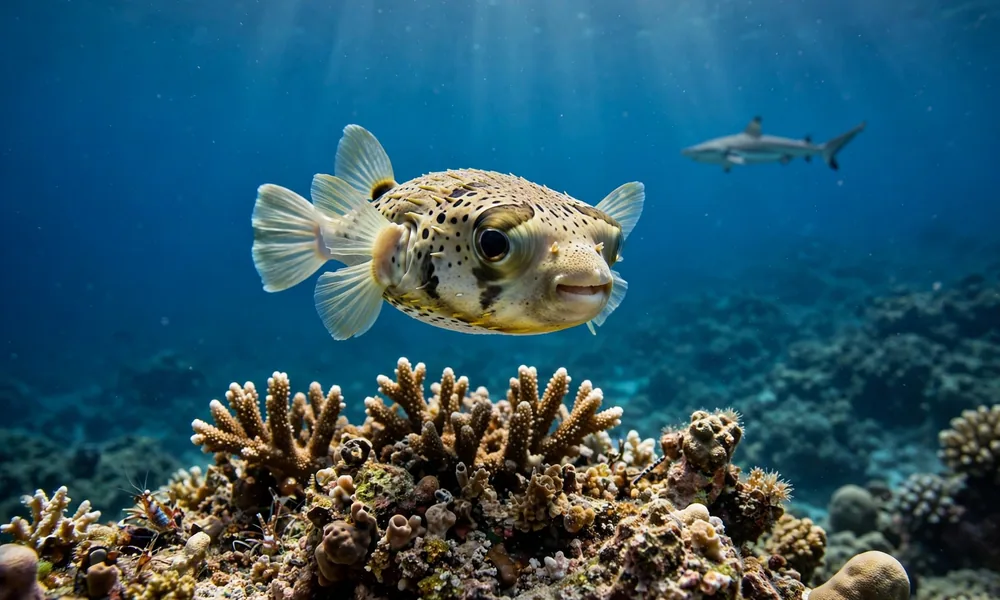
When a pufferfish is threatened, its first response is to freeze, relying on its mottled skin to break up its outline against the coral, and if that fails it will puff up a little, and only if that fails will it inflate fully and drift away. Pufferfish have no venom in their bite and no sting that matters to a person, but their skin and organs carry tetrodotoxin, and a predator that bites a pufferfish will often spit it out and learn never to try again. The poison is not made by the fish itself but by bacteria in the fish and its food, and farm-raised pufferfish fed a controlled diet carry no poison at all. A pufferfish handled roughly loses the slime that protects its skin, which is why divers are told to look and never touch.
Breeding and life cycle
Pufferfish breed in the warm months, when the water is at its warmest, and the timing is set by the temperature rather than the calendar. Most species scatter their eggs in the open water or lay them on the sea floor, and the male and female part ways once the eggs are laid, leaving the young to look after themselves. The eggs are small and round, and they hatch in a few days, and the young larvae drift in the plankton, tiny and transparent, before they settle onto the reef. A female can lay thousands of eggs in a single spawning, and she may spawn more than once in a season.
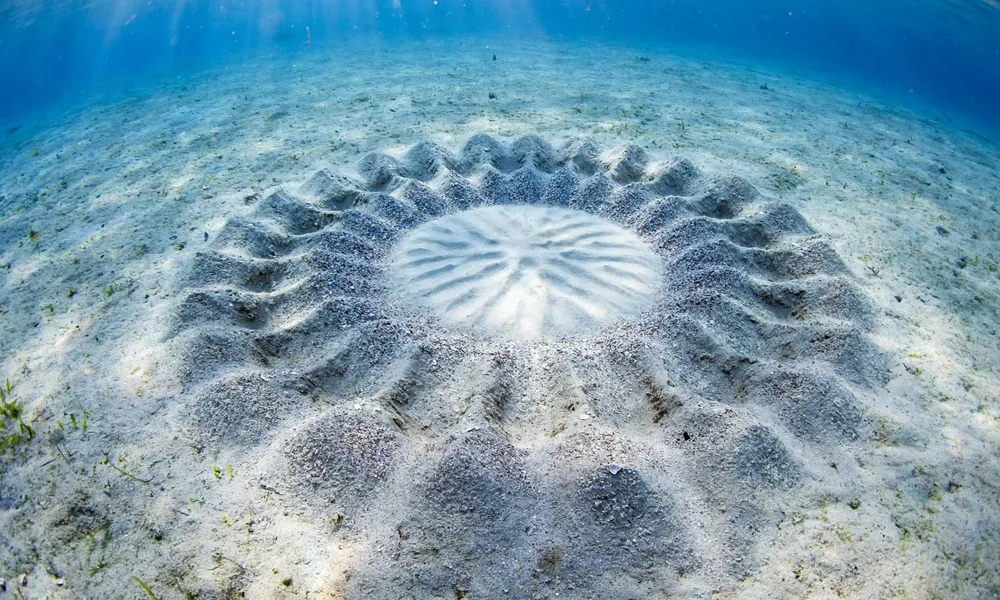
The most extraordinary breeding behaviour in the whole family belongs to the white-spotted pufferfish, Torquigener albomaculosus, a fish barely 12 centimetres long that lives on the sandy sea floor off Japan. The male builds a giant geometric pattern in the sand, a circular mandala up to two metres across, sculpting it with his fins over seven to nine days and decorating the centre with broken shells. The female arrives when the pattern is finished, and if she likes it she lays her eggs in the centre, where the ridges slow the current and keep the fine sand from burying them. The male then guards the eggs until they hatch, fanning them with his fins, and the pattern slowly washes away, so he must build it all over again for the next female.

Growth is fast in the first year, and a young pufferfish can reach several centimetres by the end of its first season, feeding on tiny crustaceans and snails before it turns to larger shellfish. It reaches breeding size in its second or third year, when it is close to half its adult length, and the lifespan in the wild is often 10 years or more, with the fahaka puffer, a river fish of Africa, known to live at least 10 years. The young are independent from the day they hatch, and a pufferfish that survives its first year has a good chance of a long life, because so few predators will risk eating it.
Conservation status
The pufferfish family is, on the whole, in better shape than most reef fish, and the reasoning is straightforward: most species have a wide range, they are still common on most of their reefs, and they breed well enough to replace themselves. The majority of pufferfish species are listed as Least Concern by the International Union for Conservation of Nature, and that broad picture hides a more worrying local one, and it is worth understanding both sides, because the pufferfish is one of the reef fish most tied to the fate of the coral it lives on. A fish that feeds on the reef cannot live where the reef has died.
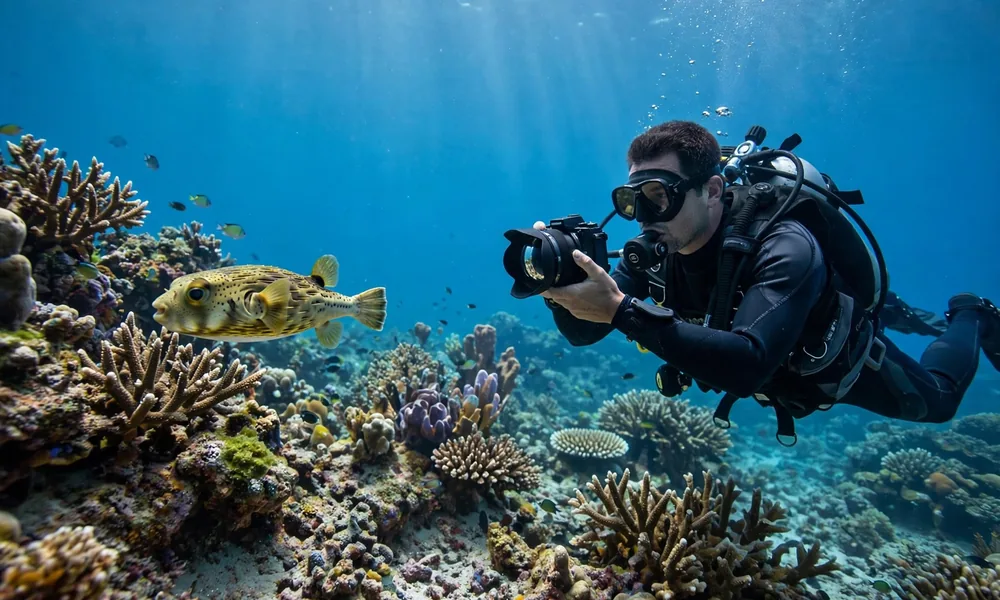
The main pressure is the loss of the reef itself. When coral bleaches and dies, or a reef is damaged by storms, pollution or careless anchoring, the puffers lose the shelter they hide in and the shellfish they feed on. Fishing is a second pressure, and in some places puffers are caught for food or for the aquarium trade, and a reef that loses its biggest puffers loses its best breeders. The silver-cheeked toadfish is a third pressure of a different kind, because it has spread into the Mediterranean and eats the shellfish that native fish depend on, and fishermen there catch it in their nets and throw it back dead, because nobody dares to eat it.
The most useful conservation work is practical, and it is the same work that helps the whole reef. Protecting the coral keeps the hunting ground and the shelter in place, and protecting the reef from pollution keeps the water clean for the fish that live in it. Marine protected areas give the puffers a safe patch to feed and breed in, and give the reef a chance to recover. The Chinese puffer, Takifugu chinensis, is the warning in the family: it is listed as Critically Endangered, and at least seven other pufferfish species are Endangered, and they are a reminder that a fish with a poison defence is still defenceless against a dying reef.
Best seasons for pufferfish watching
The best time to look for a pufferfish is the warm season, when the water is at its warmest and the fish are out feeding on the reef. In the tropical Indo-Pacific that usually means the dry season, from about November to April, when the water is clear and calm and the puffers are easy to spot. In the Caribbean the season runs longer, from about December to May, and the fish are active all year round, feeding hard through the warm months. Pufferfish are present on the reef all year round, but a warm, calm day in the dry season will show you far more fish than a rough day in the wet season, when the water is cloudy.
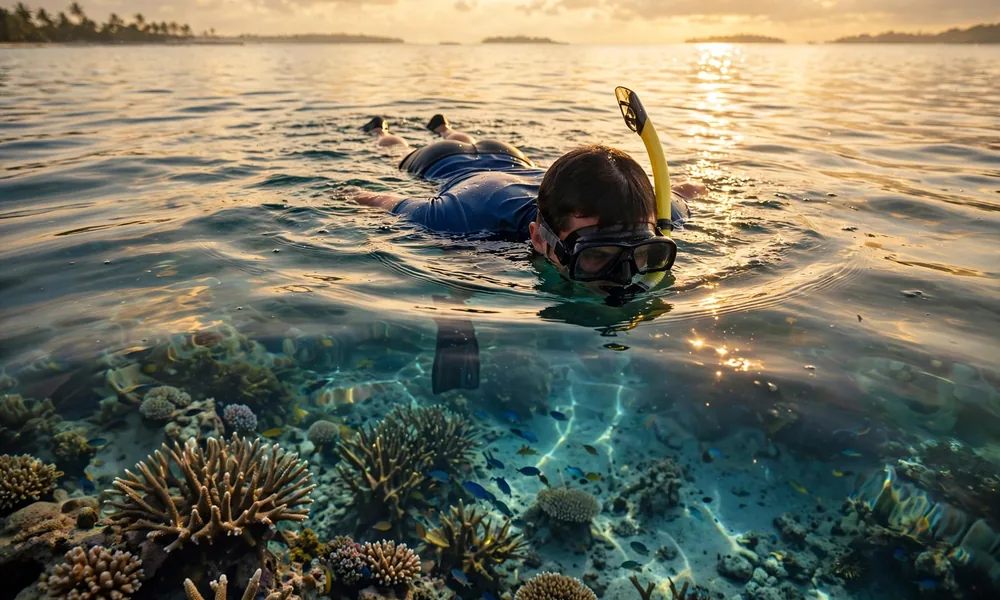
The best hours are the morning and the late afternoon, when the pufferfish are feeding actively and the light is good for seeing them. From about eight o’clock until eleven in the morning, and again from about three until five in the afternoon, the puffers are out on the reef, moving from coral head to coral head, and they are at their most approachable then. A slow drift over the reef is all you need, and the fish will often hold their ground and let you watch, if you move gently, because a pufferfish that feels safe has no reason to inflate.
Staying safe around pufferfish
A pufferfish is dangerous in one very specific way, and it is worth taking seriously, because the danger is real and there is no antidote. The fish carries tetrodotoxin in its skin, liver and ovaries, a poison about 1,200 times stronger than cyanide, and as little as 1 to 2 milligrams can kill an adult human. The poison is not in the bite, because a pufferfish will not bite you, and it is not in the water around the fish, because the fish does not leak poison into the sea. The danger is in eating the fish, and in handling a dead one with a cut on your hand, because the poison can be absorbed through broken skin. Never eat a pufferfish unless it has been prepared by a licensed fugu chef, and never handle one at all, alive or dead.
There are a few practical points for the water itself. Dive or snorkel with a buddy, stay within your depth, and keep an eye on the weather, which can change fast on a tropical reef, with wind and waves rising in minutes. Wear a life jacket when you are in a boat, and keep clear of the propeller when the engine is running. Watch for strong currents and sudden drop-offs, and wear fins that fit. A pufferfish will not hurt you if you leave it alone, but the poison can, and the sensible approach is to enjoy the fish from a distance and respect the reef they live on.
Pufferfish watching checklist
A little preparation turns a morning on the reef into a real chance of seeing pufferfish at their best, feeding in the shallows in clear, warm water.
- A visit in the warm dry season, when the water is clear and calm and the pufferfish are out feeding on the reef.
- A morning or late afternoon trip, when the pufferfish are out feeding and the light is good.
- A coral reef with sandy patches and rubble, where the fish hunt for clams, snails and crabs.
- A slow drift over the reef, watching for a round shape hovering over a coral head or a spiky ball on the sand.
- A mask and snorkel that fit well, so you can watch the fish without disturbing them.
- A buddy and a life jacket, so that a day on the water stays safe from start to finish.
- Respect for the fish and the reef, keeping your distance, never touching a pufferfish, and leaving the reef as you found it.
Frequently asked questions
How big do pufferfish get?
Most pufferfish measure between about 10 and 40 centimetres from snout to tail, and a good-sized stellate pufferfish reaches about 120 centimetres, though a fish of that size is rare. The smallest is the dwarf puffer, which grows to only about 2.5 centimetres, and the largest freshwater pufferfish is the Mbu puffer, which grows to over 50 centimetres and weighs over 5 kilograms. The size depends on the species.
Are pufferfish poisonous?
Yes, most pufferfish carry tetrodotoxin, a poison about 1,200 times stronger than cyanide, stored in the liver, ovaries and skin, and there is no known antidote. As little as 1 to 2 milligrams can kill an adult human, and the poison is made by bacteria that live in the fish and in its food, not by the fish itself. Farm-raised pufferfish fed a controlled diet carry no poison at all. Never eat a wild pufferfish, and never eat one unless it has been prepared by a licensed fugu chef in Japan.
How do pufferfish inflate?
A pufferfish inflates by swallowing water into a highly elastic stomach, gulping again and again until its body is two or three times its normal size, and the whole change takes only a few seconds. There are no ribs to get in the way, and the skin is reinforced with collagen, so it stretches without tearing, and the small spines hidden in the skin stand upright as the body swells. Once inflated, the fish cannot swim properly, and it drifts until it lets the water out again, which is why inflation is a last resort.
What do pufferfish eat?
A pufferfish eats molluscs and crustaceans, and it will eat almost any shellfish it can crack, from clams and snails to crabs and shrimps. It also eats sea urchins, starfish, worms and algae, and a big stellate pufferfish will crunch a whole sea urchin, spines and all. The four fused teeth form a beak that never stops growing, and the crunching wears it down, so a pufferfish needs hard-shelled food.
Can you keep a pufferfish in an aquarium?
You can, but it is hard, and most people should not try. A pufferfish grows to 10 to 40 centimetres or more, it needs a large tank with clean, well-oxygenated salt water, and it eats live shellfish and snails, which makes it expensive and demanding to keep. Some species are aggressive and will bite the fins of other fish, and a pufferfish that outgrows its tank must never be released into the sea where it does not belong. A pufferfish belongs on a reef, not in a living room.
How is this guide different from the parrotfish guide?
This guide covers the pufferfish, a round reef fish of 10 to 40 centimetres that defends itself by inflating into a spiky ball and carrying tetrodotoxin in its skin, while our parrotfish guide covers a brightly coloured reef fish that crunches coral with its beak, sleeps in a cocoon of mucus and helps build the sand on tropical beaches. One is a slow, solitary fish you watch from a respectful distance; the other is a noisy, colourful grazer you hear crunching coral before you see it.
Conclusion
The pufferfish species is a reminder that a fish does not need to be fast or fierce to be unforgettable. A round body, a beak of four teeth, a stomach that swallows water and a poison stronger than cyanide have made the pufferfish one of the most famous fish in the sea.
If you go looking for one, go on a warm, calm day in the dry season, go in the morning, and drift slowly over a reef with the sun behind you. Find the coral head, watch for a round shape hovering in the open water, and you will have met the pufferfish that turns a quiet reef into a place of sudden, spiky wonder.