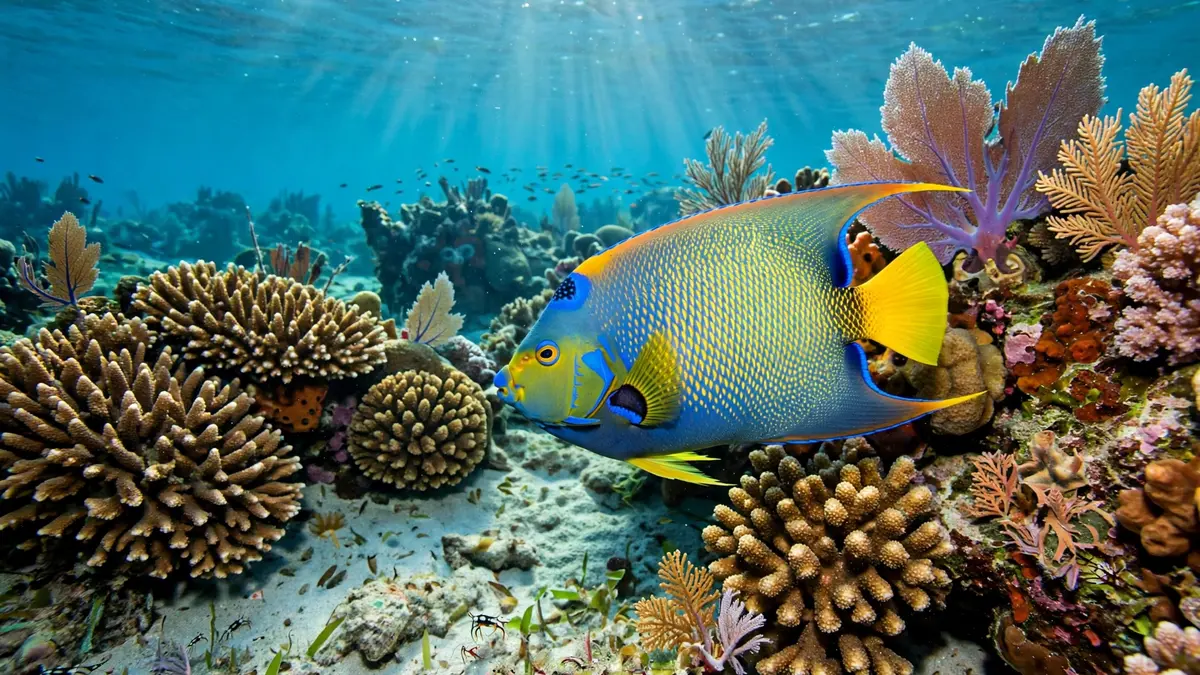
The angelfish species number about 88 in total, split between two very different groups of fish that share a name, and they are among the most beautiful fish in the sea and in the aquarium. If you are asking how many angelfish species there are, the answer is about 88: around 85 marine angelfish in the family Pomacanthidae, on tropical coral reefs, and 3 freshwater angelfish in the genus Pterophyllum, in the rivers of the Amazon basin.
An angelfish is a thin, tall, disc-shaped fish with long, flowing fins. Marine angelfish are the brightly coloured jewels of the reef, flashing blue, yellow and orange among the coral, while freshwater angelfish are elegant silver discs with dark vertical bars, gliding through the flooded forests of South America. They are not close relatives at all, but both have the tall, flat body and the long fins that make an angelfish unmistakable.
Key takeaways
- There are about 88 angelfish species in total: around 85 marine species and 3 freshwater species.
- Marine angelfish belong to the family Pomacanthidae and live on tropical coral reefs in the Atlantic, Indian and Pacific oceans.
- Freshwater angelfish belong to the genus Pterophyllum, in the cichlid family, and come from the Amazon and Orinoco river basins.
- Marine angelfish are recognised by the strong spine on their gill cover, which sets them apart from butterflyfish.
- Freshwater angelfish are among the most popular aquarium fish in the world, and marine angelfish are prized reef fish.
What makes an angelfish an angelfish
An angelfish is a deep-bodied, thin fish, taller than it is long in many species, with a small mouth, a steep forehead and long dorsal and anal fins that sweep back like a sail. Marine angelfish add bright colour to that shape: the queen angelfish is blue and yellow, the emperor angelfish wears blue and yellow stripes, and the flame angelfish is a small blaze of orange-red. Freshwater angelfish are quieter, silver with dark vertical bars, but their shape is just as striking, a tall disc with fins that trail like ribbons.
The marine angelfish carries one feature that settles its identity: a strong, sharp spine on the edge of its gill cover, the preopercle, which butterflyfish, their closest lookalikes on the reef, do not have. That spine is the reason for the family name Pomacanthidae, from Greek words meaning cover and thorn. Like clownfish, which also live among the coral, marine angelfish are fish of the reef, but they swim in open water above the coral rather than sheltering in an anemone.
The angelfish species and their relatives
There are about 88 angelfish species, in two groups that are not related to each other. The marine angelfish form the family Pomacanthidae, with about 85 species in eight genera, from the tiny dwarf angelfish of the genus Centropyge to the large Pomacanthus angels of the open reef. The freshwater angelfish form the genus Pterophyllum, in the cichlid family Cichlidae, with just three recognised species: the freshwater angelfish, the altum angelfish and Leopold’s angelfish.
The best-known marine angelfish are the queen angelfish of the tropical Atlantic, blue and yellow with a dark spot on the forehead; the emperor angelfish of the Indo-Pacific, whose juveniles are dark blue with white rings and whose adults are striped in blue and yellow; the French angelfish of the Atlantic, black with yellow-edged scales; and the flame angelfish, a small orange-red reef fish. The freshwater trio are the common freshwater angelfish, the tall altum of the Orinoco, and the smaller Leopold’s angelfish. Marine angelfish are close to butterflyfish and surgeonfish, while freshwater angelfish are cichlids, relatives of discus and oscars.

| Type | Animal | Where it lives | Best-known food | Length or Weight |
|---|---|---|---|---|
| Family | Marine angelfish (family Pomacanthidae) | Tropical coral reefs worldwide | Sponges, algae and small animals | About 10 to 45 cm long |
| Genus | Freshwater angelfish (genus Pterophyllum) | Amazon and Orinoco river basins | Small animals and algae | About 15 cm long |
| Species | Queen angelfish (Holacanthus ciliaris) | Tropical western Atlantic reefs | Sponges, algae and small animals | About 45 cm long |
| Species | Emperor angelfish (Pomacanthus imperator) | Indo-Pacific coral reefs | Sponges, algae and small animals | About 40 cm long |
| Species | French angelfish (Pomacanthus paru) | Tropical western Atlantic reefs | Sponges, algae and small animals | About 41 cm long |
| Species | Flame angelfish (Centropyge loricula) | Pacific coral reefs | Algae and small animals | About 10 cm long |
| Species | Freshwater angelfish (Pterophyllum scalare) | Amazon basin rivers | Small animals and algae | About 15 cm long |
How angelfish live
Marine angelfish are fish of the shallow reef. They spend their days picking over the coral, grazing on sponges, algae, sea squirts and small animals, and many species are strongly tied to one patch of reef, defending it against other angelfish. They are often seen in pairs, and some species pair for life, patrolling the same stretch of coral day after day. Young marine angelfish often look nothing like their parents: the juvenile emperor angelfish is dark blue with white rings, and young queen angelfish wear a different pattern of bars and spots.
Freshwater angelfish live a quieter life in the slow, warm waters of the Amazon. They drift among flooded plants and fallen branches, where their tall, thin bodies slip between stems and their vertical bars break up their outline in the dappled light. They eat small animals, insect larvae and algae, and live in loose groups. Like goldfish, which are also popular aquarium fish, freshwater angelfish have been bred in captivity into many colour forms, from silver and marble to gold and black.
Breeding is a careful business for freshwater angelfish. A pair cleans a broad leaf or a flat stone, and the female lays rows of small eggs on it, which the male then fertilises. Both parents guard the eggs and fan them with their fins until they hatch, and they keep the young close for days afterwards. Marine angelfish breed differently, releasing eggs into the open water above the reef, where they drift with the currents until they hatch.
Where angelfish live
Marine angelfish live on coral reefs in the warm, shallow seas of the tropics, in the Atlantic, Indian and Pacific oceans. The greatest number of species is in the Indo-Pacific, where reefs are richest, but the Atlantic has its own fine angels, including the queen and French angelfish of the Caribbean. They favour clear, warm water over coral and rock, from the reef crest down to 30 metres or more, and they are rarely found far from the reef that feeds and shelters them.
Freshwater angelfish live in the slow-moving rivers and flooded forests of South America, in the Amazon basin, the Orinoco basin and the rivers of the Guiana Shield. They need warm, soft, slightly acidic water and plenty of plants to hide among, and they are found in quiet backwaters and forest streams rather than in fast, open rivers. Like seahorses, which also need calm, sheltered water, freshwater angelfish are poor swimmers in a current and do best where the water barely moves.
Most angelfish are common where their habitat is healthy, and the freshwater species are widespread in the Amazon, but coral reefs are under pressure worldwide from warming seas, bleaching and pollution, and that threatens the marine angelfish that depend on them. The aquarium trade also takes large numbers of both groups, so buying captive-bred fish is kinder.
Best seasons for angelfish watching
The best time to watch marine angelfish is the dry season on the reef, when the water is clearest and calmest. In the Caribbean that means roughly December to April, when visibility is at its best and queen and French angelfish are easy to spot on shallow reefs. In the Indo-Pacific the dry months vary by place, but calm, clear water is the key everywhere. Snorkelling over a shallow reef in the morning, when the fish are feeding, is the surest way to see them.
Staying safe around angelfish
An angelfish is not dangerous to people. Marine angelfish are shy reef fish that keep their distance, and freshwater angelfish are gentle aquarium fish. The real risk is to the reef itself: never touch coral, never stand on it, and never chase a fish into its shelter, because a damaged reef cannot feed the angelfish that live on it. Watch from a little way off, swim slowly, and leave nothing behind.
Angelfish watching checklist
A little preparation turns a morning on the reef into a real chance of seeing an angelfish, so pack for warm water and bright sun.
- A mask, snorkel and fins, for watching angelfish over a shallow reef without disturbing them.
- Reef-safe sun cream, for long hours in the tropical sun above the water.
- A waterproof fish guide, for telling a queen angelfish from a French angelfish at a glance.
- A camera in a waterproof case, for the bright reef colours without getting close.
- A plan to be out in the morning, when angelfish are feeding over the coral.
- Patience and slow swimming, because angelfish are shy and a fast swimmer will send them into the coral.
- Respect for the reef, because healthy coral is what keeps angelfish on the reef at all.
Frequently asked questions
How many angelfish species are there?
There are about 88 angelfish species in total: around 85 marine angelfish in the family Pomacanthidae, and 3 freshwater angelfish in the genus Pterophyllum.
Are freshwater and marine angelfish related?
No, not closely. Freshwater angelfish are cichlids from the rivers of South America, while marine angelfish are reef fish in the family Pomacanthidae. They share a name and a tall, disc-shaped body, but they come from different families.
What do angelfish eat?
Marine angelfish eat sponges, algae, sea squirts and small animals picked from the reef, while freshwater angelfish eat small animals, insect larvae and algae in the rivers of the Amazon. Both groups graze and pick rather than chasing prey.
How big do angelfish get?
It depends on the kind. Large marine angelfish such as the queen and emperor reach about 40 to 45 centimetres long, while dwarf marine angelfish such as the flame angelfish reach only about 10 centimetres. Freshwater angelfish grow to about 15 centimetres in body length, though their fins make them look taller.
How is this guide different from the ball python species guide?
This guide covers angelfish, about 88 species of brightly coloured fish that live on coral reefs and in Amazon rivers, while our ball python species guide covers the ball python, a single snake species from West and Central Africa that curls into a ball when threatened. Angelfish swim in warm water, and the ball python hunts on dry land at night.
Are angelfish endangered?
Most angelfish are not endangered, and the freshwater species are widespread in the Amazon, but marine angelfish depend on coral reefs, which are under pressure from warming seas and pollution. Protecting the reef protects the angelfish that live on it.
Conclusion
The angelfish species show how one name can hold two very different lives: about 85 brightly coloured marine angelfish grazing the coral reefs of the tropics, and 3 elegant freshwater angelfish drifting through the flooded forests of the Amazon. Both wear the same tall, thin disc shape and long, flowing fins, and both are among the most loved fish in the sea and in the aquarium.
If you go looking for one, go to a shallow reef on a calm, clear morning, go slowly, and go with a fish guide in your hand. Watch a queen angelfish pick its way across the coral in blue and yellow, and you will understand why these fish have earned their place as the jewels of the reef, and why keeping the coral alive matters.