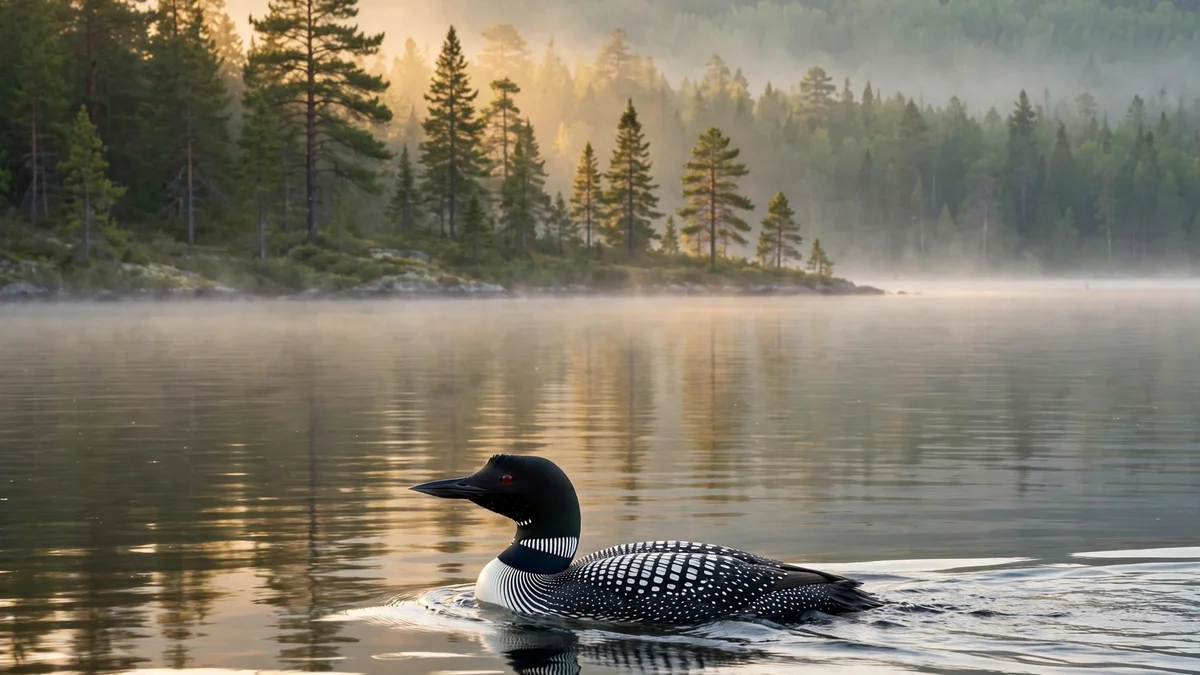
The common loon species is a single bird, Gavia immer, and it is one of the most famous waterbirds of the north, a large black-and-white diver with red eyes and a haunting yodel that carries across still lakes at dusk. If you are asking how many common loon species there are, the answer is one: there is a single common loon species, Gavia immer, one of five loon species in the genus Gavia, and it breeds on the lakes of northern North America and winters along the coasts.
A common loon is built for life on the water rather than on land. Its legs sit so far back on its body that it can barely walk, yet underwater it is a superb hunter, chasing fish with powerful strokes of its large webbed feet and diving to depths of about 60 metres. In summer its black head, white-striped neck and checkered back make it unmistakable, and its wail is one of the wildest sounds in North America.
Key takeaways
- There is one common loon species, Gavia immer, one of five loon species in the genus Gavia.
- Common loons are about 66 to 91 centimetres long, weigh roughly 2.7 to 6.3 kilograms, and have a wingspan of about 122 to 152 centimetres.
- Common loons dive for fish, usually for under a minute, and can reach depths of about 60 metres.
- They make four main calls: the wail, the tremolo, the yodel given by males, and the short hoot.
- Common loons are listed as Least Concern, though lead fishing tackle and shoreline disturbance still harm them.
What makes a common loon a common loon
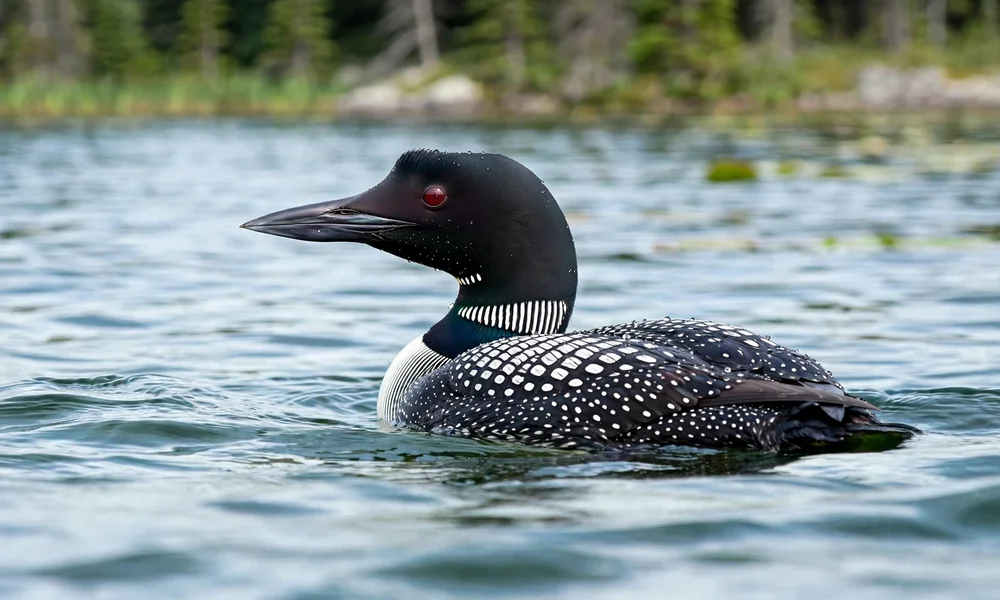
A common loon in breeding plumage is a striking bird: a black head and neck, a dagger-like black bill, red eyes, a band of black-and-white vertical stripes around the neck, and a black back patterned with neat white spots and squares. In winter the same bird looks quite different, plain grey-brown above and white below, with a paler bill, which is why winter loons on the sea are easy to mistake for other diving birds. Males are slightly larger than females, but otherwise the two sexes look alike.
The body is the real giveaway. A common loon is heavy for its size, with solid bones rather than the hollow bones of most birds, and legs set so far back that the bird is clumsy on land and needs a long stretch of open water to take off. Like penguins, which also swim far better than they walk, a loon is shaped by the water, with dense feathers it can squeeze flat to sink lower and large webbed feet that work like propellers.
The common loon species and their relatives
There is one common loon species, Gavia immer, and it belongs to the family Gaviidae, a small family of five loon species found only in the Northern Hemisphere. All five share the same shape: a long body, a pointed bill, legs set far back, and a life spent mostly on the water. The common loon is the largest and best known of the five, and it is the only loon that breeds widely across both Canada and the northern United States, as well as in Iceland and Greenland.
The other four loons are the red-throated loon, the smallest of the family, which breeds on small Arctic ponds; the black-throated loon of northern Europe and Asia; the Pacific loon of Alaska and the far north; and the yellow-billed loon, a large Arctic bird with a pale, upturned bill. In Britain the common loon is called the great northern diver, and the five species are each other’s closest relatives, with no other living bird family close to them.
| Type | Animal | Where it lives | Best-known food | Length or Weight |
|---|---|---|---|---|
| Family | Loons (family Gaviidae) | Northern Hemisphere lakes and coasts | Fish, crustaceans and aquatic insects | About 61 to 91 cm long |
| Species | Common loon (Gavia immer) | Northern North America, Iceland and Greenland | Perch, trout, minnows and crayfish | About 66 to 91 cm long |
| Species | Red-throated loon (Gavia stellata) | Arctic ponds across the far north | Small fish and marine invertebrates | About 53 to 69 cm long |
| Species | Black-throated loon (Gavia arctica) | Northern Europe and Asia | Fish, crustaceans and insects | About 58 to 73 cm long |
| Species | Pacific loon (Gavia pacifica) | Alaska, Canada and Siberia | Fish and marine invertebrates | About 58 to 74 cm long |
| Species | Yellow-billed loon (Gavia adamsii) | High Arctic lakes and coasts | Fish and crustaceans | About 76 to 97 cm long |
| Relative | Red-necked grebe (Podiceps grisegena) | Northern lakes and coasts | Fish, insects and crustaceans | About 43 to 51 cm long |
How common loons live
Common loons eat mostly fish, and they hunt by sight, which is why they need clear water to find their prey. A loon dives from the surface, propels itself with both feet stroking together, and steers with its feet and wings, chasing perch, trout, minnows and other fish underwater and swallowing them before it surfaces. Most dives last under a minute, though a loon can stay down for several minutes when it needs to.
Breeding begins soon after the ice leaves the northern lakes in spring. The pair builds a nest of reeds and grasses at the water’s edge, often on a small island or a floating mat of plants, and the female usually lays two speckled olive-brown eggs. Both parents share the incubation for about four weeks, and the striped chicks ride on their parents’ backs for the first few weeks of life. The young stay with their parents through the summer.
Loons are famous for their voices, and they make four main calls, each with its own meaning. The wail is a long rising call that keeps a pair in contact across a lake; the tremolo is a wavering, laughing call given in alarm; the yodel is a long rising call given by males to defend their territory, and each male has his own yodel; and the hoot is a short soft call used between family members at close range. Loons call most at night and in the early morning in late spring, when pairs are setting up territories.
Where common loons live
Common loons breed on the clear lakes of northern North America, from Alaska and Canada south into the northern United States, including Minnesota, Wisconsin, Michigan, New England and the Adirondacks of New York. They also breed in Iceland and Greenland. A breeding lake needs clear water for hunting, quiet shores for nesting, and enough fish to feed a family, so loons favour large, deep lakes with islands and sheltered bays.
When the northern lakes freeze in autumn, common loons fly south to spend the winter on the sea. They gather along the Atlantic and Pacific coasts of North America, from New England and the Gulf of Mexico to California and Mexico, and some winter on large ice-free lakes and reservoirs inland. In winter plumage they are grey and white, and they spend their days diving for fish far out on the water, often in loose groups.
Common loons are listed as Least Concern, because they are widespread and still common across the north, and some populations are stable or growing. They are not free of trouble, though: loons swallow lost lead fishing tackle, which can poison them, mercury builds up in their bodies and harms breeding, and nests fail when boats wash over them or shoreline building removes quiet nesting cover. Like owls, loons need undisturbed wild places to raise their young.
Best seasons for common loon watching
The best time to look for common loons is late spring and early summer, from May to July, when the birds are in their black-and-white breeding plumage and are calling on their nesting lakes. Dawn and dusk are the best hours, when the wails and yodels carry across still water, and a canoe or kayak lets you watch from a distance without disturbing a nest. In autumn, watch the coasts for loons in winter plumage diving offshore.
Staying safe around common loons
A common loon is a wild bird with a sharp, dagger-like bill, and a cornered loon can stab, so never handle one and never approach a nest closely. Keep your boat well away from nesting loons, and slow down near a loon family so your wake does not swamp the nest. If a loon gives the tremolo call, the laughing alarm, you are too close and should back away quietly.
Common loon watching checklist
A little preparation turns a dawn visit to a northern lake into a real chance of hearing a loon call, so pack for cool mornings, still water and long quiet hours.
- Binoculars, because loons keep their distance and are best watched from far off.
- A canoe or kayak, for reaching quiet bays without a noisy engine.
- Warm layers and a waterproof jacket, for cold dawns on open water.
- A visit to a clear northern lake in May to July, when the birds are in breeding plumage.
- A plan to be out at dawn or dusk, when loons call most and the water is still.
- Patience and silence, because loons are shy birds and a noisy group will send them diving.
- A field guide to birds, for telling a common loon from a red-throated loon in winter plumage.
Frequently asked questions
How many common loon species are there?
There is one common loon species, Gavia immer. It is one of five loon species in the genus Gavia, the others being the red-throated, black-throated, Pacific and yellow-billed loons.
How deep can a common loon dive?
Common loons usually dive to depths of about 4 to 10 metres, but they can reach about 60 metres when chasing fish. Most dives last under a minute, though a loon can stay underwater for several minutes.
What does a common loon eat?
Common loons eat mostly fish, including perch, trout, minnows, suckers and smelt, along with crayfish, aquatic insects and other small water animals. They hunt by sight underwater and swallow their prey before surfacing.
Why do common loons call at night?
Loons call at night and at dawn to keep in contact with a mate, to defend a territory and to warn of danger. The wail carries across a lake, the yodel marks a male’s territory, and the tremolo is an alarm.
How is this guide different from the alligator snapping turtle species guide?
This guide covers the common loon, a single diving bird species that lives on northern lakes and coasts, hunts fish underwater and calls with a yodel and a wail, while our alligator snapping turtle species guide covers the alligator snapping turtle, a huge freshwater turtle that lives in the rivers of the south-eastern United States and lures fish with a worm-like tongue. Loons fly and dive through clear northern water, and the alligator snapping turtle walks the muddy river bottom.
Are common loons endangered?
No. Common loons are listed as Least Concern, because they are widespread and still common across northern North America. They are harmed by lead fishing tackle, mercury and shoreline disturbance, so quiet lakes and lead-free tackle help them most.
Conclusion
The common loon species shows how completely one bird can belong to the water: a single species, Gavia immer, with solid bones, feet set far back, red eyes for seeing underwater, and a voice that has become the sound of the northern lakes.
If you go looking for one, go to a clear lake at dawn in early summer, go quietly, and go with patience. Watch a loon dive and surface far from where it went down, and listen for the wail rolling across still water, and you will understand why keeping its lakes quiet and clean matters most.