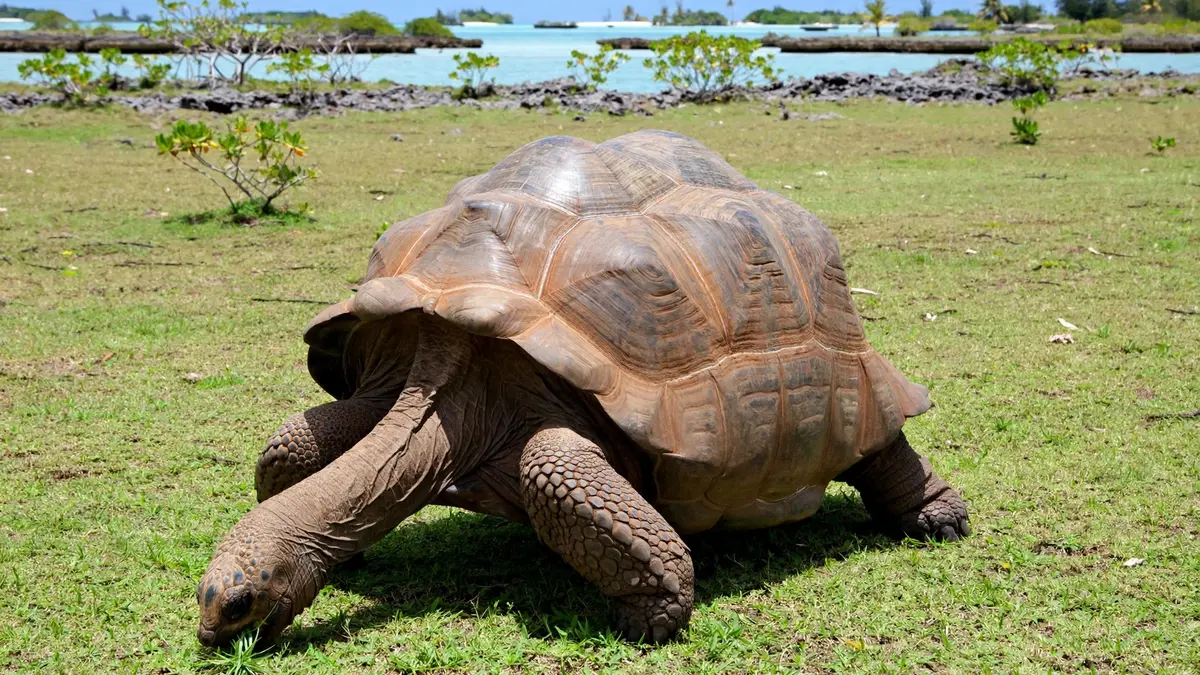
The Aldabra giant tortoise species number one, a single species called Aldabrachelys gigantea, and it is one of the largest land tortoises in the world, a slow-moving giant of the Aldabra atoll with a high domed shell. If you are asking how many Aldabra giant tortoise species there are, the answer is one: there is one recognised Aldabra giant tortoise species in the world.
The Aldabra giant tortoise lives on a remote coral atoll in the western Indian Ocean, where about 100,000 of them graze the grasslands in herds. It can live for more than a century, it can go for months without food or water, and it is the last survivor of a group of giant tortoises that once ranged across the western Indian Ocean.
Key takeaways
- There is one Aldabra giant tortoise species, Aldabrachelys gigantea, found wild only on the Aldabra atoll in the Seychelles.
- Large males reach 1.22 metres in shell length and 250 kilogrammes, while females are smaller at about 91 centimetres and 159 kilogrammes.
- They can live for more than 100 years, with some reaching 150 years old.
- Aldabra giant tortoises graze and browse on grasses, leaves, woody stems and fruit, and their grazing creates a low cropped plant community called tortoise turf.
- About 100,000 Aldabra giant tortoises live on the atoll, and the species is listed as Vulnerable.
What makes an Aldabra giant tortoise an Aldabra giant tortoise
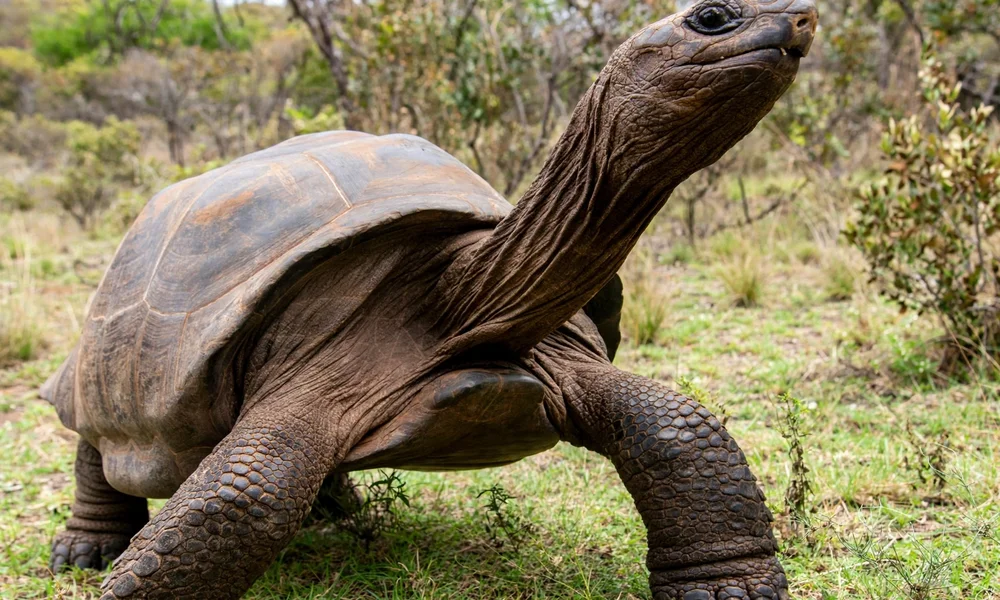
An Aldabra giant tortoise is a massive land tortoise with a high, domed carapace in brown or tan, stocky columnar legs like those of an elephant, and a very long neck that lets it browse on branches up to a metre from the ground. A large male can measure 1.22 metres in shell length and weigh up to 250 kilogrammes. Females are smaller, at about 91 centimetres and about 159 kilogrammes, and males have longer, thicker tails and a concave belly shell that helps in mating.
One small mark sets the species apart from other giant tortoises: the carapace has a small neck plate that is usually visible, a feature absent in other giant tortoise species. The head is small and pointed, the skin is dark grey to black, and the hind legs are cylindrical and heavily scaled. Like other turtles, it carries its home on its back, but it is the largest animal on Aldabra.
The Aldabra giant tortoise species and their relatives
There is one Aldabra giant tortoise species. It belongs to the family Testudinidae, the land tortoises, and to the genus Aldabrachelys, which once ranged across Madagascar and the western Indian Ocean. Of that whole group, only the Aldabra giant tortoise survives in large numbers, and its closest living relative is the Galapagos giant tortoise of the Pacific.
The Galapagos giant tortoise is similar in size and can also live for more than a century. The leopard tortoise of Africa is a smaller grassland tortoise with a spotted shell, the sulcata tortoise of the Sahel is the third largest land tortoise in the world, and the radiated tortoise of Madagascar has a star pattern on its shell.
| Type | Animal | Where it lives | Best-known food | Length or Weight |
|---|---|---|---|---|
| Species | Aldabra giant tortoise (Aldabrachelys gigantea) | Aldabra atoll, Seychelles | Grasses, leaves and fruit | Up to 1.22 m shell, up to 250 kg |
| Close relative | Galapagos giant tortoise | Galapagos Islands, Pacific | Grasses, leaves and cactus | Up to about 1.2 m shell, up to 250 kg |
| Close relative | Leopard tortoise | Grasslands of Africa | Grasses and succulents | About 70 cm shell, 18 to 40 kg |
| Close relative | Sulcata tortoise | Sahel region of Africa | Grasses and leaves | About 80 cm shell, 45 to 90 kg |
| Close relative | Radiated tortoise | Southern Madagascar | Grasses, fruit and cactus | About 40 cm shell, up to 20 kg |
| Close relative | Red-footed tortoise | Forests of South America | Fruit, leaves and flowers | About 35 cm shell, up to 15 kg |
| Close relative | Hermann’s tortoise | Mediterranean Europe | Leaves, flowers and fruit | About 20 cm shell, 2 to 4 kg |
How Aldabra giant tortoises live
Aldabra giant tortoises are creatures of the grassland and the scrub. On the open grasslands called platins the tortoises gather in herds, a habit unusual among tortoises, most of which live alone. They are most active in the early morning and late evening, and spend the heat of the day resting in shade, in shallow pools, or in mud holes. They wallow in mud against mosquitoes, and they sleep for about 18 hours a day.
Grasses make up most of the diet, along with leaves, woody plant stems and fallen fruit, and the tortoises are the main consumers of vegetation on the atoll. They knock over small trees and shrubs to reach nutritious leaves, and seeds pass through their digestive tract unharmed, spreading new plants in their droppings. Their steady grazing keeps the grass short and creates tortoise turf, a low cropped community of more than 20 species of grasses and herbs, many of them dwarfed by the constant cropping. They are mainly herbivores, but they will eat small invertebrates and carrion, and they get most of their water from their food.
Between February and May the female lays a clutch of 9 to 25 rubbery eggs, each about 5 centimetres across, in a shallow dry nest. Fewer than half the eggs are usually fertile, and they hatch after 73 to 160 days, depending on temperature. The young hatch at about 8 centimetres long, usually during the rainy season, and dig themselves out of the nest alone, because there is no parental care at all. A female can lay a second clutch in the same season, and the young reach maturity at about 25 years old, when they are about half their full size. Aldabra giant tortoises can live for more than 100 years, and some are thought to reach 150, though exact ages are hard to prove.
Where Aldabra giant tortoises live
The Aldabra giant tortoise lives on Aldabra atoll, a raised coral atoll in the outer Seychelles, more than 700 miles west of Mahe in the Indian Ocean. The atoll is ringed by jagged limestone and small beaches, and it encloses a large lagoon bordered by mangroves, with no permanent fresh water on the island. The tortoises live in grasslands, low scrub, mangrove swamps and coastal dunes, and the largest numbers are found on the platins, the open grasslands of the atoll.
Small introduced populations also live on Curieuse in the Seychelles and Changuu Island off Zanzibar, where visitors can see them more easily. But the wild heart of the species is Aldabra itself, so remote and inhospitable that it was never settled, and that isolation saved the tortoises. The atoll was declared a special reserve in the 1980s and a UNESCO World Heritage Site, and the population has grown back to about 100,000 animals, the largest population of giant tortoises in the world.
Aldabra giant tortoises are listed as Vulnerable. The main threats of the past were people: from the 1600s onwards, sailors filled their ships with tortoises, and by 1840 the only giant tortoises left alive in the whole western Indian Ocean were the ones on Aldabra. Appeals from scientists of the time, including Charles Darwin, helped save them, and today the atoll is protected, though a warming climate is a newer pressure.
Best seasons for Aldabra giant tortoise watching
There is no closed season, because Aldabra giant tortoises are active all year, but Aldabra itself has no general public access, so most people meet the species on Curieuse in the Seychelles or on Changuu Island off Zanzibar. The best months are often the cooler dry season, from May to October, when the tortoises spend more of the day grazing.
The best hours are the early morning and the late evening, when the herds are feeding. In the breeding season, from February to May, the tortoises are also active, though they rest through the middle of the day.
Staying safe around Aldabra giant tortoises
An Aldabra giant tortoise is a wild animal with a strong beak, and it can give a painful bite to a person who puts a hand near its mouth, though they almost never attack people. Keep your distance, never sit or stand on a tortoise, never pick one up, and never feed one by hand. If you see them on Curieuse or Changuu Island, stay calm, move slowly, and let them come to you.
Aldabra giant tortoise watching checklist
A little preparation turns a visit to the Seychelles into a real chance of seeing one, so pack for sun, heat and long quiet hours.
- Sun protection and a hat, for standing on bright open grassland in the tropical sun.
- Binoculars, because the herds graze across wide open ground and are best watched from a distance.
- A camera with a zoom lens, for the long necks and the domed shells without getting close.
- A visit to Curieuse Island, where introduced Aldabra giant tortoises roam freely and are easy to see.
- A plan to be out in the early morning, when the tortoises are most active and feeding.
- Patience and silence, because tortoises are shy animals and a noisy group will send them away.
- A field guide to tortoises, for telling an Aldabra giant tortoise from its smaller cousins at a glance.
Frequently asked questions
How many Aldabra giant tortoise species are there?
There is one Aldabra giant tortoise species, Aldabrachelys gigantea. It is the only giant tortoise left in the western Indian Ocean in large numbers, and about 100,000 of them live on the Aldabra atoll in the Seychelles.
How long do Aldabra giant tortoises live?
They can live for more than 100 years, and some are thought to reach 150. Exact ages are hard to prove, because they tend to outlive the scientists who study them.
What do Aldabra giant tortoises eat?
Aldabra giant tortoises eat mostly grasses, leaves, woody plant stems and fruit. They are mainly herbivores, but they will also eat small invertebrates and carrion when they find them, and they get most of their water from their food.
How big do Aldabra giant tortoises get?
A large male Aldabra giant tortoise can reach 1.22 metres in shell length and weigh up to 250 kilogrammes, and the heaviest free-roaming tortoise ever recorded weighed 305 kilogrammes. Females are smaller, at about 91 centimetres in shell length and about 159 kilogrammes.
How is this guide different from the bat-eared fox species guide?
This guide covers the single Aldabra giant tortoise species, a slow-moving reptile that lives on the Aldabra atoll and eats grasses and leaves, while our bat-eared fox species guide covers the bat-eared fox, a small mammal of the African savanna that eats termites and other insects. The Aldabra giant tortoise can weigh up to 250 kilogrammes and live for more than a century, and the bat-eared fox weighs only a few kilogrammes and lives for about a decade.
Are Aldabra giant tortoises endangered?
They are listed as Vulnerable, under an assessment from 1996 that is flagged as needing an update. About 100,000 live on the atoll, the largest population of giant tortoises in the world, and it is protected as a UNESCO World Heritage Site.
Conclusion
The Aldabra giant tortoise species shows how much history one slow animal can carry: a single species, the last of its kind in the western Indian Ocean, with a domed shell, a neck a metre long, and a life that can stretch across more than a century.
If you go looking for one, go to Curieuse or Changuu Island in the dry season, go quietly, and go with patience. Watch one graze across the grassland with its herd, and you will understand why it is called the gentle giant of the Seychelles.