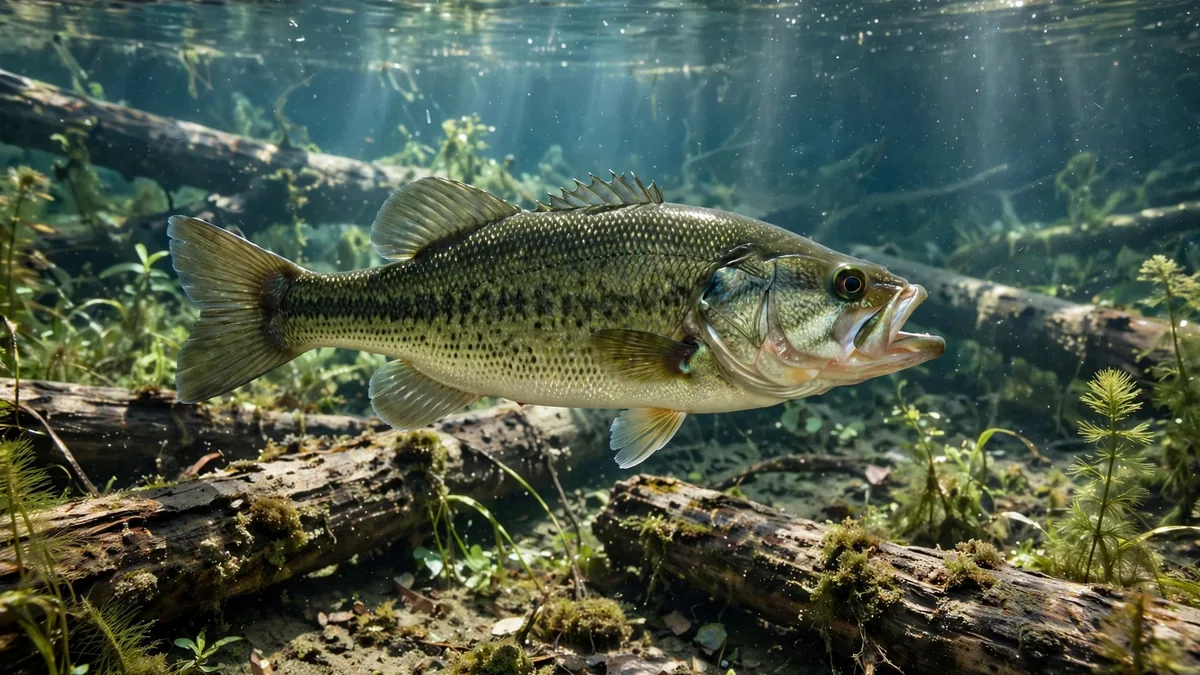
The largemouth bass species is the big-mouthed freshwater fish that sits at the top of the food chain in lakes and slow rivers across North America. If you are asking what a largemouth bass is, the short answer is Micropterus salmoides, a member of the sunfish family that grows to around 40 to 60 centimetres, hunts by ambush from weed beds and sunken timber, and has become the most popular game fish in the United States. It is the fish that leaps clear of the water when it takes a lure, the one that guards a nest of eggs in the shallows each spring, and the one that anglers talk about in the same breath as the world record of 10.1 kilograms, a fish of 22 pounds 4 ounces caught in Georgia in 1932 that has never been beaten.
Most people meet a largemouth bass on the end of a fishing rod, and the meeting is usually a lively one. You cast a lure into the weed edge on a warm summer evening, and the water erupts as the bass takes it, shakes its head and jumps, throwing spray across the surface. That is the heart of this guide: how a single species of sunfish became the most famous freshwater fish in North America, how it lives, hunts and breeds in the lakes and ponds it calls home, and why it thrives in so many waters far from the place it came from.
Key takeaways
- The largemouth bass species is Micropterus salmoides, a member of the sunfish family Centrarchidae, native to the fresh waters of North America.
- It is named for its huge mouth, which stretches back past the eye, and it commonly grows to 40 to 60 centimetres, with the world record standing at 10.1 kilograms.
- Largemouth bass are ambush hunters that wait in weed beds, lily pads and sunken timber, then strike fast at fish, crayfish, frogs and insects.
- Each spring the male clears a nest in the shallows, fans the eggs with his fins and guards the young until they can look after themselves.
- They are listed as Least Concern, are widely stocked and introduced around the world, and are mostly caught and released by anglers.
The largemouth bass species and their relatives
Largemouth bass belong to the family Centrarchidae, the sunfish family, a group of freshwater fish found only in North America. The family holds around 30 species, from small sunfish of about 10 centimetres to bass of 60 centimetres, including the bluegill, the crappie and the pumpkinseed, and the bass sit among them as the largest and most predatory members. The genus that holds the bass is Micropterus, the black basses, a name that comes from the Greek words for small and fin, a nod to the short dorsal fin that sets them apart from other sunfish. Within the genus there are several species, and the largemouth is the biggest and best known of them all.
The largemouth bass, Micropterus salmoides, is the lead species of this guide, and it is a good ambassador for the whole genus. It is a deep-bodied, green-backed fish with a dark stripe down its flank, and it is found in lakes, ponds, reservoirs and slow rivers from the Great Lakes and the eastern United States down to Mexico. It grows to about 60 centimetres, it is most active at dawn and dusk, and it is the fish that made bass fishing a sport in its own right, with tournaments, tackle shops and television shows built around it. If you have fished a warm lake in North America, there is a fair chance the fish that took your lure was a largemouth bass, or one of its close cousins in the same genus.
| Type | Animal | Where it lives | Best-known food | Length or Weight |
|---|---|---|---|---|
| Family | Sunfishes (Centrarchidae) | Fresh waters of North America | Fish, insects and crayfish | About 10 cm to 60 cm long |
| Genus | Black basses (Micropterus) | Lakes and rivers of North America | Fish, crayfish and frogs | About 30 cm to 60 cm long |
| Species | Largemouth bass (Micropterus salmoides) | Lakes and slow rivers of North America | Fish, crayfish and frogs | About 40 cm to 60 cm long |
| Species | Smallmouth bass (Micropterus dolomieu) | Cool, rocky rivers and lakes | Crayfish and small fish | About 30 cm to 40 cm long |
| Species | Spotted bass (Micropterus punctulatus) | Rivers and reservoirs of the central United States | Crayfish and small fish | About 30 cm to 45 cm long |
| Species | Florida largemouth bass (Micropterus salmoides floridanus) | Lakes of Florida and the south-east | Fish, crayfish and frogs | About 40 cm to 60 cm long |
The closest relative of the largemouth is the smallmouth bass, and the two are often confused by anglers who are new to the sport. Like the largemouth, the smallmouth is a member of the genus Micropterus, but it is a fish of cooler, clearer water, and it prefers rocky rivers and deep lakes to the weedy shallows that the largemouth loves. The smallmouth is smaller, usually 30 to 40 centimetres, and its mouth is smaller too, reaching only to the eye rather than past it, and its body is browner, with dark bars across the flank instead of a single dark stripe. Like the Atlantic cod, the largemouth is a hunter that sits near the top of its food chain, but the cod is a sea fish that roams cold northern waters in schools, while the largemouth is a freshwater fish that holds a patch of weed and waits for its food to come to it.
Within the genus, the species sort themselves by the water they like. The largemouth is the warm-water fish of weed beds and lily pads. The smallmouth is the cool-water fish of rocky rivers, strong in the current. The spotted bass sits between the two, and the Florida largemouth is a southern form that grows larger in the warm lakes of Florida.
What a largemouth bass looks like
A largemouth bass is a deep-bodied, powerful fish, built for short bursts of speed rather than long chases. Most adults measure between 40 and 60 centimetres from snout to tail, and a good fish weighs 1 to 2 kilograms, though a fish of 3 or 4 kilograms is a prize, and the world record of 10.1 kilograms has stood since 1932. The body is thick and muscular, deepest just behind the head, and it tapers to a broad tail that gives the fish its sudden, driving power. The back is dark green, fading to a pale, almost white belly, and a dark stripe runs along the flank from the gill to the tail, broken in places into a row of blotches.
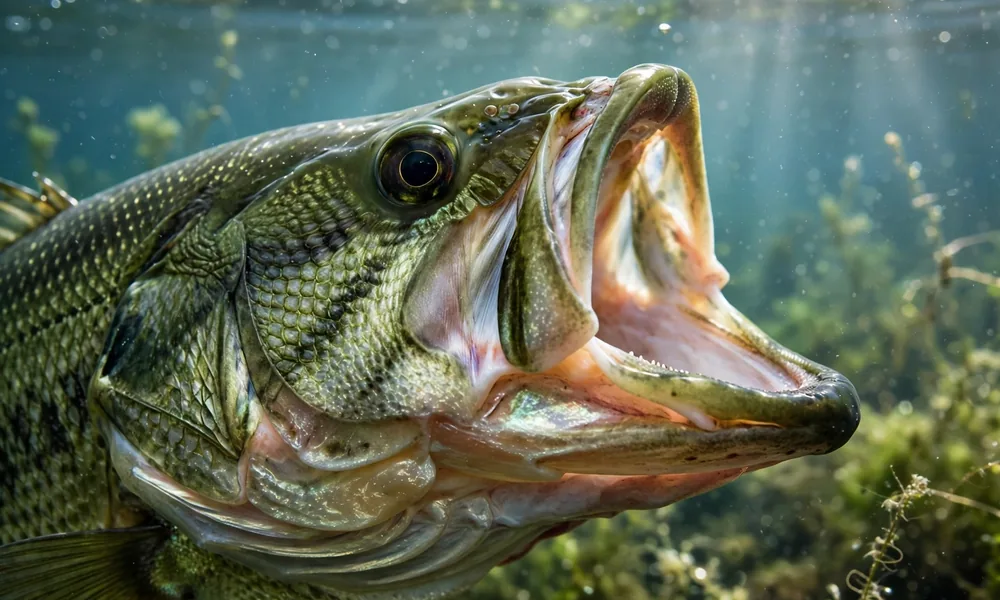
The head is large, and the mouth is the feature that gives the fish its name. The upper jaw stretches back past the rear edge of the eye, and when the fish opens its mouth it can take in prey that seems far too large for it, from a bluegill to a frog to a small duckling. The teeth are small and rough, more like sandpaper than the sharp fangs of a pike, and they are there to grip rather than to cut. The dorsal fin is in two parts, a spiny front section and a soft rear section, joined at the base, and the anal fin is broad and rounded, giving the fish its balance in the water.
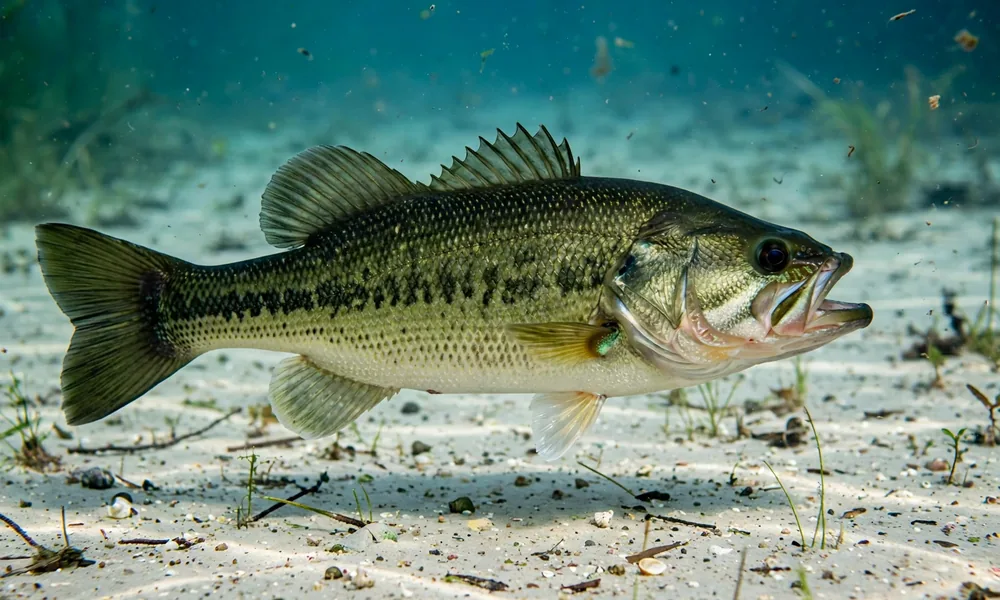
The colours change with the water the fish lives in. Fish in clear water are paler, with a bright green back and a clear stripe, while fish in dark water are darker, sometimes almost black along the back. Young fish are paler still, with a bolder stripe and a dark spot at the base of the tail that fades as they grow. Males and females look much alike, though the females grow larger, and the biggest bass in any lake are almost always female.
Compared with its cousins, the largemouth is easy to tell apart once you know what to look for. The smallmouth bass has a smaller mouth, a browner body and dark bars across its sides, and the spotted bass has a rough patch on its tongue and a row of dark spots below the lateral line. Like the salmon, the largemouth is a fish that changes with the season, but the salmon changes its whole body as it moves from river to sea and back again, while the largemouth changes only its colour, darkening in the weed and paling in open water, a shift that helps it blend into the place it is hunting.
Where largemouth bass live
Largemouth bass live in the warm, still fresh waters of North America, and they are at home in lakes, ponds, reservoirs and slow rivers. Their native range runs from the Great Lakes and the St Lawrence River in the north, down through the eastern and central United States, and into Mexico in the south. They favour water that is warm, usually above 15 degrees Celsius in summer, and they are rarely found in fast, cold rivers, where the smallmouth bass takes their place. Wherever there is warm water, weed and something to hide behind, there is a good chance a largemouth bass is nearby.
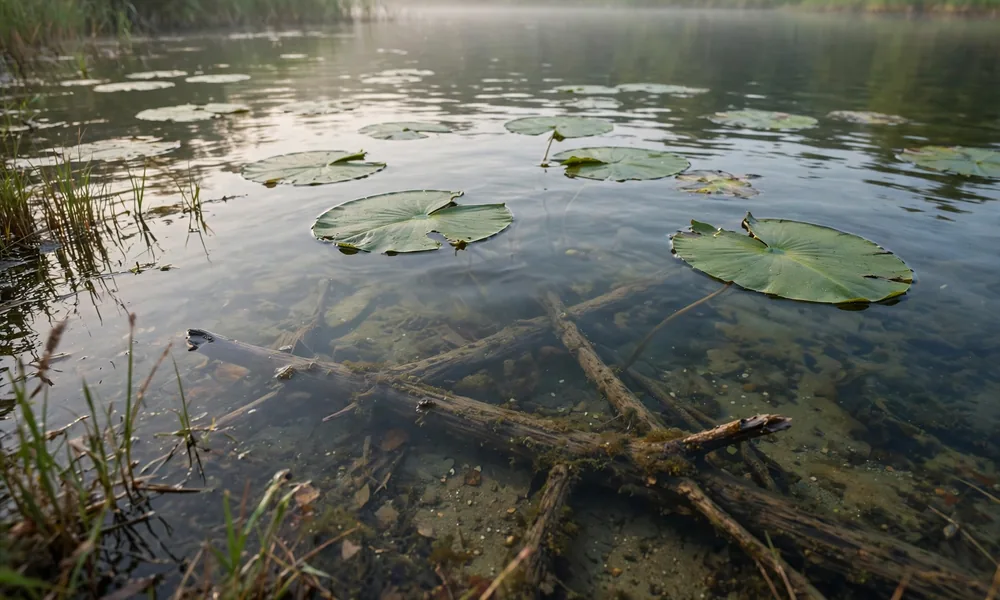
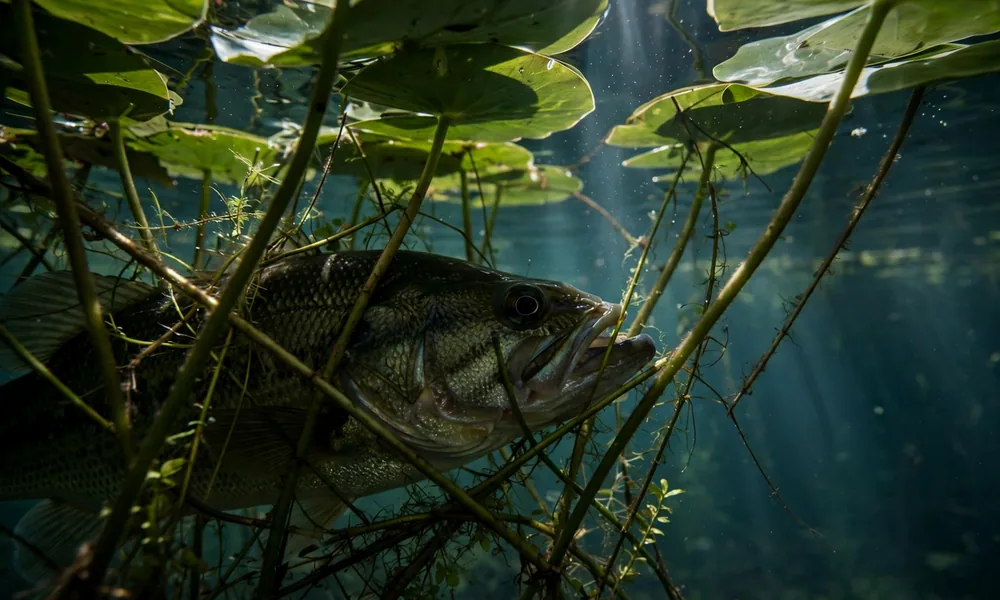
The habitat they choose is the edge of the water, and they are rarely found far from cover. Most bass live in water between 1 and 6 metres deep, along the weed edge, the lily pads, the fallen trees and the docks, where the food is richest and the shelter is thickest. They favour places with plenty of submerged plants, which give them both hunting cover and a place to hide from the herons and ospreys that hunt them from above, and they are less common in open water, where there is little to eat and nowhere to hide. A largemouth bass spends much of its life within a small stretch of shoreline, sometimes no larger than a few dozen metres, and it knows every weed bed and every sunken log in that stretch the way you know the rooms of your own house.
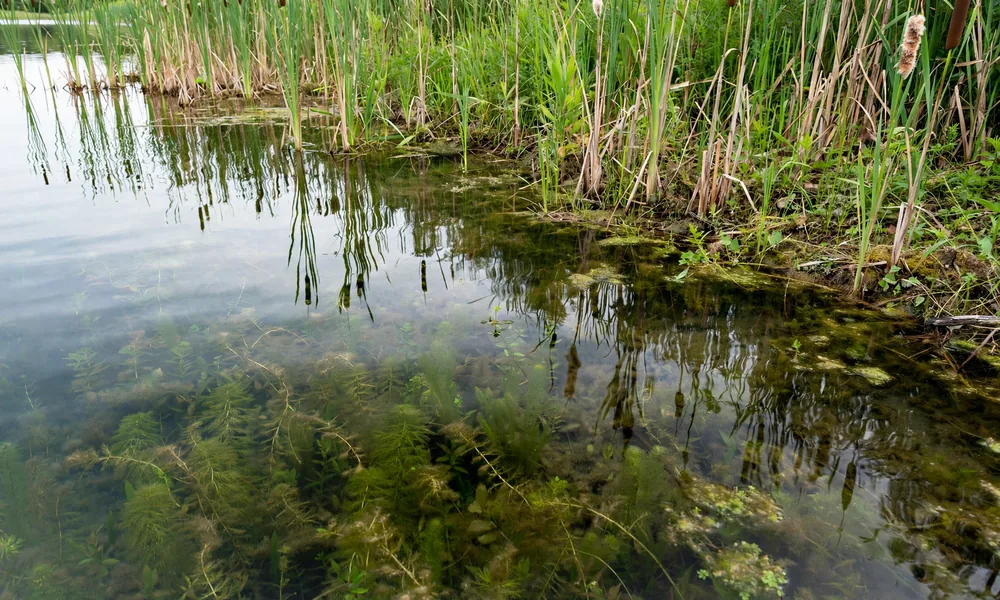
Depth matters, but not in the way it does for a deep-water fish. Largemouth bass are shallow-water animals, and most of them stay above 6 metres, where the sunlight reaches the weed and the water is warmest. In the heat of summer they may move deeper, to 8 or 10 metres, where the water is cooler, and in winter they drop deeper still, holding near the bottom in the warmest water they can find. The water temperature matters too: largemouth bass need warm water, usually above 15 degrees Celsius to feed well, and they are absent from cold northern lakes altogether, except where they have been stocked.
The largemouth bass has travelled far beyond its native range, and it now lives on every continent except Antarctica, carried there by anglers and fish farmers. It has settled in lakes and reservoirs from France to Japan to South Africa. In some of those places it has become a problem, eating native fish that have no defence against it, and in others it is a valued sport fish. Like the piranha, the largemouth is a freshwater predator that has been moved around the world by people, but the piranha is a river fish of the Amazon that hunts in groups, while the largemouth is a lake fish that hunts alone, and it is the lone hunter that has spread so far.
What largemouth bass eat
Largemouth bass are hunters, not grazers, and their diet is written on the lake itself. The everyday food is small fish, and a bass will eat almost any fish it can fit in its mouth, from bluegill and perch to shad and young bass. They also eat crayfish, frogs, large insects and the occasional small mammal or bird that falls into the water, and a big bass will take a duckling without a second thought. A single bass may eat several small fish in a day, and a lake full of bass can keep the numbers of smaller fish in check, which is one reason they are stocked in so many waters.
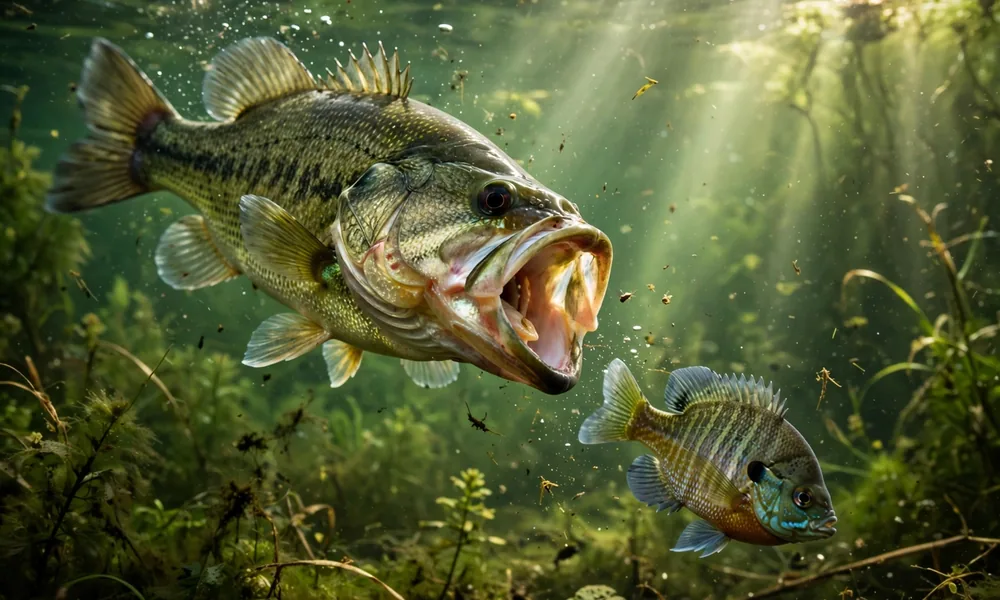
What sets the largemouth apart is how it hunts. It does not chase its prey across open water, and it does not hunt in a pack. It waits, hidden in the weed or behind a sunken log, and it watches for a fish to come within range. When the moment comes, it opens its mouth wide and flares its gills, and the rush of water sucks the prey straight in. The whole strike takes a fraction of a second, and the bass then turns and swims back to cover, holding the prey in its mouth until it can swallow it head first. Like the alligator gar, the largemouth is an ambush hunter that waits in cover, but the gar is a long, armoured fish of southern rivers that can grow to more than two metres, while the largemouth is a shorter, quicker fish that wins its meals with a sudden rush rather than a snap of long jaws.
Feeding follows the rhythm of the day and the season, and it is busiest at dawn and dusk. Largemouth bass feed most actively in the early morning and the late evening, when the light is low and the small fish are moving in the shallows, and they rest in the heat of midday, holding in the shade of a lily pad or a dock. In spring and autumn, when the water is warm but not hot, they feed hard, putting on weight for the spawning season and for the winter ahead. In winter they feed little, and a bass in cold water may go days without eating, holding near the bottom and waiting for the spring.
How largemouth bass behave
Largemouth bass are daytime fish, and their day is a quiet round of waiting, striking and moving to a new patch of cover. They wake at dawn, leave the deep water where they spent the night, and move into the shallows to feed, and they spend the day working the weed edge in a slow, unhurried way, never rushing, never chasing far. They are not strong swimmers over distance, and they do not need to be: their life is lived within a few hundred metres of shoreline, and speed matters less than knowing every weed bed and every hiding place. When a larger fish passes, a largemouth bass will often turn sideways and spread its fins, making itself look larger and harder to swallow, and if that fails it will dart into the nearest weed and wait.
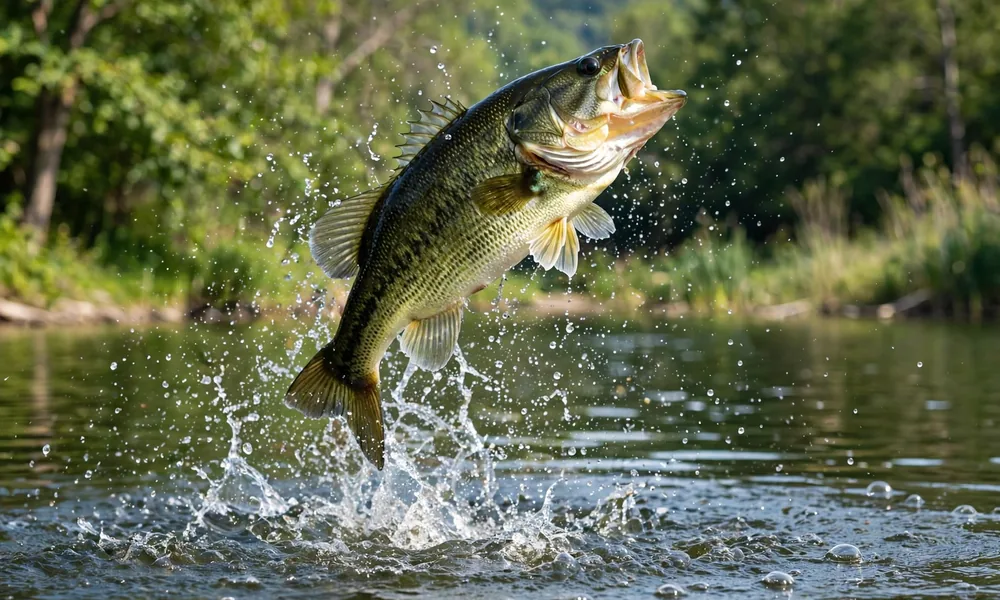
The most famous behaviour in the largemouth is the leap. When a bass takes a lure or a fly, it often jumps clear of the water, shaking its head from side to side, trying to throw the hook. The leap is a burst of pure power, and it is the moment every bass angler waits for, the fish silver-green in the air, water flying from its gills, before it crashes back into the lake and runs for the weed. The leap is not a trick, but a defence, and a bass that has been caught before will sometimes leap less, and run deeper instead, which is why the biggest bass in a lake are often the hardest to catch.
When a largemouth bass is threatened, its first response is to freeze, relying on its dark back and broken stripe to break up its outline against the weed, and if that fails it will dart into the nearest cover and stay there until the danger passes. Largemouth bass have no venom and no bite that matters to a person. A bass that is handled roughly will lose the slime that protects its skin, which is why anglers who release their fish wet their hands first and hold the fish gently.
Breeding and life cycle
Largemouth bass breed in spring, when the water warms to around 15 to 24 degrees Celsius, and the timing is set by the temperature rather than the calendar. The male arrives first, and he clears a nest in the shallows, fanning his tail over a patch of sand or gravel until he has swept it clean of silt and weed. The nest is a shallow, round hollow, usually 30 to 90 centimetres across, in water 0.3 to 1.5 metres deep, and it sits close to cover, a weed bed or a fallen log, where the eggs will be safe from the current. A male that has built a good nest will guard it fiercely, chasing away bluegill and other fish that come too close.

The female arrives when the nest is ready, and she lays her eggs in the hollow while the male releases his milt over them. A large female can lay several thousand eggs in a single spawning, and she may spawn in more than one nest, leaving the male to do the work of guarding them. The eggs are small and sticky, and they settle into the gravel, where the male fans them with his fins, keeping the water moving over them and clearing away the silt. The eggs hatch in 5 to 10 days, depending on the temperature, and the young fry rise from the nest in a tight cloud, guarded by the male for a week or more.

Growth is fast in the first year, and a young bass can reach 10 to 15 centimetres by the end of its first summer, feeding on tiny insects and crustaceans before it turns to small fish. It reaches breeding size in its second or third year, when it is close to 30 centimetres long, and the lifespan in the wild is often 10 to 16 years. The young are independent from the day they leave the nest, able to feed and hide within hours.
Conservation status
The largemouth bass is listed as Least Concern by the International Union for Conservation of Nature, and the reasoning is straightforward: it has a huge range, it is still common in most of its waters, and it breeds well enough to replace itself. That broad picture hides a more worrying local one, and it is worth understanding both sides, because the largemouth bass is one of the freshwater fish most tied to the fate of the lakes it lives in. A fish that hunts in weed beds cannot live where the weed has been cleared, and a lake that loses its shallow cover loses its bass within a season or two.
The main pressure is the loss of habitat. When a shoreline is cleared of weed and timber, or a lake is dredged or drawn down, the bass lose the cover they hunt from and the shallows they nest in. Stocking the bass outside its native range is a second pressure, as it eats native fish that have no defence against it. Fishing is a third, and a lake that loses its biggest females loses its best breeders, which is why so many fisheries set size limits and encourage anglers to release the largest fish.
The most useful conservation work is practical, and it is the same work that helps the whole lake. Protecting the weed beds and the fallen timber keeps the hunting cover and the nesting shallows in place, and protecting the shoreline from development keeps the water clean for the fish that live in it. Catch-and-release fishing, with size limits that protect the biggest females, gives the bass a safe patch to feed and breed in, and it gives the lake a chance to hold its fish from one season to the next.
Best seasons for largemouth bass watching
The best time to look for a largemouth bass is the spring and the early summer, when the water is warming and the fish are moving into the shallows to spawn. In the northern United States that usually means the months from about April to June, when the water reaches 15 to 24 degrees Celsius and the males are clearing nests in water you can see from the bank. In the south the season starts earlier, from about March, and the fish are active for longer, feeding hard through the warm months. Largemouth bass are present in the lake all year round, and they do not migrate, so there is no wrong season in the strict sense, but a warm, calm day in spring will show you far more fish than a cold day in midwinter.
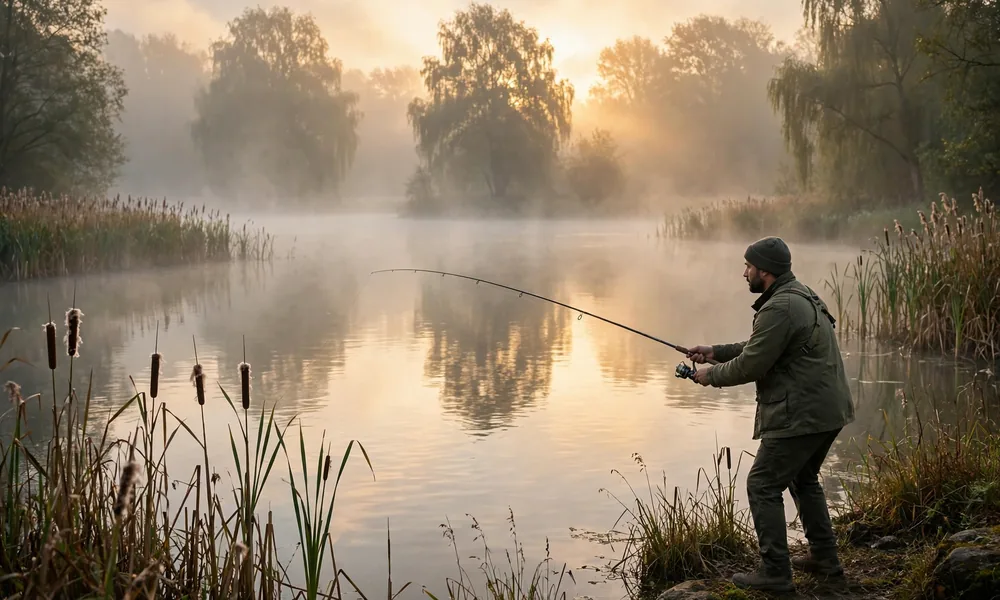
The best hours are the dawn and the dusk, when the largemouth bass are feeding actively and the light is good for seeing them. From about six o’clock until nine in the morning, and again from about five until eight in the evening, the bass are out on the weed edge, moving from cover to cover, and they are at their most approachable then. A slow walk along the bank, with the sun behind you and a pair of polarised sunglasses to cut the glare, is all you need, and the fish will often come close enough to see the stripe and the big mouth clearly, if you move gently and keep your distance.
Staying safe around largemouth bass
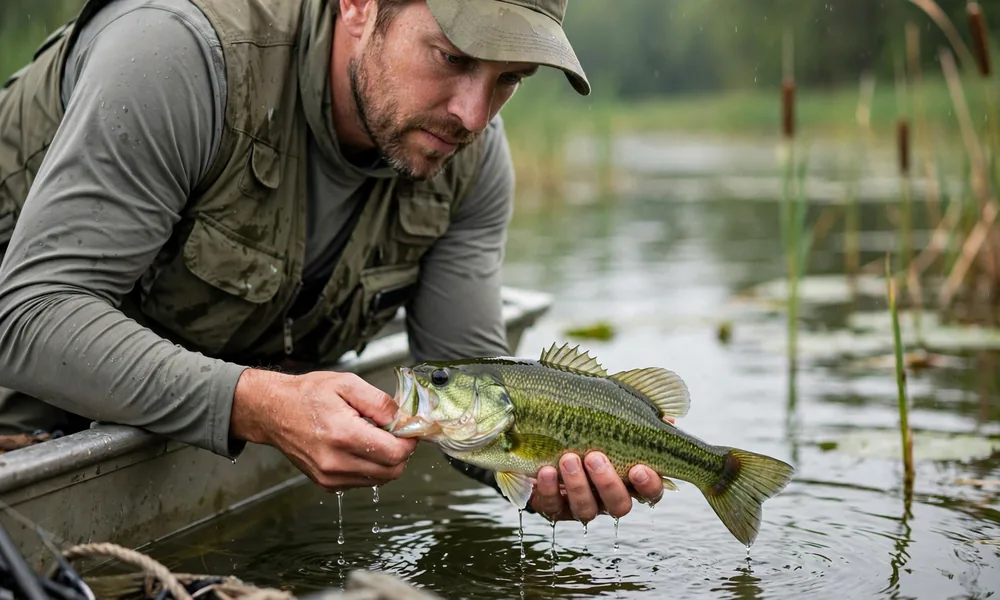
A largemouth bass is not dangerous to people, and there is no safety warning that belongs to the fish itself. It has no venom, it does not bite, and it will not chase or threaten a swimmer. The safety rules for watching largemouth bass are the rules of the lake and the water: watch the water, watch the weather, and respect the fish that you came to see. Never wade into deep water without knowing what is under your feet, never fish alone from a boat without a life jacket, and never handle a fish with dry hands, because a dry hand strips the slime that protects its skin.
There are a few practical points for the water itself. Fish with a buddy, stay within your depth, and keep an eye on the weather, which can change fast on a big lake, with wind and waves rising in minutes. Wear a life jacket when you are in a boat, and keep clear of the propeller when the engine is running. If you are wading, watch for slippery rocks and sudden drop-offs, and wear shoes that grip. A largemouth bass will not hurt you, but the water can, and the sensible approach is to enjoy the fish and respect the lake they live in.
Largemouth bass watching checklist
A little preparation turns a morning on the lake into a real chance of seeing largemouth bass at their best, feeding in the shallows in clear, warm water.
- A visit in spring or early summer, when the water is warming and the bass are moving into the shallows to spawn.
- A dawn or dusk trip, when the largemouth bass are out feeding and the light is good.
- A weedy lake edge with lily pads, fallen timber and submerged plants, where the fish hunt and shelter.
- A slow walk along the bank, watching for a dark shape holding in the weed or a swirl on the surface.
- Polarised sunglasses that cut the glare, so you can see into the water and spot the fish.
- A life jacket and a buddy, so that a day on the water stays safe from start to finish.
- Respect for the fish and the lake, keeping your distance, wetting your hands before handling a bass, and leaving the shore as you found it.
Frequently asked questions
How big do largemouth bass get?
Most largemouth bass measure between 40 and 60 centimetres from snout to tail, and a good fish weighs 1 to 2 kilograms. A fish of 3 or 4 kilograms is a prize, and the world record stands at 10.1 kilograms, a fish of 22 pounds 4 ounces caught in Montgomery Lake in Georgia in 1932 that has never been beaten. Females grow larger than males, and the biggest bass in any lake are almost always female.
What do largemouth bass eat?
A largemouth bass eats small fish, crayfish, frogs, large insects and the occasional small mammal or bird that falls into the water. It is an ambush hunter that waits in weed beds and sunken timber, then opens its mouth wide and sucks the prey in with a rush of water. The strike takes a fraction of a second, and the bass then swims back to cover to swallow its meal head first.
Do largemouth bass guard their nests?
Yes, the male largemouth bass clears a nest in the shallows in spring, fanning his tail over a patch of sand or gravel until it is clean, and he guards the eggs fiercely after the female has laid them. He fans the eggs with his fins, keeps the water moving over them, and chases away bluegill and other fish that come too close. The eggs hatch in 5 to 10 days, and the male guards the fry for a week or more until they scatter.
Are largemouth bass dangerous?
No, largemouth bass are not dangerous to people. They have no venom, they do not bite, and they will not chase or threaten a swimmer. Their whole defence is built on being hard to see, hard to catch and hard to hold, and their first response to a threat is to freeze or to dart into the nearest weed. The safety rules for watching them are the rules of the lake itself: watch the water, watch the weather, and wear a life jacket in a boat.
Can you keep a largemouth bass in an aquarium?
You can, but it is hard, and most people should not try. A largemouth bass grows to 40 to 60 centimetres, it needs a very large tank with clean, well-oxygenated water, and it eats live fish and crayfish, which makes it expensive and demanding to keep. It is also illegal to keep one in some places without a permit, and a bass that outgrows its tank must never be released into a lake where it does not belong. A bass belongs in a lake, not in a living room.
How is this guide different from the lanternfish guide?
This guide covers the largemouth bass, a freshwater fish of 40 to 60 centimetres that hunts by ambush in weedy lakes and guards a nest in the shallows each spring, while our lanternfish guide covers a small deep-sea fish that lives hundreds of metres down, glows with its own light and rises towards the surface each night to feed. One is a lake fish you watch from the bank at dawn; the other is a creature of the dark ocean you will never see from the shore.
Conclusion
The largemouth bass species is a reminder that a fish does not need to live in the sea to be unforgettable. A big mouth, a dark stripe, a leap clear of the water and a male that guards his nest in the shallows have made the largemouth bass the most famous freshwater fish in North America, at home in a weedy lake in Georgia, a reservoir in Texas and a farm pond in Ontario alike.
If you go looking for one, go on a warm, calm day in spring, go at dawn or dusk, and walk slowly along a weedy bank with the sun behind you. Find the weed edge, watch for a dark shape holding in the shade, and wait for the water to erupt, and you will have met the largemouth bass that turns a quiet lake into a place of sudden, silver-green excitement.