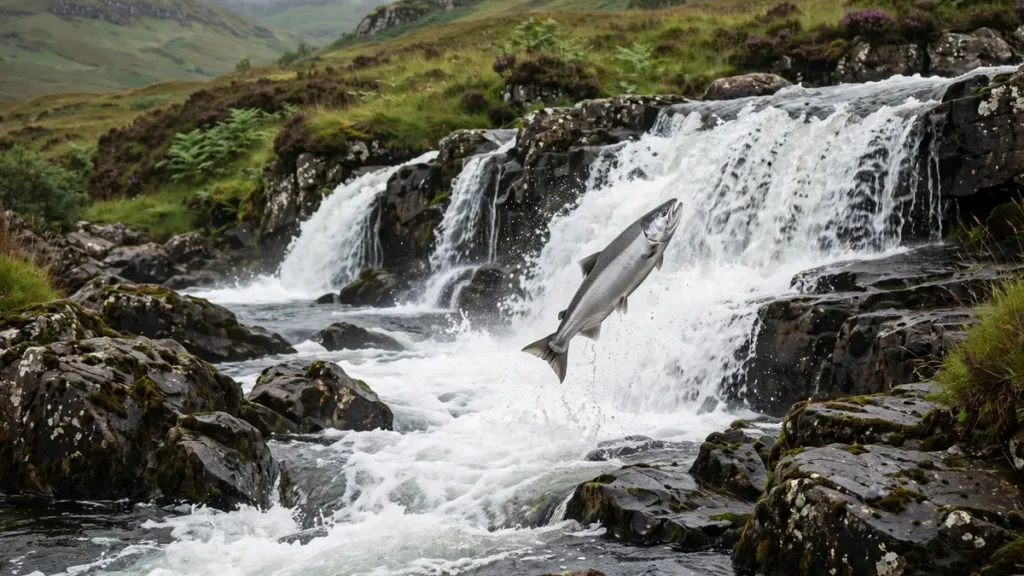
The salmon species number seven, migrating fish of the cold rivers and oceans, and they are among the greatest travellers of the fish world, swimming thousands of kilometres home to spawn. If you are asking how many salmon species there are, the answer is seven: there are seven recognised salmon species in the world, one Atlantic and six Pacific, and every salmon alive today belongs to one of them.
The salmon belongs to the family Salmonidae, along with the trout and the char, and it lives in the cold rivers and oceans of the northern hemisphere, from the Atlantic to the Pacific. Its silver body, its hooked jaw, its red spawning colours and its upstream leap make it one of the most famous fish on Earth.
Key takeaways
- There are seven salmon species, one Atlantic and six Pacific, including the Chinook, sockeye, coho, pink, chum and masu salmon.
- Salmon are born in freshwater, migrate to the sea to grow, and return to their home river to spawn, guided by smell.
- Pacific salmon die after spawning once, while Atlantic salmon can return to the sea and spawn again.
- Chinook salmon are the largest, growing up to 1.5 metres long and weighing more than 50 kilogrammes.
- Atlantic salmon are listed as Least Concern globally, though many river runs are falling as rivers are dammed and warmed.
What makes a salmon a salmon
A salmon is a large silvery fish with a streamlined body, a forked tail, small black spots and an adipose fin on its back, and it measures roughly 50 centimetres to 1.5 metres long and usually weighs between 2 and 50 kilogrammes, depending on the species. The Chinook is the largest, at up to 1.5 metres and more than 50 kilogrammes, while the pink salmon is the smallest, at about 50 centimetres and 2 kilogrammes.
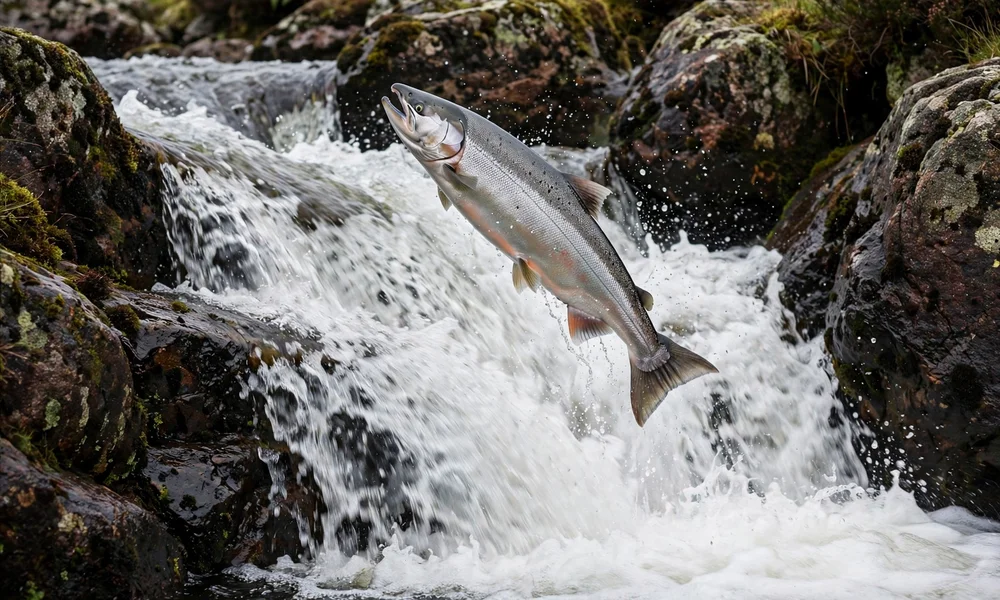
The journey defines the salmon: a fish that is born in a cold gravel stream, swims to the sea as a smolt, grows fat on krill and small fish, and then returns years later to the very stream where it was born. The salmon finds its home river by smell, recognising the scent of the water it was born in, and it leaps waterfalls and rapids to reach the spawning grounds. Like other tuna, the salmon is a powerful ocean swimmer, but it is a river fish at heart, and it must return to freshwater to breed.
The salmon species and their relatives
There are seven salmon species. The Atlantic salmon lives in the rivers of the North Atlantic, from Norway to Canada, and it is the only salmon of the Atlantic. The six Pacific salmon live in the rivers of the North Pacific, and they are the Chinook, sockeye, coho, pink, chum and masu salmon, each with its own run and its own spawning season.
The Chinook salmon is the largest salmon, with a dark back and a black mouth, and it lives in the rivers of Alaska, British Columbia and the western United States. The sockeye salmon turns bright red when it spawns, and it lives in the rivers of Alaska and British Columbia. The coho salmon is a silver salmon of the North Pacific, the pink salmon is the smallest and most numerous, and the chum salmon is a large salmon that spawns in the lower rivers. The rainbow trout is a close cousin that can live its whole life in freshwater.
| Type | Animal | Where it lives | Best-known food | Length or Weight |
|---|---|---|---|---|
| Species | Atlantic salmon (Salmo salar) | Rivers of the North Atlantic | Krill, small fish and squid | Up to 1.5 m, up to 40 kg |
| Close relative | Chinook salmon | Rivers of the North Pacific | Krill, small fish and squid | Up to 1.5 m, up to 58 kg |
| Close relative | Sockeye salmon | Rivers of Alaska and British Columbia | Plankton and small fish | 60 to 84 cm, 2.3 to 7 kg |
| Close relative | Coho salmon | Rivers of the North Pacific | Plankton, small fish and squid | 60 to 75 cm, 3 to 5 kg |
| Close relative | Pink salmon | Rivers of the North Pacific | Plankton and small fish | 50 to 65 cm, 1.5 to 2.5 kg |
| Close relative | Chum salmon | Rivers of the North Pacific | Plankton, small fish and jellyfish | 60 to 100 cm, 4 to 10 kg |
| Close relative | Rainbow trout | Rivers of North America and worldwide | Insects, small fish and crustaceans | 30 to 60 cm, 0.5 to 4 kg |
How salmon live
Salmon are creatures of the cold river and the open sea. A salmon lives in a river as a young fish, migrates to the sea to grow, and returns to its home river to spawn, and it can travel thousands of kilometres on its journey. Like other piranhas, the salmon is a freshwater fish at heart, but it is an ocean traveller, and it spends years at sea before coming home.
Krill, small fish and squid make up most of the diet at sea, along with plankton and crustaceans, and a salmon eats by hunting in the open ocean, growing fat on the rich food of the cold seas. In freshwater it eats little, living off its fat reserves as it swims upstream, and it stops feeding altogether on the spawning grounds, where it uses all its strength to reach the redds.
Breeding happens in autumn, when the salmon return to their home rivers, and the female digs a nest called a redd in the gravel, where she lays thousands of eggs. The male fertilises the eggs, and the female covers them with gravel, and the eggs hatch in spring, and the young fish stay in the river for one to three years before migrating to the sea as smolts. Pacific salmon die after spawning once, while Atlantic salmon can return to the sea and spawn again. Salmon live for around two to seven years, depending on the species.
Where salmon live
The salmon lives in the cold rivers and oceans of the northern hemisphere, from the rivers of Norway, Scotland and Iceland to the rivers of Alaska, British Columbia and Siberia, and it is most common in the rivers of Alaska, where millions of sockeye salmon return every year. The Atlantic salmon lives in the rivers of the North Atlantic, while the Pacific salmon live in the rivers of the North Pacific.
Cold clean water is the key requirement. A salmon needs cold gravel streams to spawn in, and rich cold seas to grow in, so it follows the seasons as they change, and when the rivers warm the salmon have nowhere to spawn. It depends on the rivers staying cold and clean, and it returns to the same stream year after year, generation after generation.
Atlantic salmon are listed as Least Concern globally, though many river runs are falling. The main pressures are the damming of rivers, which blocks the salmon’s journey home, the warming of rivers, fish farming, and overfishing at sea. In many rivers the salmon runs are a fraction of what they once were, and in some southern rivers the salmon have vanished altogether.
Best seasons for salmon watching
There is no closed season, because salmon are active all year, but the best time to look for them depends on where you go. In Scotland the best months are often September to November, when the salmon leap the waterfalls on their way upstream. In Alaska the best months are often June to August, when the sockeye salmon run the rivers in their millions.
Staying safe around salmon
A salmon is a wild animal with sharp teeth and a powerful tail, and it can injure a person with a bite or a thrash, though salmon almost never attack people. Keep your distance, never wade in a spawning stream, and never try to touch or catch a salmon without a licence, because a salmon that is disturbed may abandon its redd and its eggs may die. If you see salmon leaping a waterfall, watch from the bank, and never block the river, because salmon that cannot pass may die without spawning.
Salmon watching checklist
A little preparation turns a river visit into a real chance of seeing a salmon, so pack for cold water, bright glare and long quiet hours.
- Polarised sunglasses, for cutting the glare and seeing into the water.
- A camera with a zoom lens, because salmon should always be watched from a distance.
- Warm clothes and a waterproof jacket, because the best watching is on cold river mornings.
- A booked visit to a river with a salmon leap or a fish ladder.
- A plan to be out in the morning, when the salmon are most active and leaping.
- Patience and silence, because salmon are shy animals and a noisy group will send them away.
- A field guide to freshwater fish, for telling an Atlantic salmon from a sea trout at a glance.
Frequently asked questions
How many salmon species are there?
There are seven salmon species, one Atlantic and six Pacific. The Atlantic salmon is the only salmon of the Atlantic, and the six Pacific salmon are the Chinook, sockeye, coho, pink, chum and masu salmon, each with its own run and spawning season.
How do salmon find their home river?
Salmon find their home river by smell, recognising the scent of the water they were born in. They also use the sun, the stars and the Earth’s magnetic field to navigate the open ocean, and they switch to smell when they reach the coast, following the scent upstream to their home stream.
Why do Pacific salmon die after spawning?
Pacific salmon die after spawning because they use up all their energy on the journey upstream, and they stop feeding on the way. Their bodies break down as they spawn, and they die within days of laying their eggs, and their bodies feed the river, bringing nutrients from the sea to the forest.
Can you keep a salmon as a pet?
No. A salmon is a wild animal that needs cold rivers and open ocean, migrates thousands of kilometres, and is protected by fishing law in most of the places where it lives. Salmon in fish farms are raised for food, and they are not pets.
How is this guide different from the piranha species guide?
This guide covers seven salmon species, migrating fish that swim thousands of kilometres home to spawn in cold rivers, while our piranha species guide covers more than thirty piranha species, sharp-toothed hunters and scavengers of the warm slow rivers of the Amazon. The salmon is up to 1.5 metres long and leaps waterfalls, and the piranha is up to 50 centimetres long and hunts in shoals.
Are salmon endangered?
Atlantic salmon are listed as Least Concern globally, so they are not classed as endangered, but many river runs are falling. Dams, warming rivers, fish farming and overfishing are the main threats, and in some southern rivers the salmon have vanished altogether.
Conclusion
The salmon species show how much journey one fish can hold: seven species of migrating fish, with silver bodies and red spawning colours, swimming thousands of kilometres home to the stream where they were born.
If you go looking for one, go in the autumn to Scotland or Alaska, go quietly, and go with patience. Watch a salmon leap a waterfall and you will understand why it has earned its place as the greatest traveller of the rivers, and why keeping its cold clean water matters most.














