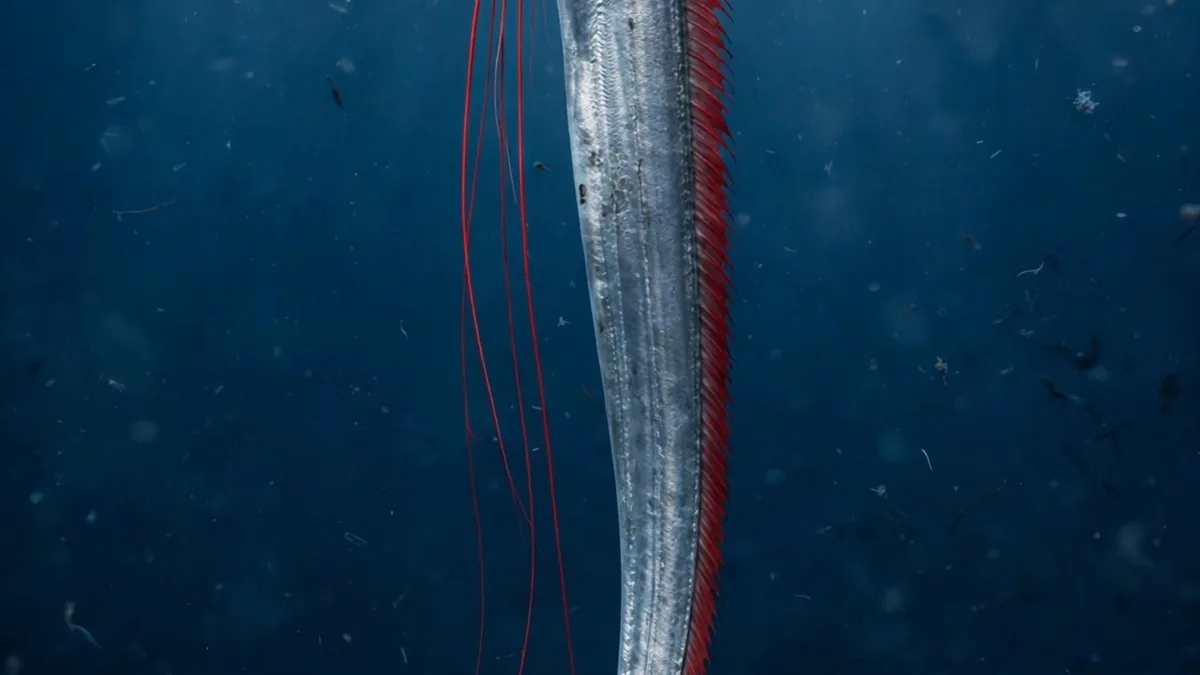
The oarfish species is the longest bony fish in the sea, a silver ribbon of a creature that can stretch longer than a city bus and yet spends its whole life out of sight, drifting upright in the dark water hundreds of metres down. If you are asking what an oarfish is, the short answer is Regalecus glesne, the giant oarfish, a deep-sea fish of the family Regalecidae that usually measures about 3 metres, grows to 7 or 8 metres in the largest documented specimens, and has been reported at up to 11 metres, with a crimson fin running the whole length of its body and a pair of long red pelvic fins like oars trailing below it. It has no scales, no teeth and no swim bladder, it feeds by straining krill and small squid from the water, and it is so rarely seen alive that most people only ever meet one when a storm throws a dying fish onto a beach.
That rarity is part of the pull. For centuries, sailors who glimpsed a long silver body at the surface told stories of sea serpents, and in Japan the fish is still known as the Messenger from the Sea God’s Palace, a creature whose arrival on shore is said to warn of earthquakes. The truth is quieter than the legends: a harmless filter feeder that hangs head-up in the water, swims by rippling its dorsal fin, and is almost never seen alive. This guide follows it down into that world, from its family tree to its food, its breeding and the reasons it keeps washing up on beaches.
Key takeaways
- The oarfish species is Regalecus glesne, the giant oarfish, a member of the family Regalecidae and the longest bony fish in the sea.
- Most giant oarfish measure about 3 metres, the largest documented specimens reach 7 to 8 metres, and there are reports of fish up to 11 metres, weighing as much as 272 kilograms.
- Oarfish live in the open ocean at depths of 20 to 1,000 metres, usually around 200 metres, and swim upright with the head pointing up.
- They are harmless filter feeders with no teeth, straining krill, small fish and squid from the water with their gill rakers.
- They are listed as Least Concern, are almost never seen alive, and usually reach people only as strandings after storms.
The oarfish species and their relatives
Oarfish belong to the family Regalecidae, a tiny family of deep-sea fish in the order Lampriformes, the group that also holds the opah and the ribbonfishes. The whole family holds just three species in two genera, which makes it one of the smallest fish families in the sea, and the giant oarfish is by far the biggest of the three. The family name comes from the Latin word regalis, meaning royal, a nod to the old name for the fish, the king of herrings, and the fish was first described by the Norwegian naturalist Peter Ascanius in 1772, from a specimen stranded on the coast of Norway.
The giant oarfish, Regalecus glesne, is the lead species of this guide, and it is the fish most people mean when they say oarfish. It is found in temperate and tropical oceans all around the world, in the Atlantic and the Mediterranean, across the Indo-Pacific and along the eastern Pacific from California to Chile, and it stays away from the polar seas. It lives in the open water rather than near the sea floor, and it is most often recorded between 20 and 200 metres down, though it has been found as deep as 1,000 metres. A fish that lives across all three oceans and yet is almost never seen is a strange combination, and it is the reason so little is known about how the oarfish actually lives.
| Type | Animal | Where it lives | Best-known food | Length or Weight |
|---|---|---|---|---|
| Family | Oarfishes (Regalecidae) | Temperate and tropical oceans worldwide | Plankton, krill and squid | About 3 m to 11 m long |
| Genus | Oarfishes (Regalecus) | Temperate and tropical oceans worldwide | Plankton, krill and squid | About 3 m to 8 m long, with reports of up to 11 m |
| Species | Giant oarfish (Regalecus glesne) | Temperate and tropical oceans worldwide | Plankton, krill and squid | About 3 m to 8 m long, with reports of up to 11 m |
| Species | Russell’s oarfish (Regalecus russelii) | Atlantic, Indian and Pacific Oceans | Plankton, krill and squid | Up to 5.4 m long |
| Species | Streamer fish (Agrostichthys parkeri) | Southern Ocean and around New Zealand | Plankton, krill and squid | Up to 3 m long |
| Species | Dealfish (Trachipterus arcticus) | North Atlantic Ocean | Plankton and small fish | Up to 3 m long |
The closest relative of the giant oarfish is Russell’s oarfish, Regalecus russelii, a fish of the Indo-Pacific and the Atlantic that looks very much like its bigger cousin but stays smaller, with the largest recorded specimen measuring 5.4 metres. The differences come down to fine details: Russell’s oarfish has more gill rakers, fewer dorsal fin rays and a row of small tubercles along the belly, while the giant oarfish has 33 to 47 gill rakers on its first gill arch and 414 to 449 soft rays in its dorsal fin. In Japanese waters Russell’s oarfish is the one that strands most often, and it is the fish behind the name Ryugu-no-tsukai, the Messenger from the Sea God’s Palace.
The third member of the family is the streamer fish, Agrostichthys parkeri, a fish of the Southern Ocean that reaches 3 metres and is known from only a handful of specimens, seven of them examined in detail. Its skin is covered in hard little tubercles rather than the smooth silvery coat of the Regalecus species, and it is the only member of its genus. Beyond the family, the nearest lookalike is the dealfish, Trachipterus arcticus, a ribbonfish of the North Atlantic that also grows to 3 metres and shares the long, flattened body and the fin that runs the length of the back, but it belongs to a different family, the Trachipteridae. Like the seahorse, the oarfish swims upright in the water, but the seahorse is a small reef fish that holds onto seaweed with a curled tail, while the oarfish hangs free in the open ocean, a ribbon several metres long with nothing to hold onto at all.
What an oarfish looks like
A giant oarfish looks like something drawn by a child who had only ever seen a ribbon and a fish separately, and then put the two together. The body is extremely long, narrow from side to side and flat like a blade, tapering to a thin point at the tail, and it is covered not in scales but in a coat of silvery guanine, the same shiny material that makes a sardine gleam, which gives the whole fish a polished, mirror-like shine. Most giant oarfish measure about 3 metres from snout to tail, and the largest documented specimens reach 7 to 8 metres, with reports of fish up to 11 metres, and the heaviest ever recorded weighed 272 kilograms. The body is deepest just behind the head and grows thinner towards the tail, and stranded specimens are often missing the tip of the tail altogether.
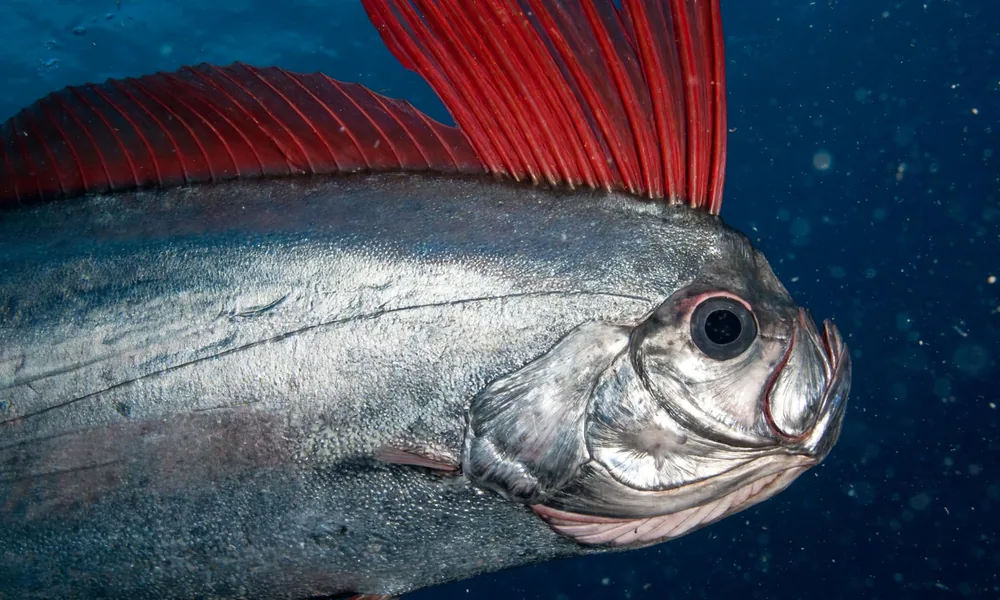
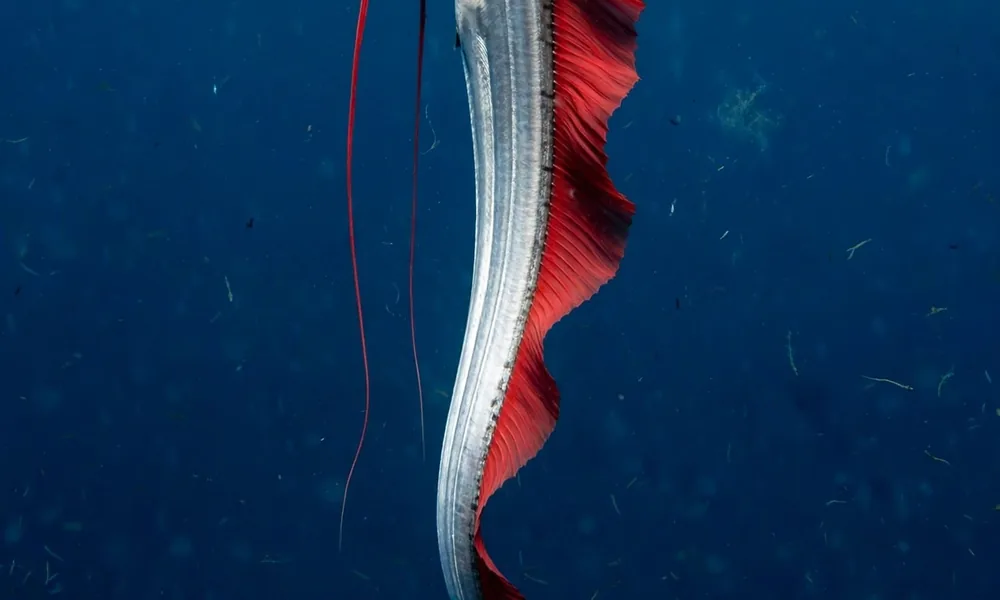
The head is small for the size of the fish, with a steep, slightly concave profile that runs down from the forehead to a small mouth that can be pushed forward like a tube. There are no visible teeth at all, and the inside of the mouth is black, which is a startling detail on a fish that is otherwise all silver and red. The eyes are small and dark, and the dorsal fin is the great showpiece: it runs the whole length of the body from between the eyes to the tip of the tail, it is made of 414 to 449 soft rays, and it is coloured a vivid crimson. The first few rays at the front stand up tall like a crest, and in a living fish they are long and flowing, which is what gives the oarfish its crowned, almost royal look.
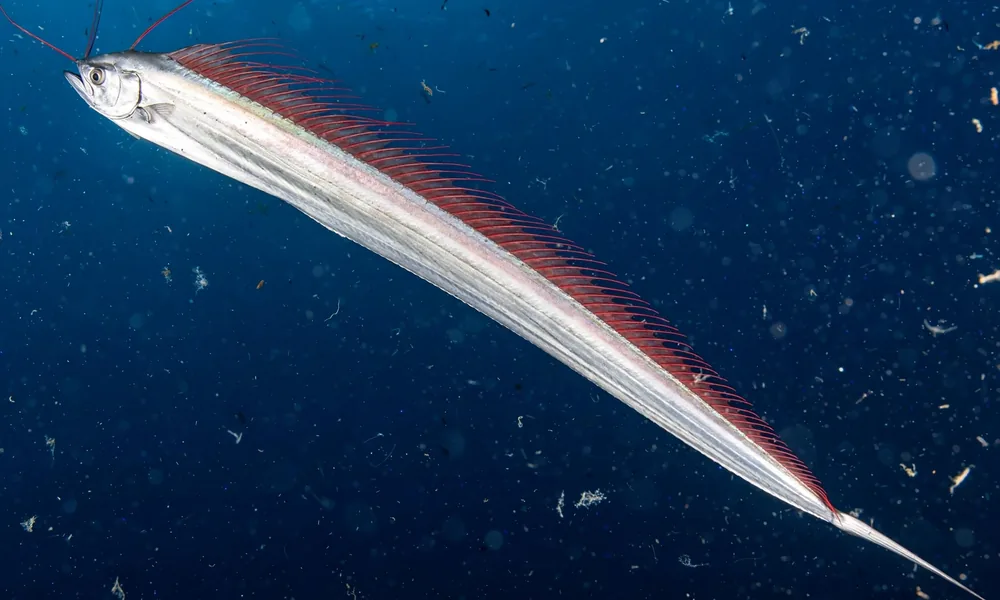
The pelvic fins are what gave the fish its English name. Each one is reduced to a single long ray, like a slender oar, that trails behind and below the fish and can be longer than a metre in a big animal, and they are coloured red like the dorsal fin. The pectoral fins, by contrast, are small and stubby, and the tail fin is short, with only four rays. There is no swim bladder, which is unusual for a fish of this size, and the body is soft and gelatinous inside, with flesh that is flabby and tasteless, which is one reason nobody fishes for oarfish on purpose. Like the angelfish, the oarfish is a fish that is recognised by its fins and its colour before anything else, but the angelfish is a compact reef fish of bright bands and short fins, while the oarfish is a long silver blade with a red crest, and the two could hardly look less alike.
Where oarfish live
Oarfish live in the open ocean, far from land and far from the sea floor, in the great blue water column that covers most of the planet. They are found in temperate and tropical seas all around the world, from the Atlantic and the Mediterranean to the Indo-Pacific and the eastern Pacific, where the range runs from Topanga Beach in southern California south to Chile. They are not found in the polar oceans, and they are not reef fish or coastal fish at all: they belong to the epipelagic and mesopelagic zones, the sunlit surface waters and the dim twilight waters below them, and they are most often recorded at depths of 20 to 200 metres, though they can go as deep as 1,000 metres.
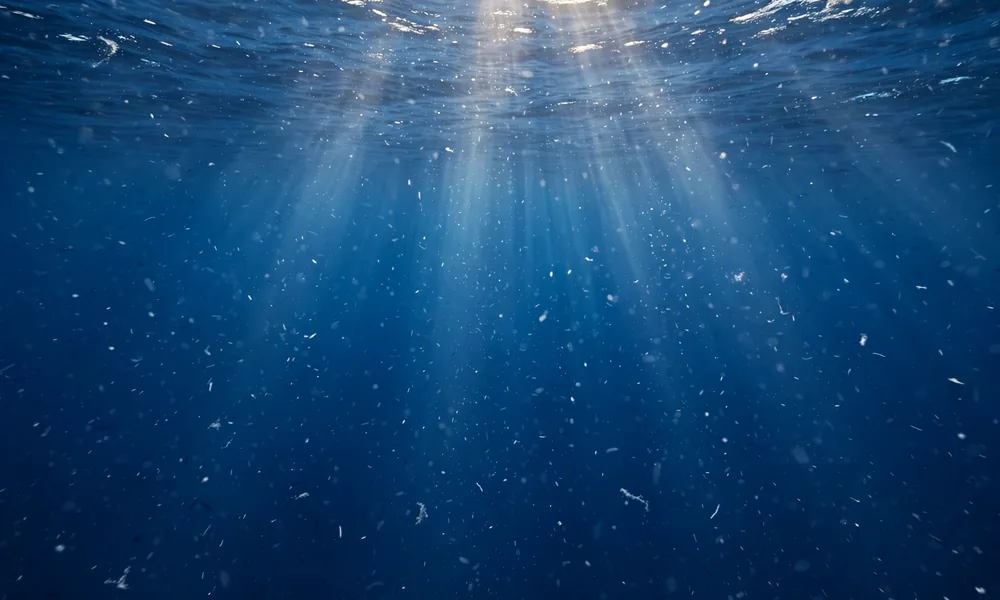
The water the oarfish chooses is cool rather than warm, and the fish follows its food more than it follows a place. It is described as oceanodromous, which means it moves through the open ocean following the plankton and krill it feeds on, rather than migrating between fixed breeding and feeding grounds the way a salmon does. It has no home range in the usual sense: no reef or rock it returns to, no territory it defends, and a single fish may drift across hundreds of kilometres of open sea in its life.
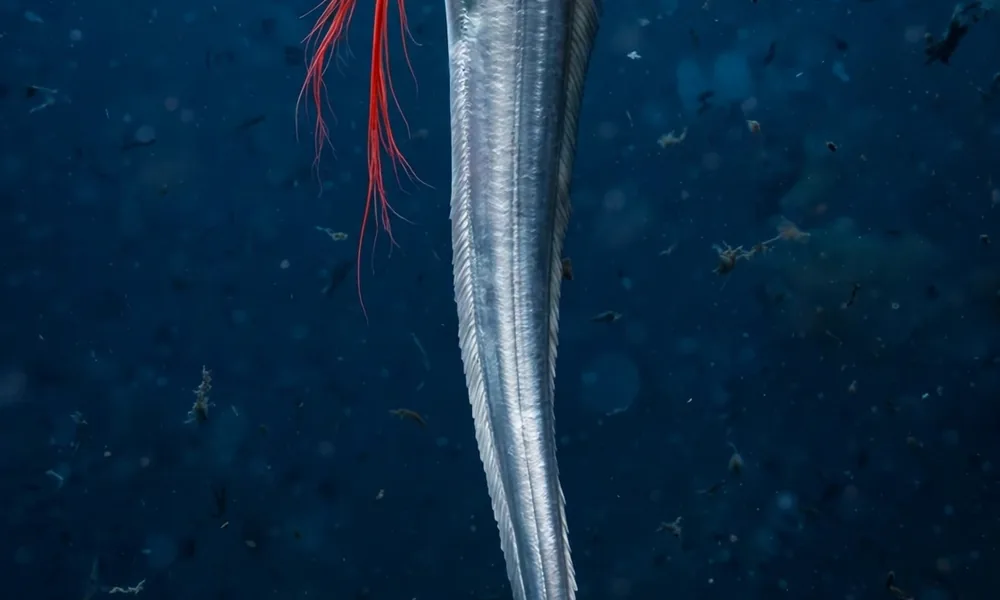
Most of what we know about where oarfish live comes from the unhappy end of the story, because healthy oarfish are almost never seen. Sick or dying fish sometimes drift up towards the surface and are spotted by boats, and dead ones are washed onto beaches after storms, and those strandings are how most specimens reach scientists at all. The deepest verified sighting came from the Gulf of Mexico, where a remotely operated vehicle filmed one at 463 to 492 metres down. In October 2013, a snorkeller found a 5.5-metre oarfish off Catalina Island in California, and in August 2024 another, about 3.6 metres long, washed up at La Jolla.
What oarfish eat
Oarfish are filter feeders, which is a surprising way of life for the longest bony fish in the sea. They eat plankton, krill and other small crustaceans, along with small fish and squid, and they take them not by chasing or biting but by straining them out of the water. The mouth is small, toothless and protrusible, which means it can be pushed forward into a tube, and when the fish opens it, water rushes in and is passed over the gill rakers, a comb of fine, closely set structures on the first gill arch, 33 to 47 of them in a large fish, which catch the food and let the water flow out. It is a quiet, unhurried way of feeding, and it suits a fish that has no teeth, no speed and no interest in a fight.
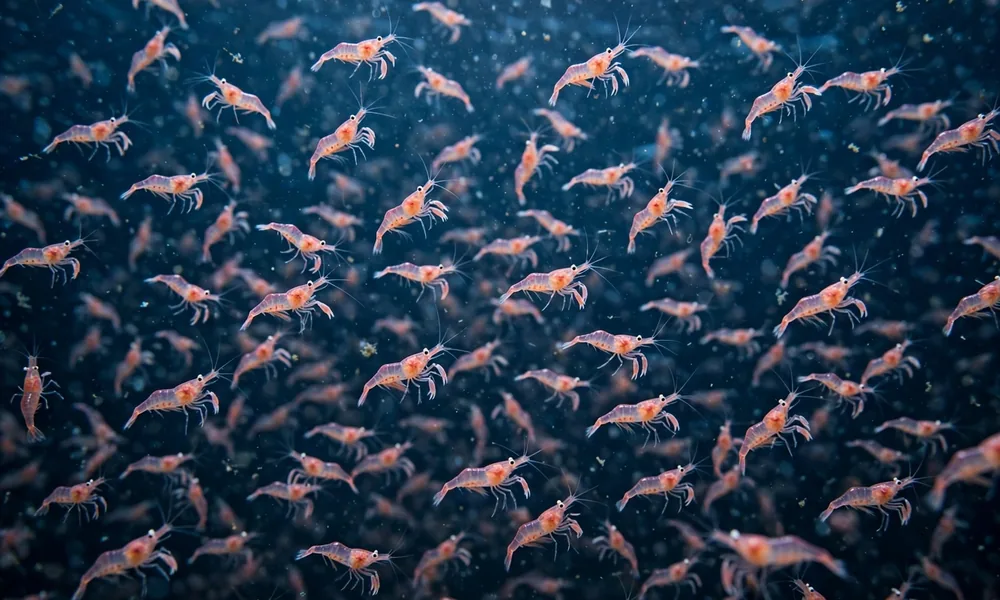
The vertical posture is part of the feeding plan. By hanging head-up in the water column, the oarfish can look up towards the light and spot the silhouettes of krill and small squid drifting above it, and then it sucks them in with a quick opening of the mouth. Krill are the most important food, and the stomachs of stranded specimens have held krill, small fish and squid. Like the salmon, the oarfish follows its food through the open sea, but the salmon is a strong swimmer that hunts fish and chases its prey, while the oarfish drifts and strains, taking whatever the water brings to it.
How oarfish behave
The most famous thing about oarfish behaviour is the way they swim, because it looks like nothing else in the sea. An oarfish holds its body straight and still, hanging upright in the water with its head pointing up towards the surface and its tail pointing down, and it moves by rippling its long dorsal fin in a wave that runs from head to tail. This is called amiiform swimming, after the bowfin, Amia, which swims the same way, and it lets the fish move slowly and precisely without bending its body at all. Divers who have seen it describe it as stately and almost unreal, a silver ribbon standing on end in the blue.
Oarfish are solitary fish, and they do not school, shoal or gather in groups. Every sighting of a living oarfish has been of a single fish on its own, and there is no evidence that they travel in pairs or keep company of any kind. They are also slow fish, and they have no burst of speed to escape a predator: their defence is to live where almost nothing can reach them, hundreds of metres down in the open ocean, and to rely on their silvery colour, which breaks up their outline in the dim light. When a predator does find one, the oarfish may shed the tip of its tail, which is why so many stranded specimens arrive with the tail missing, and the wound heals over while the fish goes on swimming.
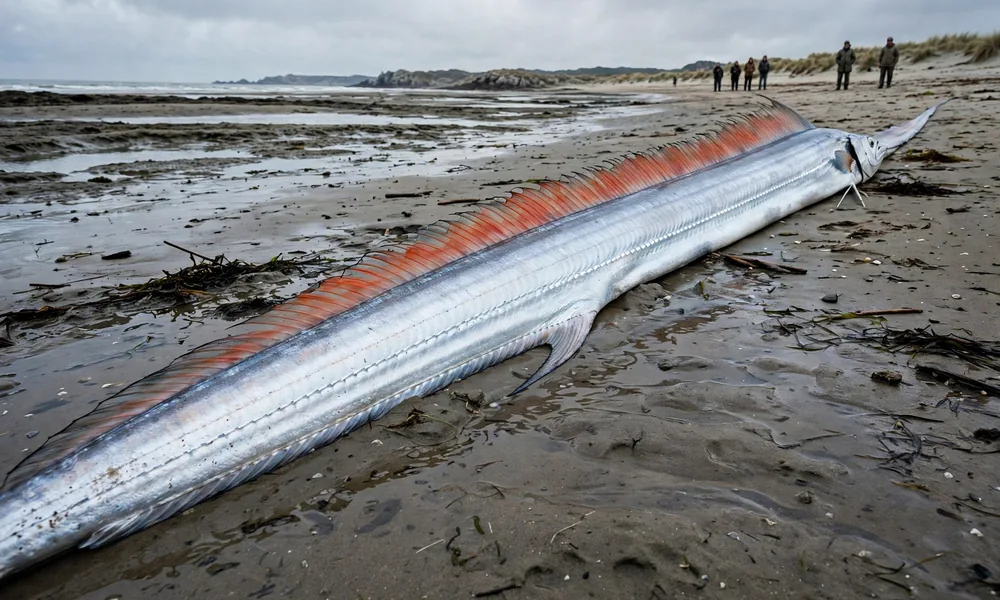
The strandings themselves are part of the behaviour that people know best, and they are also the part that is least understood. A healthy oarfish has no reason to come to the surface, so a fish found on a beach is almost always sick, injured or dying, and storms are often blamed for pushing weak fish inshore. In Japan, strandings have long been read as warnings of earthquakes, and the winter of 2009 to 2010 saw unusual numbers of Russell’s oarfish appear on Japanese beaches. Scientists have looked for a link between strandings and earthquakes and found none that holds up. Oarfish are harmless to people in every sense: they have no teeth, no venom, no bite and no interest in anything larger than a krill.
Breeding and life cycle
Almost nothing is known about how oarfish breed, and that is not an exaggeration: no one has ever seen a wild oarfish spawn, no one has ever found an oarfish nest, and there are no records of a mating pair. What is known comes from the eggs and larvae of stranded fish and from the places where young oarfish have been caught, and it paints a picture of a fish that spawns in the open ocean and leaves its young to drift. Oarfish are broadcast spawners, which means the female releases her eggs into the water and the male releases his milt over them, and fertilisation happens in the open sea with no nest, no guarding and no care of any kind afterwards.
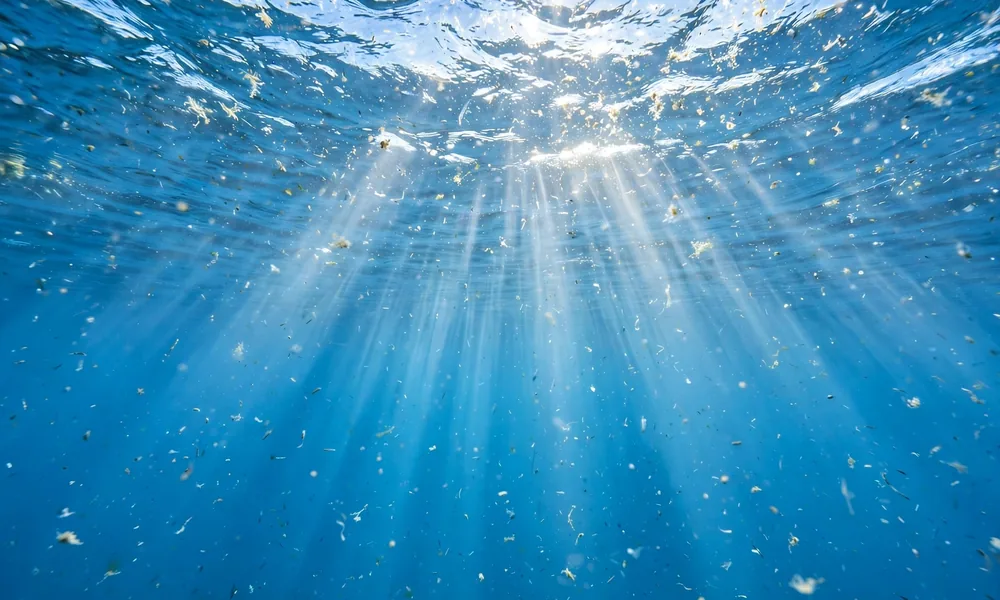
Spawning is thought to take place between July and December, in warm waters, and the eggs are large for a fish of this kind, measuring 2 to 4 millimetres across and carrying a number of oil droplets that help them float. The larvae are found near the surface, and they look very different from the adults: they are small, almost transparent, with long trailing fins and a body that is far shorter and deeper than the ribbon of the grown fish. As they grow they sink deeper, their bodies lengthen, and the red crest and the long pelvic fins develop, until they become the silver ribbons that strand on beaches. Mature fish are thought to spawn in a few known areas, including the waters off Florida, the Straits of Messina in the Mediterranean and the Chatham Rise off New Zealand.

Conservation status
The giant oarfish is listed as Least Concern by the International Union for Conservation of Nature, and the assessment, made in 2013, rests on two plain facts: the fish has a huge range across all the temperate and tropical oceans, and it has no commercial value, so nobody fishes for it on purpose. Its flesh is gelatinous and tasteless, which is a happy accident for a fish that would otherwise be an easy target. A fish that is almost never seen is also a fish whose numbers cannot be counted, so Least Concern means no decline has been measured, not that the population is known to be healthy.

The main pressures on oarfish are the ones that reach into the deep ocean. Deep-sea trawling and longlining can catch them as bycatch, and a fish with no swim bladder and a soft, gelatinous body does not survive being dragged to the surface. Pollution is a second pressure, and it matters more for a filter feeder than for most fish, because an oarfish strains its food out of the water and takes in whatever is floating in it, including the microplastics that now drift through the water column in every ocean. How much harm that does is still unclear, and it is one of the open questions about the species. Climate change is a third pressure, because warming water changes where krill gather, and a fish that follows its food through the open ocean will have to follow it into new waters.
The most useful conservation work for the oarfish is the same work that helps the whole deep sea. Protecting the open ocean from destructive trawling keeps the water column intact for the animals that live in it, and reducing plastic in the sea keeps the filter feeders from straining it out along with their food. Reporting a stranding to a local marine institute or stranding network is the single most useful thing a beach walker can do, because every stranded oarfish that is measured, sampled and recorded adds to a dataset that is still very small. A fish that is almost never seen can only be protected if the few that do appear are properly recorded, and that record starts with someone on a beach making a phone call.
Best seasons for oarfish watching
There is no reliable season for watching oarfish, and anyone who tells you otherwise is guessing. A living oarfish is almost never seen by divers, and the fish has never been kept in an aquarium, so the honest answer is that there is no time of year and no place where you can plan to see one. What there is, instead, is a pattern in the strandings: dead and dying oarfish are most often found on beaches after winter storms, when rough seas push weak fish inshore, and in Japan the most famous run of strandings came between December 2009 and March 2010. In California, the best-known recent strandings came in late summer and autumn, but two fish do not make a season.
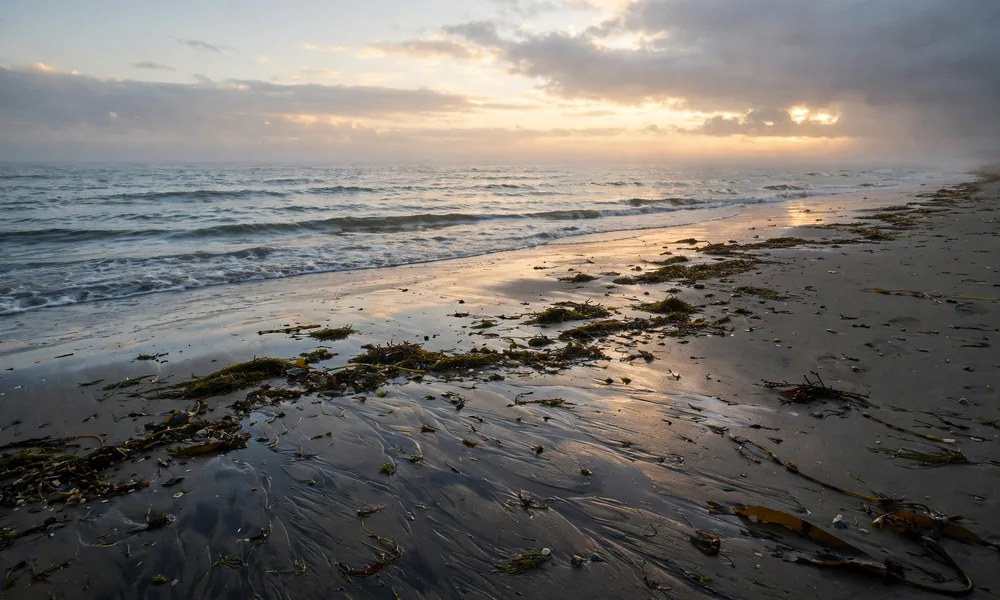
The best hours are the dawn hours after a storm, when the tide has just gone out and the beach is still empty. Walk the tide line slowly and check the wrack line where the sea leaves its debris, because a stranded oarfish is often half buried in weed and easy to walk past. If you do find one, do not touch it and do not try to push it back into the sea: a stranded oarfish is almost always dying, and the most useful thing you can do is to photograph it, note the exact place and time, and call the local marine institute or stranding network. The other way to see an oarfish is on a screen, in footage from remotely operated vehicles working in the deep ocean, and the Gulf of Mexico film from 463 to 492 metres down remains the deepest verified sighting ever recorded.
Staying safe around oarfish
An oarfish is not dangerous to people in any way, and there is no safety warning that belongs to the fish itself. It has no teeth, no venom, no spines that can hurt you and no bite that matters, and a living oarfish would rather drift away from a diver than come anywhere near one. The safety rules for oarfish watching are the rules of the sea and the beach: watch the water, watch the weather, and respect the fish that you came to see. Never walk a beach in a storm, never climb onto rocks when the waves are breaking over them, and never wade into deep water without knowing what is under your feet.
There are a few practical points for a stranding. A dead oarfish can be very large and very heavy, and its body is soft and slippery, so do not try to move it or drag it by the tail, which may already be damaged. Keep dogs away from it and wash your hands after touching any dead sea animal. If you are watching from a boat, keep your distance from any fish at the surface, wear a life jacket, and remember that a sick oarfish at the surface is a sign of rough water nearby. An oarfish will not hurt you, but the sea that brings it to you can, and the sensible approach is to enjoy the fish from a safe distance and let the experts handle it.
Oarfish watching checklist
A little preparation turns a morning on the beach into a real chance of finding a stranded oarfish, and of knowing what to do if you are lucky enough to see one.
- A walk on the beach at dawn after a winter storm, when the tide has just gone out and the strandings are fresh.
- A slow walk along the tide line and the wrack line, looking for anything long and silver among the seaweed.
- A camera or a phone, charged and ready, so that a stranding can be photographed and recorded properly.
- The phone number of the local marine institute or stranding network, saved before you leave the house.
- Sturdy shoes and warm clothes, because a winter beach is cold, wet and slippery underfoot.
- A buddy to walk with, so that a day on a storm beach stays safe from start to finish.
- Respect for the fish and the beach, keeping your distance, never dragging a stranded oarfish, and leaving the shore as you found it.
Frequently asked questions
How big do oarfish get?
Most giant oarfish measure about 3 metres from snout to tail, and the largest documented specimens reach 7 to 8 metres, with reports of fish up to 11 metres. The heaviest ever recorded weighed 272 kilograms, and the fish holds the record as the longest bony fish in the sea. Russell’s oarfish is smaller, with the largest recorded specimen measuring 5.4 metres, and the streamer fish reaches 3 metres.
What do oarfish eat?
An oarfish eats plankton, krill and other small crustaceans, along with small fish and squid, and it takes them by straining them out of the water. Its mouth is small and toothless and can be pushed forward into a tube, and the water it sucks in passes over 33 to 47 gill rakers on the first gill arch, which catch the food and let the water flow out. It is a quiet, unhurried feeder, and it spends its life drifting upright in the water column, looking up for the silhouettes of krill above it.
Do oarfish predict earthquakes?
There is no scientific evidence that oarfish predict earthquakes, even though the belief is old and widespread, especially in Japan, where the fish is called the Messenger from the Sea God’s Palace. Strandings do sometimes happen in runs, such as the winter of 2009 to 2010, but scientists who have looked for a link between strandings and earthquakes have found none that holds up. A stranded oarfish is almost always a sick or dying fish pushed inshore by storms, not a warning of anything to come.
Are oarfish dangerous?
No, oarfish are not dangerous to people. They have no teeth, no venom and no bite, and they are among the most harmless large fish in the sea. Their whole defence is to live hundreds of metres down in the open ocean, where almost nothing can reach them, and a living oarfish will drift away from a diver rather than come near. The danger in oarfish watching is the sea itself, not the fish, and the safety rules are the rules of the beach and the water.
Can you keep an oarfish in an aquarium?
No, and nobody has ever managed it. An oarfish grows to several metres long, lives in the open ocean at depths of 20 to 1,000 metres, and needs the whole water column to hang upright and feed, which no tank can provide. It also arrives at the surface only when it is sick or dying, so there is no healthy specimen to catch. An oarfish belongs in the deep sea, not in a tank, and the only way to see one is a stranding or deep-sea footage.
How is this guide different from the nurse shark guide?
This guide covers the oarfish, a deep-sea ribbon fish of about 3 metres that hangs upright in the open ocean, has no teeth at all and strains krill from the water, while our nurse shark guide covers a bottom-dwelling shark of the warm shallows that rests on the sea floor by day, sucks shellfish and small fish from the sand and carries rows of small teeth. One is a silver ribbon you will almost certainly never see alive; the other is a slow, whiskered shark that divers meet on the reef.
Conclusion
The oarfish species is a reminder that the sea still keeps secrets, even in an age when every corner of the planet has been mapped. A fish longer than a city bus, silver as a mirror and crowned in red, spends its whole life drifting upright in the dark water hundreds of metres down, and we know it mostly from the ones that wash up dead on beaches.
If you go looking for one, go after a storm, go at dawn, and walk the tide line slowly with your eyes open and a phone in your pocket. Find a long silver ribbon in the seaweed, photograph it, call the local marine institute, and you will have met the longest bony fish in the sea, the fish that launched a thousand sea-serpent stories and still refuses, most of the time, to be seen at all.