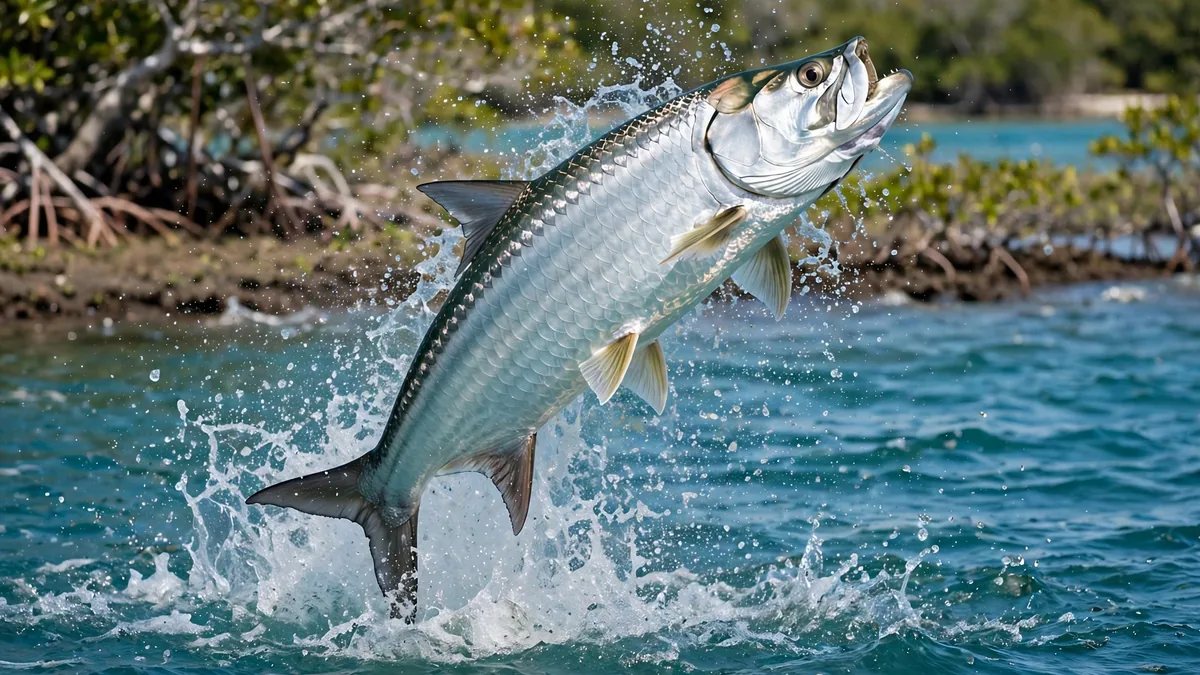
The tarpon species are the silver kings of the warm Atlantic, big bright fish that leap clear of the water, breathe air at the surface and fight harder than any fish their size. If you are asking what a tarpon is, the short answer is a member of the genus Megalops, a group of just two living species that grow to 2.5 metres and 161 kilograms, live in coastal waters, estuaries and rivers from Florida to West Africa, and are prized by anglers not for their flesh but for the wild, leaping fight they put up on the end of a line. They are ancient fish, with a larval stage like an eel and a swim bladder that works like a lung, and they have survived almost unchanged for millions of years.
Most people meet a tarpon in Florida, in the passes and flats of the Keys and at Boca Grande, where the fish gather in their thousands each spring. The Atlantic tarpon is listed as Vulnerable by the International Union for Conservation of Nature, and in Florida it has been catch and release only since 2013, which is why the great fish are still there to be caught, photographed and let go. This guide follows both tarpon species: how they look, where they live, what they eat, how they breed, and why they leap.
Key takeaways
- The tarpon species belong to the genus Megalops, the only living members of the family Megalopidae, with just two species: the Atlantic tarpon and the Indo-Pacific tarpon.
- The Atlantic tarpon grows to 2.5 metres and 161 kilograms, and the world rod-and-line record stands at 129.98 kilograms, a fish of 286 pounds 9 ounces caught in Guinea-Bissau in 2003.
- Tarpon can breathe air, filling a swim bladder that works like a primitive lung, which lets them live in warm, low-oxygen water where other fish cannot survive.
- Females release millions of eggs offshore, and the young hatch as transparent ribbon-like larvae called leptocephali before drifting inshore to grow up in mangroves and marshes.
- The Atlantic tarpon is listed as Vulnerable, and in Florida it is catch and release only, with the fish kept in the water at all times.
The tarpon species and their relatives
Tarpon belong to the family Megalopidae, a family that holds just two living species, the Atlantic tarpon and the Indo-Pacific tarpon, and nothing else. The genus is Megalops, a name that comes from the Greek words for large and eye, a nod to the big, dark eyes that stare out of the silver head, and the family sits in the order Elopiformes, alongside the ladyfish and the bonefish. The tarpon is an ancient fish, and its larval stage, the transparent ribbon-like leptocephalus, is shared with the eels, which tells you how far back its family tree reaches.
The Atlantic tarpon, Megalops atlanticus, is the lead species of this guide, and it is the fish that defines the whole genus in most people’s minds. It lives in the warm coastal waters of the Atlantic, from Nova Scotia and Bermuda in the north to Brazil in the south, and from Mauritania to Angola on the African side, and it grows to 2.5 metres and 161 kilograms. Most adults are smaller, usually 90 to 180 centimetres, and the males rarely weigh more than 45 kilograms, but a big female is a fish the size of a person, and it is still the largest inshore game fish of the tropical Atlantic.
| Type | Animal | Where it lives | Best-known food | Length or Weight |
|---|---|---|---|---|
| Family | Tarpons (Megalopidae) | Warm coastal waters of the Atlantic and Indo-Pacific | Fish, shrimp and crabs | About 1.5 m to 2.5 m long |
| Genus | Tarpons (Megalops) | Warm coastal waters worldwide | Fish, shrimp and crabs | About 1.5 m to 2.5 m long |
| Species | Atlantic tarpon (Megalops atlanticus) | Western and eastern Atlantic coasts | Fish, shrimp and crabs | Up to 2.5 m long |
| Species | Indo-Pacific tarpon (Megalops cyprinoides) | Coasts of the Indo-Pacific from East Africa to Australia | Fish, shrimp and crabs | Up to 1.5 m long |
| Species | Ladyfish (Elops saurus) | Warm Atlantic coasts and estuaries | Small fish and shrimp | About 60 cm to 90 cm long |
| Species | Bonefish (Albula vulpes) | Tropical flats of the Atlantic | Crabs, shrimp and worms | About 40 cm to 90 cm long |
The closest relative of the Atlantic tarpon is the Indo-Pacific tarpon, Megalops cyprinoides, the only other member of the genus, and a fish of the coasts of the Indian and Pacific oceans, from East Africa to Australia and Japan. Like the Atlantic tarpon, it lives in coastal waters, estuaries and rivers, and it can breathe air at the surface, but it is a smaller fish, growing to 1.5 metres, and it is far less studied, listed as Data Deficient by the International Union for Conservation of Nature because so little is known about its numbers. The two tarpon species are the only fish in their family, and they are separated by whole oceans, yet they look so alike that only an expert can tell them apart at a glance.
Within the order, the tarpon sort themselves by the water they like and the size they reach. The ladyfish is the tarpon’s closest cousin outside the genus, a slender silver fish of warm Atlantic coasts and estuaries that grows to about 60 to 90 centimetres, and it shares the tarpon’s leptocephalus larva and its habit of leaping when hooked. The bonefish is a fish of the tropical flats, growing to about 40 to 90 centimetres, and it is the ghost of the shallows, hard to see and hard to catch. Like the bluefin tuna, the tarpon is a big, powerful fish that anglers dream of catching, but the tuna is a fish of the open ocean that swims thousands of kilometres without stopping, while the tarpon is a fish of the coast that lives its life in the shallows, the estuaries and the mangroves.
What a tarpon looks like
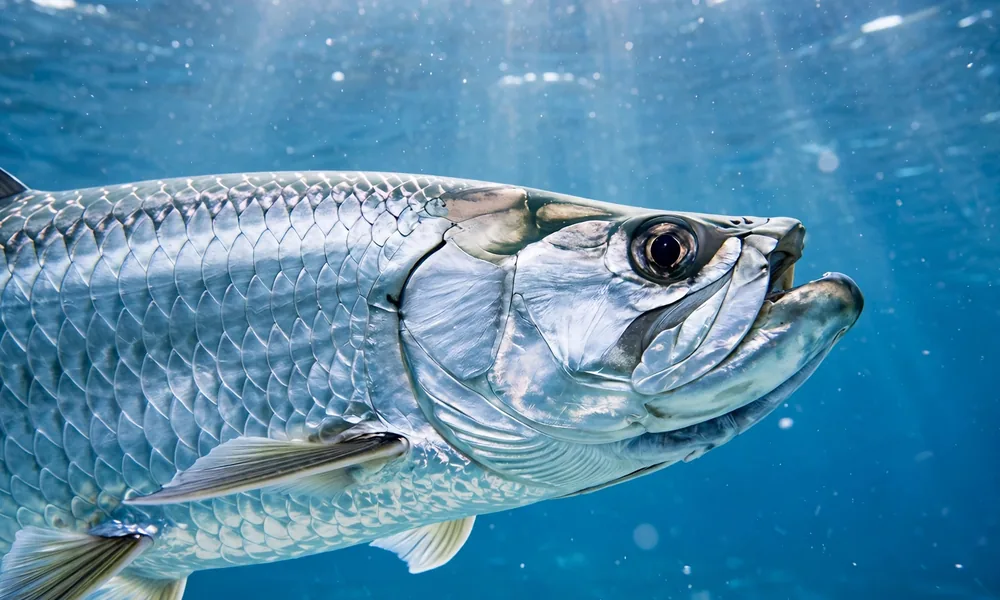
A tarpon looks like a fish made of polished silver, and once you have seen one you will never mistake it for anything else. The body is long and deep, compressed from side to side, and it is covered in large, bright scales that shine like coins in the sun, with a blue-green back fading to a silver belly. The head is large and bony, with a big dark eye and a mouth that turns sharply upward, made for feeding at the surface, and the lower jaw is hard and bony, which is why so many hooked tarpon throw the hook. The dorsal fin is set far back on the body, and its last ray stretches into a long trailing thread, a filament that streams behind the fish as it swims, and it is one of the easiest ways to tell a tarpon from any other fish.
The mouth is the most distinctive part of the fish, and it is built for a life at the surface. The lower jaw juts forward and upward, and the whole mouth opens wide to take in small fish and shrimp from just below the surface, and the bony plates of the jaw are so hard that a hook often finds no purchase, which is why anglers say a tarpon is hooked only when it jumps. The teeth are small and fine, more like sandpaper than the sharp fangs of a barracuda, and they are there to grip rather than to cut. The tail is broad and deeply forked, and it gives the fish its sudden, driving power, the power that sends it six feet clear of the water when it leaps. Like the marlin, the tarpon is a fish that leaps when it is hooked, but the marlin is a fish of the open ocean that leaps with a long bill and a tall dorsal fin, while the tarpon is a fish of the coast that leaps with a silver body and a trailing thread on its back.
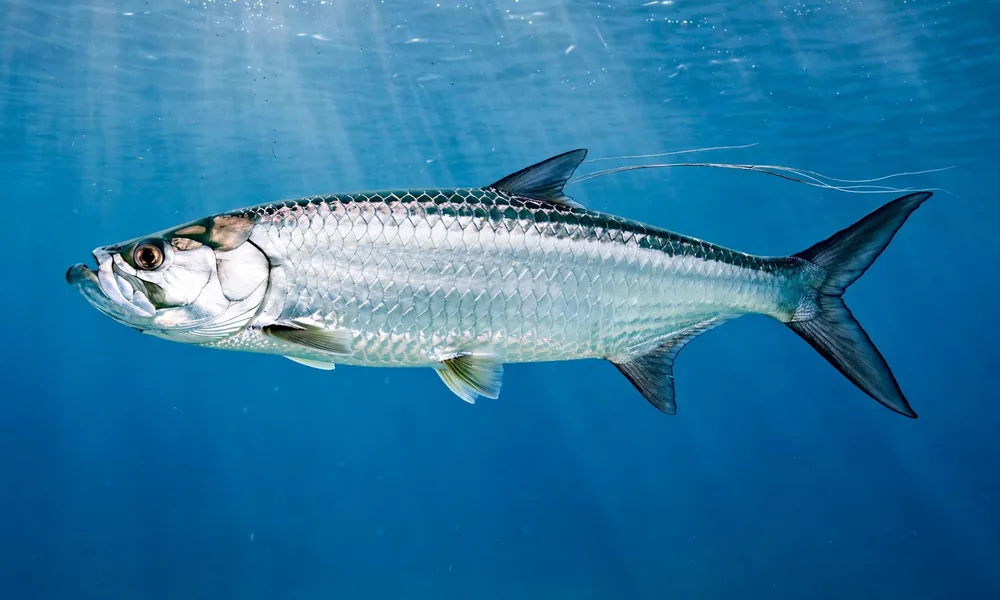
The size of a tarpon depends on the species, and the range is wide. The Atlantic tarpon grows to 2.5 metres and 161 kilograms, and most adults are 90 to 180 centimetres, while the Indo-Pacific tarpon grows to 1.5 metres, a smaller fish in every way. The females grow larger than the males in both species, and the biggest tarpon in any bay is almost always a female, heavy with eggs, and the males rarely weigh more than 45 kilograms. A tarpon of 100 pounds is roughly 1.7 to 2 metres long, a fish of 150 pounds is about 2.1 metres, and a fish of 200 pounds approaches 2.4 metres, which is why anglers measure a tarpon by its length and its girth rather than lifting it from the water.
Compared with other fish, the tarpon is easy to tell apart once you know what to look for. No other inshore fish has scales as large and bright as a tarpon’s, no other has a dorsal filament trailing behind it, and no other combines a silver body with a habit of rolling at the surface to gulp air. The ladyfish is the fish most often confused with a small tarpon, and it has a smaller mouth, a more slender body and no dorsal filament, so the two are easy to separate once you have seen them side by side.
Where tarpon live
Tarpon live in the warm coastal waters of the Atlantic and the Indo-Pacific, and they are fish of the shallows. Their range runs from Nova Scotia and Bermuda in the north to Brazil in the south, through the Gulf of Mexico and the Caribbean, and from Mauritania to Angola on the African side, and the Indo-Pacific tarpon ranges from East Africa to Australia and Japan. They favour water that is warm, usually 22 to 28 degrees Celsius, and they are rarely found in cold water, where they become sluggish and may die if the temperature falls below 4 degrees Celsius.
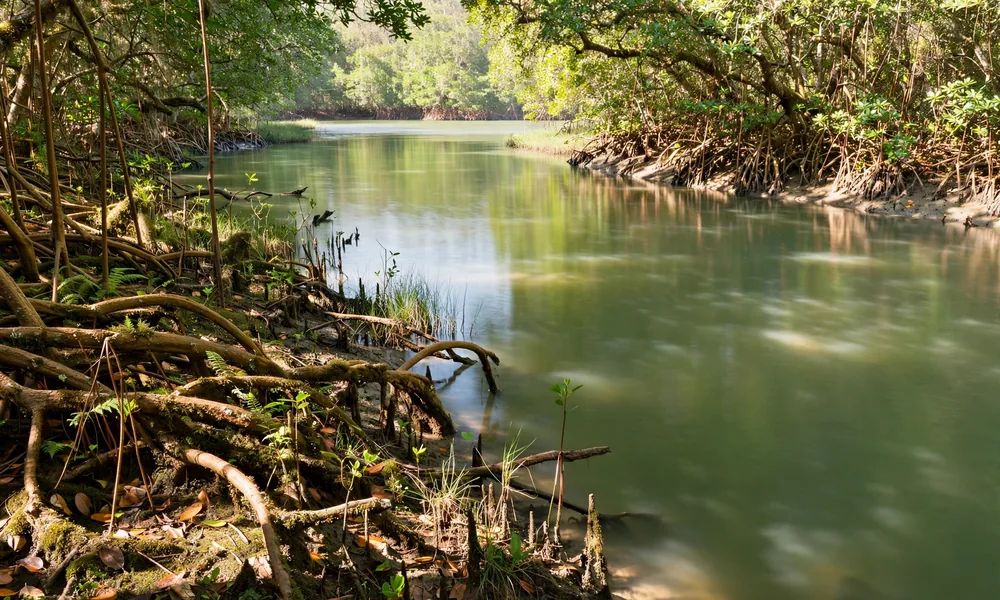
The habitat they choose is the edge of the water, and they are rarely found far from it. Most tarpon live in water between 1 and 15 metres deep, along the mangrove creeks, the tidal flats, the river mouths and the bays, where the food is richest and the shelter is thickest. They favour places with plenty of mangrove roots and seagrass, which give them both hunting cover and a place to hide from the sharks that hunt them from below, and they are less common in open water, where there is little to eat and nowhere to hide. A tarpon spends much of its life within a small stretch of coastline, and it knows every creek and every flat in that stretch.
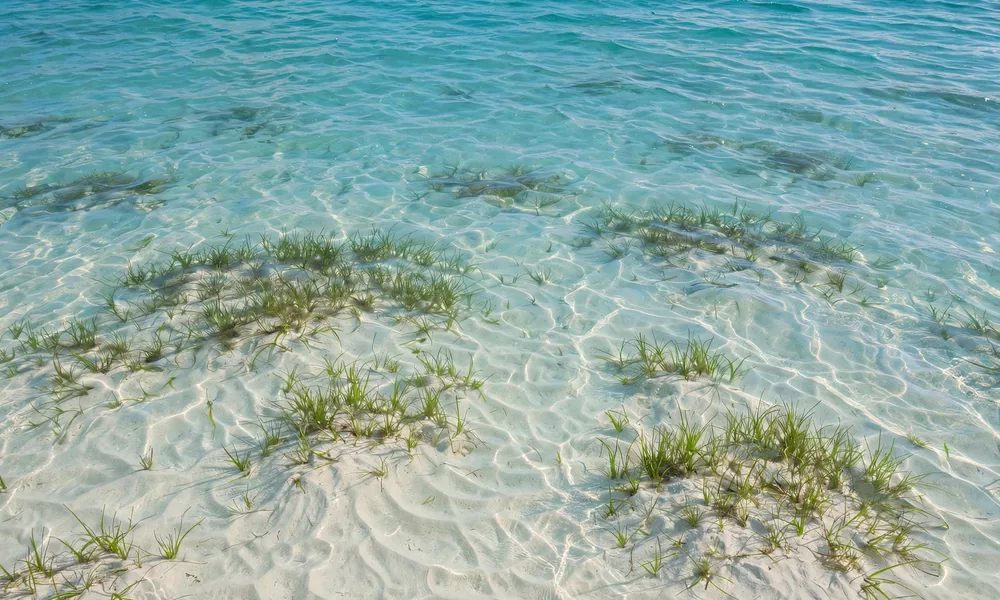
Depth matters, but not in the way it does for a deep-water fish. Tarpon are shallow-water animals, and most of them stay above 40 metres, where the sunlight reaches the seagrass and the water is warmest. In the heat of summer they may move deeper, to 20 or 30 metres, where the water is cooler, and in winter they move into the warmest water they can find, holding in the deep channels and the river mouths. The water temperature matters most of all: tarpon need warm water, usually 22 to 28 degrees Celsius to feed well, and below 16 degrees Celsius they become inactive, which is why they are absent from cold northern coasts altogether.
The tarpon has travelled far beyond its native range, but not by choice, and it now lives in waters where it was never meant to be. Tarpon have been found in the Mediterranean, carried there by ships or by warm currents, and in the rivers of West Africa they have pushed far upstream, into fresh water. In some of those places they have become a problem, eating native fish that have no defence against them, and in others they are a valued sport fish. Like the swordfish, the tarpon is a fish of warm water that moves with the seasons, but the swordfish is a fish of the open ocean that dives hundreds of metres down in the cold dark, while the tarpon is a fish of the shallows that stays in the warm sunlit water at the top.
What tarpon eat
Tarpon are hunters, and their diet is written on the flats themselves. The everyday food is small fish, and a tarpon will eat almost any fish it can fit in its mouth, from mullet and sardines to anchovies and young tarpon. They also eat shrimp, crabs and other crustaceans, and a big tarpon will take a crab without a second thought. A bay full of tarpon keeps the numbers of smaller fish in check, which is one reason they matter to the whole estuary.
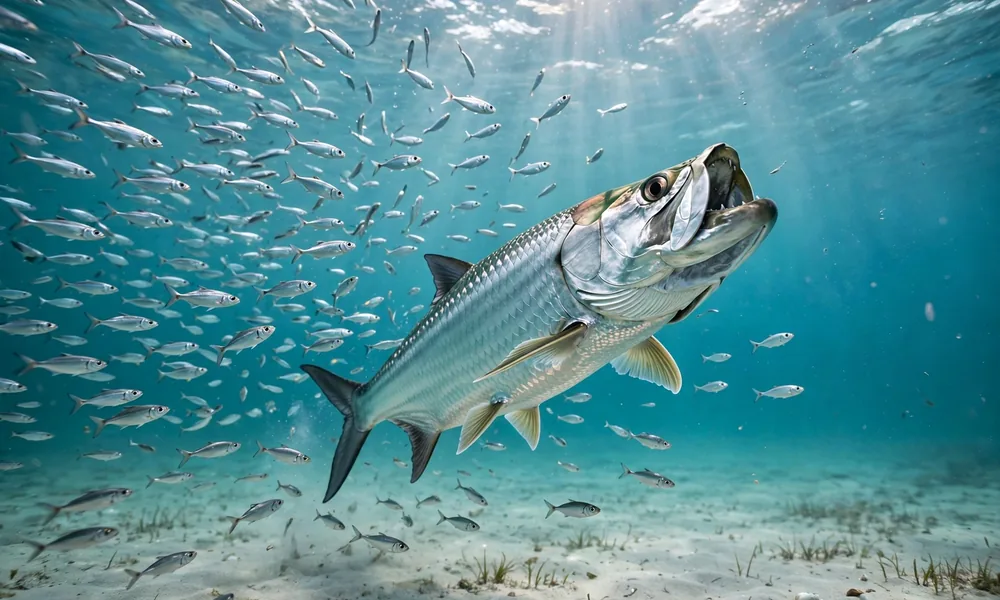
What sets the tarpon apart is how it hunts. It does not wait in ambush, and it does not hunt in a pack. It cruises slowly through the shallows, rolling at the surface to gulp air, and it watches for a school of small fish to come within range. When the moment comes, it opens its mouth wide and takes the prey in a rush, and the whole strike takes a fraction of a second, and the tarpon then turns and swims on, holding the prey in its mouth until it can swallow it whole. Like the mahi-mahi, the tarpon is a fast, bright hunter of warm water, but the mahi-mahi is a fish of the open ocean that hunts in the blue water far from land, while the tarpon is a fish of the coast that hunts in the shallows, among the mangroves and the seagrass.
Feeding follows the rhythm of the day and the season, and it is busiest at dawn and dusk. Tarpon feed most actively in the early morning and the late evening, when the light is low and the small fish are moving in the shallows, and they rest in the heat of midday, holding in the shade of a mangrove or a dock. In spring and summer, when the water is warm, they feed hard, putting on weight for the spawning season, and in winter they feed little, and a tarpon in cold water may go days without eating, holding in the deep channels and waiting for the spring. Young tarpon eat zooplankton, insects and small fish, and they grow fast on that rich food, reaching 30 centimetres or more in their first year.
How tarpon behave
Tarpon are daytime fish, and their day is a quiet round of cruising, rolling and feeding in the shallows. They wake at dawn, leave the deep channels where they spent the night, and move onto the flats to feed, and they spend the day working the mangrove edge in a slow, unhurried way, never rushing, never chasing far. They are not strong swimmers over distance, and they do not need to be: their life is lived within a few kilometres of coastline. When a shark passes, a tarpon will often leap clear of the water, throwing itself into the air to escape, and if that fails it will dart into the mangroves and wait.
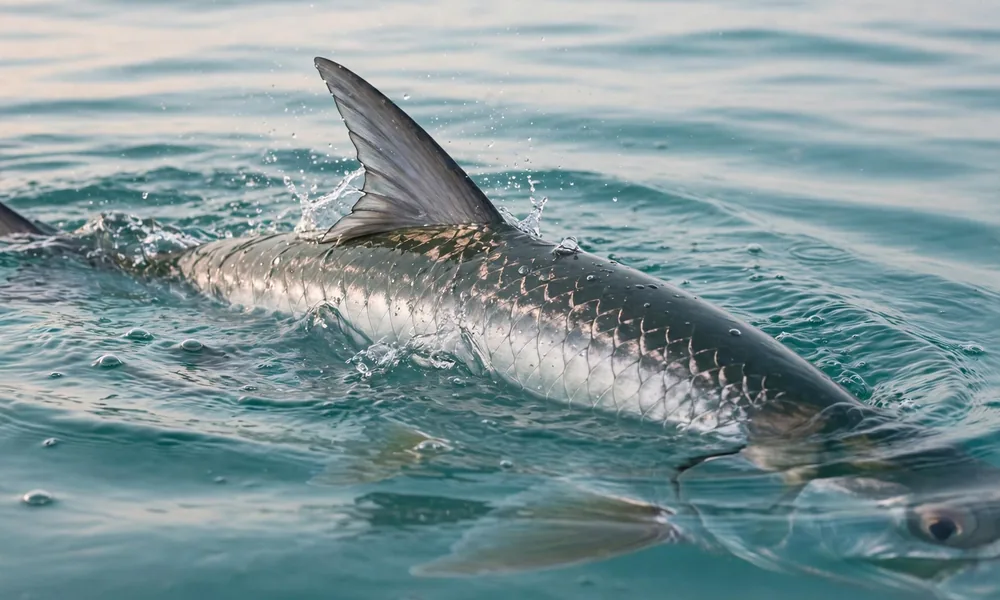
The most famous behaviour in the tarpon is the leap. When a tarpon takes a lure or a fly, it often jumps clear of the water, shaking its head from side to side, trying to throw the hook, and a big tarpon may leap six feet clear of the surface, its whole silver body in the air, before it crashes back into the sea and runs for the mangroves. The leap is a burst of pure power, and it is the moment every tarpon angler waits for, the fish silver in the air, water flying from its gills, before it crashes back and runs again. The leap is not a trick, but a defence, and a tarpon that has been caught before will sometimes leap less, and run deeper instead, which is why the biggest tarpon in a bay are often the hardest to catch.
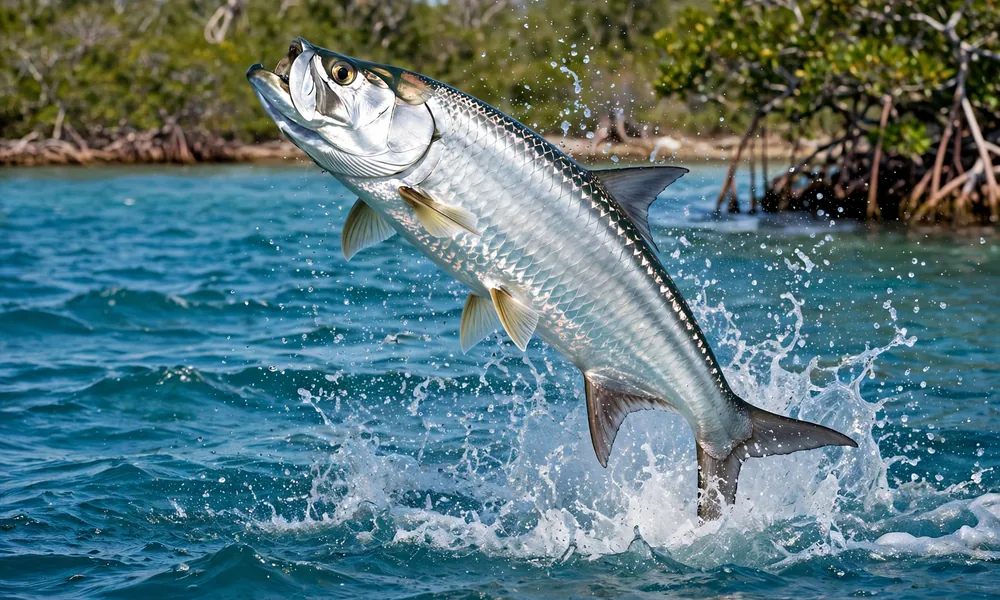
When a tarpon is threatened, its first response is to leap, relying on its speed and its size to break free, and if that fails it will run for the mangroves and stay there until the danger passes. Tarpon have no venom and no bite that matters to a person. A tarpon that is handled roughly will lose the slime that protects its skin, which is why anglers who release their fish keep them in the water and hold them gently by the lower jaw, and why a tarpon over 40 inches must stay in the water in Florida, by law.
Breeding and life cycle
Tarpon breed in late spring and early summer, when the water is warmest, and the timing is set by the temperature and the moon rather than the calendar. The adults gather in large schools near the coast, and they swim offshore, sometimes 100 miles out into the Gulf, to the spawning grounds, and the journey takes days. A female tarpon may not breed until she is six or seven years old, when she is about 1.2 metres long, and she may then release millions of eggs in a single spawning, more than almost any other fish in the sea.
The female arrives at the spawning ground and releases her eggs into the open water while the male releases his milt over them, and a large female can lay up to 12 million eggs at once, with some estimates running as high as 20.7 million. The eggs are tiny and transparent, and they drift with the current, hatching into larvae called leptocephali, transparent ribbon-like creatures that look nothing like a fish at all. The leptocephalus stage lasts 20 to 30 days, and the larvae drift towards the shore, feeding on nothing but the nutrients they absorb from the seawater, until they reach the estuaries and the mangrove nurseries.
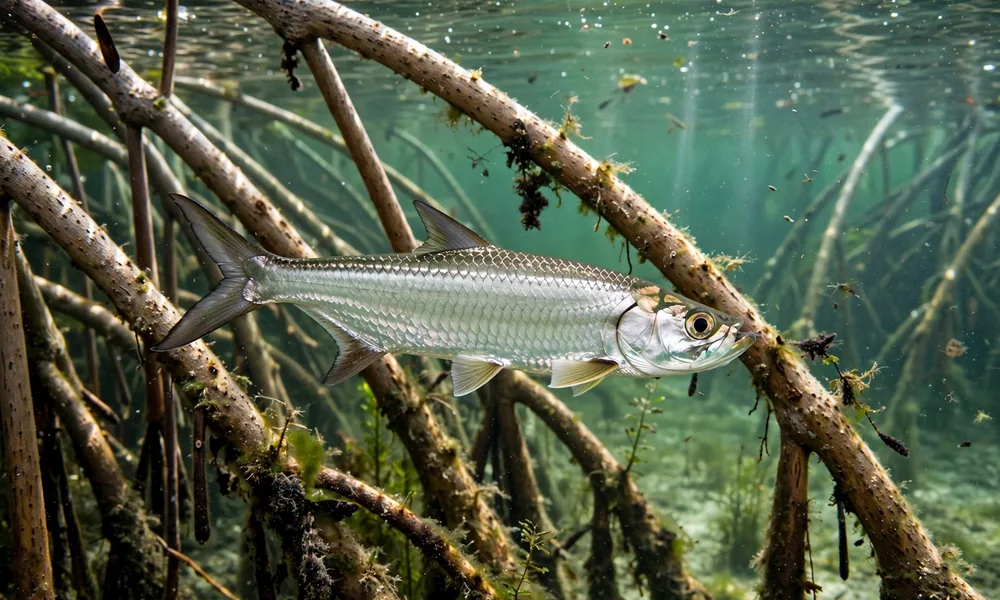
Growth is fast in the first year, and a young tarpon can reach 30 centimetres or more by the end of its first summer, feeding on zooplankton, insects and small fish before it turns to larger prey. It reaches breeding size in its sixth or seventh year, when it is about 1.2 metres long, and the lifespan in the wild is often 50 years or more, with the oldest fish aged at 55 years. The young are independent from the day they reach the estuary, able to feed and hide within hours, but most of them will never reach adulthood, eaten by fish and birds in their first weeks.
Conservation status
The Atlantic tarpon is listed as Vulnerable by the International Union for Conservation of Nature, and the reasoning is straightforward: it has a huge range, but it is slow to mature, it gathers in large schools to spawn, and it depends on mangroves and estuaries that are being lost to development. That broad picture hides a more hopeful local one, because the tarpon is tied to the fate of the coast it lives on. A fish that breeds offshore and grows up in the mangroves cannot live where the mangroves have been cleared, and a coast that loses its mangroves loses its tarpon within a season or two.
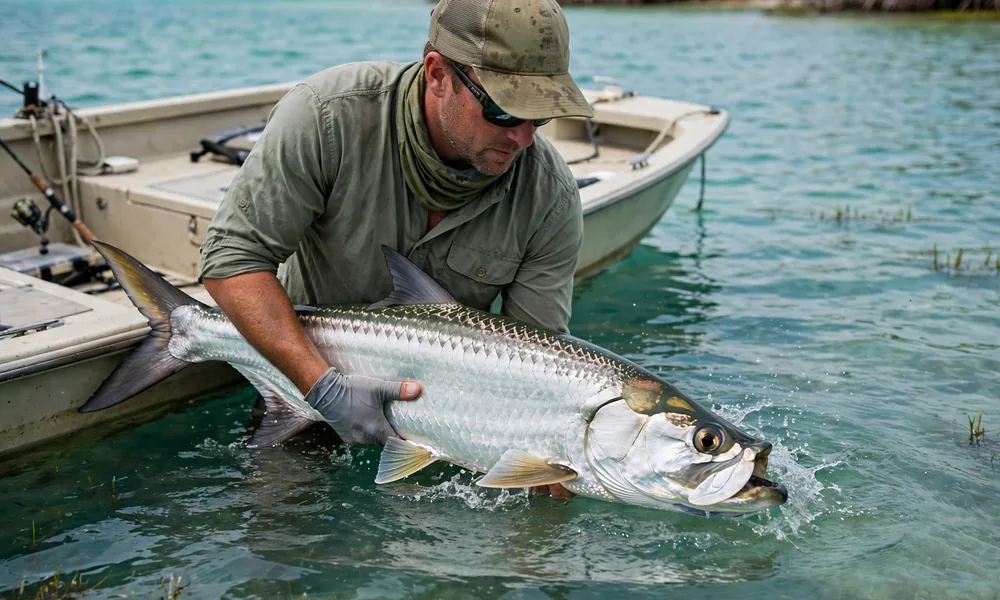
The main pressure is the loss of habitat. When a mangrove forest is cleared for development, or an estuary is dredged or filled in, the tarpon loses the nursery where its young grow up, and the shallow flats where it feeds. Fishing is a second pressure, and a bay that loses its biggest females loses its best breeders, which is why so many fisheries now require the fish to be released, and why Florida has made the tarpon catch and release only since 2013. Water quality is a third pressure, and a bay that loses its seagrass to pollution loses the small fish and shrimp the tarpon feeds on.
The most useful conservation work is practical, and it is the same work that helps the whole coast. Protecting the mangrove forests and the seagrass beds keeps the nursery and the feeding grounds in place, and protecting the shoreline from development keeps the water clean for the fish that live in it. Catch-and-release fishing, with rules that keep the fish in the water, gives the tarpon a safe patch to feed and breed in, and it gives the bay a chance to hold its fish from one season to the next.
Best seasons for tarpon watching
The best time to look for a tarpon is the spring and the early summer, when the water is warming and the fish are gathering in the passes and the bays to spawn. In Florida that usually means the months from about April to July, when the water reaches 22 to 28 degrees Celsius and the tarpon are rolling at the surface in numbers you can see from the shore. In the Caribbean the season starts earlier, from about March, and the fish are active for longer, feeding hard through the warm months. Tarpon are present in the coastal waters all year round, so there is no wrong season in the strict sense, but a warm, calm day in May will show you far more fish than a cold day in midwinter.
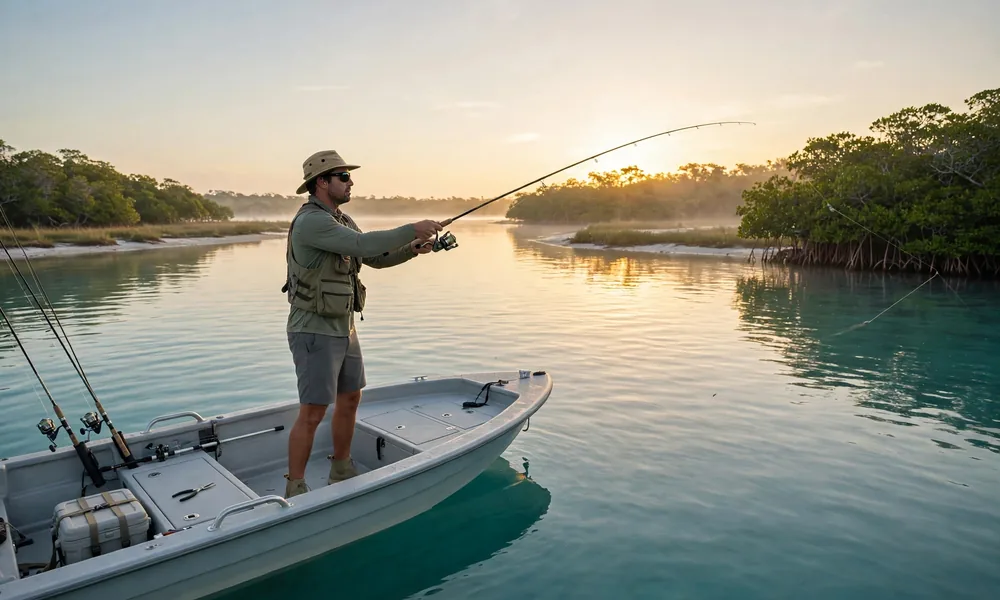
The best hours are the dawn and the dusk, when the tarpon are feeding actively and the light is good for seeing them. From about six o’clock until nine in the morning, and again from about five until eight in the evening, the tarpon are out on the flats, rolling at the surface and moving from creek to creek, and they are at their most approachable then. A slow drift along the mangrove edge, with the sun behind you and a pair of polarised sunglasses to cut the glare, is all you need, and the fish will often roll close enough to see the silver back and the dorsal filament clearly, if you move gently and keep your distance.
Staying safe around tarpon
A tarpon is not dangerous to people, and there is no safety warning that belongs to the fish itself. It has no venom, it does not bite, and it will not chase or threaten a swimmer. The safety rules for watching tarpon are the rules of the sea and the water: watch the water, watch the weather, and respect the fish that you came to see. Never wade into deep water without knowing what is under your feet, never fish alone from a boat without a life jacket, and never handle a fish with dry hands, because a dry hand strips the slime that protects its skin.
There are a few practical points for the water itself. Fish with a buddy, stay within your depth, and keep an eye on the weather, which can change fast on a big bay, with wind and waves rising in minutes. Wear a life jacket when you are in a boat, and keep clear of the propeller when the engine is running. If you are wading, watch for slippery rocks and sudden drop-offs, and wear shoes that grip. A tarpon will not hurt you, but the water can, and the sensible approach is to enjoy the fish and respect the sea they live in.
Tarpon watching checklist
A little preparation turns a morning on the bay into a real chance of seeing tarpon at their best, rolling at the surface in clear, warm water.
- A visit in spring or early summer, when the water is warming and the tarpon are gathering in the passes to spawn.
- A dawn or dusk trip, when the tarpon are out feeding and the light is good.
- A mangrove-lined bay with tidal flats, seagrass beds and deep channels, where the fish hunt and shelter.
- A slow drift along the mangrove edge, watching for a silver back rolling at the surface or a swirl on the water.
- Polarised sunglasses that cut the glare, so you can see into the water and spot the fish.
- A life jacket and a buddy, so that a day on the water stays safe from start to finish.
- Respect for the fish and the bay, keeping your distance, keeping the fish in the water, and leaving the shore as you found it.
Frequently asked questions
How big do tarpon get?
Most tarpon measure between 90 and 180 centimetres from snout to tail, and a good fish weighs 20 to 45 kilograms. A fish of 100 pounds is roughly 1.7 to 2 metres long, and the world rod-and-line record stands at 129.98 kilograms, a fish of 286 pounds 9 ounces caught by Max Domecq at Rubane in Guinea-Bissau on 20 March 2003. The largest tarpon ever measured reached 2.5 metres and 161 kilograms, and females grow larger than males, with the males rarely weighing more than 45 kilograms.
What do tarpon eat?
A tarpon eats small fish, shrimp, crabs and other crustaceans, which it takes from just below the surface with its upturned mouth. The everyday food is mullet, sardines and anchovies, and a big tarpon will take a crab without a second thought. Young tarpon eat zooplankton, insects and small fish, and they grow fast on that rich food, reaching 30 centimetres or more in their first year.
Why do tarpon leap out of the water?
Tarpon leap to throw the hook, to escape a shark, and, most of the time, for reasons nobody fully understands. When a tarpon is hooked it often jumps clear of the water, shaking its head from side to side, and a big fish may leap six feet clear of the surface before crashing back down. The leap is a burst of pure power, and it is the moment every tarpon angler waits for, the fish silver in the air, water flying from its gills.
Are tarpon dangerous?
No, tarpon are not dangerous to people. They have no venom, they do not bite, and they will not chase or threaten a swimmer. Their whole defence is built on being hard to hook, hard to hold and hard to tire, and their first response to a threat is to leap or to run for the mangroves. The safety rules for watching them are the rules of the sea itself: watch the water, watch the weather, and wear a life jacket in a boat.
Can you keep a tarpon in an aquarium?
You can, but it is hard, and most people should not try. A tarpon grows to 2.5 metres, it needs a very large tank with clean, well-oxygenated water, and it eats live fish and shrimp, which makes it expensive and demanding to keep. It is also illegal to keep one in some places without a permit, and a tarpon that outgrows its tank must never be released into waters where it does not belong. A tarpon belongs in the bay, not in a living room.
How is this guide different from the sturgeon guide?
This guide covers the tarpon, a silver coastal fish of up to 2.5 metres that leaps clear of the water, breathes air at the surface and grows up in the mangroves, while our sturgeon guide covers an armoured river fish of up to 7.2 metres that vacuums the riverbed, swims hundreds of kilometres upstream to spawn and lives for a century. One is a fish you watch rolling on the flats at dawn; the other is a giant you meet on a wide northern river.
Conclusion
The tarpon species are a reminder that a fish does not need to live in the deep sea to be unforgettable. A silver body, a big eye, a leap clear of the water and a swim bladder that works like a lung have made the tarpon the most famous inshore game fish of the tropical Atlantic, at home in a mangrove creek in Florida, a pass in the Keys and a bay in West Africa alike.
If you go looking for one, go on a warm, calm day in spring, go at dawn or dusk, and drift slowly along a mangrove edge with the sun behind you. Find the flat, watch for a silver back rolling at the surface, and wait for the water to erupt, and you will have met the tarpon that turns a quiet bay into a place of sudden, silver excitement.