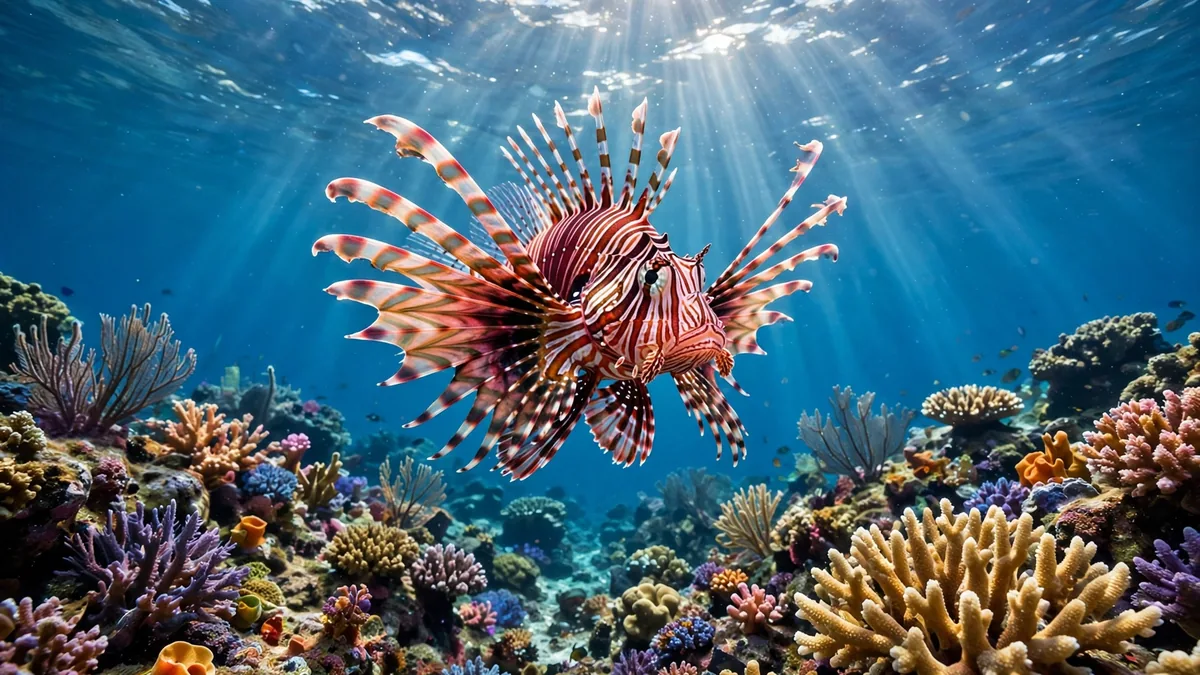
The lionfish species are the striped show-offs of the tropical reef, fish so beautiful that people kept them in aquariums and so dangerous that the same fish have taken over whole oceans. If you are asking what a lionfish is, the short answer is a venomous reef fish of the genus Pterois, native to the Indo-Pacific, with bold red and white stripes, great fan-like fins and thirteen venomous spines along its back, a fish that grows to about 38 centimetres and has become one of the most destructive invaders the sea has ever seen. It looks like an ornament and hunts like a machine, and in the Atlantic, where it does not belong, there is almost nothing that can stop it.
Most people meet a lionfish on a coral reef, hovering head-down under an overhang with its fins spread wide, or in a fish tank, where it drifts slowly through the water like a piece of drifting weed. It is a fish that seems to have been designed to be looked at, and that is exactly the problem: people looked, people bought, and people let them go. This guide follows the lionfish species: how they look, where they live, what they eat, how they breed, and why the Atlantic invasion is so hard to turn back.
Key takeaways
- The lionfish species belong to the genus Pterois, a group of about a dozen venomous reef fish, and the best known is the red lionfish, Pterois volitans, which grows to about 38 centimetres.
- A lionfish carries thirteen venomous dorsal spines, plus venomous spines on its anal and pelvic fins, and a sting causes intense pain, swelling and, in rare cases, far worse.
- Lionfish are native to the Indo-Pacific, from the Red Sea to Australia and Japan, but they have invaded the western Atlantic and the Caribbean since the mid-1980s, most likely through the aquarium trade.
- A single female lionfish can release about two million eggs a year, spawning every few days all year round in warm water, which is why the invasion has been so hard to stop.
- The red lionfish is listed as Least Concern in its native range, because the problem in the Atlantic is not that lionfish are rare, but that there are far too many of them.
The lionfish species and their relatives
Lionfish belong to the family Scorpaenidae, the scorpionfishes, a family of venomous, bottom-dwelling fish that sit still on the reef and wait for their food to come to them. The genus is Pterois, a name that comes from the Greek word for wing, a nod to the great fan-like pectoral fins that spread out on either side of the fish like wings, and the genus holds about a dozen recognised species. The lionfish is a scorpionfish that left the bottom and learned to hover in open water, and it is the most flamboyant member of a family that is otherwise famous for being hard to see.
The red lionfish, Pterois volitans, is the lead species of this guide, and it is the fish that defines the whole genus in most people’s minds. It lives on the reefs of the Indo-Pacific, from the Red Sea and the east coast of Africa to Australia, Japan and the islands of the Pacific, and it grows to about 38 centimetres long and about 1.1 kilograms in weight, though fish in the Atlantic, where there are few predators, have been recorded at 43 centimetres. Most adults are smaller, usually 25 to 30 centimetres, and the females grow to breeding size in their first year, which is part of the reason the species spreads so fast.

| Type | Animal | Where it lives | Best-known food | Length or Weight |
|---|---|---|---|---|
| Family | Scorpionfishes (Scorpaenidae) | Tropical reefs of the Indo-Pacific | Small fish, shrimp and crabs | About 20 cm to 38 cm long |
| Genus | Lionfishes (Pterois) | Tropical reefs of the Indo-Pacific | Small fish, shrimp and crabs | About 20 cm to 38 cm long |
| Species | Red lionfish (Pterois volitans) | Indo-Pacific reefs; invasive in the western Atlantic | Small fish, shrimp and crabs | Up to 38 cm long |
| Species | Devil firefish (Pterois miles) | Red Sea and Indian Ocean; invasive in the Mediterranean | Small fish, shrimp and crabs | Up to about 35 cm long |
| Species | Spotfin lionfish (Pterois antennata) | Reefs of the Indo-Pacific | Small fish and shrimp | About 20 cm long |
| Species | Clearfin lionfish (Pterois radiata) | Reefs of the Indo-Pacific | Small fish and shrimp | About 24 cm long |
The closest relative of the red lionfish is the devil firefish, Pterois miles, the lionfish of the Red Sea and the Indian Ocean, and the two are so alike that only an expert, or a DNA test, can tell them apart with certainty. The devil firefish is a touch smaller, growing to about 35 centimetres, and it has taken a different road: while the red lionfish crossed the Atlantic, the devil firefish swam through the Suez Canal and into the Mediterranean, where it is now spreading along the coasts of Turkey, Cyprus and Greece. About 93 percent of the invasive lionfish in the western Atlantic are red lionfish, and about 7 percent are devil firefish, so the Atlantic invasion is mostly one species, and the Mediterranean invasion is mostly the other.
Within the genus, the lionfish sort themselves by size and by the reefs they like. The spotfin lionfish is a smaller fish, growing to about 20 centimetres, and it lives on the reefs of the Indo-Pacific, hiding in crevices by day and hunting at dusk, and the clearfin lionfish grows to about 24 centimetres, a fish of the same reefs that is told apart by the clear, unspotted fins that give it its name. Like the bluefin tuna, the lionfish is a hunter that eats other fish, but the tuna is a fish of the open ocean that swims thousands of kilometres without stopping, while the lionfish is a fish of the reef that lives its life within a few hundred metres of one coral head.
What a lionfish looks like
A lionfish looks like a fish that was dressed for a parade, and once you have seen one you will never mistake it for anything else. The body is banded in bold vertical stripes of red, maroon and white, the head is striped too, and the fins are long, feathery and spread wide, so that the whole fish seems far bigger than it is. The pectoral fins are the most striking part, great fans of unconnected rays that spread out on either side of the body like the wings of a bird, and they are used to herd small fish into corners where they cannot escape. The dorsal fin is a row of thirteen long, separate spines, each one carrying venom, and it stands up along the back like a fence.
The size of a lionfish depends on the species, and the range is wide. The red lionfish grows to about 38 centimetres and about 1.1 kilograms, and most adults are 25 to 30 centimetres, while the devil firefish grows to about 35 centimetres, and the spotfin lionfish grows to about 20 centimetres. The females grow to breeding size in their first year, when they are only about 16 centimetres long, and the males grow larger than the females in most cases. A lionfish of 38 centimetres is a fish the size of a dinner plate, and with its fins spread it looks bigger still, which is part of the reason so few predators try to eat one.
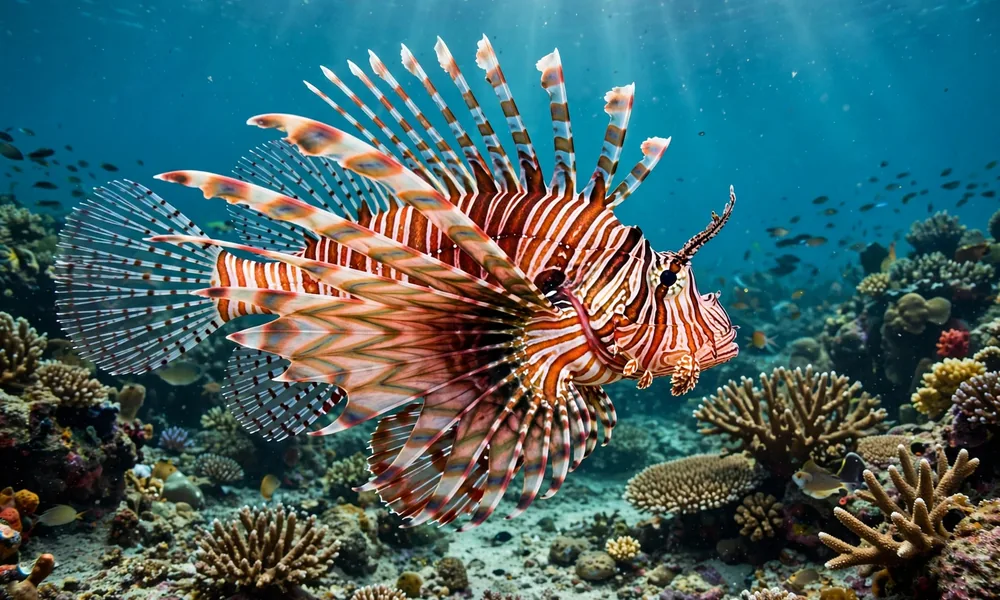
The colours are a warning, and they work. The red and white bands are what biologists call aposematic colouring, a pattern that tells a predator the animal is dangerous, and most reef fish learn the lesson quickly or learn it once and never forget it. The stripes break up the outline of the body against the coral, so the fish is hard to see until it moves, and then the fins open and the fish looks suddenly much larger than it is. The fleshy tentacles above the eyes and below the mouth add to the disguise, waving gently in the current like bits of weed, and the whole fish drifts so slowly that it looks like something the reef grew rather than something that hunts on it.
Compared with other reef fish, the lionfish is easy to tell apart once you know what to look for. No other reef fish has fins as long and feathery as a lionfish’s, no other has a row of thirteen separate dorsal spines, and no other combines red and white bands with a habit of hovering head-down under a coral overhang. The scorpionfish is the fish most often confused with a lionfish, and it has a stout, mottled body, a large head and a habit of sitting still on the bottom, so the two are easy to separate once you have seen them side by side.
Where lionfish live
Lionfish live on the coral reefs of the Indo-Pacific, and they are fish of warm, shallow, clear water. Their native range runs from the Red Sea and the east coast of Africa across the Indian Ocean to Australia, Japan and the islands of the Pacific, and they favour water that is warm, usually 22 to 28 degrees Celsius, and reefs that are rich in coral and in small fish. They are found from just below the surface to about 55 metres down, though most of them live between 2 and 30 metres, where the light is good and the prey is thickest.
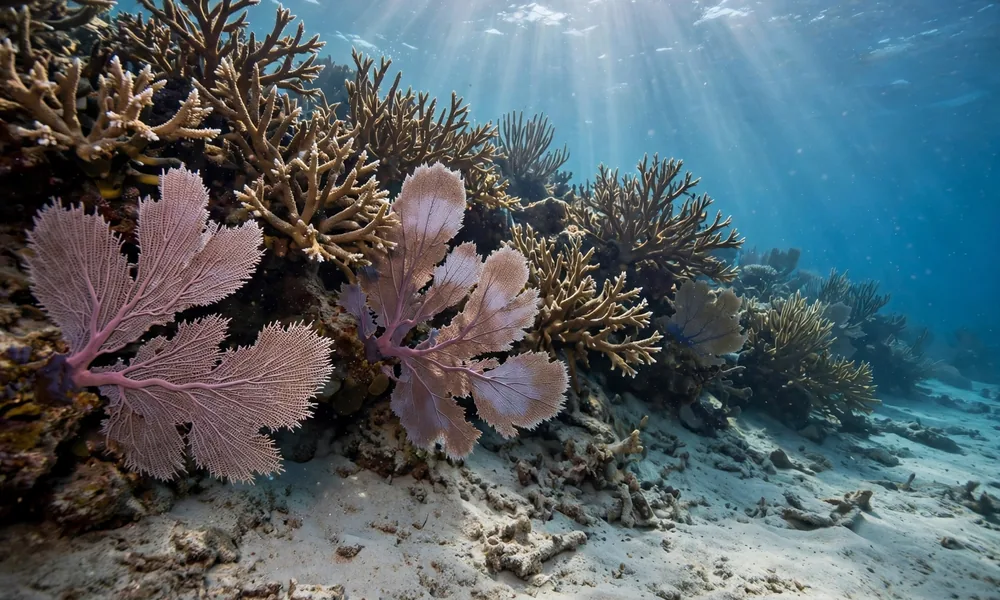
The habitat they choose is the edge of the reef, and they are rarely found far from it. Most lionfish live on the reef slope, under overhangs, in crevices and around coral heads, where the shelter is thickest and the small fish gather, and they are less common in open water, where there is little to eat and nowhere to hide. A lionfish spends much of its life within a small patch of reef, and it knows every crevice and every overhang in that patch, returning to the same resting place day after day.

Depth matters, but not in the way it does for a deep-water fish. Lionfish are shallow-water animals, and most of them stay above 55 metres, where the sunlight reaches the coral and the water is warmest. In the heat of summer they may move deeper, to 30 or 40 metres, where the water is cooler, and in winter they move into the warmest water they can find, holding on the reef slope and in the deeper channels. The water temperature matters most of all: lionfish need warm water, usually 22 to 28 degrees Celsius to feed well, and below 16 degrees Celsius they become inactive, which is why they are absent from cold northern coasts altogether.
The lionfish has travelled far beyond its native range, and it did so because people carried it there. The first lionfish in the Atlantic were recorded off the coast of Florida in 1985, most likely released from aquariums, and from there the fish spread with astonishing speed, through the Bahamas, the Caribbean and the Gulf of Mexico, and up the coast of the United States as far as North Carolina. National Geographic has followed the spread as it moved from reef to reef, and the invasion is now described as one of the most rapid marine fish invasions in history, a fish that crossed an ocean in a bucket and then took the whole western Atlantic in a single generation. Like the mahi-mahi, the lionfish is a bright, fast hunter of warm water, but the mahi-mahi is a fish of the open ocean that hunts in the blue water far from land, while the lionfish is a fish of the reef that hunts among the coral, in water barely deeper than a swimming pool.
What lionfish eat
Lionfish are hunters, and their diet is written on the reef itself. The everyday food is small fish, and a lionfish will eat almost any fish it can fit in its mouth, from gobies and blennies to young grouper and snapper, and it does so in numbers that no native predator can match. They also eat shrimp, crabs and other crustaceans, and a big lionfish will take a shrimp without a second thought. A reef full of lionfish keeps the numbers of small fish down, which is one reason they matter so much to the whole reef, and one reason they do so much damage where they do not belong.
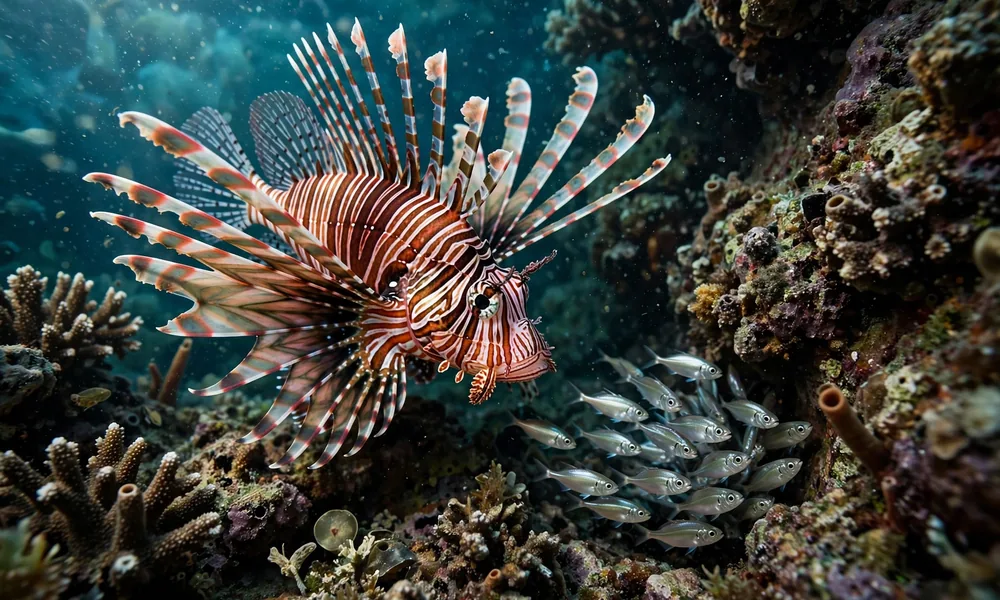
What sets the lionfish apart is how it hunts. It does not chase, and it does not wait in ambush. It hovers slowly towards its prey, spreading its great pectoral fins to herd the small fish into a corner, and when the moment comes it opens its mouth wide and sucks the prey in with a sudden rush of water, a strike that takes as little as 15 milliseconds, faster than the eye can follow. The prey fish of the Atlantic have no defence against this, because they have never met a lionfish before, and they often show no fear at all, swimming calmly towards the striped hunter until it is too late. A single lionfish can eat dozens of small fish in a day, and a reef with many lionfish can lose most of its small fish within weeks.
Feeding follows the rhythm of the day and the season, and it is busiest at dawn and dusk. Lionfish feed most actively in the early morning and the late evening, when the light is low and the small fish are moving on the reef, and they rest in the heat of midday, holding under an overhang or in a crevice. In the warm months they feed hard, putting on weight for the spawning season, and in the cooler months they feed less, though in the tropics there is no real winter and the fish feed all year round. Young lionfish eat plankton, tiny shrimp and small fish, and they grow fast on that rich food, reaching breeding size in their first year.
How lionfish behave
Lionfish are slow, deliberate fish, and their day is a quiet round of hovering, herding and feeding on the reef. They wake at dawn, leave the crevice where they spent the night, and move onto the reef slope to hunt, and they spend the day working the coral heads in a slow, unhurried way, never rushing, never chasing far. They are not strong swimmers over distance, and they do not need to be: their life is lived within a few hundred metres of reef, and they know every overhang and every crevice in that patch.
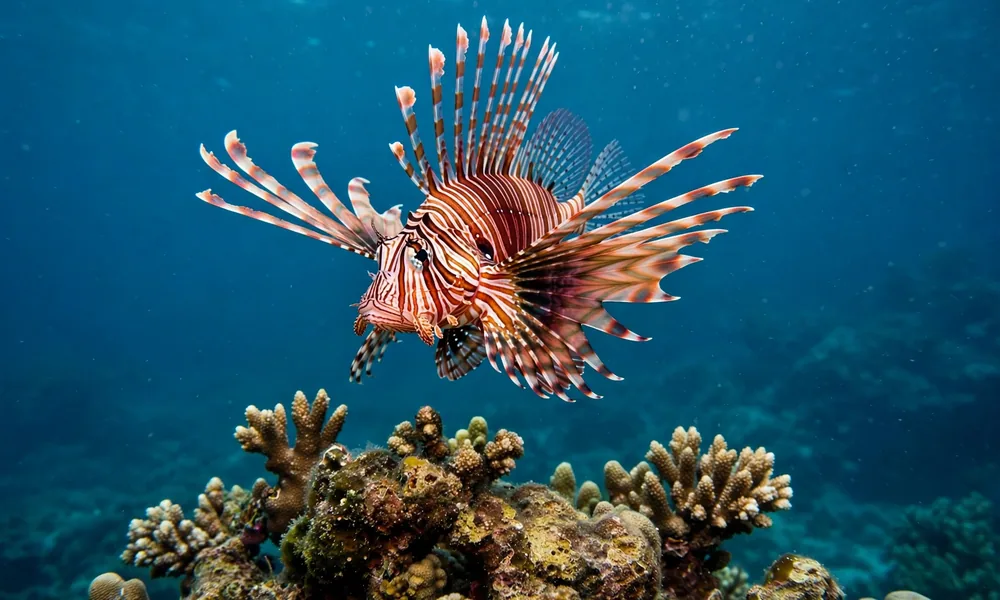
The most famous behaviour in the lionfish is the herding hunt, and it is a piece of teamwork with no team. The fish spreads its pectoral fins wide, drives a small fish into a corner of coral, and then strikes with a sudden sucking rush that takes the prey whole, and the whole hunt takes a few seconds from start to finish. The fins are not just for show: they are a wall that the prey cannot see past, and a fish that tries to escape sideways finds itself facing a fan of spines. The lionfish is one of the few reef fish that hunts with its fins as a tool, and it is the reason the fish is so hard for its prey to escape.
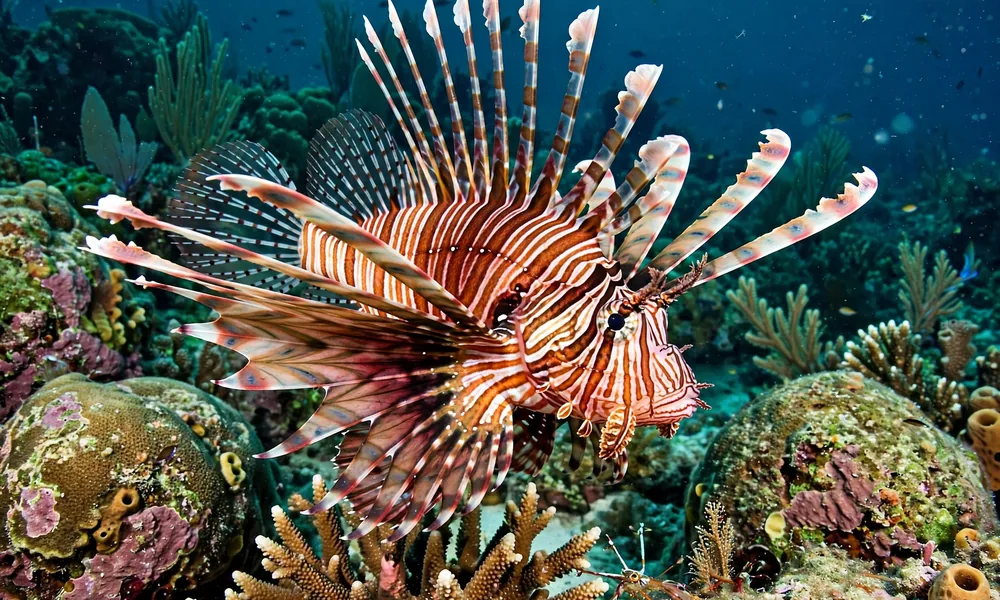
When a lionfish is threatened, its first response is to flare its fins and raise its spines, relying on its colours and its venom to warn the attacker away, and if that fails it will turn and present its dorsal spines to the threat, backing away slowly rather than fleeing. Lionfish have few natural predators in their native range, and almost none in the Atlantic, where the reef fish have never learned that the striped fish is dangerous. A lionfish that is handled roughly will sting, and the sting is the fish’s whole defence, which is why divers who cull lionfish carry them in puncture-proof containers and never touch the spines with bare hands. Like the marlin, the lionfish is a hunter that other fish fear, but the marlin is a fish of the open ocean that hunts by speed and a long bill, while the lionfish is a fish of the reef that hunts by patience and a fan of fins.
Breeding and life cycle
Lionfish breed all year round in warm water, and the timing is set by the temperature rather than the calendar. The adults gather on the reef, and the males defend their patches of coral against rivals, spreading their fins and chasing away any male that comes too close, while the females choose the best ground they can find. A female lionfish can spawn every three or four days, and she may release as many as two million eggs in a single year, more than almost any other reef fish, which is the engine of the whole invasion.
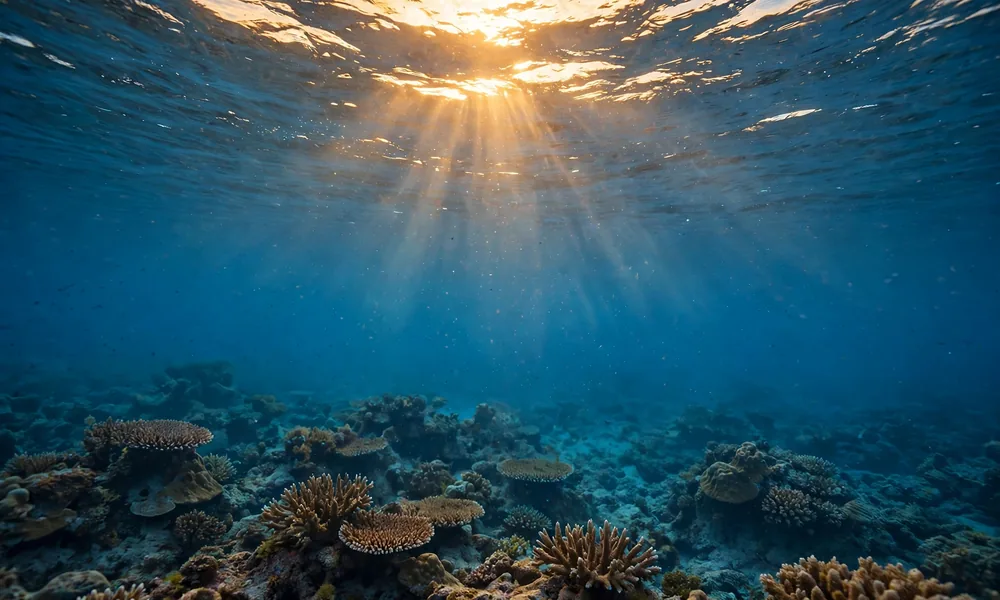
The female releases her eggs in two floating, jelly-like masses, and the male releases his milt over them as they drift away from the reef, and each mass holds thousands of eggs, as many as 30,000 in a single spawning. The masses float towards the surface, where the jelly breaks down and releases the larvae into the water, and the larvae drift with the current for weeks, feeding on plankton, until they are carried to a new reef. A female that spawns every few days can release about two million eggs in a year, and even if only a handful in every thousand survive, that is enough to fill a reef.
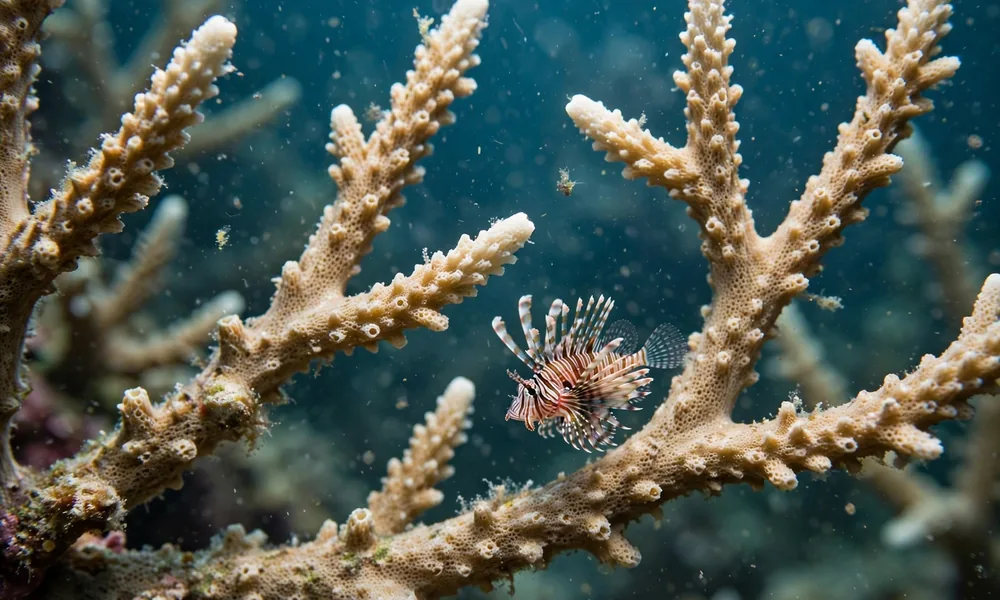
Growth is fast in the first year, and a young lionfish can reach breeding size in its first year, when it is only about 16 centimetres long, feeding on plankton and tiny shrimp before it turns to larger prey. It reaches full size in its second or third year, and the lifespan in the wild is often 10 years, with the oldest fish aged at 10 years. The young are independent from the day they settle on the reef, able to feed and hide within hours, but most of them will never reach adulthood, eaten by fish and swept away by currents in their first weeks, and only a handful in every thousand will live to breed.
Conservation status
The red lionfish is listed as Least Concern by the International Union for Conservation of Nature, and the reasoning is straightforward: it has a huge native range, it is common across most of it, and nothing in its home waters threatens it. That broad picture hides a stranger local one, because the lionfish is a fish that is safe at home and a disaster abroad. In the Indo-Pacific it is one predator among many, kept in check by the fish that eat it and the reef that limits it, and in the western Atlantic it is a plague, eating the small fish that keep the reef alive and doing so in numbers no native predator can match.
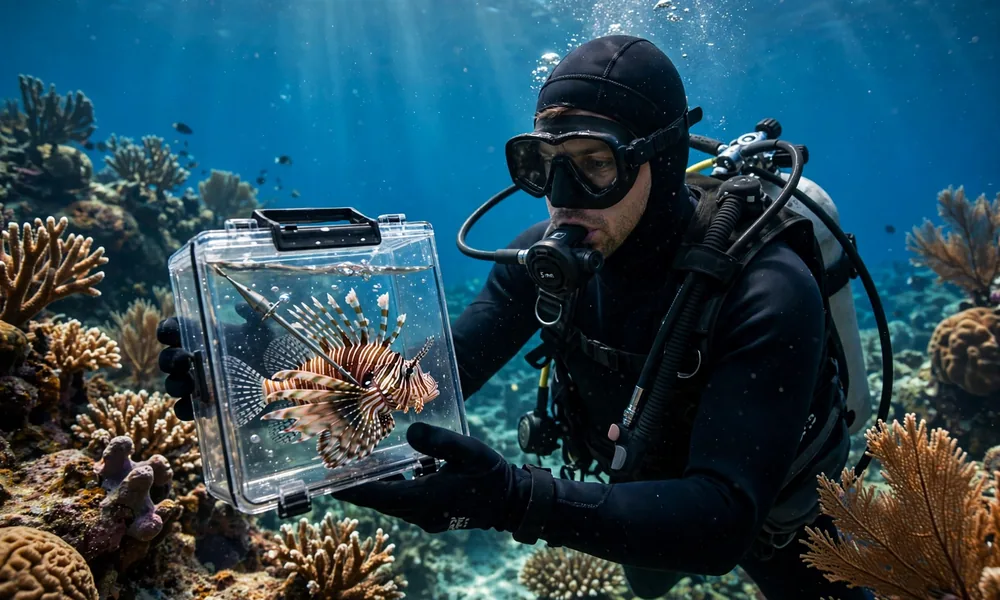
The main pressure on the Atlantic reefs is the lionfish itself. A single lionfish can cut the number of small reef fish on its patch by most of what was there, and a reef with many lionfish can lose the small fish that clean the coral, the young grouper and snapper that grow into the fish people eat, and the grazers that keep the algae down. The lionfish has no natural predator in the Atlantic that eats it in any numbers, and the native fish have never learned to fear it, which is why the invasion has run so far and so fast. The most useful work against it is practical: organised culls by divers, lionfish derbies that pay for every fish caught, and restaurants that serve lionfish as food, which turns a pest into a catch worth hunting.
The most useful conservation work is the same work that helps the whole reef. Protecting the coral and the seagrass keeps the nursery and the feeding grounds in place, and protecting the native predators, the grouper and the snapper that might one day learn to eat lionfish, gives the reef a chance to fight back. Eating lionfish is the part of the plan that surprises people most, and it works: the flesh is white, firm and good, the venom is only in the spines and not in the meat, and every lionfish on a plate is one less lionfish on the reef.
Best seasons for lionfish watching
The best time to look for a lionfish is the warm half of the year, from spring through to early autumn, when the water is warm, the visibility is good and the fish are out hunting in the open. In the Caribbean the season starts earlier, from about March, and the fish are active for longer, feeding hard through the warm months. Lionfish are present on the reefs all year round, so there is no wrong season in the strict sense, but a warm, calm day in June will show you far more fish than a cold day in midwinter.
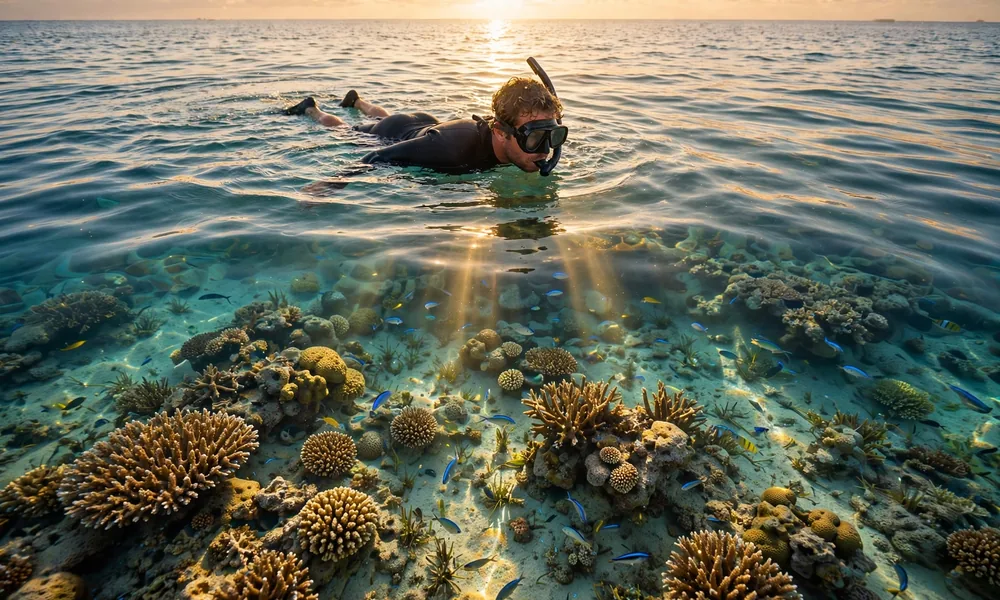
The best hours are the dawn and the dusk, when the lionfish are feeding actively and the light is good for seeing them. From about six o’clock until nine in the morning, and again from about five until eight in the evening, the lionfish are out on the reef slope, hovering over the coral heads and herding small fish into corners, and they are at their most approachable then. A slow drift along the reef edge, with the sun behind you and a mask that fits well, is all you need, and the fish will often hover close enough to see the striped body and the fan-like fins clearly, if you move gently and keep your distance.
Staying safe around lionfish
A lionfish is venomous, and the safety rules for watching one are the rules of the spines. The thirteen dorsal spines, the three anal spines and the two pelvic spines all carry venom, and a sting causes intense pain, swelling and redness, and in rare cases nausea, breathing difficulty and far worse. The fish will not chase you, and it will not attack, but it will sting if you touch it, step on it, or corner it against the reef, so the rule is simple: never touch one, never pick one up, and never put your hand into a crevice where one may be hiding.
There are a few practical points for the water itself. If you are stung, get out of the water, remove any broken spine with tweezers, and immerse the sting in hot water, as hot as you can stand, for 30 to 90 minutes, which breaks the venom down and eases the pain, then seek medical help, especially if the pain spreads, you feel sick, or you have trouble breathing. Snorkel and dive with a buddy, wear gloves and shoes on the reef, and keep your distance from any lionfish you see. A lionfish will not hurt you if you leave it alone, but the spines can, and the sensible approach is to enjoy the fish from a few metres away and let it hunt in peace.
Lionfish watching checklist
A little preparation turns a morning on the reef into a real chance of seeing lionfish at their best, hovering over the coral with their fins spread wide.
- A visit in the warm months, from spring to early autumn, when the water is warm and the lionfish are out hunting in the open.
- A dawn or dusk trip, when the lionfish are feeding actively and the light is good.
- A coral reef with overhangs, crevices and coral heads, where the fish hover and shelter.
- A slow drift along the reef edge, watching for a striped body hovering head-down under an overhang.
- A mask, snorkel and fins that fit well, so you can watch the reef without struggling in the water.
- A buddy and a first-aid plan for a sting, including hot water, so that a day on the reef stays safe from start to finish.
- Respect for the fish and the reef, keeping your distance, never touching a lionfish, and leaving the coral as you found it.
Frequently asked questions
How big do lionfish get?
Most lionfish measure between 25 and 30 centimetres from snout to tail, and a good fish weighs a few hundred grams. The red lionfish grows to about 38 centimetres and about 1.1 kilograms, and fish in the Atlantic, where there are few predators, have been recorded at 43 centimetres. The devil firefish grows to about 35 centimetres, and the spotfin lionfish grows to about 20 centimetres.
What do lionfish eat?
A lionfish eats small fish, shrimp, crabs and other crustaceans, which it herds into corners with its great pectoral fins and takes with a sudden sucking strike. The everyday food is gobies, blennies and young grouper and snapper, and a big lionfish will take a shrimp without a second thought. Young lionfish eat plankton, tiny shrimp and small fish, and they grow fast on that rich food, reaching breeding size in their first year.
Are lionfish dangerous?
Yes, lionfish are venomous, though they are not aggressive. Their thirteen dorsal spines, three anal spines and two pelvic spines all carry venom, and a sting causes intense pain, swelling and redness, and in rare cases nausea and breathing difficulty. The fish will not chase or attack you, and the danger comes only from touching one, so the rule is simple: look, keep your distance, and never put your hand near the spines.
How did lionfish get to the Atlantic?
The most likely explanation is the aquarium trade. Lionfish were popular aquarium fish, and the first ones in the Atlantic were recorded off the coast of Florida in 1985, most likely released by owners who no longer wanted them. From there they spread through the Bahamas, the Caribbean and the Gulf of Mexico, and up the coast of the United States, carried by currents and by their own extraordinary breeding rate of about two million eggs per female per year.
Can you eat lionfish?
Yes, and you should, because every lionfish eaten is one less lionfish on the reef. The flesh is white, firm and good, and the venom is only in the spines, not in the meat, so a lionfish that has had its spines removed is safe to eat. Restaurants across the Caribbean now serve lionfish, and derbies pay divers for every fish they catch, which turns a pest into a catch worth hunting.
How is this guide different from the freshwater fish guide?
This guide covers the lionfish, a venomous striped reef fish of the sea that grows to about 38 centimetres, hunts with fan-like fins and has invaded the Atlantic from the Indo-Pacific, while our freshwater fish guide covers the fish of rivers and lakes, thousands of species from trout and carp to catfish and cichlids that live in water with almost no salt in it. One is a fish you watch hovering on a coral reef; the other is a fish you meet on a riverbank at dawn.
Conclusion
The lionfish species are a reminder that beauty and danger can live in the same animal, and that a fish kept in a tank can change an ocean. A striped body, a fan of fins, thirteen venomous spines and a habit of herding small fish into corners have made the lionfish the most famous reef fish of the tropical Atlantic, at home on a reef in the Red Sea, a coral head in the Bahamas and a wreck in the Gulf of Mexico alike.
If you go looking for one, go on a warm, calm day in summer, go at dawn or dusk, and drift slowly along a reef edge with the sun behind you. Find the coral head, watch for a striped body hovering head-down under an overhang, and wait for the fins to spread wide, and you will have met the lionfish that turns a quiet reef into a place of sudden, striped beauty.