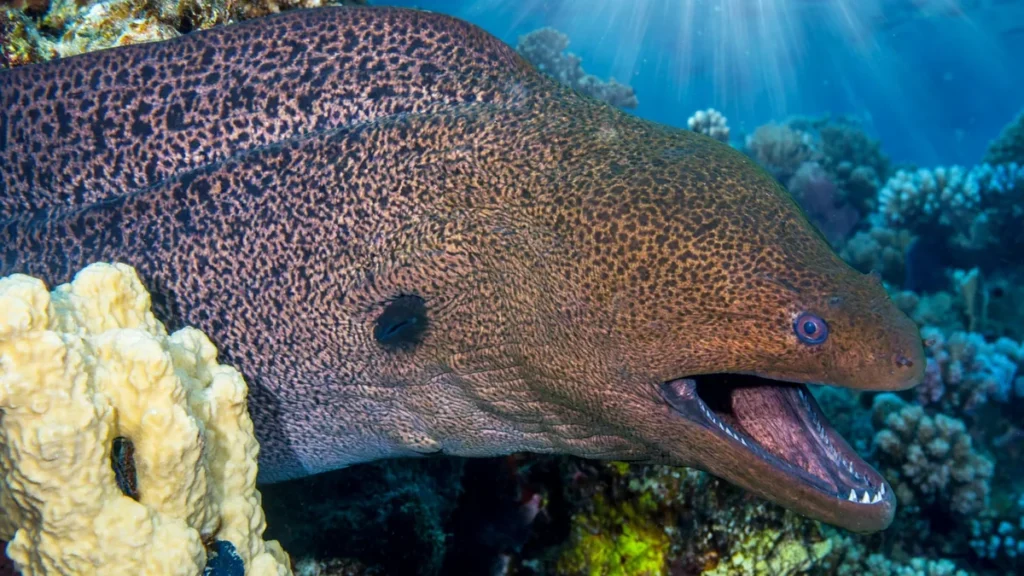
The moray eel species are the reef’s hidden hunters, long, muscular fish that live in the cracks of coral reefs and rocky shores, peer out with a slow, opening and closing mouth, and strike with a second set of jaws hidden deep in the throat. If you are asking what a moray eel is, the short answer is a member of the family Muraenidae, a group of about 200 species in 15 genera, almost all of them marine, that range from a moray of just 11.5 centimetres to the slender giant moray of about 4 metres, and from the ribbon moray of the Indo-Pacific to the green moray of the Caribbean. They have no pectoral fins, no scales, and no patience for open water, and they have survived by doing one thing better than almost any other reef fish: hunting in places too tight for anything else to follow.
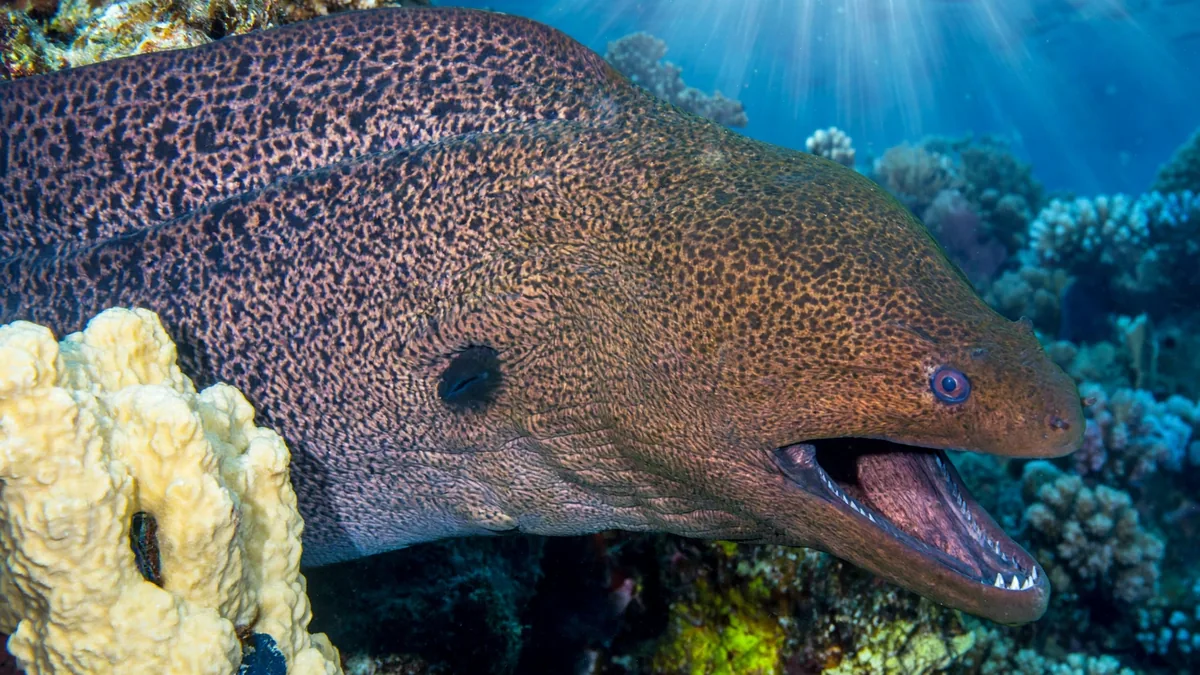
Most people meet a moray eel the same way I did, on a dive over a reef in the Indo-Pacific, when the guide pointed at a hole in the coral and the hole turned out to have a face in it, a brown, spotted head with a large eye and a mouth full of teeth, opening and closing in a slow, steady rhythm. There was no menace in the meeting at all, once you knew what you were looking at. The mouth was not threatening me; it was breathing, pumping water over the gills because a moray has no gill covers to do the job for it. That is the heart of this guide: how a family of about 200 species became the reef’s most patient predator, how the giant moray grows to about 3 metres and 30 kilograms, how the pharyngeal jaws work, and why divers love these eels while swimmers are rightly told to keep their hands out of the holes.
Key takeaways
- The moray eel species belong to the family Muraenidae, with about 200 species in 15 genera, almost all of them living in tropical and subtropical seas.
- The giant moray, Gymnothorax javanicus, is the heaviest moray, growing to about 3 metres and 30 kilograms, while the slender giant moray is the longest, at about 4 metres.
- Morays have a second set of jaws, the pharyngeal jaws, in the throat, which shoot forward into the mouth to grip prey and drag it down into the gut.
- Most morays are nocturnal hunters that feed by smell, eating fish, octopus and crustaceans, and some hunt in partnership with groupers.
- The giant moray is listed as Least Concern, and morays are mostly seen by divers and snorkellers peering from crevices on coral reefs.
The moray eel species and their relatives
Moray eels belong to the family Muraenidae, a family of true eels in the order Anguilliformes that holds about 200 species in 15 genera, and every one of them shares the same long, muscular body, the same lack of pectoral and pelvic fins, the same scaleless skin coated in protective mucus, and the same habit of living in a hole. They range in size from the smallest moray, Snyder’s moray, which reaches a maximum length of just 11.5 centimetres, to the slender giant moray, which reaches up to about 4 metres, so the family as a whole spans about 11 cm to 4 m long, and the moray eel sits in the middle of that range as the reef fish most divers know by sight. The family is found in tropical and subtropical seas worldwide, with the greatest diversity on the coral reefs of the Indo-Pacific, and a few species venture into brackish water and even fresh water.
The giant moray, Gymnothorax javanicus, is the lead species of this guide, and it is a good ambassador for the whole family. It is a heavy, powerful eel with a brown body covered in leopard-like black spots, a broad head and a mouth full of long, backward-curving teeth, and it is found on coral reefs from the Red Sea and East Africa across the Indian Ocean to the Pacific islands. It grows to about 3 metres and 30 kilograms, making it the heaviest moray of all, and it is the eel that divers mean when they talk about the big moray in the reef, an animal with a reputation for fierceness that owes far more to its teeth than to its temper. If you have dived an Indo-Pacific reef, there is a fair chance the spotted head watching you from a crevice was a giant moray, or one of its close cousins in the same genus.
| Type | Animal | Where it lives | Best-known food | Length or Weight |
|---|---|---|---|---|
| Family | Moray eels (Muraenidae) | Tropical and subtropical seas worldwide | Fish, octopus and crustaceans | About 11 cm to 4 m long |
| Genus | Moray eels (Gymnothorax) | Tropical reefs worldwide | Fish, octopus and crustaceans | About 20 cm to 3 m long |
| Species | Giant moray (Gymnothorax javanicus) | Coral reefs of the Indo-Pacific | Fish and octopus | Up to 3 m long |
| Species | Green moray (Gymnothorax funebris) | Western Atlantic reefs and rocky shores | Fish, octopus and crustaceans | Up to 2.5 m long |
| Species | Spotted moray (Gymnothorax moringa) | Western Atlantic reefs and rocky bottoms | Fish and crustaceans | Up to 2 m long |
| Species | Ribbon moray (Rhinomuraena quaesita) | Coral reefs of the Indo-Pacific | Small fish and crustaceans | Up to 1.3 m long |
The closest relatives of the giant moray are the other members of the genus Gymnothorax, by far the largest genus in the family, holding more than half of all moray species. The genus as a whole spans about 20 cm to 3 m long, from the dwarf moray of about 20 centimetres to the giant moray itself, and its members share the same heavy body, the same spotted or mottled patterning and the same reef-crevice way of life. Like the octopus in our general guide, the moray is a hunter of reef crevices that feeds by smell and touch as much as by sight, but the octopus is a soft-bodied animal that squeezes itself into a hole and changes colour to vanish, while the moray is a long, muscular fish that lives in the hole full time and defends it with its teeth.
Within the family, the species sort themselves by the ocean they live in and the size they reach. The green moray, Gymnothorax funebris, is the giant of the tropical Atlantic, uniformly dark green to brown, commonly about 1.5 metres long and reaching 2.5 metres and 29 kilograms, and it ranges from the east coast of the United States through the Caribbean to Brazil. The spotted moray, Gymnothorax moringa, is a smaller Atlantic cousin, pale with dense dark spots, commonly about 60 centimetres long and reaching up to 2 metres, and it is often active by day. The ribbon moray, Rhinomuraena quaesita, is the showpiece of the family, a slender eel of Indo-Pacific reefs that grows to about 1.3 metres and changes colour and sex as it ages, starting life black as a male, turning bright blue, and finally turning yellow as a female. The four of them share the same shape and the same habits, and they are separated mostly by the water they swim in and the pattern on their skin.
What a moray eel looks like
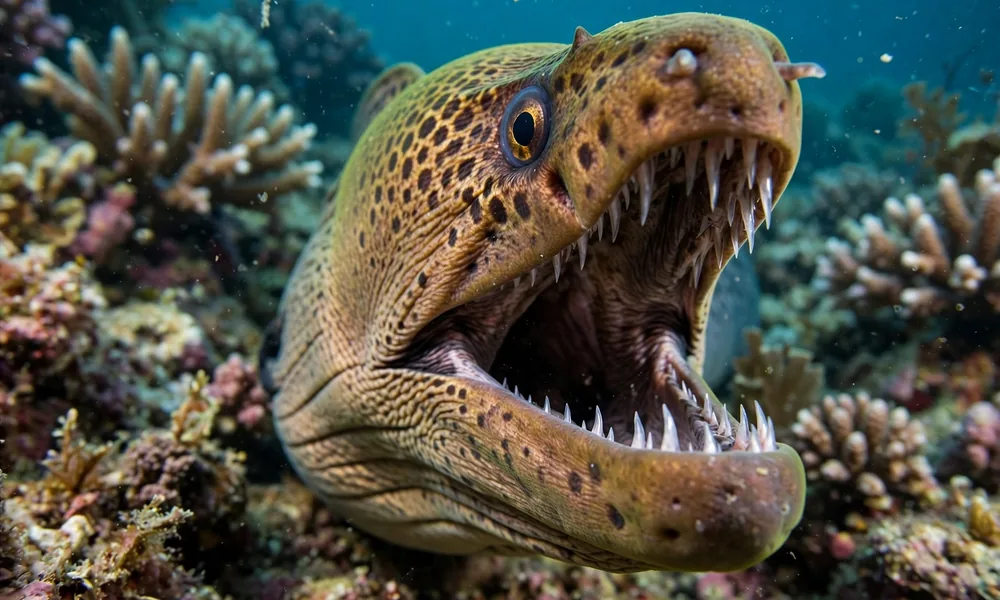
A moray eel looks like a fish that has been stretched out and stripped back to the essentials, and once you have seen one you will never mistake it for a snake, even though that is the first comparison most people reach for. The body is long and muscular, round in cross-section and thickest just behind the head, and it tapers to a tail that is flattened from side to side, which helps the eel swim in short, powerful bursts. The skin has no scales at all, and it is coated in a thick layer of mucus that protects it from scrapes in the reef and from parasites, and in the green moray that mucus is yellow, which is what makes a brown fish look green. The dorsal fin runs in a low ridge along the back from just behind the head to the tail, and there are no pectoral or pelvic fins at all, which is why the eel moves the way it does, rippling its whole body from side to side.
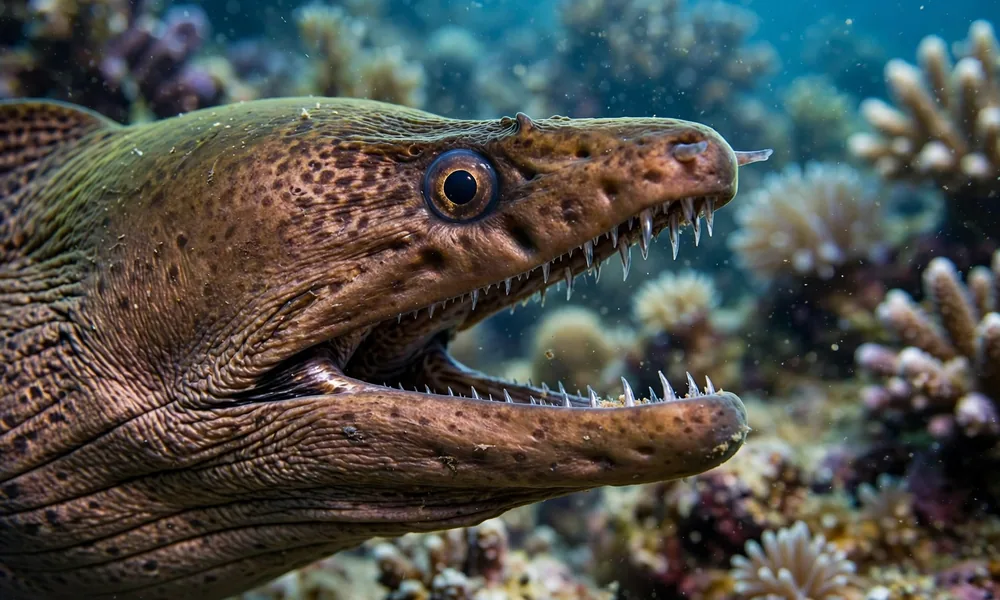
The head is long and narrow, and the snout is the feature that gives the animal its look. It is pointed and slightly upturned, with the mouth set wide and the jaws lined with long, sharp, backward-curving teeth, made for gripping slippery prey rather than for cutting it. The eyes are small and set high on the head, and behind them sit the small, round gill openings, which are little more than holes in the skin, because a moray has no gill covers. The nostrils are tubular and sit at the tip of the snout, and they are the eel’s real sense organs, tasting the water for the scent of fish and octopus hidden in the reef. Like the shark in our general guide, the moray is a hunter with a mouth full of teeth, but the shark is a fast, open-water animal that chases its prey down, while the moray is a slow, crevice-living animal that waits for its prey to come within reach and then strikes from its hole.
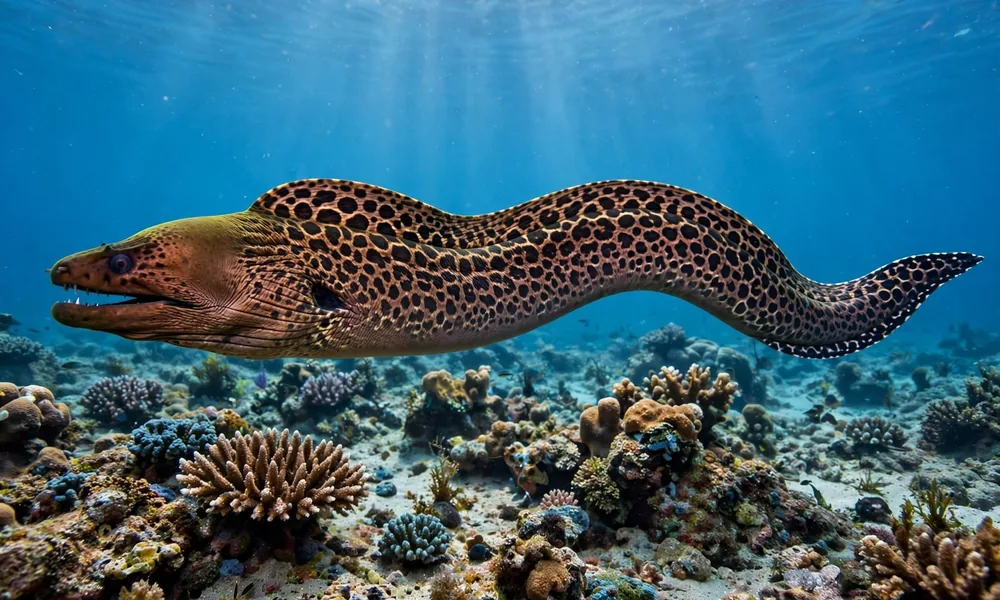
The size of a moray depends on the species, and the range is wide. The giant moray grows to about 3 metres and 30 kilograms, and most adults are 1.5 to 2.5 metres, while the green moray grows to 2.5 metres and 29 kilograms, the spotted moray to 2 metres, and the ribbon moray to about 1.3 metres. At the other end of the family, the dwarf moray barely reaches 20 centimetres, and Snyder’s moray reaches just 11.5 centimetres, which is shorter than your hand. A moray of 2 metres is a fine sight, and a moray of 3 metres is a fish the size of a tall person, heavy and powerful, and it is still the largest moray most divers will ever meet.
Where moray eels live
Moray eels live in the warm, shallow waters of the world’s tropical and subtropical seas, and they are at home on coral reefs, rocky shores and rubble slopes. Their range runs through the Indo-Pacific from the Red Sea and East Africa to Hawaii and the Pacific islands, through the western Atlantic from the east coast of the United States to Brazil, and through the eastern Atlantic from the Mediterranean to West Africa, with the centre of diversity on the coral reefs of the Indo-Pacific, where more moray species live than anywhere else. They favour water that is warm, usually 22 degrees Celsius and above, and they are rarely found in cold water, where other eels take their place. Wherever there is warm water, a reef and a hole to live in, there is a good chance a moray is nearby.
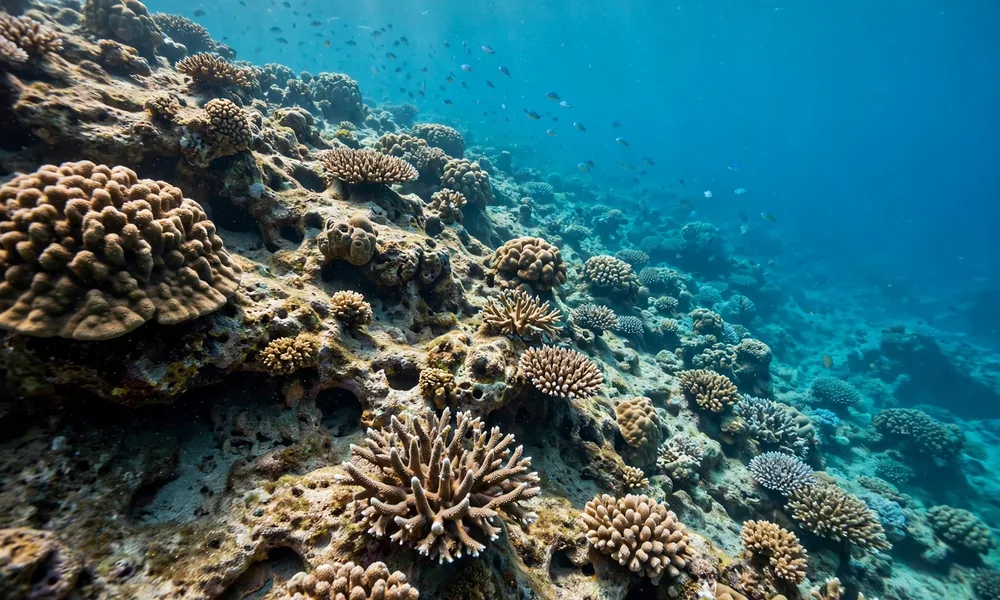
The habitat they choose is the hole in the reef, and they are rarely found far from it. Most morays live in water between 1 and 50 metres deep, on the reef slope, in the channels and around the coral heads, where the food is richest and the shelter is thickest. The giant moray is found from the surface to about 50 metres, the green moray from about 1 to 50 metres, and the spotted moray from the surface to 200 metres, though it is usually found in shallow water. They favour places with plenty of caves and crevices, which give them both a home by day and a hunting ground by night, and they are less common in open water, where there is little to eat and nowhere to hide. A moray spends much of its life within a small patch of reef, sometimes no larger than a few hundred metres, and it knows every hole and every crevice in that patch the way you know the rooms of your own house.

The moray has stayed close to its home waters, and it has not spread the way some reef fish have, because it needs warm, shallow water and it does not cross deep ocean easily. It is common on the reefs of the Indo-Pacific and the Caribbean, and it is a regular sight for divers in the Red Sea, the Maldives, Hawaii and the Florida Keys. Like the clownfish, the moray is a fish of the coral reef that lives its whole life in one small patch, but the clownfish is a tiny fish that never leaves its anemone and feeds on plankton in the water above it, while the moray is a large predator that leaves its hole each night to hunt the reef around it, and it is the hunter that the small fish of the reef learn to avoid.
What moray eels eat
Moray eels are hunters, and their diet is written on the reef itself. The everyday food is fish and octopus, and a moray will eat almost any fish it can fit in its mouth, from small reef fish to larger prey that wanders too close to its hole. They also eat crabs, shrimps and other crustaceans, and a big moray will take a crab without a second thought. A smaller group, including the zebra moray and the species of the genus Echidna, has blunt, crushing teeth for crabs, snails and other hard-shelled prey, and they feed on the shellfish of the reef rather than on fish. A single moray may eat several fish in a night, and a reef full of morays can keep the numbers of smaller fish in check, which is one reason they sit near the top of the food chain on so many shallow reefs.
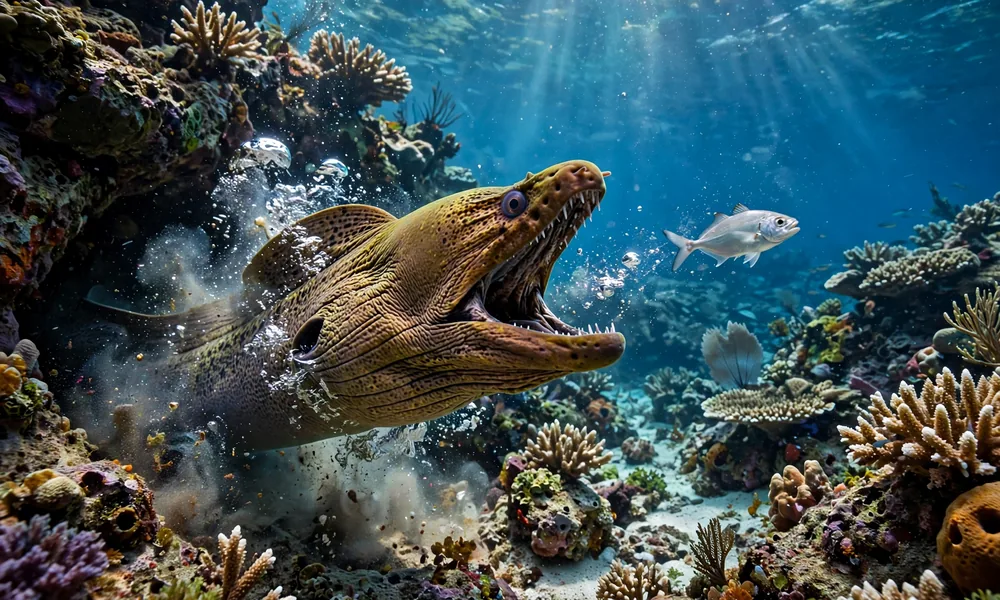
What sets the moray apart is how it hunts, and the answer is the second set of jaws. Most fish swallow by suction, expanding the mouth to draw water and prey backwards, but a moray’s head is too narrow to make that work, and it hunts in tight crevices where suction is weak anyway. Instead, the moray seizes its prey in its oral jaws, and then the pharyngeal jaws, a second complete set of jaws in the throat with their own teeth, shoot forward into the mouth, grip the prey independently, and drag it back down into the gut. The mechanism was first described in detail by Rita Mehta and Peter Wainwright of the University of California, Davis, in 2007, using high-speed X-ray video, and it is unique among vertebrates: no other animal uses throat jaws to capture prey in quite this way. The whole strike takes a fraction of a second, and the moray then retreats into its hole to swallow in safety.
How moray eels behave
Moray eels are night animals, and their day is a quiet round of resting, waking and hunting along the reef. They wake at dusk, leave the hole where they spent the day, and move out onto the reef to feed, and they spend the night working the crevices in a slow, unhurried way, never rushing, never chasing far. They are not strong swimmers over distance, and they do not need to be: their life is lived within a few hundred metres of reef, and speed matters less than knowing every hole and every crevice. When a larger predator passes, a moray will often pull back into its hole and stay still, relying on its spotted pattern to blend into the reef, and if that fails it will retreat deeper into the rock and wait. Morays can even swim backwards, which lets them back into a crevice after a hunt without having to turn around in a space too tight for turning.
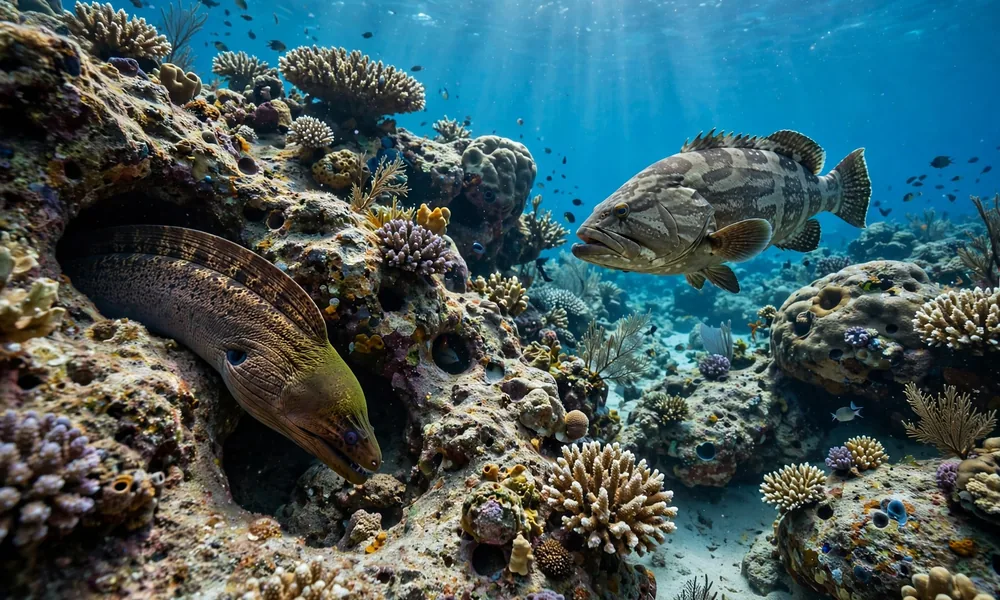
The most famous behaviour in the moray is the cooperative hunt. On Indo-Pacific reefs, the giant moray is recruited by roving coral groupers to hunt together, and the partnership is one of the best studied in the sea. The grouper finds a prey fish hiding in a crevice it cannot reach, and it signals the moray with a shake of its head, standing on its tail over the hole. The moray swims over, slides into the crevice, and flushes the prey out into the open, where the grouper is waiting, or the moray catches the prey itself in the hole. Both animals eat more together than either would alone, and the grouper even waits for the moray to arrive before it starts hunting. It is a genuine partnership between two very different predators, and it is the kind of behaviour that makes a reef feel less like a collection of animals and more like a neighbourhood.
Breeding and life cycle
Moray eels breed in the warm months, when the water is at its warmest, and the timing is set by the temperature and the season rather than the calendar. The adults gather near the reef, and the courtship is a slow affair, with two eels gaping widely at each other and then wrapping their long bodies around one another in a slow, graceful dance. They release their eggs and sperm into the water together, and the fertilisation happens outside the body, in the open water above the reef. A female may release about 10,000 eggs in a single spawning, and after the eggs are fertilised there is no parental care at all: the parents swim away, and the young are on their own from the moment they hatch.
The eggs hatch into larvae called leptocephali, transparent, ribbon-like creatures that look nothing like an eel at all. The leptocephali float in the open ocean with the plankton for eight to twelve months, drifting on the currents while they grow, and then they swim down to the reef as elvers, young eels that settle into a hole and begin life on the bottom. The long larval stage is one reason morays are found on reefs so far apart: a larva that drifts for a year can travel a very long way before it settles. The young are independent from the day they reach the reef, able to feed and hide within hours, but most of them will never reach adulthood, eaten by fish and birds in their first weeks.
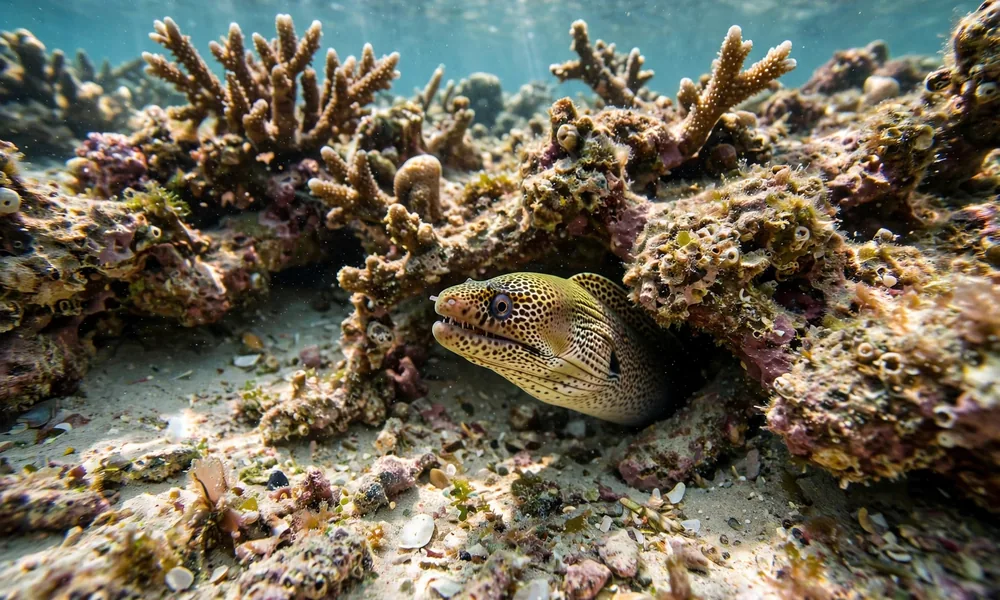
Growth is steady, and a young moray takes a few years to reach breeding size, with the baby eels reaching sexual maturity at about two and a half years old. The lifespan in the wild is about 10 to 30 years, depending on the species, and some animals have lived for more than 30 years in aquaria. The ribbon moray adds one more twist: every ribbon eel is born male, and as it ages it changes colour and sex, turning from black to bright blue as a male, and finally to yellow as a female.
Conservation status
The giant moray is listed as Least Concern by the International Union for Conservation of Nature, and the reasoning is straightforward: it has a huge range across the Indo-Pacific, it is common on many reefs, and there is no evidence of a steep decline in its numbers. That broad picture hides a more complicated local one, because the moray is tied to the fate of the reef it lives on. An eel that lives in a hole and hunts on a reef cannot live where the reef has been broken, and a coast that loses its coral loses its morays within a season or two. The green moray and the spotted moray are also listed as Least Concern, and the family as a whole is not endangered, which is good news for a group of animals that divers love to meet.
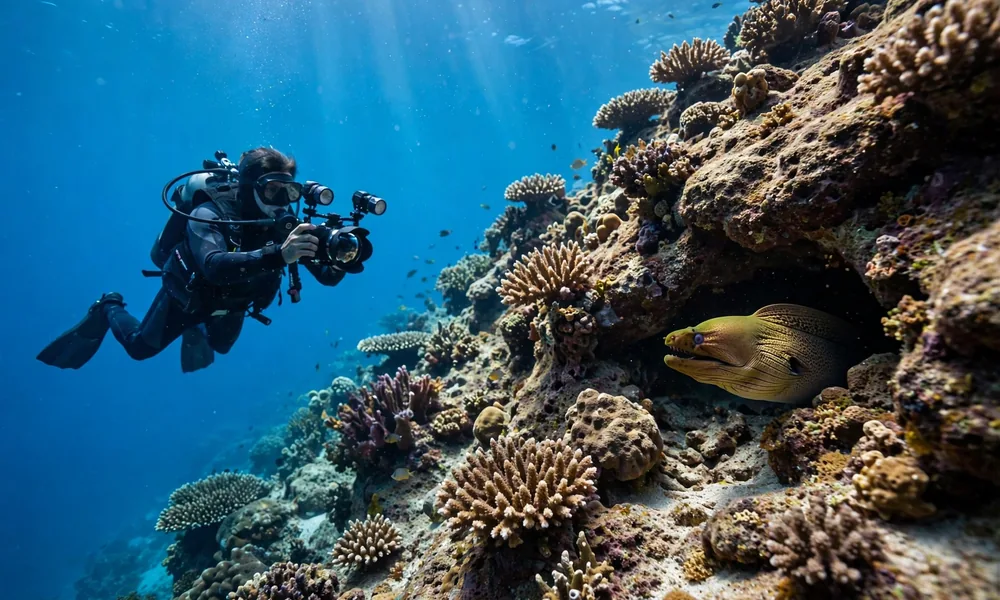
The main pressure is the loss of habitat. When a coral reef is damaged by bleaching, by storms, by pollution or by building, the moray loses the holes where it lives and the fish it feeds on, and the reef loses one of its top predators. Fishing is a second pressure, and a reef that loses its biggest morays loses the animals that keep the smaller fish in check, which is why so many reefs now protect their morays, and why the giant moray is rarely taken for food, partly because of the risk of ciguatera poisoning from its flesh. Water quality is a third pressure, and a bay that loses its coral to pollution loses the morays that lived in it.
Best seasons for moray eel watching
The best time to look for a moray eel is the warm season, when the seas are calm and the water is clear, and the eels are out hunting at night. In the Indo-Pacific that usually means the months from about November to May, when the water is warm and the visibility is at its best, and in the Caribbean the season runs longer, with good diving through most of the year. Morays are present on the reef all year round, and they do not migrate, so there is no wrong season in the strict sense, but a calm, clear day in the warm season will show you far more eels than a rough day in the storm season, when the water is cloudy and the eels stay deep in their holes.
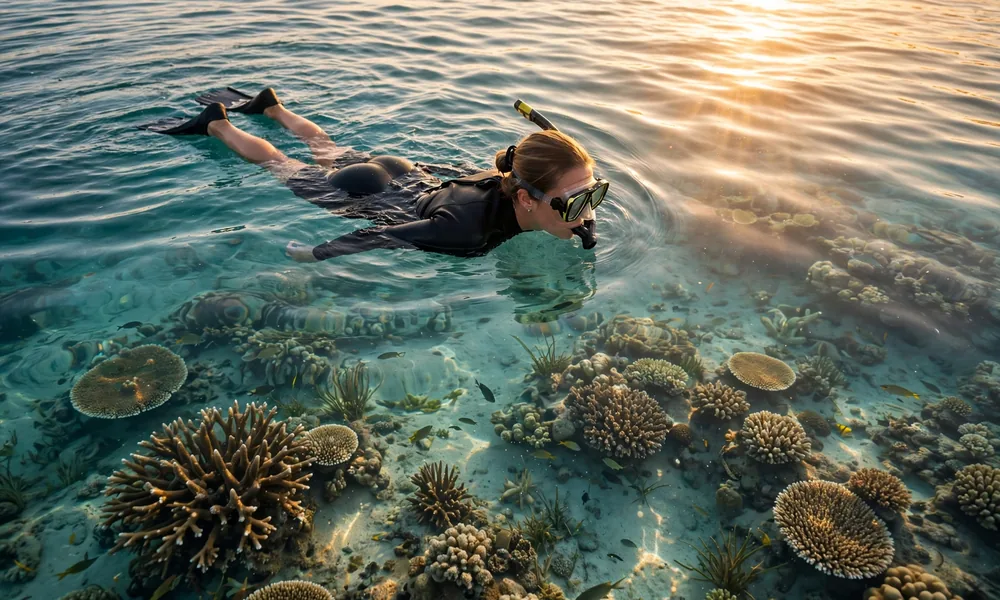
The best hours are the dawn and the dusk, and the night itself, when the morays are out hunting and the light is good for seeing them. From about six o’clock until nine in the morning, and again from about five until eight in the evening, the morays are moving between their holes and the reef, and they are at their most approachable then. A night dive is the best way of all to see them, with a torch to light the crevices, and the eels will often be out in the open, hunting in the dark, if you move gently and keep your distance.
Staying safe around moray eels
A moray eel is not dangerous to people who leave it alone, and there is no safety warning that belongs to the eel itself when you are diving or snorkelling on a reef. It is not aggressive, it does not chase swimmers, and it will not leave its hole to attack you. The bites that do happen are almost always provoked, by a diver who puts a hand into a hole, or a swimmer who tries to feed the eel, and the safety rules are simple: watch the eel, watch the water, and respect the animal that you came to see. Never put your hand into a hole or a crevice, never try to feed a moray, never try to pull one from its hole, and never swim with your hands trailing over the reef.
Moray eel watching checklist
A little preparation turns a day on the reef into a real chance of seeing moray eels at their best, peering from their holes in clear, warm water.
- A visit in the warm season, when the seas are calm, the water is clear and the eels are out hunting at night.
- A dawn, dusk or night dive, when the morays are moving between their holes and the reef.
- A coral reef or rocky shore with caves and crevices, where the eels live by day and hunt by night.
- A slow swim over the reef, watching for a spotted head peering from a hole or a long body slipping between the rocks.
- A torch for a night dive, so you can light the crevices and see the eels hunting in the dark.
- A buddy and a boat that knows the reef, so that a day on the water stays safe from start to finish.
- Respect for the eel and the reef, keeping your distance, never putting a hand into a hole, and leaving the reef as you found it.
Frequently asked questions
How big do moray eels get?
Most morays measure between 60 centimetres and 2.5 metres from snout to tail, and a good eel weighs 5 to 30 kilograms. A giant moray of 3 metres is a fish the size of a tall person, and the largest moray ever measured was the slender giant moray, at about 4 metres, a fish caught in the Maroochy River in Queensland, Australia, in 1927, measuring 3.94 metres. The smallest moray, Snyder’s moray, reaches just 11.5 centimetres, which is shorter than your hand, and the dwarf moray barely reaches 20 centimetres.
What do moray eels eat?
A moray eats fish, octopus, crabs, shrimps and other crustaceans, which it takes from the reef around its hole with a sudden strike. The everyday food is small reef fish and octopus, and a big moray will take a crab without a second thought. A smaller group, including the zebra moray and the species of the genus Echidna, has blunt, crushing teeth for crabs, snails and other hard-shelled prey, and they feed on the shellfish of the reef rather than on fish.
Do moray eels really have a second set of jaws?
Yes, morays have a second set of jaws, the pharyngeal jaws, in the throat, with their own teeth, which shoot forward into the mouth to grip prey and drag it down into the gut. Most fish swallow by suction, but a moray’s head is too narrow to make that work, and it hunts in tight crevices where suction is weak anyway. The mechanism was first described in detail by Rita Mehta and Peter Wainwright in 2007, using high-speed X-ray video, and it is unique among vertebrates.
Are moray eels dangerous?
No, moray eels are not dangerous to people who leave them alone. They are not aggressive, they do not chase swimmers, and they will not leave their hole to attack you. Their whole defence is built on being hard to see, hard to reach and hard to hold, and their first response to a threat is to retreat into the nearest hole. The bites that do happen are almost always provoked, by a diver who puts a hand into a hole or tries to feed the eel, so the safety rule is simple: look, do not touch.
Can you keep a moray eel in an aquarium?
You can, but it is hard, and most people should not try. A moray grows to 2 metres or more, it needs a very large tank with clean, well-oxygenated water and plenty of hiding places, and it eats fish, octopus and crustaceans, which makes it expensive and demanding to keep. It is also illegal to keep one in some places without a permit, and a moray that outgrows its tank must never be released into waters where it does not belong. A moray belongs on a reef, not in a living room.
How is this guide different from the lionfish guide?
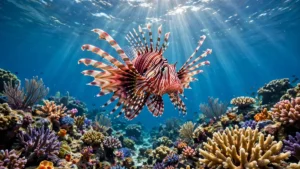
This guide covers the moray eel, a long, scaleless reef fish of up to about 3 metres that lives in a hole, hunts by smell at night and swallows its prey with a second set of jaws in its throat, while our lionfish guide covers a spiny, striped reef fish that hovers in the open water, fans its venomous fins and sucks small fish into its mouth in broad daylight. One is a hunter you meet by peering into a crevice; the other is a hunter you meet drifting over the reef in plain sight.
Conclusion
The moray eel species are a reminder that a fish does not need to be fast or brightly coloured to be unforgettable. A long, muscular body, a mouth full of teeth, a second set of jaws in the throat and a habit of living in a hole have made the moray the hidden hunter of the coral reef, at home in a crevice in the Red Sea, a hole in the Maldives and a rocky shore in the Caribbean alike.
If you go looking for one, go on a calm, clear day in the warm season, go at dawn or dusk or on a night dive, and swim slowly over a shallow reef with the sun behind you. Find the hole, look into the shade of the crevice, and watch for a spotted head peering out at you, and you will have met the moray that turns a quiet reef into a place of slow, spotted wonder.