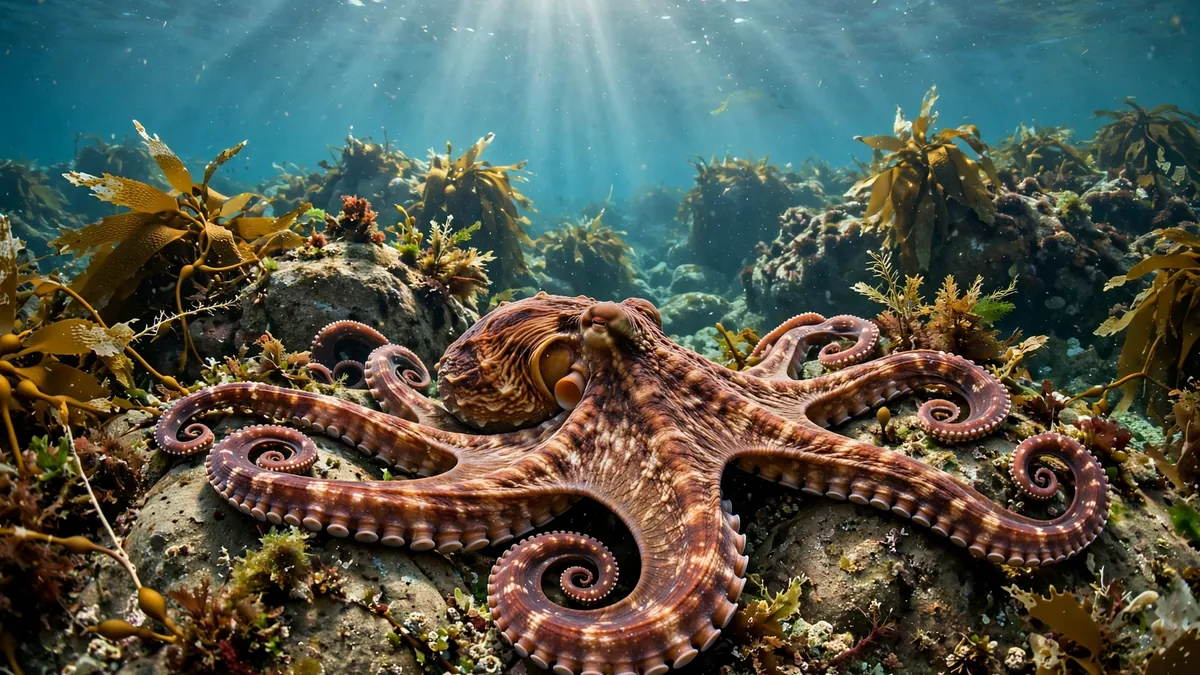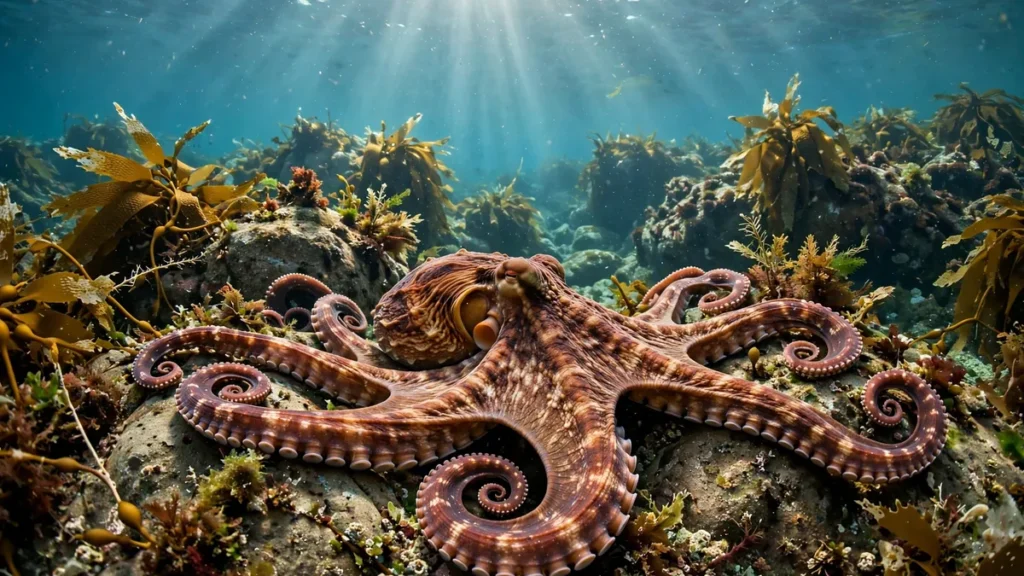
Octopus species number around 300 worldwide, from the common octopus that changes colour on a Mediterranean reef to the giant Pacific octopus with arms longer than a person is tall and the tiny blue-ringed octopus whose bright rings warn of one of the deadliest venoms in the sea. If you are wondering which octopus species exist and what makes an octopus different, the short answer is this: octopuses are eight-armed, soft-bodied molluscs with three hearts, blue blood and no bones at all, and they are among the cleverest animals in the ocean.
Key takeaways
- Octopus species number around 300 worldwide, living in oceans from shallow coral reefs to the deep sea.
- The common, giant Pacific, blue-ringed, mimic, dumbo and coconut octopuses are the best-known species.
- Octopuses have eight arms, three hearts and blue blood, and no bones at all, so they can squeeze through tiny gaps.
- An octopus changes colour and texture in a fraction of a second to camouflage itself or warn predators.
- Rocky reefs, coral reefs and tide pools at low tide are the best places to see octopuses in the wild.
What makes an octopus an octopus
An octopus is a mollusc, a relative of snails and clams, but it has given up its shell and grown a soft, muscular body instead. Its head holds a large brain and two well-developed eyes, and eight arms spread from the head, each lined with suckers that can taste, grip and feel. The arms can bend in any direction, pick up objects and even open jars.
An octopus has three hearts. Two pump blood through the gills, and one pumps blood through the body, and that third heart stops beating when the octopus swims. Their blood is blue because it uses copper, not iron, to carry oxygen.
Because an octopus has no bones, it can squeeze its whole body through any gap wider than its beak, which is the only hard part of its body. An octopus the size of a football can slip through a hole the size of a coin, which is how octopuses escape from predators and, famously, from tanks in aquariums. Among the ocean animals of the reef, the octopus is the great escape artist.
The great octopuses of the world
The common octopus is the octopus most people meet first. It lives in the Mediterranean Sea and the eastern Atlantic Ocean, on rocky reefs and in shallow water, and it is a master of camouflage, changing its colour and skin texture to match the rock, sand or coral around it. The common octopus hunts crabs, shrimps and molluscs at night, returning to its den to eat in safety.
The giant Pacific octopus is the largest octopus species in the world, with an arm span of up to six metres and a weight of up to 50 kilograms. It lives in the cold waters of the northern Pacific Ocean, from Japan and Alaska to California, hunting crabs, shrimps and fish in rocky reefs and kelp forests. It is shy, hiding in a den during the day and hunting at night.
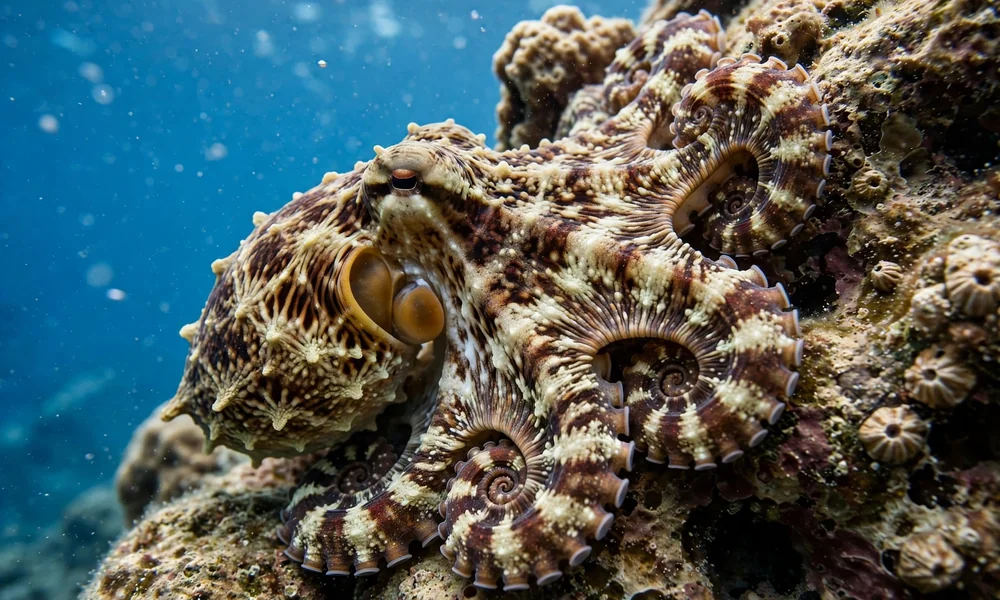
The blue-ringed octopus is one of the smallest octopus species, no bigger than a golf ball, but it is also one of the most dangerous animals in the sea. When threatened, it flashes bright blue rings across its yellow skin, a warning that its bite carries tetrodotoxin, a venom that can kill a person. Blue-ringed octopuses live in tide pools and shallow reefs around Australia and the western Pacific Ocean, and they are best admired from a safe distance.
The mimic octopus is the great actor of the octopus world. It can change its colour, shape and behaviour to imitate other animals, flattening itself like a flatfish, raising its arms like a sea snake or trailing them like a jellyfish. It lives on sandy sea floors in Indonesia and Malaysia, where there is little cover, so disguise is its best defence.
The dumbo octopus lives in the deep sea, and it has two fins on its head that look like the ears of the elephant Dumbo. The coconut octopus carries coconut shells and clam shells around with it, using them as a portable shelter on the sandy sea floor. The day octopus hunts in daylight on coral reefs, changing colour as it moves, and the blanket octopus is a deep-sea species in which the female trails a long, shimmering blanket of skin, while the male is tiny, no bigger than a walnut.
Camouflage, ink and escape
An octopus changes colour with special skin cells called chromatophores, tiny sacs of pigment controlled by the brain. It can also change the texture of its skin, raising bumps and ridges to match rock or smoothing itself to match sand, and it can do all of this in less than a second.
When camouflage fails, an octopus has two more defences. It can squirt a cloud of dark ink, confusing a predator while it jets away, and it can squeeze its soft body into the smallest crevice on the reef. The predators that hunt octopuses include sharks, eels and seals, so escape is a skill an octopus uses every day.
Octopuses are also famous for their intelligence. They solve puzzles, open jars and remember the layout of their home reef. Their intelligence is different from ours, spread through the arms as well as the brain, with each arm able to taste, feel and act partly on its own.
How octopuses hunt
Octopuses are hunters, and they hunt mostly at night. A hunting octopus crawls along the reef, feeling into every crack with its arms, searching for the scent of crabs and shrimps. When it finds prey, it pounces, wrapping its arms around the animal and pulling it to its beak to bite and inject venom.
The octopus beak is sharp and parrot-like, hidden in the centre of its arms, and it can crack open the shells of crabs, clams and snails. An octopus eats in its den, discarding the empty shells outside the entrance. Among the coastal animals of the reef, the octopus is one of the most skilled hunters, and one of the hardest to spot.
Where octopuses live
Octopuses live in every ocean on Earth, from warm coral reefs to cold northern seas. The common octopus lives on rocky reefs in the Mediterranean and the eastern Atlantic, the giant Pacific octopus lives in the cold waters of the northern Pacific, and the blue-ringed octopus lives in tide pools around Australia.
Most octopuses live in a den, a hole in the rock or a crevice in the reef, which they defend and return to after hunting. They are solitary, meeting only to mate, and they live fast and die young: most species live for only one to five years. The female lays thousands of eggs in her den, guards them without eating until they hatch, and dies soon after, while the tiny young drift away in the plankton. The shark species of the reef hunt octopuses too, so a good den and good camouflage are matters of life and death.
| Species | Where it lives | Best-known feature | Size |
|---|---|---|---|
| Common octopus | Mediterranean Sea and eastern Atlantic | Master of camouflage on rocky reefs | Arm span up to 1 metre |
| Giant Pacific octopus | Cold waters of the northern Pacific | Largest octopus species in the world | Arm span up to 6 metres |
| Blue-ringed octopus | Tide pools around Australia and the western Pacific | Bright blue rings warn of deadly venom | Up to 20 centimetres |
| Mimic octopus | Sandy sea floors of Indonesia and Malaysia | Imitates flatfish, sea snakes and jellyfish | Arm span up to 60 centimetres |
| Dumbo octopus | Deep sea worldwide, down to 7,000 metres | Ear-like fins on its head | Up to 20 centimetres |
| Coconut octopus | Sandy sea floors of the western Pacific | Carries shells as a portable shelter | Arm span up to 50 centimetres |
| Day octopus | Coral reefs of the Indo-Pacific | Hunts in daylight, changes colour as it moves | Arm span up to 80 centimetres |
| Blanket octopus | Open ocean in tropical waters | Female trails a long shimmering blanket | Female arm span up to 2 metres |
Best seasons for octopus watching
Summer is the finest season for octopus watching in temperate seas, when the water is warm and clear and octopuses hunt on rocky reefs at night. In the Mediterranean, dusk is best, when common octopuses leave their dens to hunt.
In the tropics, octopuses are active all year round, and the best time to look is at low tide in rock pools and on shallow reefs.
Staying safe around octopuses
Octopuses are wild animals, and they deserve respect. Never pick up an octopus, never put your hand into a hole where one may be hiding, and never touch a blue-ringed octopus: its bite carries a venom that can kill a person, and there is no antidote. Admire them from a safe distance.
Take care when exploring rock pools and reefs. Wear sturdy shoes, watch the tide, and never get cut off by rising water. Never chase an octopus: a frightened octopus may ink, bite or hide, and the best view is always the calm, patient one.
Octopus watching checklist
- Look for a pile of empty shells outside a hole in the rock, which marks an octopus den.
- Visit rocky reefs and tide pools at low tide, and look for colour changes on the reef.
- Watch at dusk or at night with a torch, when octopuses leave their dens to hunt.
- Never pick up an octopus and never put your hand into a hole where one may be hiding.
- Never touch a blue-ringed octopus: its bite carries a venom with no antidote.
- Leave no trace: take your rubbish home and keep to marked paths on the shore.
Frequently asked questions
How many octopus species are there?
There are around 300 octopus species worldwide, living in oceans from shallow coral reefs to the deep sea. New species are still being found, especially in the deep sea.
How is this guide different from the ocean animals guide?
This guide covers octopuses only, in detail: common, giant Pacific, blue-ringed, mimic, dumbo and the other great octopus species, with how they camouflage, hunt and escape. The ocean animals guide covers the whole range of animals that live in the sea, from whales and sharks to jellyfish and starfish, with octopuses as only one small part of that wider picture.
How many hearts does an octopus have?
An octopus has three hearts: two pump blood through the gills and one pumps blood through the body. Octopus blood is blue because it uses copper, not iron, to carry oxygen.
What is the largest octopus species?
The giant Pacific octopus is the largest octopus species in the world, with an arm span of up to six metres and a weight of up to 50 kilograms, living in the cold waters of the northern Pacific Ocean.
Are blue-ringed octopuses dangerous?
Yes, blue-ringed octopuses are very dangerous. Their bite carries tetrodotoxin, a venom powerful enough to kill a person, and there is no antidote. Admire them from a safe distance and never touch one.
How long do octopuses live?
Most octopus species live for only one to five years. The female lays thousands of eggs in her den, guards them without eating until they hatch, and dies soon after.
Conclusion
Octopus species are the shape-shifters of the sea: common octopuses vanishing into the reef, giant Pacific octopuses hunting crabs in cold northern waters, blue-ringed octopuses flashing their warning rings in tide pools and mimic octopuses mimicking flatfish, sea snakes and jellyfish.
The next step is to pick one reef and one low tide — a summer evening on a Mediterranean reef, a tropical rock pool at dawn, or a night dive in the northern Pacific — and plan your visit around it.