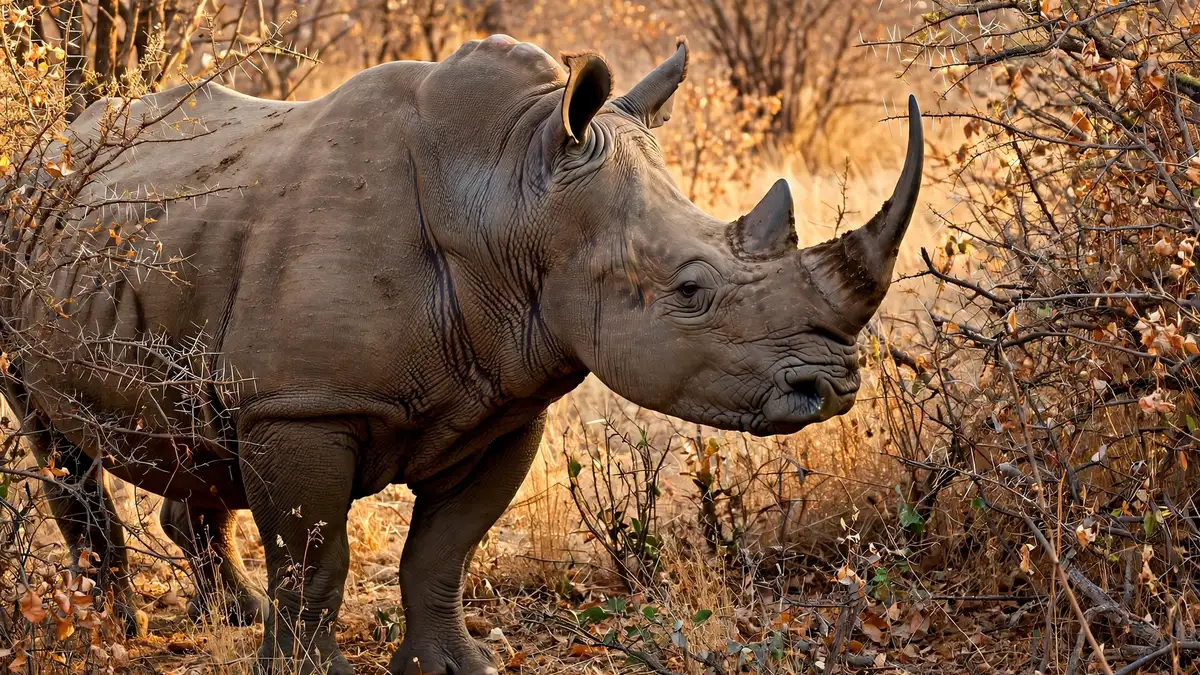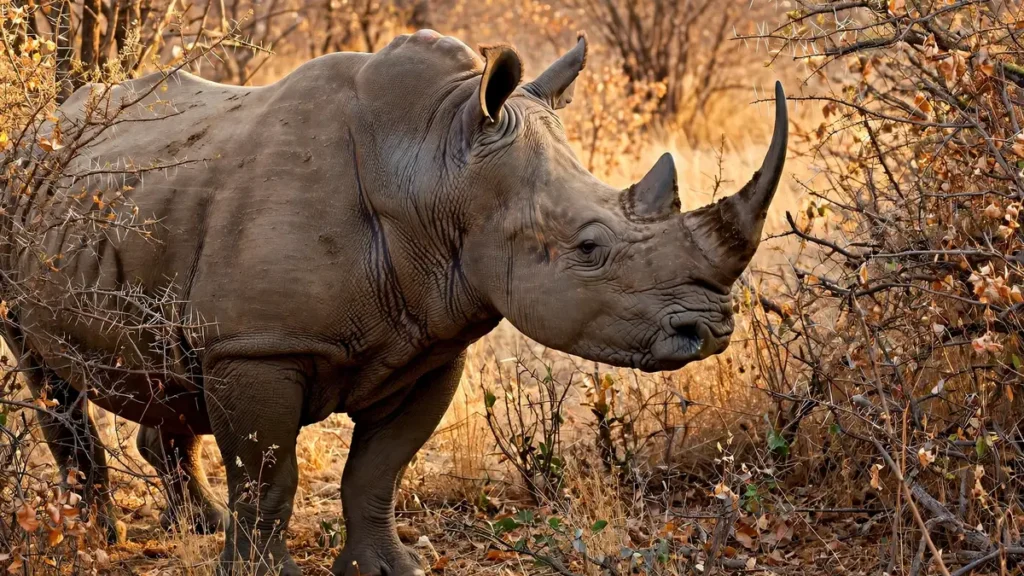
The black rhinoceros species is a single species, Diceros bicornis, a solitary browser of the African bush that is smaller and more aggressive than its white cousin, with a pointed lip for picking leaves from thorny branches. If you are asking how many black rhinoceros species there are, the answer is one, and like the white rhinoceros it is not black at all — its name only marks it out from its white cousin, and its skin is grey-brown.
The black rhinoceros belongs to the family Rhinocerotidae, the same family as the white rhinoceros, yet it lives very differently from its white cousin. It lives alone in thick bush, browsing leaves and twigs with a pointed prehensile lip, and it is the most solitary and most aggressive of all the rhinoceroses, charging at anything it cannot see clearly.
Key takeaways
- There is only one black rhinoceros species, Diceros bicornis, with four recognised subspecies, one of which, the western black rhinoceros, was declared extinct in 2011.
- Black rhinoceroses are not black: they are grey-brown, and the name only distinguishes them from the white rhinoceros.
- Black rhinoceroses are browsers, not grazers, using a pointed prehensile upper lip to pick leaves and twigs.
- Black rhinoceroses are solitary, short-tempered and short-sighted, with excellent hearing and smell.
- Black rhinoceroses are listed as Critically Endangered, with about 6,000 left in the wild.
What makes a black rhinoceros a black rhinoceros
A black rhinoceros is a grey-brown animal with a short head, a pointed prehensile upper lip, no shoulder hump and two horns, the front one much longer than the back. Its body measures roughly 300 to 375 centimetres long and 140 to 180 centimetres at the shoulder, and it usually weighs between 800 and 1,400 kilogrammes, with the males heavier than the females.
The lip defines the black rhinoceros: pointed and prehensile, it works like a finger for picking leaves and twigs from thorny branches, and the animal holds its head high as it browses, unlike the white rhinoceros, which holds its head low to graze. The horns, made of keratin like human fingernails, can grow to more than a metre long on the front horn. Black rhinoceroses browse mainly in the morning and the evening, and they can eat up to 50 kilogrammes of leaves and twigs in a day.
The black rhinoceros species and its relatives
Diceros bicornis is the only black rhinoceros species, and it is split into four recognised subspecies. Diceros bicornis bicornis lives in Namibia and South Africa, Diceros bicornis michaeli lives in East Africa, Diceros bicornis minor lives in Southern Africa, and Diceros bicornis longipes, the western black rhinoceros, was declared extinct in 2011, the last one seen in Cameroon in 2006.
The white rhinoceros is the black rhinoceros’s closest relative, being larger and living in herds on the open grasslands, but it grazes grass with a wide square lip, while the black rhinoceros browses leaves with a pointed lip. The Indian rhinoceros is another close relative, living in the tall grasslands of India and Nepal, while the woolly rhinoceros, now extinct, was a cold-climate cousin that lived in the Ice Age steppes of Europe and Asia.

| Type | Animal | Where it lives | Best-known food | Weight |
|---|---|---|---|---|
| Species | Black rhinoceros | Bush and thicket of Africa | Leaves and twigs | 800 to 1,400 kg |
| Close relative | White rhinoceros | Grasslands of Southern Africa | Short grasses | 1,400 to 2,400 kg |
| Close relative | Indian rhinoceros | Tall grasslands of India and Nepal | Grasses and leaves | 1,800 to 2,700 kg |
| Close relative | Sumatran rhinoceros | Rainforests of Sumatra and Borneo | Leaves, fruit and twigs | 500 to 1,000 kg |
| Close relative | Javan rhinoceros | Rainforest of Ujung Kulon, Java | Leaves and twigs | 900 to 2,300 kg |
| Close relative | Woolly rhinoceros (extinct) | Ice Age steppes of Europe and Asia | Grasses and shrubs | 1,500 to 2,500 kg |
| Subspecies | Western black rhinoceros (extinct) | Formerly Cameroon and Chad | Leaves and twigs | 800 to 1,400 kg |
How black rhinoceroses live
Black rhinoceroses are creatures of solitude. A black rhinoceros lives alone, holding a home range that it marks with dung middens and urine sprays, and it meets other rhinoceroses only to mate. The males fight with their horns, and a fight can leave deep wounds, though it rarely ends in death. Like other nocturnal animals, black rhinoceroses are not truly nocturnal, but they browse through much of the night as well as the day, resting in the heat of the afternoon in thick shade.
Leaves and twigs make up most of the diet, and the black rhinoceros browses with its pointed lip, picking leaves from thorny acacia branches that no other animal can reach.
Breeding can happen at any time of year, and after a gestation of about 15 to 16 months the female gives birth to a single calf, which stands within an hour and stays close to its mother for two to three years. The calf learns which leaves to eat and where the water is, and it can pick its mother out of the thick bush by smell alone. Young males leave their mothers at about three years old, while the females stay nearby for life. Black rhinoceroses live for around 35 to 50 years in the wild, and more than 50 years in captivity.
Where black rhinoceroses live
The black rhinoceros’s range once stretched across Africa, from the Mediterranean to the Cape, but it has shrunk to scattered bush in East and Southern Africa. It lives in thick bush and woodland, wherever there are leaves and twigs to browse and waterholes to drink from. It is one of the characteristic savanna animals of Africa, most common in the great parks of Namibia and South Africa, where the animals are best protected.
Thick bush is the key requirement. A black rhinoceros needs cover to hide in and thorny branches to browse, so it avoids open grassland and desert, and it stays in the same home range for years. It depends on the bush staying thick and connected, like many other African animals.
The black rhinoceros is listed as Critically Endangered, and its numbers are rising slowly after a catastrophic fall. The main pressure is poaching for horn, which is made of keratin and wrongly believed in some places to have medicinal value, while the loss of bush to farming adds to the decline. About 6,000 black rhinoceroses remain in the wild, up from fewer than 2,500 in the 1990s, and the western subspecies is already extinct.
Best seasons for black rhinoceros watching
There is no closed season, because black rhinoceroses are active all year in Africa, but the dry season is usually the best time to look for them. The bush thins out, the animals gather at waterholes, and the rhinoceroses are easier to find against the open ground. In East Africa the dry season runs from June to October, and in Southern Africa from May to September.
Whichever season you choose, the best hours are the first few after dawn and the hour before dusk, when the rhinoceroses come down to the waterholes to drink.
Good places to try include Etosha in Namibia, where the black rhinoceroses come to the waterholes at night and are easy to see from the floodlit hides, and the Kruger National Park and Lewa in Kenya, where the animals are well protected and tracked by rangers.
Staying safe around black rhinoceroses
A black rhinoceros is a wild animal with a huge body and a horn more than a metre long, and it is the most aggressive of all the rhinoceroses. Keep your distance, never get out of your vehicle in rhinoceros country, and never walk alone in the bush at night. If you meet a rhinoceros on foot, stand your ground, make yourself look big and back away slowly, and never run, because a black rhinoceros can charge at 55 kilometres an hour.
Like other wild mammals, black rhinoceroses can carry diseases, and any bite or scratch should be washed at once and checked by a doctor without delay. Admire from a distance. Avoid flash photography too, because a bright flash can startle a rhinoceros and trigger a charge.
Black rhinoceros watching checklist
A little preparation turns a safari into a real chance of seeing a black rhinoceros, so pack for the heat, the dust and the early mornings.
- Binoculars with good low-light performance, for picking a rhinoceros out among the thick bush.
- A camera with a long lens, because rhinoceroses should always be watched from a distance.
- Light layers and sun protection, because the bush is hot by day and cool at dawn.
- Water and snacks for long drives, because the best sightings come after hours of searching.
- A booked local guide who knows the home ranges, the waterholes and the browsing grounds.
- A plan to be out at dawn, when rhinoceroses are most active and the light is at its best.
- Patience and silence, because rhinoceroses are quiet animals and a noisy vehicle will send them away.
Frequently asked questions
How many black rhinoceros species are there?
There is one black rhinoceros species, Diceros bicornis. It is split into four recognised subspecies, but one of them, the western black rhinoceros, was declared extinct in 2011, so only three survive in the wild today.
Are black rhinoceroses really black?
No. Black rhinoceroses are grey-brown, like white rhinoceroses. The name only distinguishes them from the white rhinoceros, and it may come from the dark mud they wallow in, or from the Dutch word for the pointed lip. Neither rhinoceros is the colour its name suggests.
Why are black rhinoceroses so aggressive?
Black rhinoceroses are aggressive because they are solitary, short-sighted and nervous, with excellent hearing and smell but poor eyesight. They cannot see clearly beyond about 30 metres, so they charge at anything they cannot identify, and they defend their home ranges fiercely.
Can you keep a black rhinoceros as a pet?
No. A black rhinoceros is a wild animal that needs a huge territory, eats up to 50 kilogrammes of leaves a day, and can kill a person with one charge. Keeping one is illegal in many places, and many pet rhinoceroses end up in rescue centres when they grow too large to handle.
How is this guide different from the white rhinoceros species guide?
This guide covers the single black rhinoceros species, a solitary browser of the African bush, while our white rhinoceros species guide covers the single white rhinoceros species, a grazer of the open grasslands. The black rhinoceros lives alone in thick bush and browses leaves, and the white rhinoceros lives in herds on open grassland and grazes grass.
Are black rhinoceroses endangered?
Black rhinoceroses are listed as Critically Endangered, so they are among the most threatened large mammals in Africa. About 6,000 remain in the wild, up from fewer than 2,500 in the 1990s, and the western subspecies is already extinct. Protecting large areas of bush and stopping poaching for horn are the most important steps for keeping them healthy.
Conclusion
The black rhinoceros species shows how much specialisation one animal can hold: a single species, with a pointed lip for browsing, poor eyesight and a fierce temper, and a life spent alone in the thick bush of Africa. It is the most solitary and most aggressive of all the rhinoceroses, and it has ruled the bush of Africa for thousands of years.
If you go looking for one, go at dawn, go with a guide, and go quietly. Watch a black rhinoceros browse in the thick bush and you will understand why it has earned its place as the browser of the African bush, and why keeping its bush thick matters most.