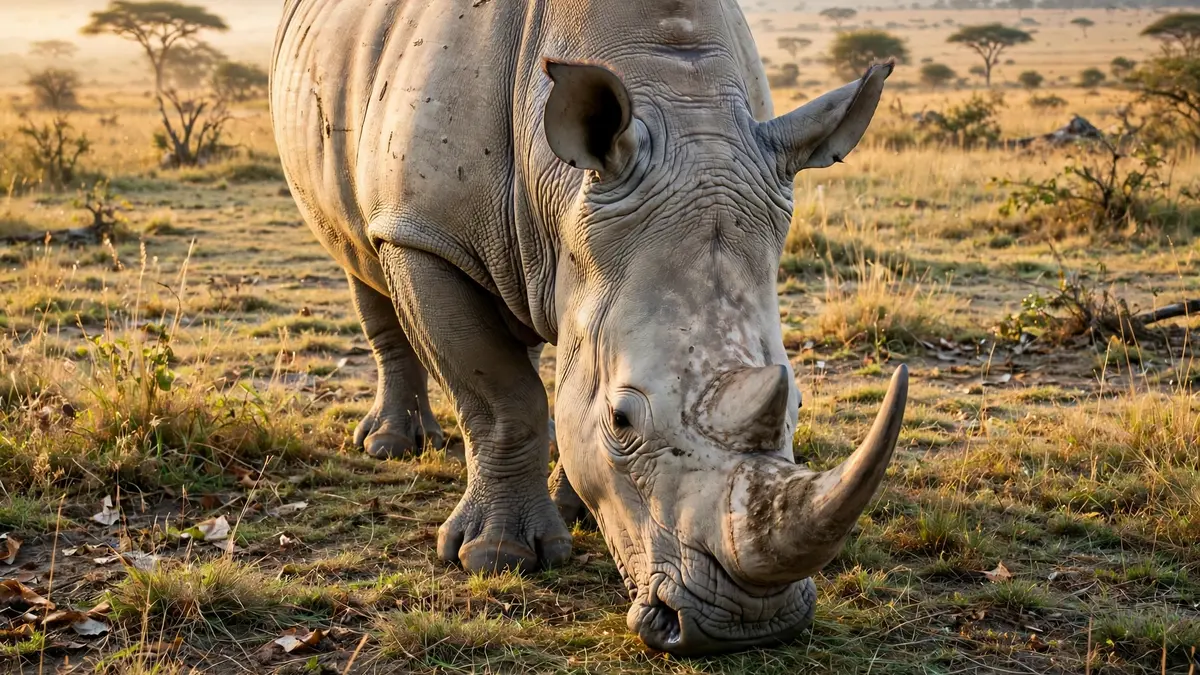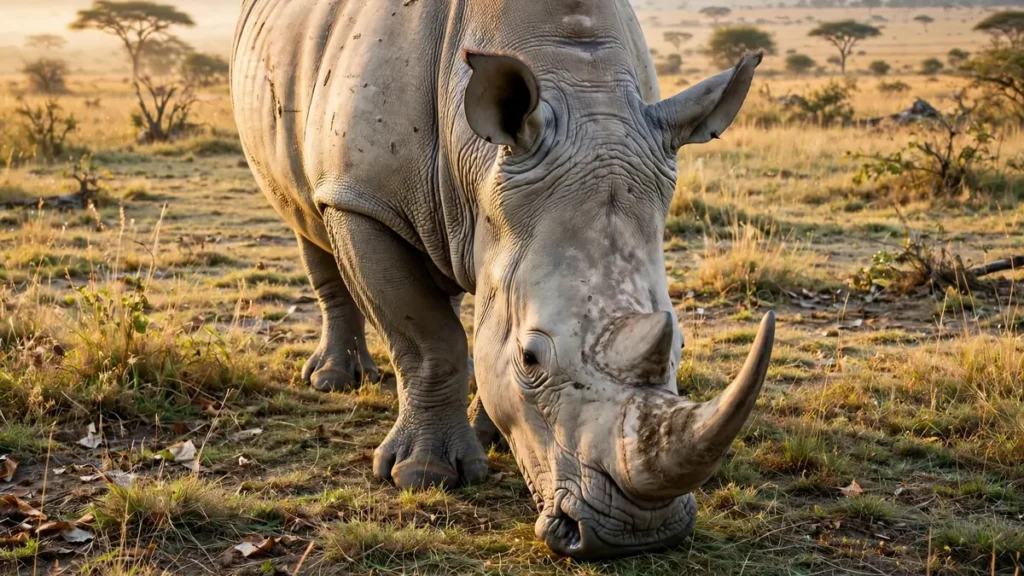
The white rhinoceros species is a single species, Ceratotherium simum, the largest rhinoceros on Earth and the second-largest land animal alive, a grey giant of the African grasslands that is not white at all. If you are asking how many white rhinoceros species there are, the answer is one, and its name comes from the Dutch word wijd, meaning wide, for the wide square lip it grazes with — not from its colour.
The white rhinoceros belongs to the family Rhinocerotidae, the same family as the black rhinoceros, yet it lives very differently from its black cousin. It grazes in herds on the open grasslands, holding its long head low to the ground, and it is the most social of all the rhinoceroses, while the black rhinoceros lives alone in the bush.
Key takeaways
- There is only one white rhinoceros species, Ceratotherium simum, with two subspecies, southern and northern.
- White rhinoceroses are not white: the name comes from the Dutch wijd, meaning wide, for their wide square grazing lip.
- White rhinoceroses are the largest rhinoceroses on Earth, with males weighing up to 2,400 kilogrammes.
- The northern white rhinoceros is functionally extinct, with only two females left in the world.
- Southern white rhinoceroses are listed as Near Threatened, with about 16,000 to 18,000 left in the wild.
What makes a white rhinoceros a white rhinoceros
A white rhinoceros is a huge grey animal with a long low head, a wide square lip, a pronounced shoulder hump and two horns, the front one much longer than the back. Its body measures roughly 370 to 400 centimetres long and 170 to 190 centimetres at the shoulder, and it usually weighs between 1,400 and 2,400 kilogrammes, with the males heavier than the females.
The lip defines the white rhinoceros: wide and square, it is built for grazing short grass, and the animal holds its head low to the ground as it feeds, swinging it from side to side. The shoulder hump is a mass of muscle that supports the heavy head, and the horns, made of keratin like human fingernails, can grow to 1.5 metres long on the front horn. White rhinoceroses graze mainly in the morning and the evening, and they can eat up to 50 kilogrammes of grass in a day.
The white rhinoceros species and its relatives
Ceratotherium simum is the only white rhinoceros species, and it is split into two subspecies. Ceratotherium simum simum, the southern white rhinoceros, lives in Southern Africa, while Ceratotherium simum cottoni, the northern white rhinoceros, lived in Central Africa and is now functionally extinct, with only two females left, Najin and Fatu, living under guard at Ol Pejeta in Kenya. The last male, Sudan, died in 2018.
The black rhinoceros is the white rhinoceros’s closest relative, being smaller and living alone in the bush, but it browses leaves and twigs with a pointed prehensile lip, while the white rhinoceros grazes grass with a wide square lip. The Indian rhinoceros is another close relative, living in the tall grasslands of India and Nepal, while the woolly rhinoceros, now extinct, was a cold-climate cousin that lived in the Ice Age steppes of Europe and Asia.
| Type | Animal | Where it lives | Best-known food | Weight |
|---|---|---|---|---|
| Species | White rhinoceros | Grasslands of Southern Africa | Short grasses | 1,400 to 2,400 kg |
| Close relative | Black rhinoceros | Bush and thicket of Africa | Leaves and twigs | 800 to 1,400 kg |
| Close relative | Indian rhinoceros | Tall grasslands of India and Nepal | Grasses and leaves | 1,800 to 2,700 kg |
| Close relative | Sumatran rhinoceros | Rainforests of Sumatra and Borneo | Leaves, fruit and twigs | 500 to 1,000 kg |
| Close relative | Javan rhinoceros | Rainforest of Ujung Kulon, Java | Leaves and twigs | 900 to 2,300 kg |
| Close relative | Woolly rhinoceros (extinct) | Ice Age steppes of Europe and Asia | Grasses and shrubs | 1,500 to 2,500 kg |
| Subspecies | Northern white rhinoceros | Ol Pejeta, Kenya (two females) | Short grasses | 1,400 to 2,400 kg |
How white rhinoceroses live
White rhinoceroses are creatures of the crash. A crash is made up of females and their calves, with the adult males living alone in territories that they mark with dung middens and defend from rival males. The males fight with their horns, and a fight can leave deep wounds, though it rarely ends in death. Like other nocturnal animals, white rhinoceroses are not truly nocturnal, but they graze through much of the night as well as the day, resting in the heat of the afternoon in mud wallows.
Short grasses make up most of the diet, and the white rhinoceros grazes with its wide square lip, cropping the grass close to the ground as it walks slowly forward. A single rhinoceros can eat more than 50 kilogrammes of grass in a day, and it must drink every day, walking to the waterholes in the heat of the afternoon.
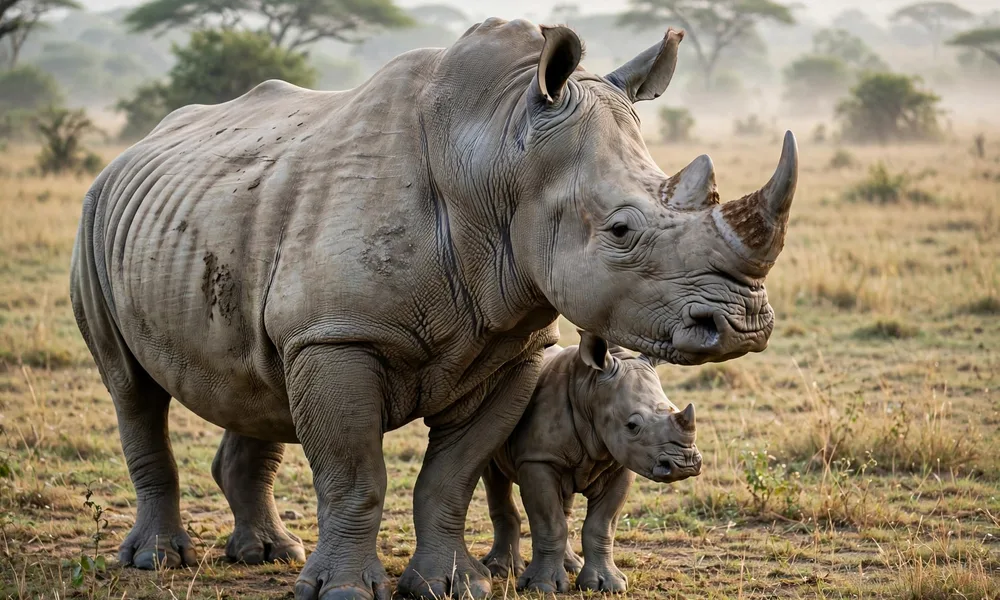
Breeding can happen at any time of year, and after a gestation of about 16 months the female gives birth to a single calf, which stands within an hour and stays close to its mother for two to three years. The calf learns which grasses to eat and where the water is, and it can pick its mother out of a crash of many animals. Young males leave their mothers at about three years old, while the females stay with the crash for life. White rhinoceroses live for around 40 to 50 years in the wild, and more than 50 years in captivity.
Where white rhinoceroses live
The white rhinoceros’s range once stretched across Africa, from the Mediterranean to the Cape, but it has shrunk to scattered grasslands in Southern Africa. It lives in open grassland and light woodland, wherever there is short grass to eat and waterholes to drink from. It is one of the characteristic savanna animals of Africa, most common in the great parks of South Africa, where the herds are largest.
Open country with short grass is the key requirement. A white rhinoceros needs room to graze and mud wallows to cool off in, so it avoids dense forest and desert, and it follows the rains as they move across the savanna. It depends on the savanna staying open and connected, like many other African animals.
The southern white rhinoceros is listed as Near Threatened, and its numbers are falling. The main pressure is poaching for horn, which is made of keratin and wrongly believed in some places to have medicinal value, while the loss of grassland to farming adds to the decline. About 16,000 to 18,000 southern white rhinoceroses remain in the wild, and the northern subspecies is functionally extinct, with only two females left in the world.
Best seasons for white rhinoceros watching
There is no closed season, because white rhinoceroses are active all year in Africa, but the dry season is usually the best time to look for them. The grass is short, the animals gather at waterholes, and the rhinoceroses are easier to find against the open plains. In Southern Africa the dry season runs from May to September.
Whichever season you choose, the best hours are the first few after dawn and the hour before dusk, when the rhinoceroses come down to the waterholes to drink.
Good places to try include the Kruger National Park and Hluhluwe-iMfolozi in South Africa, where the white rhinoceroses are well used to vehicles and easy to see on the open grasslands, and Ol Pejeta in Kenya, where the last two northern white rhinoceroses live under guard.
Staying safe around white rhinoceroses
A white rhinoceros is a wild animal with a huge body and a horn up to 1.5 metres long, and it can kill a person. Keep your distance, never get out of your vehicle in rhinoceros country, and never walk alone in the bush at night. If you meet a rhinoceros on foot, stand your ground, make yourself look big and back away slowly, and never run, because running can trigger a chase.
Like other wild mammals, white rhinoceroses can carry diseases, and any bite or scratch should be washed at once and checked by a doctor without delay. Admire from a distance. Avoid flash photography too, because a bright flash can startle a rhinoceros and disturb its grazing.
White rhinoceros watching checklist
A little preparation turns a safari into a real chance of seeing a white rhinoceros, so pack for the heat, the dust and the early mornings.
- Binoculars with good low-light performance, for picking a rhinoceros out among the tall grass.
- A camera with a long lens, because rhinoceroses should always be watched from a distance.
- Light layers and sun protection, because the savanna is hot by day and cool at dawn.
- Water and snacks for long drives, because the best sightings come after hours of searching.
- A booked local guide who knows the crashes, the waterholes and the grazing grounds.
- A plan to be out at dawn, when rhinoceroses are most active and the light is at its best.
- Patience and silence, because rhinoceroses are quiet animals and a noisy vehicle will send them away.
Frequently asked questions
How many white rhinoceros species are there?
There is one white rhinoceros species, Ceratotherium simum. It is split into two subspecies, southern and northern, but they are all the same species. The northern subspecies is functionally extinct, with only two females left in the world.
Are white rhinoceroses really white?
No. White rhinoceroses are grey, like black rhinoceroses. The name comes from the Dutch word wijd, meaning wide, for their wide square grazing lip, which was misheard as white by English speakers. The black rhinoceros is not black either.
Why do white rhinoceroses wallow in mud?
White rhinoceroses wallow in mud to cool off and to protect their skin from the sun and from biting insects. The mud dries into a crust that shields the skin, and the wallow is also a social place where the animals gather and rest.
Can you keep a white rhinoceros as a pet?
No. A white rhinoceros is a wild animal that needs a huge territory, eats up to 50 kilogrammes of grass a day, and can kill a person with one charge. Keeping one is illegal in many places, and many pet rhinoceroses end up in rescue centres when they grow too large to handle.
How is this guide different from the hippopotamus species guide?
This guide covers the single white rhinoceros species, the largest rhinoceros on Earth, while our hippopotamus species guide covers the two hippopotamus species, the river horses of Africa. The white rhinoceros lives on the open grasslands and grazes by day, and the hippopotamus lives in the rivers and grazes at night.
Are white rhinoceroses endangered?
Southern white rhinoceroses are listed as Near Threatened, so they are not classed as endangered, but their numbers are falling, and the northern subspecies is functionally extinct, with only two females left. Protecting large areas of grassland and stopping poaching for horn are the most important steps for keeping them healthy.
Conclusion
The white rhinoceros species shows how much specialisation one animal can hold: a single species, with a wide square lip for grazing, a shoulder hump that supports a heavy head, and a life spent grazing in herds on the open grasslands of Africa. It is the largest rhinoceros on Earth, and it has ruled the grasslands of Africa for thousands of years.
If you go looking for one, go at dawn, go with a guide, and go quietly. Watch a crash of white rhinoceroses graze on the open plains and you will understand why they have earned their place as the largest rhinoceroses on Earth, and why keeping their grasslands open matters most.