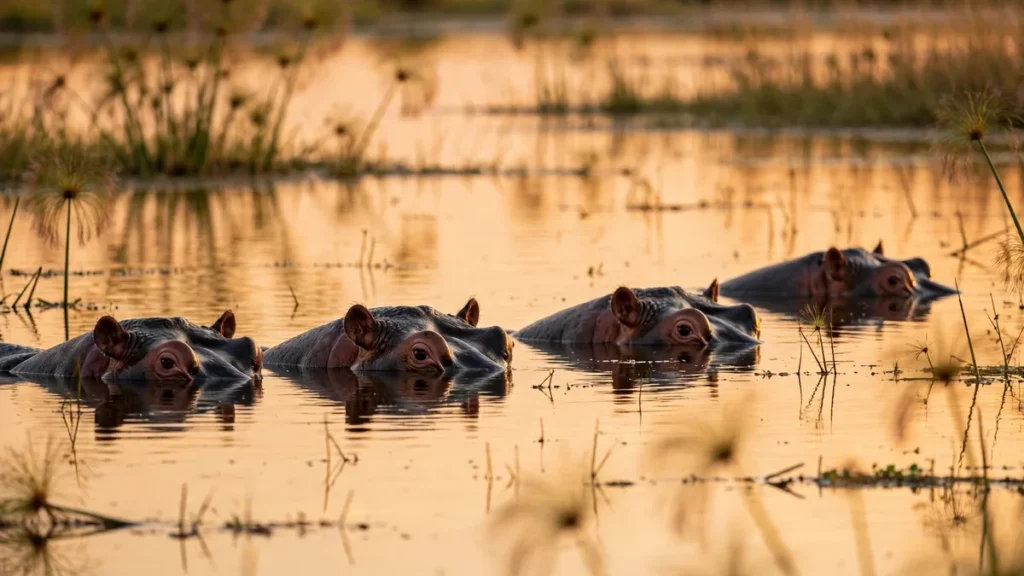
The hippopotamus species are two — the common hippopotamus and the pygmy hippopotamus — the river horses of Africa, spending their days in the water and their nights grazing on the banks. If you are asking how many hippopotamus species there are, the answer is two, and the common hippopotamus is one of the largest land animals on Earth, while the pygmy hippopotamus is a shy forest animal a tenth of its size.
The hippopotamus belongs to the family Hippopotamidae, and its closest living relatives are not elephants or rhinos but whales and dolphins, sharing a common ancestor with the whales some 55 million years ago. It lives in rivers and lakes across Africa, and it is the most dangerous large mammal in Africa, killing more people each year than lions or crocodiles.
Key takeaways
- There are two hippopotamus species: the common hippopotamus and the pygmy hippopotamus, which lives in the forests of West Africa.
- Common hippopotamuses are the third-largest land animals on Earth, with males weighing up to 3,200 kilogrammes.
- Hippopotamuses spend the day in the water and graze at night, walking up to 10 kilometres to feed.
- Their skin oozes a pinkish-red secretion that works as a natural sunscreen and antibiotic.
- Common hippopotamuses are listed as Vulnerable, with about 115,000 to 130,000 left, while pygmy hippopotamuses are listed as Endangered.
What makes a hippopotamus a hippopotamus
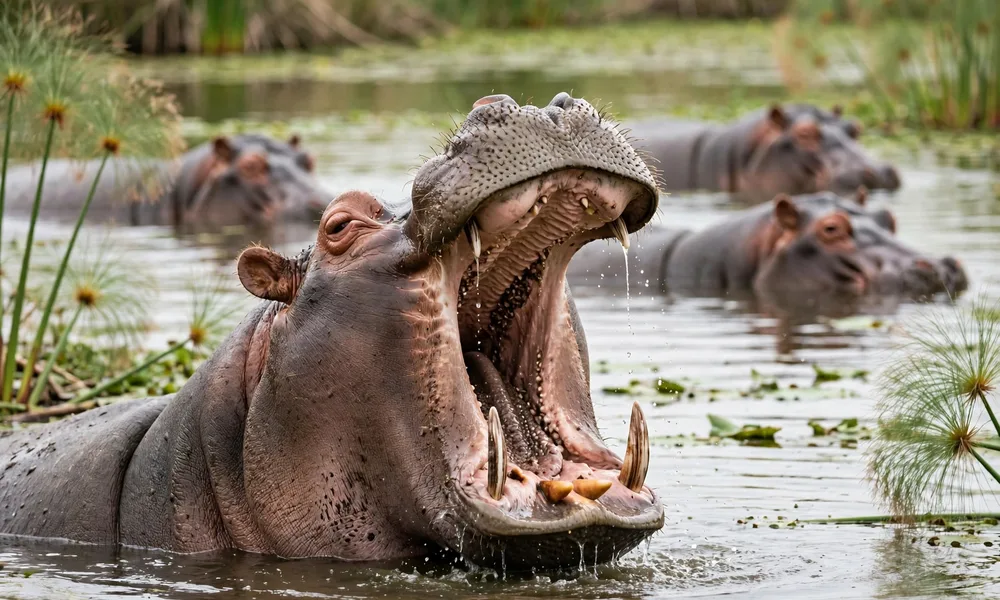
A common hippopotamus is a huge barrel-shaped animal with short legs, a massive head, small ears and eyes set high on the skull, and grey-brown skin that looks almost pink in the sun. Its body measures roughly 350 to 500 centimetres long, and it usually weighs between 1,500 and 3,200 kilogrammes, with the males heavier than the females.
The skin defines the hippopotamus: hairless and thin, it dries out quickly in the sun, so the animal spends the day in the water and oozes a pinkish-red secretion that works as a sunscreen and an antibiotic. The eyes, ears and nostrils sit high on the head, so the animal can see, hear and breathe while almost all of its body stays underwater. Hippopotamuses graze mainly at night, and they can eat up to 40 kilogrammes of grass in a single night.
The hippopotamus species and their relatives
The two hippopotamus species are the common hippopotamus and the pygmy hippopotamus. The common hippopotamus lives in the rivers and lakes of sub-Saharan Africa, while the pygmy hippopotamus lives in the forest streams of Liberia, Sierra Leone, Guinea and Ivory Coast, and it is much smaller, weighing only 180 to 275 kilogrammes. The pygmy hippopotamus is solitary and shy, while the common hippopotamus lives in pods of ten to thirty animals.
The whale is the hippopotamus’s closest living relative, sharing a common ancestor some 55 million years ago, though the whale went to the sea and the hippopotamus stayed in the rivers. The pig is another distant cousin, and the extinct giant hippopotamuses of Madagascar and Malta were much larger than any hippopotamus alive today.
| Type | Animal | Where it lives | Best-known food | Weight |
|---|---|---|---|---|
| Species | Common hippopotamus | Rivers and lakes of sub-Saharan Africa | Grasses | 1,500 to 3,200 kg |
| Species | Pygmy hippopotamus | Forest streams of West Africa | Leaves, fruit and ferns | 180 to 275 kg |
| Close relative | Blue whale | Oceans worldwide | Krill | Up to 180,000 kg |
| Close relative | Common bottlenose dolphin | Warm oceans worldwide | Fish and squid | 150 to 650 kg |
| Close relative | Wild boar | Forests of Europe and Asia | Roots, fruit and nuts | 50 to 100 kg |
| Close relative | Madagascan dwarf hippopotamus (extinct) | Rivers of Madagascar | Grasses and leaves | About 400 kg |
| Close relative | White rhinoceros | Grasslands of Southern Africa | Grasses | 2,000 to 2,400 kg |
How hippopotamuses live
Hippopotamuses are creatures of the pod. A pod is made up of females and their calves, with one dominant male, and it holds a stretch of river that the male defends from rival males. The males fight with their huge canine teeth, and a fight can leave deep wounds, though it rarely ends in death. Like other nocturnal animals, hippopotamuses feed mainly at night, leaving the water at dusk to graze on the banks and returning before dawn.
Grasses make up most of the diet, and the hippopotamus grazes with lips like a lawnmower, cropping short grass along the riverbanks and walking up to 10 kilometres in a night to find it. A single hippopotamus can eat more than 40 kilogrammes of grass in a night, and it returns to the same grazing paths night after night.
Breeding can happen at any time of year, and after a gestation of about eight months the female gives birth to a single calf, usually in the water, where the calf can swim within minutes. The calf nurses underwater, closing its ears and nostrils to suckle, and it stays close to its mother for years. Young males leave the pod at about seven years old, while the females stay for life. Hippopotamuses live for around 40 to 50 years in the wild, and more than 50 years in captivity.
Where hippopotamuses live
The hippopotamus’s range once stretched across Africa, from the Mediterranean to the Cape, but it has shrunk to scattered rivers and lakes in sub-Saharan Africa. It lives in slow rivers, lakes and swamps, wherever there is water deep enough to submerge in and grassland nearby to graze. It is one of the characteristic wetland animals of Africa, most common in the great rivers of East and Southern Africa, where the pods are largest.
Permanent water is the key requirement. A hippopotamus needs water deep enough to keep its skin wet through the day, so it avoids fast rivers and dry country, and it follows the water as the seasons change. It depends on the rivers staying full and connected, like many other African animals.
The common hippopotamus is listed as Vulnerable, and its numbers are falling. The main pressure is the loss of rivers and wetlands to farming and settlement, which removes water and grazing, while hunting for meat and ivory adds to the decline in some countries. About 115,000 to 130,000 common hippopotamuses remain in the wild, and only about 2,000 to 2,500 pygmy hippopotamuses are left, listed as Endangered.
Best seasons for hippopotamus watching
There is no closed season, because hippopotamuses are active all year in Africa, but the dry season is usually the best time to look for them. The water falls, the animals gather in the remaining pools, and the hippopotamuses are easier to find, packed together in the shrinking rivers. In East Africa the dry season runs from June to October, and in Southern Africa from May to September.
The wet season has its own rewards: the rivers are full, the calves are born, and the wetlands are at their greenest. The trade-off is that the animals spread out across the flooded plains, the roads are muddy and there are more insects. Whichever season you choose, the best hours are the first few after dawn, when the pods are still in the water, and the hour before dusk, when they leave to graze.
Good places to try include the Okavango Delta and the Luangwa River, where the pods are enormous, and Lake St Lucia in South Africa, where the hippopotamuses are well used to boats and easy to see from the water.
Staying safe around hippopotamuses
A hippopotamus is a wild animal with a huge body and teeth up to 50 centimetres long, and it kills more people in Africa than any other large mammal. Keep your distance, never get between a hippopotamus and the water, and never walk alone along a riverbank at night. If you meet a hippopotamus on foot, do not run towards the water, because that is where it is heading, and get behind a large tree or climb one if you can.
Like other wild mammals, hippopotamuses can carry diseases, and any bite or scratch should be washed at once and checked by a doctor without delay. Admire from a distance, and never swim in a river where hippopotamuses live. Avoid flash photography too, because a bright flash can startle a hippopotamus and disturb its rest.
Hippopotamus watching checklist
A little preparation turns a safari into a real chance of seeing a hippopotamus, so pack for the heat, the dust and the early mornings.
- Binoculars with good low-light performance, for picking a hippopotamus out among the reeds.
- A camera with a long lens, because hippopotamuses should always be watched from a distance.
- Light layers and sun protection, because the riverbanks are hot by day and cool at dawn.
- Water and snacks for long drives, because the best sightings come after hours of searching.
- A booked local guide who knows the pods, the rivers and the grazing grounds.
- A plan to be out at dawn, when hippopotamuses are most visible and the light is at its best.
- Patience and silence, because hippopotamuses are quiet animals and a noisy boat will send them under.
Frequently asked questions
How many hippopotamus species are there?
There are two hippopotamus species: the common hippopotamus and the pygmy hippopotamus. The common hippopotamus lives in the rivers and lakes of sub-Saharan Africa, while the pygmy hippopotamus lives in the forest streams of West Africa and is much smaller and more solitary.
Is a hippopotamus the most dangerous animal in Africa?
Among large mammals, yes. Hippopotamuses kill more people in Africa than lions, leopards or crocodiles, with estimates of about 500 deaths a year. They are territorial, fast on land, and fiercely protective of their calves and their stretch of river.
Why do hippopotamuses spend all day in the water?
Hippopotamuses spend the day in the water because their thin, hairless skin dries out quickly in the sun. The water keeps them cool and wet, and their skin oozes a pinkish-red secretion that works as a sunscreen and an antibiotic.
Can you keep a hippopotamus as a pet?
No. A hippopotamus is a wild animal that needs a river, eats up to 40 kilogrammes of grass a night, and can kill a person with one bite. Keeping one is illegal in many places, and many pet hippopotamuses end up in rescue centres when they grow too large to handle.
How is this guide different from the zebra species guide?
This guide covers the two hippopotamus species, the river horses of Africa, while our zebra species guide covers the three zebra species, the striped horses of Africa. The hippopotamus lives in the rivers and grazes at night, and the zebra lives on the open grasslands and grazes by day.
Are hippopotamuses endangered?
The common hippopotamus is listed as Vulnerable, and the pygmy hippopotamus as Endangered, with only about 2,000 to 2,500 left in the wild. Protecting rivers and wetlands, keeping grazing land open and stopping hunting for meat and ivory are the most important steps for keeping them healthy.
Conclusion
The hippopotamus species show how much specialisation two animals can hold: two species, one the third-largest land animal on Earth and the other a shy forest animal a tenth of its size, both spending their days in the water and their nights grazing on the banks. They are the river horses of Africa, and they have ruled the rivers of Africa for thousands of years.
If you go looking for one, go at dawn, go with a guide, and go quietly. Watch a pod of hippopotamuses surface in a river at sunrise and you will understand why they have earned their place as the river horses of Africa, and why keeping their rivers full matters most.