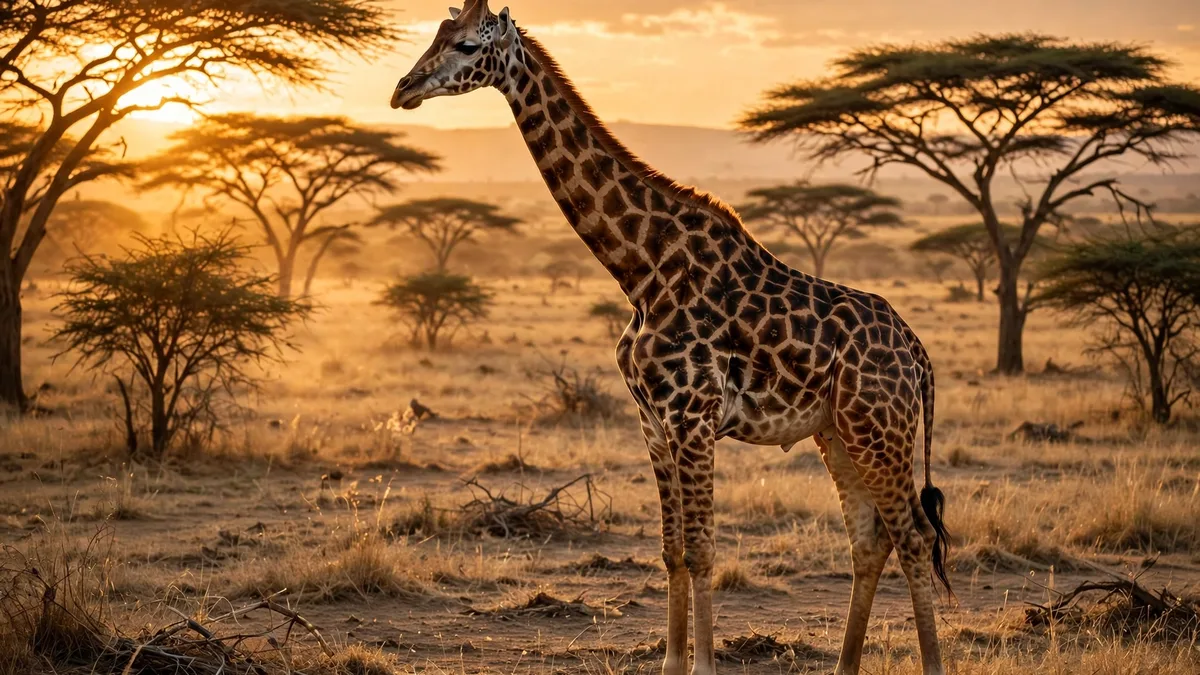
The giraffe species are four, recognised since 2016 — the northern, southern, reticulated and Masai giraffes — the tallest land animals on Earth, with necks nearly two metres long and coats no two of which are alike. If you are asking how many giraffe species there are, the answer is four, though many books still describe a single species, Giraffa camelopardalis, with nine subspecies, and the two views are both in use.
The giraffe belongs to the family Giraffidae, the same family as the okapi, its only close living relative, yet it lives very differently from the forest-dwelling okapi. It lives in loose herds on the open savanna, browsing the tops of acacia trees that no other animal can reach, and it is the only animal that can eat leaves two storeys above the ground.
Key takeaways
- There are four giraffe species recognised since 2016: northern, southern, reticulated and Masai, though some authorities still count one species with nine subspecies.
- Giraffes are the tallest land animals on Earth, with males reaching up to 5.5 metres and weighing up to 1,200 kilogrammes.
- A giraffe’s neck has only seven vertebrae, the same number as a human neck, but each one can be 25 centimetres long.
- Giraffes rarely need to drink, getting most of their water from the leaves they eat.
- Giraffes are listed as Vulnerable, with about 117,000 left in the wild, and two of the four species are listed as Endangered.
What makes a giraffe a giraffe
A giraffe is a tall animal with a long neck, long legs, a short body and a spotted coat, with small horn-like ossicones on its head and a long dark tongue. Its body measures roughly 4.3 to 5.5 metres tall, and it usually weighs between 800 and 1,200 kilogrammes, with the males taller and heavier than the females.
The neck defines the giraffe: nearly two metres long, it lets the animal browse the tops of acacia trees that no other animal can reach, and it is held upright by powerful muscles and a heart weighing about 11 kilogrammes, which pumps blood two metres up to the brain. The spots are unique to each animal, like a human fingerprint, and they help it hide among the dappled light of the savanna. Giraffes feed mainly in the morning and the evening, and they can eat up to 30 kilogrammes of leaves in a day.
The giraffe species and their relatives
The four giraffe species are the northern giraffe, the southern giraffe, the reticulated giraffe and the Masai giraffe. The northern giraffe lives in West, Central and East Africa, the southern giraffe in Southern Africa, the reticulated giraffe in the Horn of Africa, and the Masai giraffe in East Africa. Each has its own spot pattern: the reticulated giraffe has sharp-edged chestnut patches, the Masai giraffe has jagged vine-leaf spots, and the northern giraffe has paler, more broken patches.
The okapi is the giraffe’s only close living relative, a forest animal of the Congo with a giraffe’s head and a zebra’s striped legs, but it lives alone in the rainforest, while the giraffe lives in herds on the open savanna. The extinct Sivatherium was a giant short-necked cousin of the giraffe, as tall as an elephant at the shoulder, and it lived in Asia and Africa until about 8,000 years ago.

| Type | Animal | Where it lives | Best-known food | Height |
|---|---|---|---|---|
| Species | Masai giraffe | Savannas of Kenya and Tanzania | Acacia leaves | Up to 5.5 m |
| Species | Reticulated giraffe | Dry country of Kenya, Somalia and Ethiopia | Acacia and commiphora leaves | Up to 5.5 m |
| Species | Northern giraffe | West, Central and East Africa | Acacia leaves | Up to 5.5 m |
| Species | Southern giraffe | Savannas of Southern Africa | Acacia and mopane leaves | Up to 5.5 m |
| Close relative | Okapi | Rainforests of the Congo | Leaves, buds and fruit | 1.5 to 2 m |
| Close relative | Sivatherium (extinct) | Asia and Africa | Leaves and branches | Up to 3 m at the shoulder |
| Close relative | Plains zebra | Grasslands of Africa | Grasses | 1.2 to 1.5 m at the shoulder |
How giraffes live
Giraffes are creatures of the loose herd. A herd is made up of females and their calves, with the males wandering alone or in small bachelor groups, and the members come and go as they please, in what scientists call a fission-fusion society. The males fight by necking, swinging their heavy heads at each other like clubs, and the winner earns the right to mate. Like other nocturnal animals, giraffes are not truly nocturnal, but they feed through much of the night as well as the day, resting in short spells standing up.
Acacia leaves make up most of the diet, and the giraffe eats with a tongue up to 45 centimetres long, stripping leaves from thorny branches that no other animal can reach.
Breeding can happen at any time of year, and after a gestation of about 15 months the female gives birth to a single calf, which drops two metres to the ground and stands within an hour. The calf stays close to its mother for years, and all the females in a nursery group help to watch over it. Young males leave their mothers at about two years old, while the females stay with the herd for life. Giraffes live for around 25 years in the wild, and more than 30 years in captivity.
Where giraffes live
The giraffe’s range once stretched across Africa, from the Mediterranean to the Cape, but it has shrunk to scattered savannas in sub-Saharan Africa. It lives in open savanna and light woodland, wherever there are acacia trees to browse. It is one of the characteristic savanna animals of Africa, most common in the great parks of East and Southern Africa, where the herds are largest.
Open country with tall trees is the key requirement. A giraffe needs room to see predators coming and acacias tall enough to feed on, so it avoids dense forest and desert, and it follows the rains as they move across the savanna. It depends on the savanna staying open and connected, like many other African animals.
The giraffe as a whole is listed as Vulnerable, and its numbers are falling. The main pressure is the loss of savanna to farming and settlement, which removes food trees and brings giraffes into conflict with people, while hunting and the trade in giraffe parts add to the decline in some countries. About 117,000 giraffes remain in the wild, and the Masai and reticulated giraffes are both listed as Endangered, while the Nubian and Kordofan giraffes, subspecies of the northern giraffe, are listed as Critically Endangered.
Best seasons for giraffe watching
There is no closed season, because giraffes are active all year in Africa, but the dry season is usually the best time to look for them. The grass is short, the animals gather at waterholes, and the giraffes are easier to find against the open plains. In East Africa the dry season runs from June to October, and in Southern Africa from May to September.
Whichever season you choose, the best hours are the first few after dawn and the hour before dusk, when the giraffes come down to the waterholes to drink.
Good places to try include the Serengeti and the Masai Mara, where the great migration brings the herds, and the Kruger National Park and Etosha, where the giraffes are well used to vehicles and easy to see against the open plains.
Staying safe around giraffes
A giraffe is a wild animal with a huge body and powerful legs, and a kick from a giraffe can kill a person. Keep your distance, never get out of your vehicle in giraffe country, and never walk alone in the bush at night. If you meet a giraffe on foot, stand your ground, make yourself look big and back away slowly, and never run, because running can trigger a chase.
Like other wild mammals, giraffes can carry diseases, and any bite or scratch should be washed at once and checked by a doctor without delay. Admire from a distance. Avoid flash photography too, because a bright flash can startle a giraffe and disturb its feeding.
Giraffe watching checklist
A little preparation turns a safari into a real chance of seeing a giraffe, so pack for the heat, the dust and the early mornings.
- Binoculars with good low-light performance, for picking a giraffe out among the acacia trees.
- A camera with a long lens, because giraffes should always be watched from a distance.
- Light layers and sun protection, because the savanna is hot by day and cool at dawn.
- Water and snacks for long drives, because the best sightings come after hours of searching.
- A booked local guide who knows the herds, the waterholes and the feeding grounds.
- A plan to be out at dawn, when giraffes are most active and the light is at its best.
- Patience and silence, because giraffes are quiet animals and a noisy vehicle will send them away.
Frequently asked questions
How many giraffe species are there?
There are four giraffe species recognised since 2016: northern, southern, reticulated and Masai. Many books still describe a single species, Giraffa camelopardalis, with nine subspecies, and both views are in use, but the four-species view is now used by the IUCN and by most giraffe scientists.
Is a giraffe the tallest land animal in the world?
Yes. The giraffe is the tallest land animal on Earth, with males reaching up to 5.5 metres. The African savanna elephant is the heaviest land animal, but the giraffe is taller, and no other land animal comes close to its height.
Why do giraffes have such long necks?
Giraffes have long necks so they can browse the tops of acacia trees that no other animal can reach, feeding on leaves two storeys above the ground. Males also use their necks in necking fights, swinging their heavy heads at each other to win the right to mate.
Can you keep a giraffe as a pet?
No. A giraffe is a wild animal that needs a huge territory, eats up to 30 kilogrammes of leaves a day, and can kill a person with one kick. Keeping one is illegal in many places, and many pet giraffes end up in rescue centres when they grow too tall to handle.
How is this guide different from the Asian elephant species guide?
This guide covers the four giraffe species, the tallest land animals on Earth, while our Asian elephant species guide covers the single Asian elephant species, a forest-dwelling giant of South and South-east Asia. The giraffe lives on the open savanna of Africa, and the Asian elephant lives in the forests of Asia.
Are giraffes endangered?
Giraffes as a whole are listed as Vulnerable, so they are not classed as endangered, but their numbers are declining. About 117,000 remain in the wild, down from hundreds of thousands a century ago, and the Masai and reticulated giraffes are listed as Endangered. Protecting large areas of savanna and stopping poaching are the most important steps for keeping them healthy.
Conclusion
The giraffe species show how much specialisation four animals can hold: four species, with necks nearly two metres long, hearts weighing 11 kilogrammes, and coats no two of which are alike, all living on the open savanna of Africa. They are the tallest land animals on Earth, and they have ruled the treetops of Africa for thousands of years.
If you go looking for one, go at dawn, go with a guide, and go quietly. Watch a giraffe bend its long neck down to drink and you will understand why it has earned its place as the tallest land animal on Earth, and why keeping its savanna open matters most.