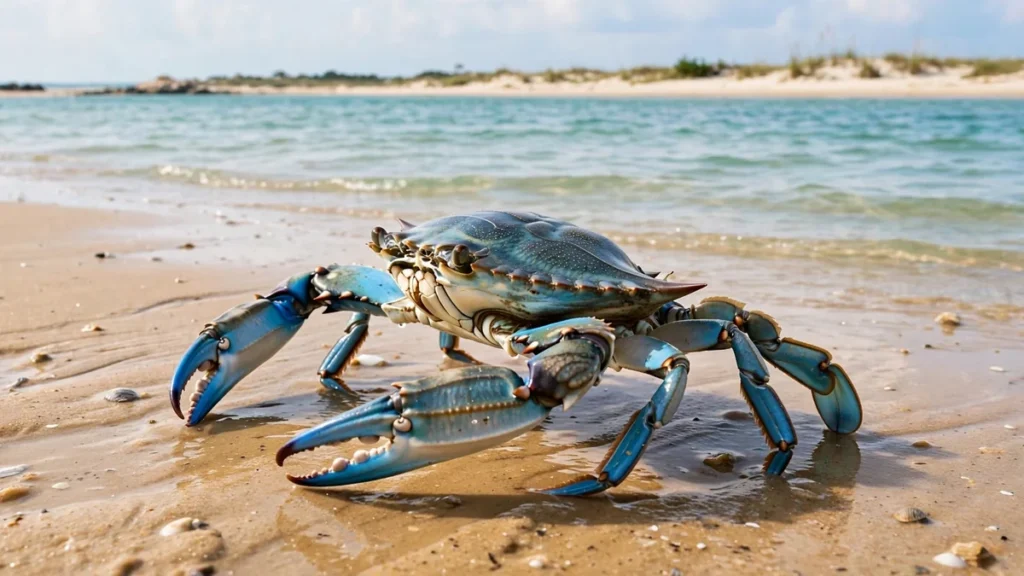
Crab species number around 7,000 worldwide, from the hermit crab that carries a borrowed shell along the beach to the fiddler crab waving one giant claw on a mudflat and the coconut crab that climbs trees on tropical islands. If you are wondering which crab species exist and what makes a crab different from other sea creatures, the short answer is this: crabs are ten-legged crustaceans with a hard shell, two claws and a flattened body.
Key takeaways
- Crab species number around 7,000 worldwide, living in oceans, rivers, beaches, mangroves and tropical forests.
- The hermit crab, fiddler crab, coconut crab, blue crab, Dungeness crab and Japanese spider crab are the best-known species.
- Crabs have ten legs, including two claws, and they walk sideways because of the way their leg joints are arranged.
- A crab grows by moulting, shedding its old shell and growing a new, larger one while it is soft and vulnerable.
- Rocky shores, mangrove mudflats and tropical beaches at low tide are the best places to see crabs in the wild.
What makes a crab a crab
A crab is a crustacean with a broad, flattened body covered by a hard shell called a carapace, ten legs and two claws. The claws, or chelipeds, are the first pair of legs, used for feeding, defence and, in some species, for signalling to mates. The remaining four pairs of legs are used for walking, and the last pair is flattened into paddles in swimming crabs such as the blue crab.
Crabs belong to the order Decapoda, which means ten feet, and they share that group with lobsters, shrimps and prawns. Their stalked eyes give them a wide view of their surroundings. Most crabs breathe through gills under the carapace, which must stay damp, so even land crabs live close to water or in humid places.
Crabs walk sideways because their leg joints bend in a way that makes forward movement awkward and sideways movement fast. A startled crab can scuttle sideways across a beach far quicker than it could ever walk forwards. Crabs are among the easiest coastal animals to find, hiding under rocks and in rock pools at low tide.
The great crabs of the world
The hermit crab is the crab most people meet first. It has a soft, unprotected abdomen, so it lives inside an empty sea-snail shell that it carries everywhere, changing shells as it grows. Hermit crabs live on beaches and in shallow water around the world, and land hermit crabs live in tropical coastal forests. Without a shell, a hermit crab is defenceless.
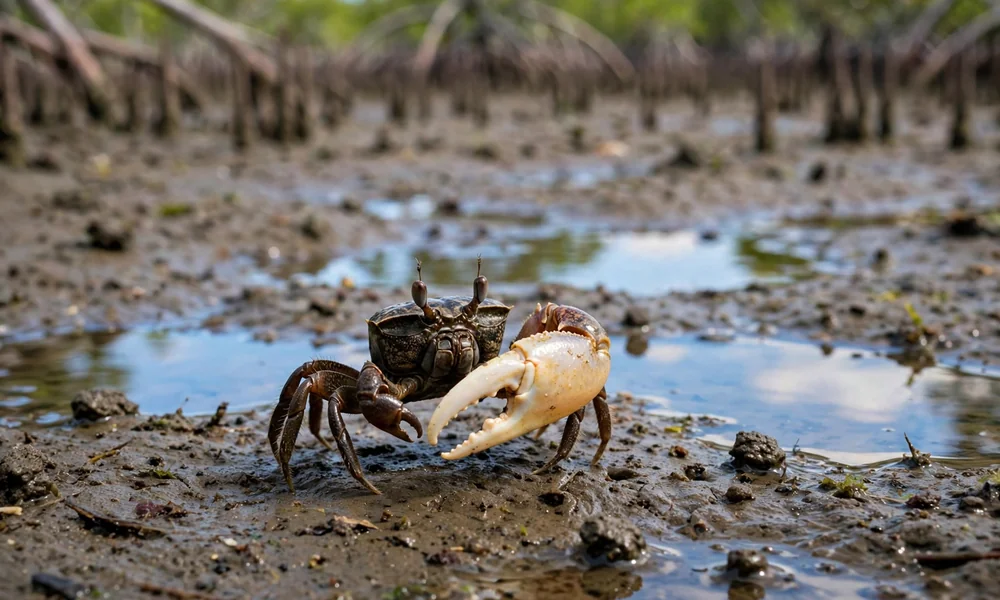
The fiddler crab is a small crab of mangrove mudflats and salt marshes, famous for the male’s one enormous claw, which can be nearly as large as the rest of its body. Males wave the big claw to attract females and warn off rivals, feeding with the small claw. Fiddler crabs live in burrows in the mud, emerging at low tide to feed on algae and tiny particles scraped from the surface.
The coconut crab is the largest land arthropod in the world, a giant hermit crab that has outgrown the need for a shell. It lives on tropical islands across the Indian and Pacific Oceans, climbing palm trees to cut down coconuts, which it cracks open with its powerful claws. A large coconut crab can have a leg span of up to one metre and weigh more than four kilograms.
The blue crab is the swimming crab of the Atlantic coast of the Americas, named for its bright blue claws and olive-green shell. It is a strong swimmer, a fierce hunter of small fish, molluscs and other crabs, and one of the most important food crabs in the world. The Dungeness crab of the Pacific coast of North America is another prized food crab, living on sandy sea floors and growing to more than 20 centimetres across the shell.
The Japanese spider crab is the largest crab species of all, with a leg span of up to 3.7 metres, longer than a tall person is high. It lives on the deep sea floor off Japan, scavenging dead animals and slow-moving shellfish. The stone crab of Florida is famous for its claws, which are harvested while the crab is returned alive to regrow them, and the red crab of Christmas Island is famous for its mass migration, when millions march from the forest to the sea to breed.
How crabs feed
Crabs are mostly scavengers and omnivores, eating almost anything they can catch or find. Many crabs feed on algae, dead fish, molluscs, worms and small crustaceans, tearing food apart with their claws. Some crabs are active hunters, ambushing small fish and shrimp, while others scrape algae from rocks. One claw is often large and blunt for crushing shells, while the other is smaller and sharper for cutting and tearing.
Crabs are also an important food for other animals. Fish, octopuses, sea birds and seals all hunt crabs, and a newly moulted soft crab is easy prey. Among the predators of the shore, the crab is both hunter and hunted, and its hard shell and sharp claws are its main defence.
Moulting: how a crab grows
A crab cannot grow inside its hard shell, so it must moult, shedding the old shell and growing a new one. Before moulting, the crab absorbs calcium from its shell and grows a soft new shell underneath. Then it splits the old shell along the back and backs out of it, which can take less than an hour for a small crab.
The newly moulted crab is soft, swollen with water and almost defenceless, so it hides under rocks or buries itself in sand while the new shell hardens. A young crab may moult many times in its first year, while an adult may moult only once a year or less.
Where crabs live
Crabs live in almost every watery habitat on Earth. Blue crabs live in estuaries and shallow coastal waters, Dungeness crabs live on sandy sea floors, and spider crabs live on the deep ocean floor hundreds of metres down. Hermit crabs live on beaches and rocky shores, fiddler crabs live on mangrove mudflats, and red crabs live in tropical forests, marching to the sea only to breed.
Some crabs have left the sea almost entirely. Land crabs live in burrows in tropical forests and come to the sea only to release their eggs, and the coconut crab spends its whole adult life on land, climbing trees and living in burrows lined with coconut husk. Freshwater crabs live in rivers and streams across Africa, Asia and South America, and ocean animals of the deep sea include crabs that live around hydrothermal vents.
| Species | Where it lives | Best-known feature | Size |
|---|---|---|---|
| Hermit crab | Beaches and shallow seas worldwide | Lives in a borrowed snail shell | Up to 15 centimetres |
| Fiddler crab | Mangrove mudflats and salt marshes | Male has one giant claw | Up to 5 centimetres |
| Coconut crab | Tropical islands of the Indian and Pacific Oceans | Largest land arthropod, climbs palms | Leg span up to 1 metre |
| Blue crab | Atlantic coast of the Americas | Bright blue claws, strong swimmer | Up to 23 centimetres |
| Dungeness crab | Pacific coast of North America | Prized food crab of sandy sea floors | Up to 25 centimetres |
| Japanese spider crab | Deep sea floor off Japan | Longest legs of any crab | Leg span up to 3.7 metres |
| Stone crab | Shallow waters off Florida and the Gulf of Mexico | Claws harvested and regrown | Up to 15 centimetres |
| Red crab | Christmas Island in the Indian Ocean | Mass migration to the sea to breed | Up to 11 centimetres |
Best seasons for crab watching
Summer is the finest season for crab watching on temperate shores, when the water is warm, the tides are low in the daytime and rock pools are full of small crabs and hermit crabs. Spring is the best season for watching fiddler crabs on mangrove mudflats, when the males are waving their great claws at low tide.
On Christmas Island, the red crab migration usually begins with the first rains of the wet season, often in October or November, when millions of crabs march from the forest to the sea.
Staying safe around crabs
Crabs are wild animals, and their claws can give a painful nip. Never pick up a crab by its claws or its legs, and never let a crab’s claw close on a finger: a large crab can break skin, and a coconut crab can break a finger. If you turn over a rock to look underneath, always put it back exactly as you found it, since other animals live there too.
Take care with the tide when crab watching on the shore. Check the tide times before you go, watch the water, and never get cut off by a rising tide.
Crab watching checklist
- Check the tide times and visit the shore at low tide, when rock pools and mudflats are exposed.
- Look under rocks and among seaweed for hermit crabs, shore crabs and small swimming crabs.
- Watch mangrove mudflats at low tide for fiddler crabs waving their great claws.
- Never pick up a crab by its claws or legs, and never let a claw close on a finger.
- Always put turned-over rocks back exactly as you found them.
- Leave no trace: take your rubbish home and keep to marked paths on the shore.
Frequently asked questions
How many crab species are there?
There are around 7,000 crab species worldwide, living in oceans, rivers, beaches, mangroves and tropical forests. New species are still being found, especially in the deep sea and in remote tropical rivers.
How is this guide different from the ocean animals guide?
This guide covers crabs only, in detail: hermit crabs, fiddler crabs, coconut crabs, blue crabs and the other great crab species, with how they feed, moult and live on land and in the sea. The ocean animals guide covers the whole range of animals that live in the sea, from whales and sharks to jellyfish and starfish, with crabs as only one small part of that wider picture.
Why do crabs walk sideways?
Crabs walk sideways because their leg joints bend in a way that makes sideways movement fast and forward movement awkward. A startled crab can scuttle sideways across a beach far quicker than it could walk forwards, which helps it escape predators.
What is the largest crab species?
The Japanese spider crab is the largest crab species, with a leg span of up to 3.7 metres. The coconut crab is the largest land crab and the largest land arthropod in the world, with a leg span of up to one metre.
Do crabs live on land?
Yes, many crabs live on land. Land crabs and coconut crabs live in burrows in tropical forests and come to the sea only to breed. Their gills must stay damp, so land crabs live in humid places and hide in burrows during the heat of the day.
Can a crab regrow a lost claw?
Yes, a crab can regrow a lost leg or claw over several moults, although the replacement is often smaller than the original. Some crabs can even shed a leg deliberately to escape a predator and regrow it later.
Conclusion
Crab species are the sideways scuttlers of the shore: hermit crabs carrying borrowed shells, fiddler crabs waving their great claws on the mudflats, coconut crabs climbing palms on tropical islands and spider crabs stretching their long legs across the deep sea floor.
The next step is to pick one shore and one low tide — a summer rock pool for hermit crabs, a mangrove mudflat for fiddler crabs, or a tropical beach at dawn for land crabs — and plan your visit around it.














