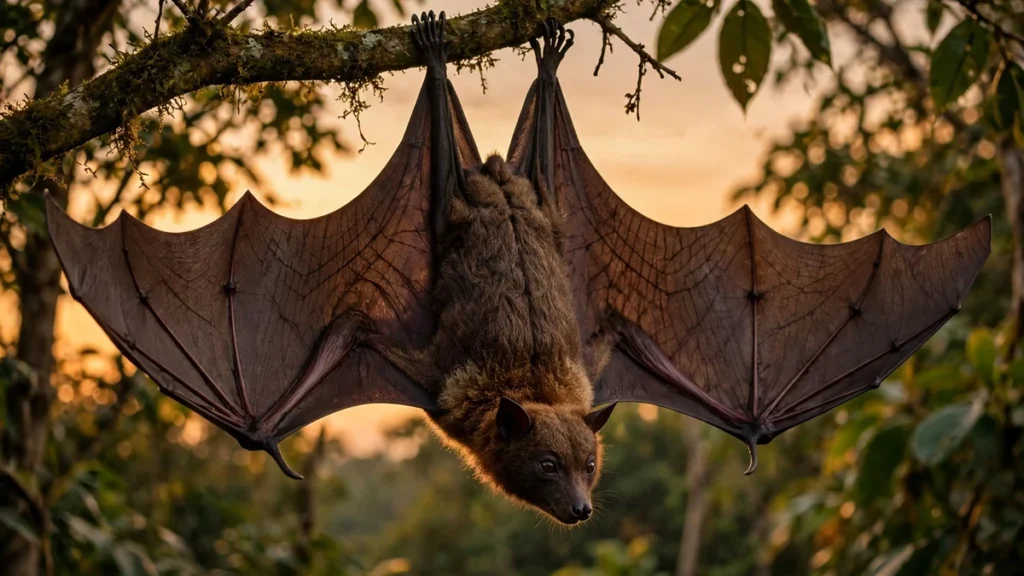
Bat species number around 1,400, making bats the second-largest group of mammals on Earth, about one in every five mammal species, from the tiny bumblebee bat to the flying foxes with wingspans of more than a metre. If you are wondering which bat species exist and how bats fly and hunt in the dark, the short answer is this: bats are the only mammals that can truly fly, most of them find their way with echolocation, and they live on every continent except Antarctica, in caves, trees, buildings and forests.
Key takeaways
- There are around 1,400 bat species, about 20 per cent of all mammal species.
- Most bats find their way with echolocation: they send out sounds and listen for the echoes.
- Fruit bats eat fruit and nectar and do not use echolocation, while most insect-eating bats do.
- Vampire bats are the only bats that feed on blood, and only three species do so.
- Caves, old buildings, woodland edges and riverbanks are the best places to see bats, at dusk when they leave their roosts.
What makes a bat a bat
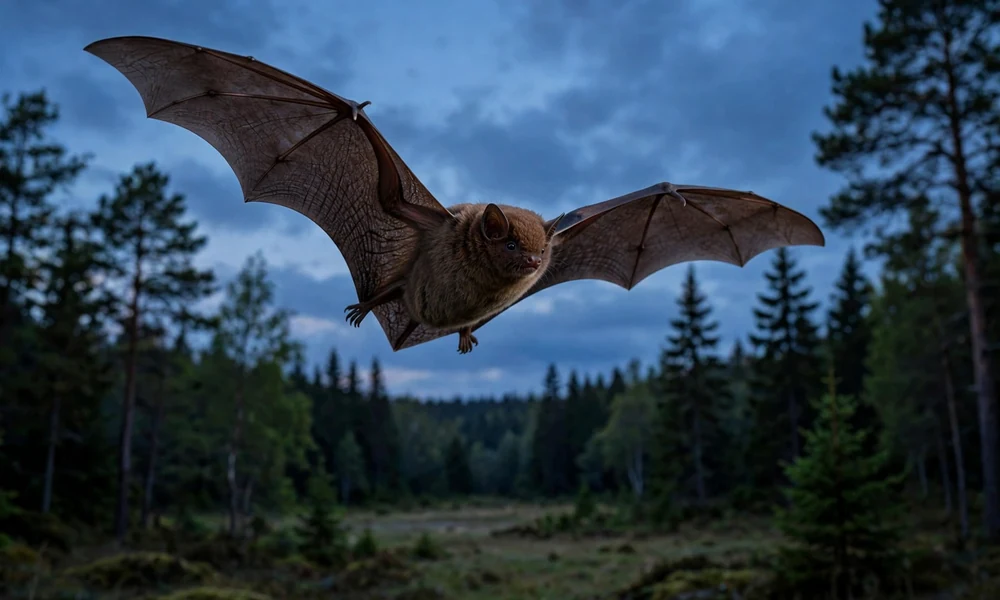
A bat is a mammal with wings made of skin stretched between long finger bones. Bats are the only mammals that can truly fly: flying squirrels and other gliders can only glide from tree to tree, while bats can flap, turn and hover. A bat’s wing is like a hand with a thin membrane between the fingers, and the membrane is so sensitive that a bat can feel the air moving over it.
Most bats are small, with bodies the size of a mouse and wings that fold neatly away when they rest. The smallest bat, the bumblebee bat of Thailand, weighs about two grams. The largest bats, the flying foxes of Asia and Australia, weigh more than a kilogram and have wingspans of more than a metre and a half.
Bats hang upside down to rest, gripping a branch or a rock with their feet. Their legs are turned so that hanging takes no effort, and they can drop into flight simply by letting go.
Echolocation: seeing with sound
Most bats find their way in the dark with echolocation. A bat sends out a stream of high-pitched sounds, far too high for human ears, and listens for the echoes bouncing back from insects, trees and walls. From the echoes it builds a picture of the world around it, and it can catch a flying insect in total darkness.
Echolocation is so precise that a bat can tell a moth from a leaf, judge the speed of its prey and avoid a wire no thicker than a human hair. Some moths have evolved to hear a bat’s calls and drop to the ground to escape, and some can even jam a bat’s sonar with clicks of their own. Fruit bats, by contrast, do not use echolocation: they find their food by sight and smell, and they have large eyes for seeing in the dark.
Horseshoe bats are the masters of echolocation. They send out their calls through their nose, which is shaped like a horseshoe, and they can pick a fluttering insect out of a dense thicket by the movement of its wings. Their calls are among the loudest sounds made by any animal for their size, and they can hear the tiny changes in an echo caused by a beating wing.
Fruit bats and flying foxes
Fruit bats are the large bats of the tropics, and they eat fruit, nectar and pollen rather than insects. The flying foxes of Asia, Africa and Australia are the largest bats in the world, with wingspans of more than a metre and a half, and they roost in huge colonies in trees, sometimes numbering in the tens of thousands. At dusk they fly out to feed, and a single flying fox can carry a fig for kilometres before dropping the seeds.
Fruit bats are vital pollinators and seed spreaders. The bats that feed on the nectar of the baobab and the durian pollinate the flowers as they feed, and the seeds they drop grow into new trees far from the parent. Without fruit bats, many tropical forests would lose some of their most important trees.
The smallest fruit bats are the blossom bats, which hover like hummingbirds at flowers to drink nectar, and the tube-nosed fruit bats of South-East Asia, which feed on the fruit of the forest canopy. Fruit bats have large eyes and a good sense of smell, and they find ripe fruit by its scent from far away.
Vampire bats and other specialists
Vampire bats are the most famous bats of all, and the most misunderstood. Only three bat species feed on blood, and they live in Central and South America, where they feed on the blood of sleeping birds and mammals. A vampire bat makes a small, painless cut with its sharp teeth and laps up the blood, and its saliva stops the blood from clotting. A vampire bat drinks about a tablespoon of blood each night.
Other bats are just as specialised. The fishing bat of Central America catches fish with its long claws, skimming the surface of the water at night. The frog-eating bat of the American tropics listens for the calls of male frogs and swoops down to catch them. The false vampire bat of Asia and Australia hunts birds, frogs and other bats.
The long-tongued bats of the Americas feed on the nectar of cactus and agave flowers, and their tongues are as long as their bodies. The bumblebee bat of Thailand, the smallest bat of all, weighs about two grams and roosts in limestone caves. The spectral bat of Central America is the largest bat of the Americas, with a wingspan of a metre.
Where bats live
Bats live almost everywhere, and the cave animals of the world’s caves include some of the largest bat colonies on Earth. The Bracken Cave in Texas holds one of the largest colonies of any mammal: around 20 million Mexican free-tailed bats, which fly out each evening in a column that can be seen on weather radar. Caves give bats a cool, dark and safe place to rest during the day.
Many bats roost in trees, in the hollows of old trunks or under loose bark, and the jungle animals of the tropical forests include fruit bats, fishing bats and frog-eating bats. Other bats roost in old buildings, under bridges and in the roofs of houses, and the common pipistrelle of Europe is one of the most familiar bats of towns and gardens, hunting insects around street lights at dusk.
The best time to see bats is at dusk, when they leave their roosts to feed. Stand near a woodland edge, a riverbank or an old building and watch the sky: bats fly in looping, fluttering paths, quite unlike the straight flight of a bird. A bat detector, which turns their high-pitched calls into sounds we can hear, makes the watch far more rewarding.
| Species | Where it lives | Size | Best-known trait |
|---|---|---|---|
| Common pipistrelle | Europe and Asia | 4 centimetres | Hunts insects around lights |
| Greater horseshoe bat | Europe and Asia | 7 centimetres | Echolocation through its nose |
| Grey-headed flying fox | Australia | Wingspan 1.5 metres | Largest bat in Australia |
| Common vampire bat | Central and South America | 9 centimetres | Feeds on blood |
| Bumblebee bat | Thailand | 3 centimetres | Smallest bat in the world |
| Mexican free-tailed bat | Americas | 9 centimetres | Colonies of millions |
| Greater fishing bat | Central and South America | 13 centimetres | Catches fish with its claws |
| Brown long-eared bat | Europe | 5 centimetres | Huge ears; listens for prey |
Bats through the seasons
In cold climates, bats hibernate through the winter, sleeping in caves, mines and old buildings where the temperature stays steady. A hibernating bat slows its heart to a few beats a minute and can live for months on the fat it stored in autumn. In warm climates, bats stay active all year, though some migrate: the Mexican free-tailed bat flies hundreds of kilometres between its summer and winter roosts.
Spring is the finest season for bats, when the females gather in nursery colonies to give birth to a single pup. A young bat grows fast and can fly within a few weeks, and the mothers recognise their own pup among hundreds by its call and smell. Autumn is the season for swarming, when bats gather at caves and old buildings to mate before hibernation.
Staying safe around bats
Bats are harmless to people and will never attack, but they deserve respect. Never handle a wild bat: a frightened bat may bite, and bats can carry disease. Never disturb a roost, and never shine a bright light into a cave where bats are resting: a disturbed colony may abandon its young. Among the nocturnal animals of the night, bats are among the most useful, eating thousands of insects every night.
If you find a bat on the ground, do not touch it with bare hands. Call a local bat rescue group, who can care for it safely. Bats are protected in many countries, and their roosts are protected too, so a bat in your roof is a guest to be welcomed, not a pest to be removed.
Bat watching checklist
- Go out at dusk, when bats leave their roosts to feed.
- Stand near a woodland edge, a riverbank or an old building and watch the sky.
- Take a bat detector to hear their high-pitched calls.
- Look for the looping, fluttering flight that is quite unlike a bird.
- Never handle a wild bat and never disturb a roost.
- Leave no trace: take your rubbish home and keep to marked paths.
Frequently asked questions
How many bat species are there?
There are around 1,400 bat species, about 20 per cent of all mammal species, making bats the second-largest group of mammals after rodents. New species are still being found every year, especially in the tropics.
How is this guide different from the nocturnal animals guide?
This is a species-level guide to bats: it covers fruit bats, vampire bats, horseshoe bats and more in detail. The nocturnal animals guide is a general roundup of many different animals of the night, from owls to moths, and does not go into any one group in this depth.
Do all bats use echolocation?
No. Most insect-eating bats use echolocation, but fruit bats do not: they find their food by sight and smell, and they have large eyes for seeing in the dark. Horseshoe bats are among the best echolocators of all, sending their calls through their nose.
Are vampire bats dangerous to people?
Vampire bats rarely bite people, and they drink only about a tablespoon of blood each night. They are far more of a danger to farm animals than to humans, and only three bat species feed on blood at all.
Do bats really drink blood?
Only three bat species do: the common, hairy-legged and white-winged vampire bats of Central and South America. All other bats eat insects, fruit, nectar, pollen, fish or small animals, and most bats eat insects.
Where is the best place to see bats?
Bats are best at dusk near a woodland edge, a riverbank or an old building. Caves hold the largest colonies, and a bat detector, which turns their calls into sounds we can hear, makes the watch far more rewarding.
Conclusion
Bat species are the night shift of the mammal world: pipistrelles hunting insects around street lights, horseshoe bats calling through their noses, flying foxes carrying figs across the forest, and Mexican free-tailed bats pouring out of their caves in their millions.
The next step is to pick one evening and one place — a riverbank, a woodland edge or an old bridge — and watch the sky at dusk for the first bat of the night.














