
Cave animals are the creatures that live in the dark world beneath our feet, in limestone caves, lava tubes and underground rivers where sunlight never reaches. If you are wondering what can possibly live in total darkness, the short answer is this: bats, blind fish, pale salamanders, crickets and glow-worms have all found ways to feed, breed and find their way around without ever seeing the sun, and many of them live nowhere else.
This guide covers the best-known cave animals, from the bats that fly out at dusk to the olm, the blind cave fish and the glow-worms that light the dark.
Key takeaways
- Cave animals include bats, olms, blind cave fish, cave crickets, cave salamanders, glow-worms and cave spiders.
- Many true cave animals have lost their eyes and their colour, and find food by touch, smell and hearing instead.
- Bats are the best-known cave animals, but most only roost in caves and hunt outside at night.
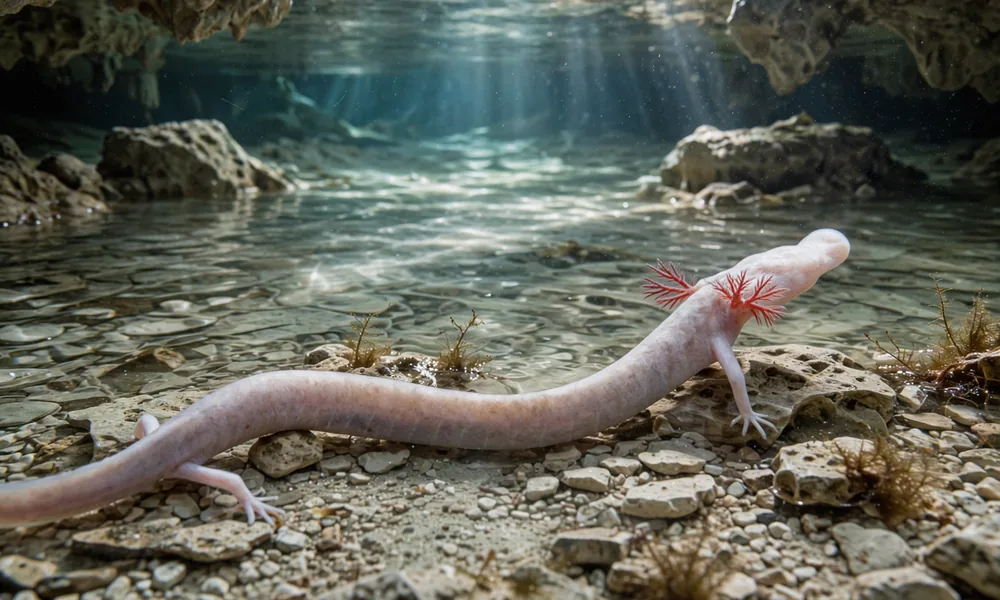
- The olm is a pale cave salamander that can live for many decades and go for years without food.
- Glow-worms light up cave ceilings with thousands of tiny blue-green lights to catch their prey.
Bats of the dark
Bats are the animals most people think of first when they think of caves: caves are the perfect daytime roost for a bat. A cave stays cool in summer and mild in winter, it is dark all day, and its ceilings give thousands of bats a safe place to hang upside down. In the evening the bats stream out of the cave mouth in great clouds to hunt insects over fields, rivers and forests, and they return before dawn to rest.
Bats find their way in the dark by echolocation, making high-pitched calls and listening to the echoes that bounce back from walls, trees and flying insects. This lets a bat fly at speed through a pitch-black cave without touching the walls, and catch a moth in mid-air on a moonless night. Like the nocturnal animals that hunt after dark, bats do their real work at night, and the cave is their bedroom, not their hunting ground.
Some bats spend the winter asleep in caves, in a deep sleep called hibernation, while the cold months pass. Their bodies cool down, their breathing slows, and they live off the fat they stored during the summer and autumn. Cave-roosting bats include horseshoe bats, with their strange horseshoe-shaped noses, and long-eared bats.
Fish and salamanders of the underground water
The olm is the most famous of all true cave animals: a pale, almost white salamander with pinkish skin, tiny legs, feathery red gills on the outside of its head and eyes so small they are covered by skin. It lives in the underground rivers and pools of the limestone caves of south-eastern Europe, where it hunts small snails, shrimps and worms by smell and by sensing tiny movements in the water. It can live for many decades, and it can go for years without a meal, barely moving in the cold, dark water.
Blind cave fish are the fish that have given up their eyes altogether. In caves in Mexico, the blind cave tetra is a small silver fish with no eyes at all, only dark hollows where the eyes once were. It finds food by feeling the water with its skin and by following the smell of anything edible. Other blind fish live in caves in many parts of the world, and each has solved the same problem the same way: eyes are no use in the dark, so they have been lost, and the senses that do work there have grown sharper.
Crickets, spiders and glow-worms
Cave crickets are the jumpers of the underground world: pale, long-legged crickets with very long antennae that they use like walking sticks, feeling their way across the cave floor and walls. They do not sing like the crickets of the fields, because there is no one to hear them in the dark, and they eat almost anything: dead leaves washed into the cave, fungi, bat droppings and dead insects. Cave crickets often gather in great numbers near the cave mouth, where food is richer, and they feed the spiders and salamanders that hunt deeper inside.
Cave spiders are patient hunters that spin their webs in the still air of the cave, where no wind ever disturbs them. Some are small and pale, while others are larger and darker, and they live on the flies, moths and crickets that wander into the cave. In some caves, spiders are the top hunters, sitting at the centre of their webs for days, waiting for prey.
Glow-worms are the lights of the cave world. The glow-worms of New Zealand are not worms at all but the larvae of a small fly, and they hang from the cave ceiling on silken threads, glowing with a soft blue-green light. Each larva lets down sticky fishing lines, and the light lures small flies towards them to be caught and eaten. In a large cave the ceiling can be covered with thousands of these tiny lights, like a night sky full of stars. Like the forest animals that light up the woods on a summer night, glow-worms use light to hunt, but in a cave their light is the only light there is.
How cave animals survive
Life in a cave is life without light, and cave animals have changed their bodies to fit. The most famous change is the loss of eyes: animals that have lived in caves for countless generations, like the olm and the blind cave fish, have eyes that are tiny, covered with skin or gone altogether, because eyes are useless in the dark and cost energy to grow and keep. Instead, their other senses have grown stronger: cave fish feel the water with sensitive skin, cave crickets feel their way with long antennae, and bats hear their way with echolocation.
Colour is another thing cave animals have lost. Most true cave animals are white, pale pink or grey, because there is no need for camouflage or warning colours where nothing can see them. Their skin is often thin and delicate, and some, like the olm, can breathe partly through their skin as well as through their gills. Food is scarce in a cave, because no plants can grow without sunlight, so cave animals have learned to live slowly, growing slowly, breeding slowly and moving slowly, and many can go for long periods without eating.
Food in a cave comes from outside. Leaves, twigs and dead animals are washed in by streams and rain, and bats bring in food every night in their droppings, which feed fungi, bacteria and small insects, which in turn feed crickets, spiders and salamanders. A cave with a large bat colony is rich with life, while a cave with no bats and no stream may be almost empty. Like the ocean animals of the deep sea, cave animals live on food falling from above, and they make the most of every scrap.
Cave animals and people
People have always been drawn to caves, and cave animals have suffered for it. Caves are fragile places: the animals that live in them are used to a world that never changes, with a steady temperature, still air and clean water, and even small changes can harm them. Torchlight disturbs bats, footsteps crush cave crickets, and dirty water from farms and towns can poison the underground rivers where olms and blind fish live. Some caves have lost their bats because visitors woke them during hibernation, and a bat woken in winter may starve.
The good news is that caves can be protected. Many of the best-known caves are now closed to visitors during the winter, when bats are hibernating, and some take only small guided groups. Cave animals are protected by law in many countries, and the olm is a protected species throughout its range. Protecting cave animals means protecting the whole cave: the clean water, the still air, the bats that bring in food and the darkness itself. A cave is a world apart, and its animals have lived there far longer than people have walked the earth.
| Animal | Type | Where it lives | Best-known fact |
|---|---|---|---|
| Horseshoe bat | Mammal | Caves of Europe, Asia and Africa | Navigates by echolocation |
| Olm | Amphibian | Underground rivers of south-eastern Europe | Pale salamander that can fast for years |
| Blind cave tetra | Fish | Caves of Mexico | Has no eyes at all |
| Cave cricket | Insect | Caves worldwide | Feels its way with long antennae |
| Cave spider | Arachnid | Caves worldwide | Spins webs in still cave air |
| Glow-worm | Insect larva | Caves of New Zealand and Australia | Lights the ceiling blue-green |
| Cave salamander | Amphibian | Damp caves of North America | Climbs wet cave walls |
Cave animals checklist
- Start with the bats: horseshoe bats and long-eared bats roost in caves and hunt outside at night.
- Remember the water dwellers: the olm, blind cave fish and cave salamanders of the underground rivers.
- Do not forget the small hunters: cave crickets, cave spiders and harvestmen of the cave floor and walls.
- Add the glow-worms: their blue-green lights turn a cave ceiling into a night sky.
- Check the facts: a true cave animal has lost its eyes and its colour, and lives by touch, smell and hearing.
- Use this guide for quizzes, school projects and trips, and add your own favourites.
Frequently asked questions
What animals live in caves?
Caves are home to bats, olms, blind cave fish, cave crickets, cave spiders, cave salamanders and glow-worms. Bats roost in caves but hunt outside, while the olm and the blind cave fish live their whole lives underground.
Why do cave animals have no eyes?
Eyes are no use in total darkness, and they cost energy to grow and keep. Over countless generations, cave animals lost their eyes, while their senses of touch, smell and hearing grew sharper to take their place.
What is an olm?
The olm is a pale cave salamander that lives in the underground rivers of the limestone caves of south-eastern Europe. It has tiny legs, feathery red gills and skin-covered eyes, and it can go for years without food.
How do bats find their way in a dark cave?
Bats use echolocation, making high-pitched calls and listening to the echoes that bounce back from the walls and from flying insects. The echoes tell the bat where things are, so it can fly through a pitch-black cave without touching the walls.
What are glow-worms?
Glow-worms are the larvae of a small fly, found in the caves of New Zealand and Australia. They hang from the cave ceiling on silken threads and glow blue-green to lure small flies into their sticky fishing lines, which they then eat.
Can I visit a cave where these animals live?
Yes, many caves are open to visitors, but go with a guide, keep your voice down, and never touch the animals or shine a bright light on them. Many are closed in winter while bats hibernate, so check before you go.
Conclusion
Caves look empty from the mouth, but they are full of life that has learned to live without the sun. Bats fly out at dusk, olms drift through underground rivers, crickets feel their way across the floor, and glow-worms light the ceiling like stars.
Step into a cave quietly, look and listen, and you will see a world that has been dark for longer than people have walked the earth.














